
NEWS
The Salary Cap Fight That Can Freeze Baseball’s TV Payday
MLB owners are expected to lock out players on Dec. 1 over a $245.3 million cap, a fight that can also delay the next national TV windfall.

MLB owners are expected to lock players out on Dec. 1, and they have tied every offer to a $245.3 million salary cap. The current Basic Agreement ends at 11:59 p.m. Eastern that night. If there is no new deal, clubs plan to shut the sport themselves, the same way they did in December 2021.
They are doing it after 71,752,722 people paid to watch regular-season baseball in 2026. They are also doing it with a hidden meter on the calendar: lose 60 games in 2027, and most national TV contracts can roll into 2029, delaying the payday owners want from the next rights auction.
Owners Want a $245.3 Million Ceiling Next Season
The league’s opening economic plan for 2027 is a hard cap of $245.3 million and a floor of $171.2 million, with a 50-50 split of industry revenue. Commissioner Rob Manfred said in June that the first year was built so major league players would earn more than they did in 2026. His math was specific. Twelve clubs would have to spend up to the floor, adding $617 million. Eight clubs cut a combined $578 million to fit under the cap.
Bruce Meyer, the MLBPA’s interim executive director, has called that framing a cut, not a raise. On MLB Network Radio in late September he said the proposed pool would fold in major league salaries, amateur signing bonuses, benefits, and health costs. Players already take well over 50 percent of league revenue, he said. Put that cap on 2026, and “the owners would’ve kept $600 million more, put it in their pocket.”
He also said progress is “extremely hard, if not impossible” while the league will not bargain without a cap. Every other offer, including a higher minimum, is “expressly contingent” on the union taking the cap “and all the stuff that comes with it.”
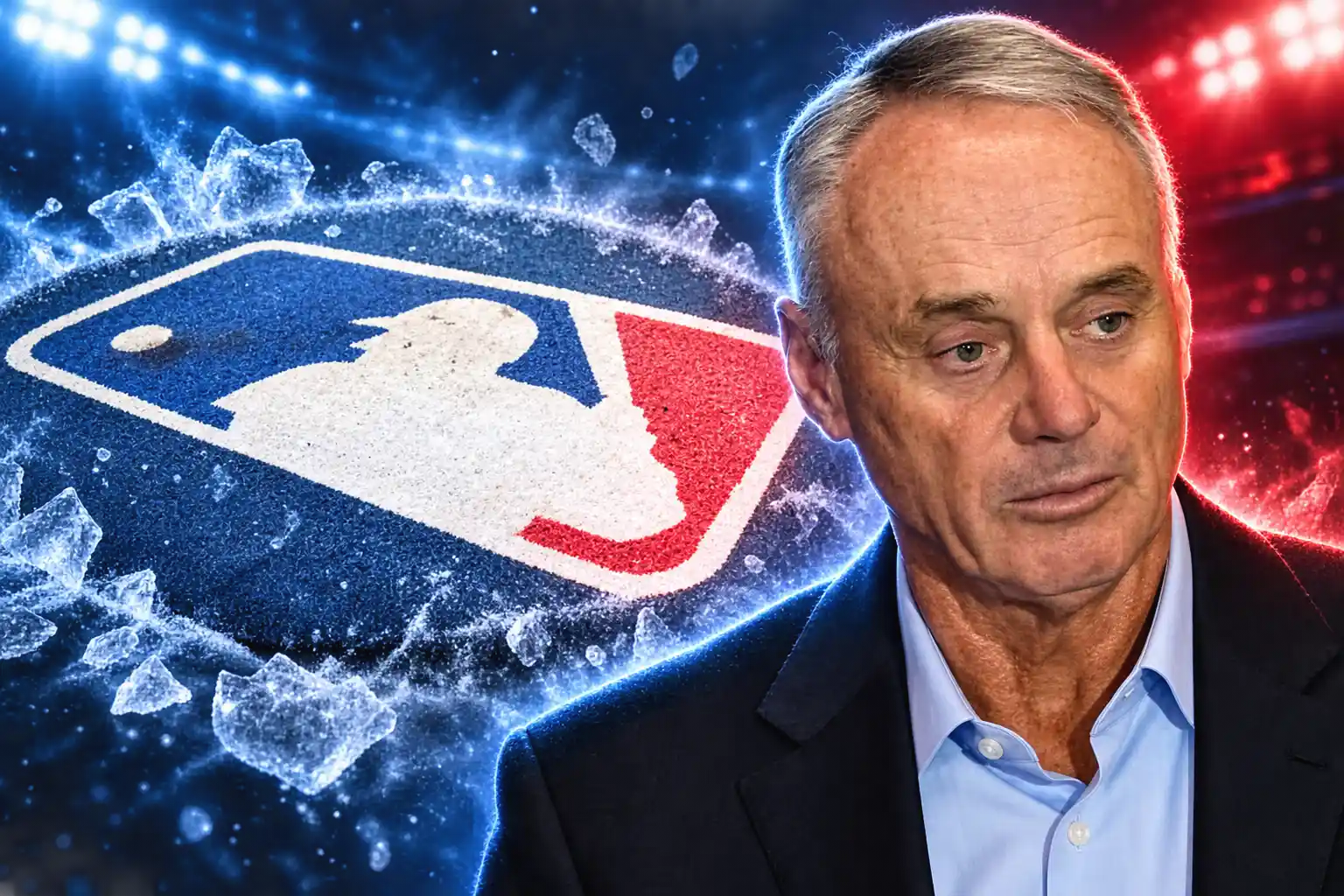
A $1.3 Million Gap Separates the Cap From the Tax Line
The hard ceiling sits $1.3 million above this year’s Competitive Balance Tax threshold of $244 million. That tax is a surcharge, not a stop. Clubs can still spend. They just pay more, and repeat offenders pay a 50 percent rate plus extra bands at $20 million, $40 million, and $60 million over the line.
A cap at $245.3 million turns that line into a wall. Current luxury-tax payrolls show how sharp the drop would be for the clubs that actually buy free agents.
PAYROLLS ABOVE THE PROPOSED CAP
| Club | 2026 tax payroll | Over $245.3M cap |
|---|---|---|
| Los Angeles Dodgers | $433 million | $187.7 million |
| New York Mets | $359 million | $113.7 million |
| New York Yankees | $342 million | $96.7 million |
| Philadelphia Phillies | $322 million | $76.7 million |
| Toronto Blue Jays | $316 million | $70.7 million |
Those 2026 figures come from Spotrac’s tax tracker, which already folds in benefits and other CBT add-ons. The Dodgers $433 million luxury-tax payroll is the clearest picture of what a $245.3 million lid would crush. Manfred’s eight-club, $578 million cut was the league’s own June snapshot. The October board is not smaller.
The cap is only the lid. The rest of the package would rewrite how stars get paid.
THE OTHER STRINGS ON THE CAP
- Free-agent length: A player who switches clubs would face a five-year $202 million free-agent cap on the guarantee.
- Cornerstone deals: A club re-signing its own star could go six years and $265 million, a cousin of NBA Bird rights.
- Yearly max: First-year salary would top out at 15 percent of the cap, or $36.8 million, and 16 percent, or $39.2 million, on a re-signing.
- No deferrals: The league would outlaw deferred money, the tool the Dodgers used to spread Shohei Ohtani’s deal.
- Escrow: A 50-50 split would hold back some pay if revenues miss the projection, which ends the fully guaranteed contract as players know it.
The league also offered to lift the minimum from $780,000 to $1 million in 2027 for players with at least two years of service, and to $900,000 plus an automatic $100,000 bonus for younger players who finish a full year. The union has asked for $1.5 million. Meyer noted the league number on radio as “I think 900,000.” The official fact sheet is the $1 million / $900,000 split, and even that raise is chained to the cap.
Sixty Lost Games Would Freeze the Next TV Payday
People briefed on the league’s national rights contracts say a 2027 shutdown that wipes at least 60 games would extend most of those deals through 2029. The current packages run through 2028. Manfred wants the next auction to bundle national rights with centralized local streams. A 2029 bolt-on leaves partners sitting on extra baseball at today’s rate and pushes the hoped-for jump a full year.
Owners would not go unpaid in a lost 2027. Most national deals, worth more than $2 billion a year with Fox, TNT Sports, and others, still cut checks even if no games are played. That slice is about 17 percent of the sport’s $12 billion-plus in revenue. Gate receipts, parking, and concessions go to zero. The TV check does not.
If the whole season vanished, networks would pay nothing in 2029 for the extra year they received. If baseball came back after 60 games and staged a short season, they would owe some 2029 money. Either way, the 60-game mark, roughly the end of May on the present schedule, is the first date that hits future earnings, not just 2027 cash.
Fox pays about $729 million a year for a package that includes the World Series. TNT Sports is a little under $500 million. The NBA’s national deals average $7 billion a year. The NFL’s average more than $11 billion. That gap is the money a new baseball auction is supposed to chase. A lockout that trips the make-good clause asks owners to wait a year to chase it.
Mid-May is already the date a lot of the public argument has priced in for baseball’s return. That is not a coincidence. It is the first week the TV contracts start to work against the people who would lock the gates.
Payroll Certainty Is the Asset Owners Are Selling
Manfred has sold the cap as competitive balance. “We have tried mightily over several rounds of bargaining to use a competitive balance (luxury) tax to address competitive concerns,” he said after the first proposals landed. “You just can’t ignore that financial penalties have not gotten it done for us.” At the All-Star Game in Philadelphia he added that he has “an ownership group that is more united than any group in my entire time of baseball.”
The union’s answer is that the product is not broken. Meyer said so on the same All-Star podium.
The supposed stewards of the game have spent an inordinate amount of time trying to convince those same fans that they don’t have hope or they shouldn’t have hope or that the product that they’re paying to consume in record numbers is somehow broken. I think it’s perverse.
Bruce Meyer, MLBPA interim executive director, All-Star Game press conference in Philadelphia
On Aug. 27, after the league rolled out weekly rosters and a short free-agency window, all of it still tied to a cap, Meyer called the packaging dishonest. He said the league, “through their propaganda arm,” was selling roster ideas as player-friendly while conditioning them on a system that “would drastically reduce overall player compensation, eliminate fully guaranteed contracts through escrow, and turn back the clock on fundamental player rights.” The December signing window, he said, would turn free agency into “a game of musical chairs pitting player vs. player.”
The Dodgers are the poster in that fight. They are also a convenient one. Owners tried to install a cap in 1994, long before this roster. What they want now is the thing NFL and NBA sales get: a known payroll band a buyer can model. Sal Galatioto, president of Galatioto Sports Partners, has said the leading reason baseball valuations still trail those leagues is a lack of “payroll certainty.”
Sportico’s 2026 study put the average MLB club worth $3.17 billion, with the Yankees at $9.4 billion, the Marlins at $1.45 billion, and the 30 clubs worth $95 billion in all. The Padres sold in August at $3.9 billion, a baseball record at the time. On Sept. 1, Stan Kroenke’s group agreed to buy the Angels at $4 billion, a deal slated to close in the first quarter of 2027 if owners approve it. Those prices are rising. Owners still argue they should rise faster, and a cap is the lever.
Owners Last Tried a Cap and Lost a World Series
A lockout is a management shutdown. Players cannot report, sign, or be traded. It is not a strike. The last one started at 12:01 a.m. on Dec. 2, 2021, and ended on March 10, 2022, after 99 days. Opening Day slid from March 31 to April 7. The 162-game season was saved with makeup dates. No regular-season games were wiped. That is the stoppage Manfred still cites when he says none have been lost on his watch.
The stoppage that matches this fight is older.
BASEBALL’S LAST THREE SHUTDOWNS
- February 15, 1990: Owners lock players out over free agency and arbitration. Opening Day moves to April 9. No regular-season games are lost.
- August 12, 1994: Players strike after owners push a salary cap. The World Series is cancelled. Across 1994 and 1995, 938 regular-season games vanish. The 1995 season is cut to 144 games.
- December 2, 2021: Owners lock players out when the 2016 deal expires. Talks yield a five-year pact on March 10, 2022. Spring training is short. The full season is played.
The 1994 strike is the scar. It is also the last time owners put a hard cap on the table and meant it. They are back with the same ask, this time as a lockout timed for winter, so the first games at risk are in March and April, not October. The structure changed. The demand did not.
Crowds Hit Their Highest Mark Since 2017
League totals for 2026 were 71,752,722 through 2,425 dates, an average of 29,589. That is up 0.4 percent from 71,409,421 and 29,471 in 2025. It is the highest total since 2017, and the first four-year attendance climb since 2004-07. Thirteen clubs drew more people. Seventeen drew fewer.
THE 2026 CROWD
- Dodgers: A club-record 4,034,219, or 49,805 a night, in a season that has already carried them back to the National League Championship Series.
- Rays: Up 628,255 to 1,414,975 after returning to Tropicana Field, then a sweep of the Yankees in the Division Series.
- White Sox: Up 540,687 to 1,986,425 on an 84-78 wild-card year after three straight 100-loss seasons, and still playing in October.
- Blue Jays: Up 488,943 to 3,338,878 after an American League pennant in 2025.
Small-market clubs in the Division Series do not, by themselves, settle a labor fight. They do make the “broken product” pitch harder to hear while those same clubs are still playing. The Rays just beat the Yankees. The White Sox, given up for dead a year ago, sold more than half a million extra tickets. Owners still want a system that would have forced the Dodgers to cut about $188 million off a tax payroll of $433 million.
The public argument treats that cut as the point. It is the sales brochure. The asset being priced is the franchise, and the cap is how a buyer is told the next decade of payroll will look.
The Lockout Clock Starts Before Pitchers Report
Pitchers and catchers are due in mid-February. The 2021 lockout ate the first weeks of camp and still spared the season. A cap fight is a different species. Meyer said in March that a lockout is guaranteed if the deal dies on time, and nothing since then has narrowed the gap on the only item the league will not drop.
Weekly bargaining can continue through November. It has not produced a path that lets the union take a cap, and it has not produced a path that lets owners drop one. Roster ideas, draft tweaks, and a higher minimum are on paper. They move only if the cap moves with them.
The first hard date is Dec. 1. The first operational date is when camps are supposed to open. The first date that threatens the next TV cycle is the 60th lost game, in late May. Owners can hold a lockout through the winter and still collect the 2027 national checks. They cannot hold it through May without putting a finger on 2029.
The current deal expires at 11:59 p.m. Eastern on Dec. 1. Owners have not said they will keep the gates open if it lapses.

The Salary Cap Fight That Can Freeze Baseball’s TV Payday

The 2027 Mercedes GLE and GLS Keep Alabama Busy

Margaret Hamilton Dies at 90 With a Harder Fight Unfinished

Unity Parks Its Engine Inside Google’s Prompt Games

The Hidden Vendor Cut in 403(b) vs 401(k) Plans

Microsoft 365 Auth Fault Took Down Exchange and Teams

Diesel Breaks Its Record as the White House Claims Credit

Xbox Caps Game Pass Cloud Gaming at 15 Hours

IFA 2026’s Weird Gadgets Are Building a Sensor Home

Tesla Puts Its Wheel-Free Cybercab on Austin Streets
-
 NEWS1 month ago
Microsoft 365 Auth Fault Took Down Exchange and Teams
-
 GAMING1 month ago
Xbox Caps Game Pass Cloud Gaming at 15 Hours
-
 BUSINESS1 month ago
Diesel Breaks Its Record as the White House Claims Credit
-
 AUTO1 month ago
Tesla Puts Its Wheel-Free Cybercab on Austin Streets
-

 BUSINESS1 month ago
ChargePoint Stock Rally Prices Wilmer’s Three-Year Cash Plan
-
 NEWS1 month ago
IFA 2026’s Weird Gadgets Are Building a Sensor Home
-

 NEWS1 month ago
OpenAI Unveils GPT-6 Astra With a Critical Cyber Label
-

 NEWS1 month ago
OpenClaw 2.0 Ships a Team Workplace With Host-Trust Defaults