
BUSINESS
Meta’s Record Quarter Sold Off on the Funding Path
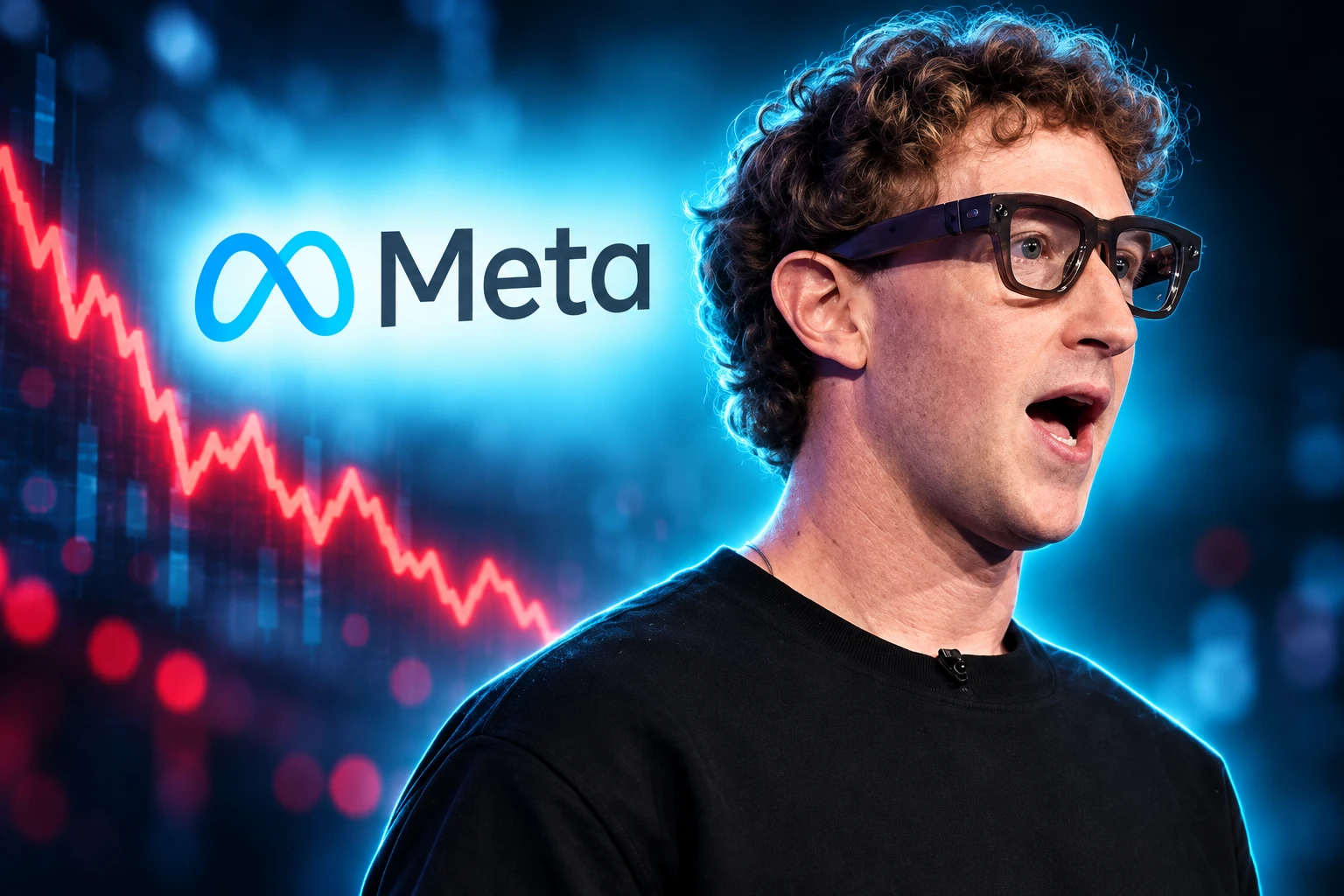
Meta stock fell 6.98% after record revenue as Class C shares and $810.25 billion of locked bills recast the AI funding path.

Meta shares closed at $648.85 on October 22, down 6.98%, a day after quarterly revenue of $64.601 billion.
The print beat the $63.3 billion sales estimate and still left a negative cash number, a new non-voting share class, and hundreds of billions of locked future bills.
Record Revenue Came With Negative Free Cash Flow
Meta’s third-quarter results ended September 30 showed sales of $64.601 billion, up 26% from $51.242 billion a year earlier. Family daily active people averaged 3.64 billion in September, up 3%. Ad impressions rose 10% and the average price per ad rose 14%.
Reported profit did not travel with the ads. Diluted earnings were $3.83 a share, against $1.05 a year earlier and against a $3.56 estimate. That figure includes a $9.89 billion charge tied to an August agreement with 52 state attorneys general on teen mental health and social media, a deal that provides for payments of up to about $18.59 billion. Strip out the charge and earnings would have been $7.40 a share, and operating income would have been $22.88 billion instead of $12.988 billion.
Cash from operations was $32.79 billion. Capital spending, including principal payments on finance leases, was $34.91 billion, so free cash flow was negative $2.12 billion. A year earlier the same line was an inflow of $10.625 billion. Meta still paid $1.36 billion of dividends and ended the quarter with $82.45 billion of cash, cash equivalents, and marketable securities. Headcount was 66,775, down 15% from a year earlier.
THE THIRD QUARTER PRINT
| Measure | Q3 2026 | Q3 2025 |
|---|---|---|
| Revenue | $64.601 billion | $51.242 billion |
| Operating income | $12.988 billion | $20.535 billion |
| Operating margin | 20% | 40% |
| Diluted EPS | $3.83 | $1.05 |
| EPS excluding the legal charge | $7.40 | n/a |
| Free cash flow | negative $2.12 billion | $10.625 billion |
| Capex, including finance-lease principal | $34.91 billion | n/a |
Fourth-quarter revenue is guided to $73 billion to $76 billion, with foreign exchange marked as about a 1% headwind. Full-year expenses are now $175 billion to $179 billion, a range that folds in the $9.89 billion charge. Reality Labs losses are pegged at $18 billion to $19 billion for 2026 and about $15 billion in 2027. Reality Labs revenue in the quarter was $443 million, down 6%.
A Broad Dump Across the AI Trade
The capex guide moved only at the floor. Meta now expects 2026 capital spending of $135 billion to $145 billion, narrowed from $130 billion to $145 billion, a $5 billion lift at the low end with the high end unchanged. Susan Li, the chief financial officer, did not put a number on 2027. The company’s outlook said it is still building that budget and still expects to invest aggressively in the core business and in new AI work.
That $5 billion tweak does not price a 6.98% close on its own. The tape sold a funding mix: negative free cash flow, a new share class designed for later equity raises, and a 10-Q full of bills that are already signed. Five-year credit default swaps on Meta traded at 114.79 basis points, a record. Shay Boloor, chief market strategist at Futurum Equities, said that jump can reflect banks hedging Meta’s AI debt more than a true default call.
THE TAPE ON OCTOBER 22
- Meta: Closed at $648.85, down 6.98%.
- Nasdaq Composite: Down 2.60% to 26,008.86, the steepest drop since June.
- Philadelphia Semiconductor Index: Down 6.7%.
- CoreWeave: Down 10.06%, with Nvidia down 4.40% to $212.21.
Long-term debt was $80.922 billion at September 30, against $58.744 billion at the end of 2025, after Meta sold $25.00 billion of senior notes in May. The common stock is being asked to fund a build that already leans on the bond market.
The 10-Q Lists $810.25 Billion of Future Bills
The number that sits behind the $5 billion guide is already on the books as promises, not as this year’s capex range. As of September 30, Meta had $355.73 billion of operating and finance leases that have not yet started, covering data centers, energy gear, colocations, and network kit, with start dates from the rest of 2026 through 2036 and terms from more than a year to 30 years.
On top of those leases, the 10-Q records non-cancelable contractual commitments of $454.52 billion. Those contracts are mostly third-party cloud capacity, servers and network gear, energy-service deals for data centers, and Reality Labs hardware. About $45.85 billion of that stack is due in the rest of 2026 and $121.41 billion is due in 2027. The two lines together are $810.25 billion.
Meta also has contingent obligations to buy up to $14.72 billion of cloud capacity over five years, an amount that can shrink if the provider resells the capacity. Add that contingent line and the combined stack is $824.97 billion. Clean-energy deals that run nine to 25 years and do not name a fixed volume sit outside those totals.
SIGNED BILLS OFF THE RUN-RATE GUIDE
| Item in the 10-Q | Amount | What it covers |
|---|---|---|
| Leases not yet started | $355.73 billion | Data centers, energy, colocations, network; start 2026 to 2036 |
| Non-cancelable contracts | $454.52 billion | Cloud, servers, energy service, Reality Labs hardware |
| Of those contracts due in 2026 | $45.85 billion | Remainder of this year |
| Of those contracts due in 2027 | $121.41 billion | Next year |
| Contingent cloud purchases | up to $14.72 billion | Can fall if the provider resells capacity |
| Leases plus contracts plus contingent cloud | $824.97 billion | Combined signed stack |
Those counterparties, energy firms, cloud hosts, and hardware vendors, now hold a multi-year claim on Meta’s cash that equity holders cannot vote away. The 2026 capex range only describes what hits the cash-flow statement this year. The 10-Q describes what Meta has already promised to keep buying.
Zuckerberg’s Eight-Year California Bargain
The board approved a new class of publicly listed, non-voting Class C common stock, effective January 19, 2027. Shareholders get one Class C share for each Class A share and each Class B share, a dividend the company says should trade like a two-for-one split and will not change anyone’s vote on day one.
The split is not the funding signal. The 8-K says the new class exists so Meta can raise capital, pay workers, and do deals without thinning founder voting power. Mark Zuckerberg told the special committee he would not support an equity raise that cut his control. Class C is the workaround: later issues can dilute the economic pie while his Class B super-votes stay put.
The same paperwork is a California tax hedge. Proposition 40 on the November 3 ballot would impose a one-time tax of up to 5% on covered assets over $1 billion for people who were California residents on January 1, 2026, with the bill due in 2027 and 90% of the money earmarked for health care. The Founder Alignment Agreement, signed October 20, lets Zuckerberg sell 20% of the Class C shares he receives, equal to 10% of his economic stake, for any reason, including a Prop 40 bill, without giving up majority voting control. The other 80% is stapled: selling it requires a matching cut in voting stock. In return he pledged to remain a California resident, or a resident of wherever Meta keeps its headquarters, for eight years unless material unforeseen circumstances make a move prudent.
THE CLASS C CALENDAR
- October 19, 2026: The board, on a special committee’s unanimous recommendation, approves the Class C recapitalization.
- October 20, 2026: Shareholders approve the restated charter by written consent, and Zuckerberg signs the Founder Alignment Agreement.
- October 21, 2026: Meta reports the quarter and announces the new stock class.
- November 3, 2026: California votes on Proposition 40.
- January 19, 2027: The restated charter takes effect and the Class C dividend follows.
Zuckerberg’s lawyers had already told the committee he intended to set up residence outside California before the November 3 election if no deal was done. The bargain keeps him in the state and keeps his vote. It also tells the market Meta now has a listed non-voting paper it can sell into the AI build.
What Muse Has to Earn to Cover the Build
The payoff Meta is selling against that stack is Muse, a personal agent, and Muse Wonder, its first frontier model. Zuckerberg said that in just a month and a half, more than 10 million people in the United States and Canada had set up Muse agents, that about 25% of them use it on a given day, and that this is more than twice the start he cited for Threads and for other AI apps. The most common use is shopping: more than 25% of people using Muse do so, with an average purchase over $200. Plaid and Stripe both had to raise limits in the first week, he said.
If compute efficiency continues improving quickly for another few years, which we think is highly likely, then Muse will be highly profitable over the years.
Mark Zuckerberg, CEO, Q3 2026 earnings call
Near term, he said Muse is very compute heavy to run, and the company expects to improve cost efficiency by more than 10 times in the next year so it can be profitable once revenue is at scale. Family of Apps revenue per American user is already several hundred dollars a year, and he said Muse should in time run higher because of the commerce already showing up.
HOW MUSE IS SUPPOSED TO PAY
- Free plus take rate: Most people pay nothing; Meta takes a fee on transactions, billed to businesses.
- Direct subscriptions: People who want the most advanced models or extra tokens pay Meta.
- Work and extra tools: Business owners and companies that want Muse for work subscribe, and users can also plug Muse into ads and content across Meta.
That is a commerce bet, not an ads footnote. It also needs the cost cut. If the 10-times efficiency gain slips, the $810.25 billion of signed bills stay due on the old cost curve. The product is already being treated as a free download people actually install, including for shopping and chores, which is the demand Zuckerberg needs. Trust is the drag: Muse asks for mail, calendars, and payments on a week when a New Mexico court just called Facebook’s old privacy promises false, and some users will not hand a Meta agent those keys.
The Muse personal agent app went live in Japan the same afternoon the stock closed at $648.85. The official account posted the launch after the cash session, pitching everyday tasks, while North America was still counting 10 million setups.
こんにちは日本!
I came to eat sashimi and assist you in your everyday tasks…
and I’m all out of sashimi.
download here: https://t.co/T2OeSwX3GG 🇯🇵 pic.twitter.com/L3a2FB0lR5
— Muse (@Muse) October 22, 2026
New Mexico’s $25 Billion Order Goes to Appeal
The AI bill was not the only invoice dated October 21. Hours around the earnings release, New Mexico District Judge Francis J. Mathew ordered Meta to pay the state $25 billion after a Santa Fe jury found more than 43 million violations of the state’s consumer-protection law. The case grew out of the Cambridge Analytica scandal and the claim that Facebook misled users about who could see their data. Mathew wrote that a penalty of more than $219 billion was warranted under a $5,000-per-violation statute and then cut the figure to $25 billion. He also wrote that Facebook’s promise that users controlled their data was false.
At its core, this lawsuit seeks to impose a tax on speech to enforce new rules for what people can say online. We are confident we will prevail on appeal.
C.J. Mahoney, chief legal officer, company statement
The $25 billion order is separate from the $9.89 billion attorneys-general charge already in the quarter. Li also warned that youth-related trials are still scheduled in the United States in the coming months. Meta can run a $64.601 billion ads engine and a 10 million-user agent at the same time it is booking legal bills that flatten reported earnings and a spending map that has already flipped free cash flow.
Muse is in app stores in a new country. Class C paper is set for January 19. Proposition 40 goes to voters on November 3. The $810.25 billion of leases and contracts does not wait on any of those dates, and that is the number Thursday sold.
Disclaimer: This article is news reporting and analysis of Meta’s third-quarter results, share-class plan, and related legal matters, and it is for information only. It is not investment advice, tax advice, or legal advice, and it is not a recommendation to buy, sell, or hold Meta stock, Class C shares, or any other security, nor a view on how to vote on California Proposition 40. Readers should consult a licensed financial adviser, tax professional, or attorney before making investment, tax, or legal decisions. Figures, court orders, ballot language, and company guidance are those published by the cited filings, the California Secretary of State, and company statements as of the dates in this article and can change with later filings, appeals, or market moves.

Final Fantasy Resonance Turns a Dead Gacha Into HD-2D

PHP2Shell Forced Sites Offline While Exploits Stalled

Kindle+ Folds AI Audiobooks Into the Page-Read Fund

Chip Stocks Fall as the Bond Rally Cheapens AI Spend

Comcast’s Record Odyssey Quarter Doubles as the Exit

Microsoft 365 Auth Fault Took Down Exchange and Teams

Xbox Caps Game Pass Cloud Gaming at 15 Hours

OpenClaw 2.0 Ships a Team Workplace With Host-Trust Defaults

OpenAI Unveils GPT-6 Astra With a Critical Cyber Label

Diesel Breaks Its Record as the White House Claims Credit
-
 NEWS2 months ago
Microsoft 365 Auth Fault Took Down Exchange and Teams
-
 GAMING2 months ago
Xbox Caps Game Pass Cloud Gaming at 15 Hours
-
 NEWS2 months ago
OpenAI Unveils GPT-6 Astra With a Critical Cyber Label
-
 NEWS2 months ago
OpenClaw 2.0 Ships a Team Workplace With Host-Trust Defaults
-
 BUSINESS2 months ago
Diesel Breaks Its Record as the White House Claims Credit
-

 LIFESTYLE2 months ago
Squishy Dumpling Toys Recalled After Hiding Illegal Water Beads
-

 BUSINESS2 months ago
ChargePoint Stock Rally Prices Wilmer’s Three-Year Cash Plan
-

 AUTO2 months ago
Tesla Puts Its Wheel-Free Cybercab on Austin Streets