
NEWS
Living Sensor Crops Turn Disease Into a Spray Alert
Gene-edited soy and purple corn now feed timed fungicide calls through a paid sensor grid, Deere cameras, and sentinel plots farmers never plant themselves.

In 2025, engineered soybeans in South Dakota and Nebraska sent farmers a fungal alert by text, weeks before any lesions showed. The plants that fired that warning were not sitting in those growers’ own rows.
InnerPlant, a Davis, California seed company, had planted InnerSoy sensor plots in a regional grid and piped the reading into CropVoice. The glow is invisible to the eye. The commercial object is a timed spray call, sold as a subscription, while the glowing seed stays with the company.
A Text Beat the First Brown Spot
On September 23, 2025, InnerPlant said CropVoice sensors had tripped on a fungal infection in Yankton County, S.D., and northern Cedar County, Neb. Alerts went to nearby growers before symptoms were scoutable. Dylan Tacke, a Nebraska agronomy sales representative who got one of those notes, was already planning to spray for white mold. He was waiting on when.
I knew I was going to spray for white mold, but I wasn’t sure about when. When I got the alert, I knew that it was time, and it was good to have confirmation before putting money down in the field.
Dylan Tacke, Nebraska agronomy sales representative, InnerPlant CropVoice announcement
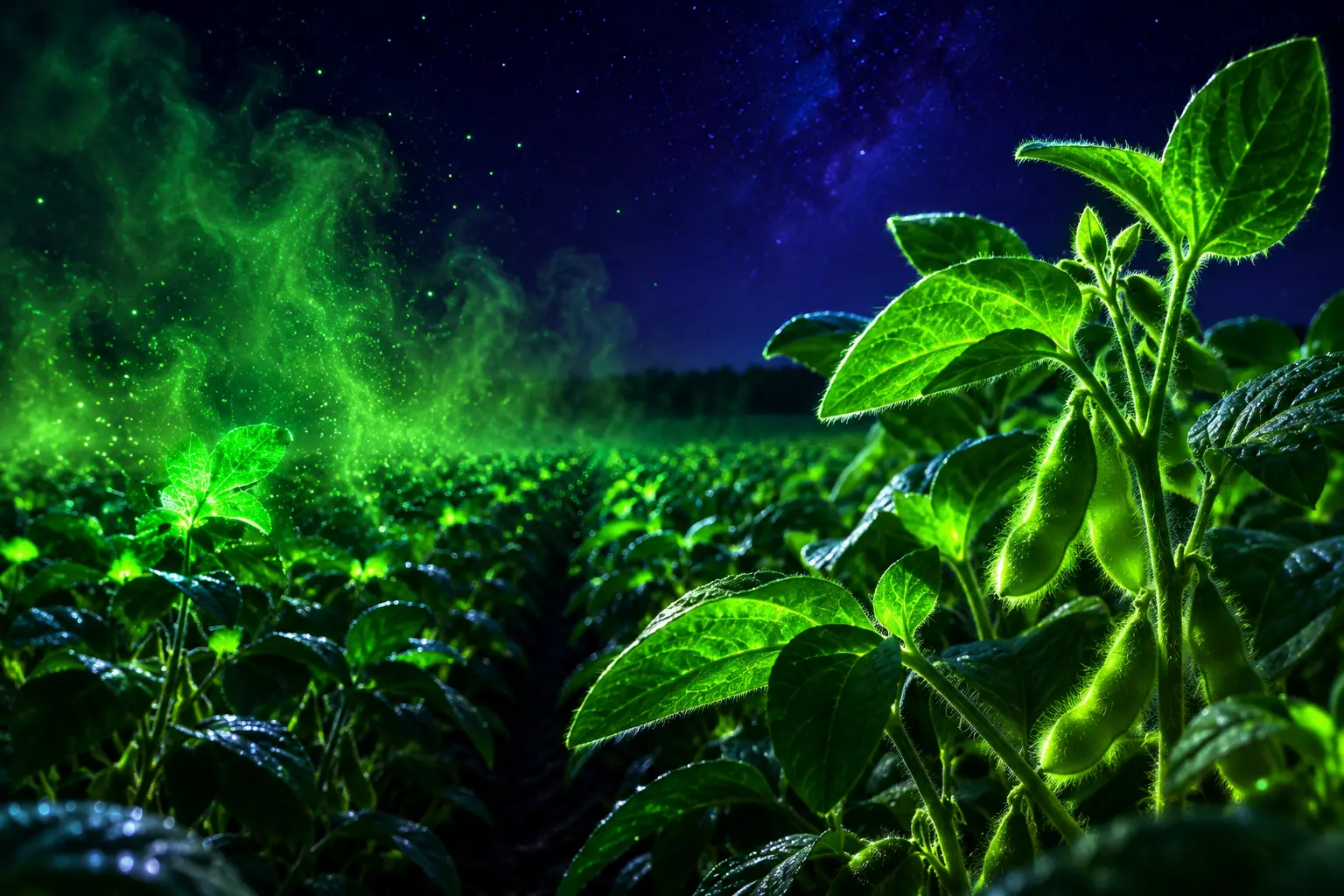
Shely Aronov, InnerPlant’s chief executive and co-founder, describes the trait as extra code in the seed. When the plant’s immune system answers a fungus, it makes a protein that throws an optical signal. Cameras on tractors, drones, or satellites can read it. People walking a row cannot.
The company says that fluorescence can show up within 48 hours of stress starting, as much as two weeks before the same stress is obvious in the field. CropVoice then adds lab tests, scouting, weather, and local agronomy before a disease alert goes out. The network names white mold and frogeye leaf spot, the two above-ground soybean fungi it treats as the in-season, sprayable threats.
https://www.youtube.com/watch?v=t4GDrZKDlBM
The Glowing Seed Is Not for Sale
InnerPlant launched in 2018. CropVoice, named among TIME’s Best Inventions of 2024, is how the trait reaches a farm. The company’s own product page is blunt: InnerSoy seed is not for sale. Insights come only through the network. There is no planter-box version for 2026.
Coverage ran 50,000 Midwest acres in 2025. InnerPlant is scaling that footprint to more than 500,000 acres in 2026. Gary Schaefer, chief commercial officer, has described the live map as Nebraska, Iowa, and parts of South Dakota and Kansas. Plots are laid out like cell towers, roughly one per covered county, planted with at least five seed types so the grid does not rest on a single hybrid’s weakness. Growers enroll every soybean field they have inside the coverage zone. InnerPlant and its retail partners run the plots.
That design is why the talking-crop pitch and the product on offer are different things. A farmer is not walking glowing rows at dawn. A farmer is buying a county reading that arrives as text alerts and John Deere Ops Center notices, plus weekly scouting notes. InnerCorn is scheduled as an add-on in 2027, billed as its own SKU, if the grower already buys InnerSoy and has corn inside the network.
CROPVOICE LIST PRICES FOR SOY ACRES
| Plan | Soy acres | Standard list |
|---|---|---|
| CV-500 | Under 500 | $2,200 |
| CV-1000 | 501 to 1,000 | $3,300 |
| CV-2000 | 1,001 to 2,000 | $4,500 |
| CV-4000 | 2,001 to 4,000 | $6,700 |
| CV-Unlimited | 4,000 and up | $11,200 |
Those figures are InnerPlant’s farmer MSRP for January 16 through May 31. InnerCorn add-ons are listed from $1,000 to $5,000 depending on tier. The sales copy on the same page splits buyers in two: people who already spray every year, and people who decide each season. Both paths still end at a fungicide call, timed or skipped.
Deere Reads the Plant for Syngenta
John Deere put money into InnerPlant in 2022 and has fitted smart tractors with cameras meant to catch the signal. Dan Leibfried, Deere’s vice president of marketing and shared services, said the draw was a plant that reports on itself instead of waiting for a human to spot a lesion. Alerts already sync into Deere’s Operations Center. In March 2023 InnerPlant also teamed with Satellogic on satellite sensors tuned to the same glow.
On November 7, 2023, InnerPlant, Deere, and Syngenta announced a joint soybean effort that would join plant signals to See & Spray treatments. Deere’s boom would vary the rate and spray only where the optical flag appeared. Syngenta would supply chemistry chosen for an early window. Feroz Sheikh, then Syngenta’s chief information and digital officer, said InnerPlant’s detection catches disease that otherwise goes unseen or untreated.
That 2023 stack is still a development pact, not the 2026 retail SKU. CropVoice today is a regional watch, sold through large agricultural retailers, with a field team InnerPlant says combines more than 60 years of agronomy time and eight doctorates. The plant-by-plant sprayer loop is the version Deere and Syngenta said they wanted to build. The version a grower can buy now is the text.
THE CLOSED LOOP THEY ARE BUILDING
- The trait: InnerSoy makes a fluorescent protein when its immune system answers an above-ground fungus.
- The readers: tractor cameras, drones, aircraft, and satellites pick up a glow people cannot see.
- The desk: lab work, scouts, and models confirm which disease is moving before a text goes out.
- The boom: Deere See & Spray and a Syngenta early-window fungicide are the intended last step, plant by plant.
Aronov has said the edit is like adding a line of code, so a fungal reaction also makes the optical protein. Leibfried has called InnerPlant the kind of tool that will change the industry over time. The change he is pointing at is not a chemical-free field. It is a machine that hears the plant, then sprays a smaller patch, sooner.
Purple Leaves Show Up in the Cab
Insignum AgTech, based in Indiana, is building a different sensor, one a person can see. Kyle Mohler, the founder and chief executive, grew up on a corn and soybean farm where the family sprayed every acre every year, needed or not. He started the company in 2019 after a biochemistry degree at Purdue. The first gene ties corn’s own disease-defense response to anthocyanin, the purple pigment already sitting in so-called Indian corn.
When a fungal spore lands, purple tissue spreads around the breach about a week before ordinary lesions, Insignum says, and sometimes seven to 10 days. In a Purdue tar-spot trial, purple spots showed five days after inoculation. Mohler’s line to growers is simple. When you see disease, it is too late. Plants start answering in minutes. Farmers, he says, do not know for days or weeks.
The limit is baked into the color. Purple means the plant is fighting. It does not name the fungus. Insignum scores signaling in the money part of the canopy from 0 to 10, and company trials point to a spray threshold around two to three. Abby Horlacher, an agronomist who owns Nickel Plate Consulting, said the aim is to hit timing exactly, or to skip the pass. Chris Cook, Insignum’s director of commercial operations, has compared it to a cold: the immune fight starts before the sore throat.
USDA’s Animal and Plant Health Inspection Service told Insignum in 2023 that the edited corn can be sold and grown without the extra permits that still follow many engineered plants. That path is available because the company recodes DNA already in corn, rather than importing a glowing protein. Mohler closed a $2.4 million Series Seed round in September 2025, led by Innova Memphis, with Elevate Ventures, Purdue Strategic Ventures, and FFA Ventures. Purdue’s Ag-Celerator had put in $100,000 in January 2022. Field tests were in their fifth year by the 2025 raise, including work with Beck’s Hybrids and farmer-owned Keystone Cooperative.
Farmers will not plant whole fields of Insite corn at first. Mohler has set precommercial customer trials for 2027 and commercial seed for 2028, starting as sentinel strips inside ordinary fields. Broader hybrid use depends on more approvals. Insignum is already testing cameras and aerial imagery, because walking purple plants across a county would cap the tool.
TWO WAYS A CROP SAYS IT IS SICK
| InnerPlant CropVoice | Insignum Insite | |
|---|---|---|
| Crop now | Soybean sensor plots | Corn, purple at the infection site |
| What you see | Nothing; cameras read a glow | Purple tissue, by eye or camera |
| Lead time | 48 hours to a signal; up to two weeks before scoutable symptoms | About 7 to 10 days before ordinary lesions |
| Who plants it | InnerPlant and retailers, about one plot per county | Growers, in sentinel strips from 2028 |
| U.S. status | USDA review in 2023; FDA protein consult in 2025; service selling in 2026 | APHIS clearance in 2023 to grow without extra permits; seed still in the pipeline |
The two companies are not selling the same object. One sells a reading from plants you never own. The other wants to put a visible flag in your own stand, then, later, in the hybrid itself.
What the Signal Is For
Open InnerPlant’s pitch and the job of the glow is not a mystery. Yearly sprayers are told they can hit a better window, match the product to the disease, and know the pass paid. Seasonal deciders are told they can skip a quiet year. Insignum’s slogan is the same idea in six words: exactly when, precisely where, and only if.
Aidan Kleinschmit, a soybean grower in northeast Nebraska, is on InnerPlant’s testimonial page with a yield split from a CropVoice year. He said he cut 86 bushels where he sprayed after an alert, and only in the 50s or low 60s where he did not, at least 25 bushels apart. Brandon Hunnicutt, a large Nebraska farmer, said the service takes guesswork out of the soybean fungicide decision by warning early enough to protect yield. Those are spray stories. They are also skip stories, if the grid stays quiet.
The louder public glow on X is a different plant entirely, the decorative petunia and lantern-crop clips that travel because they look like night lights. The farm version barely shows up there. It lives in retailer enrollments, Deere logins, and a product page that asks whether you already spray every year. The sensor is doing agronomy, not theater.
Mixed Grain Still Scares the Export Desk
InnerPlant’s soybeans carry the LanFP1 protein from a lancelet, Branchiostoma floridae, dropped into Williams 82 under a pathogen-inducible promoter. That is a food-use protein in a crop that can enter meal and oil if a sentinel plot is harvested into the bulk stream. InnerPlant finished the Food and Drug Administration’s New Protein Consultation for that fluorescent protein on January 22, 2025, with help from a United Soybean Board grant, after APHIS completed regulatory status reviews announced on July 18, 2023.
U.S. biotech crops still move through a three-agency split. APHIS, EPA, and FDA split oversight of plant-pest risk, pesticidal traits, and food safety. Insignum’s native-DNA edit got a lighter APHIS outcome than InnerPlant’s imported protein. Both still face a market problem the agencies do not solve. Some markets, including the European Union, bar food with genome edits on the scale these products use. U.S. shoppers remain wary of engineered food even where a few gene-edited crops already sell.
Mohler said as early as 2023 that much of the supply chain did not want a fast commercial launch, because a special corn is hard to keep out of export grain. In October 2025, Lianne Bouwman, Mark Sturme, and Gijs Kleter warned in Trends in Biotechnology that if phytosensor plants are managed poorly, commingling could disrupt trade and raise safety questions, even when the plants were never meant to be the main harvest. They argued for segregation and a food-and-feed look at the new proteins before a mix-up happens. InnerPlant’s present answer is structural: the company keeps the seed and runs the plots. Insignum’s 2028 strips put that mixing risk back on the farm, unless identity-preserved handling holds.
FROM LAB MARKER TO COUNTY ALERTS
- 1996: Researchers publish an engineered green fluorescent protein that works as a live reporter in plant cells.
- 2018: InnerPlant launches around crops that emit optical stress signals.
- 2019: Mohler founds Insignum to turn corn’s own pigment genes into a disease flag.
- 2022: Deere invests in InnerPlant and begins putting signal cameras on equipment.
- July 18, 2023: APHIS clears InnerPlant soybean sensor lines through regulatory status review.
- November 7, 2023: InnerPlant, Deere, and Syngenta announce the See & Spray fungus platform.
- January 22, 2025: FDA’s New Protein Consultation for LanFP1 is complete.
- 2025: CropVoice sells across 50,000 acres; Yankton and Cedar counties get the first live fungus texts; Insignum raises $2.4 million.
- 2026: CropVoice scales to more than 500,000 acres.
- 2027: InnerCorn is slated to join CropVoice; Insignum plans precommercial customer trials.
- 2028: Insignum aims to sell commercial sentinel seed.
Most of those dates are pipeline dates, not harvest dates. The EU door is still shut. The grain trade still hates a mixed bin. The protein in InnerSoy has an FDA consult behind it, which is not the same thing as a global passport.
The Marker Left the Lab Thirty Years Ago
Fluorescent proteins have been plant tools since 1996, when Wan-ling Chiu and colleagues showed a recoded GFP lighting up living plant cells. Field tobacco with GFP was already being walked with handheld UV lamps by the late 1990s, and papers from that period sketched pathogen-inducible glow as an early-warning system. InnerPlant and Insignum are not inventing the marker. They are trying to hang a business on it: one as a county network with Deere and a chemical partner, one as purple tissue a scout can count.
Aronov still talks about a future with InnerPlant sensors in every field. CropVoice’s present tense is narrower, and it is the honest one. The plants that “tell” a farmer they are sick are, for now, a plot InnerPlant tends, a camera a person did not bring, and a text that tells a sprayer when to roll. InnerCorn is due in 2027. Insignum’s seed is due in 2028. Until those bags exist, the talking crop is a subscription.

Final Fantasy Resonance Turns a Dead Gacha Into HD-2D

PHP2Shell Forced Sites Offline While Exploits Stalled

Kindle+ Folds AI Audiobooks Into the Page-Read Fund

Chip Stocks Fall as the Bond Rally Cheapens AI Spend

Comcast’s Record Odyssey Quarter Doubles as the Exit

Microsoft 365 Auth Fault Took Down Exchange and Teams

Xbox Caps Game Pass Cloud Gaming at 15 Hours

OpenClaw 2.0 Ships a Team Workplace With Host-Trust Defaults

OpenAI Unveils GPT-6 Astra With a Critical Cyber Label

Diesel Breaks Its Record as the White House Claims Credit
-
 NEWS2 months ago
Microsoft 365 Auth Fault Took Down Exchange and Teams
-
 GAMING2 months ago
Xbox Caps Game Pass Cloud Gaming at 15 Hours
-
 NEWS2 months ago
OpenAI Unveils GPT-6 Astra With a Critical Cyber Label
-
 NEWS2 months ago
OpenClaw 2.0 Ships a Team Workplace With Host-Trust Defaults
-
 BUSINESS2 months ago
Diesel Breaks Its Record as the White House Claims Credit
-

 LIFESTYLE2 months ago
Squishy Dumpling Toys Recalled After Hiding Illegal Water Beads
-

 BUSINESS2 months ago
ChargePoint Stock Rally Prices Wilmer’s Three-Year Cash Plan
-

 AUTO2 months ago
Tesla Puts Its Wheel-Free Cybercab on Austin Streets