
NEWS
The Ultra 4 Puts New Sensors in the Same Titanium Tank
Apple Watch Ultra 4 keeps the Ultra 2 case and spends $799 on a recovery loop that also ships on Series 12, plus extra battery after Ultra 3 already added satellite.

Apple Watch Ultra 4 starts at $799 with the same 49mm titanium case as the Ultra 2, plus a Health Sensing System that also ships on the $399 Series 12. The usual buyer chart treats three years as one leap. Apple Watch Ultra 3 already added satellite, 5G, and the larger screen in 2025.
What you pay for now is a recovery coach, extra battery, and a faster chip inside a tank Apple has barely restyled. The discontinued Ultra 2 still runs watchOS 27 and Siri AI.
Apple Already Sold Satellite and 5G on Ultra 3
Apple Watch Ultra 2 launched in 2023 at $799 with the S9 chip, LTE cellular, dual-frequency GPS, a 3,000-nit display, an Action button, a siren, and recreational diving to 40 meters. Those adventure-watch pieces did not wait for 2026. Ultra 3 shipped them forward in 2025, then added the radios the Ultra 2 never had.
Ultra 3 moved to the S10, a wide-angle LTPO3 screen at 422 by 514 pixels, 5G, and Emergency SOS, Messages, and Find My via satellite. Rated battery life rose from 36 hours to 42 hours. Apple includes two years of satellite service on Ultra 3 and later. The Ultra 4 keeps that radio stack and that screen size.
Put Ultra 3 back in the middle and the three-year leap shrinks. Satellite, 5G, and the 5% larger display are last year’s goods. Ultra 4 spends its generation on the S11, 4GB of memory, the Health Sensing System, Readiness, Audio Intelligence, and a further battery bump.
THE ULTRA LINE BY YEAR
- September 2022: Apple launches the first Ultra at $799 with a 49mm titanium case and a 36-hour rating.
- September 2023: Ultra 2 keeps the case and the 36-hour rating, adds the S9 chip, and raises peak brightness to 3,000 nits.
- September 2025: Ultra 3 adds satellite messaging, 5G, the LTPO3 422-by-514 display, and a 42-hour rating.
- September 9, 2026: Apple announces Ultra 4 at $799 with the S11 chip and the Health Sensing System.
- September 14, 2026: watchOS 27 ships for Ultra 2 and later, plus Series 9 and later and SE 3.
- September 18, 2026: Ultra 4 reaches stores.
The original Ultra from 2022 is off that software list. Ultra 2 is now the oldest Ultra that still gets the new system release, which is why a skip-a-generation chart is such a convenient sales tool.
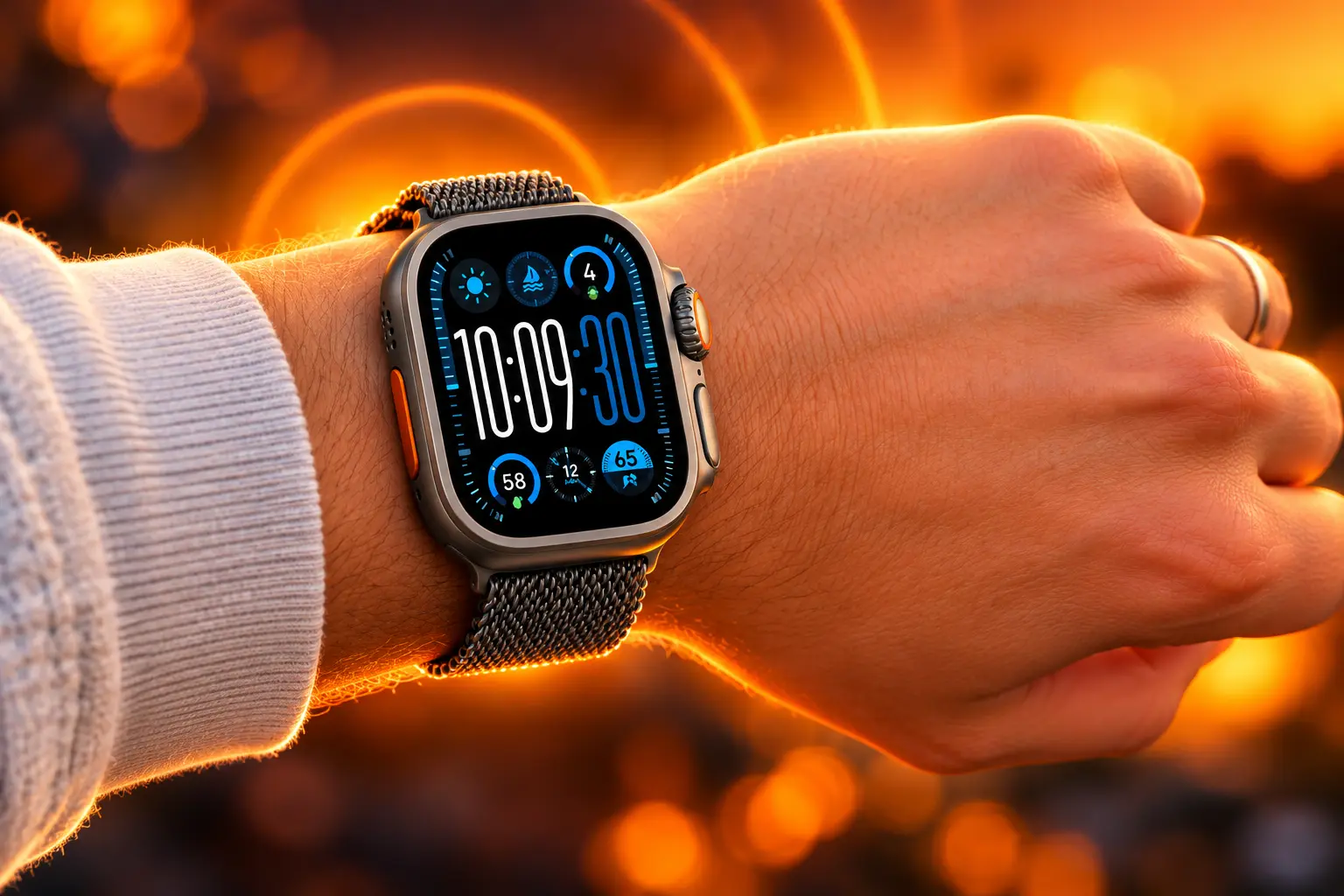
What $799 Buys Over the Ultra 2
The case, the 3,000-nit sapphire, the Action button, the siren, 100-meter water resistance, and the 40-meter dive rating are shared. So is the $799 launch price. The money moved into silicon, sampling rate, and stamina.
ULTRA 2 VS ULTRA 3 VS ULTRA 4
| Spec | Ultra 2 (2023) | Ultra 3 (2025) | Ultra 4 (2026) |
|---|---|---|---|
| Chip / memory | S9 / 2GB | S10 / 2GB | S11 / 4GB |
| Display | 410 x 502, LTPO2 | 422 x 514, LTPO3 | 422 x 514, LTPO3 |
| Normal battery | 36 hours | 42 hours | 50 hours |
| Low Power Mode | 72 hours | 72 hours | 84 hours |
| Cellular | LTE | 5G | 5G |
| Satellite SOS and Messages | No | Yes | Yes |
| Health Sensing System | No | No | Yes |
| Readiness app | No | No | Yes |
| Launch price | $799 | $799 | $799 |
Ultra 4 is model A3579. Natural titanium weighs 63.0 grams, up 1.6 grams from Ultra 2’s 61.4 grams; black titanium is 63.1 grams. Apple’s spec sheet lists precision dual-frequency GPS with GPS, Galileo, QZSS, and BeiDou, and it no longer names GLONASS, which Ultra 2 listed. Charging to 80 percent drops from about an hour to about 45 minutes, and 15 minutes on the cable is rated for 18 hours of use.
Storage stays at 64GB. watchOS 27 is not a reason by itself, because Ultra 2 and Ultra 3 both receive it. The features that stay behind are the ones wired to the new sensors and the S11’s Secure Exclave.
Series 12 Ships Those Sensors at $399
Apple’s Series 12 spec sheet uses the same Health Sensing System line as Ultra 4: a second-generation electrical heart sensor, an always-on optical heart sensor, blood oxygen, and temperature. Both watches get high-frequency background heart rate, Recovery HRV, the Vitals app, the Readiness app, the Steps complication, the S11 chip, 64GB, and Audio Intelligence.
Series 12 starts at $399 for 42mm aluminum GPS. Cellular, a 46mm case, titanium, and ceramic cost more, and a ceramic Series 12 can exceed Ultra 4’s price. The $400 gap from the base Series 12 to Ultra 4 is battery, the 49mm Grade 5 titanium block, 3,000 nits against 2,000, 100-meter water resistance against 50 meters, dual-frequency GPS, the dive gauge, the Action button, the siren, and satellite. It is not a second health platform.
That split changes the upgrade math for anyone who does not need two days between charges or a message off the grid. The recovery loop Apple is selling this year is a 2026 Apple Watch feature, not an Ultra feature. A dedicated strap still charges for the same idea; WHOOP One membership at $199 a year bundles the band, and Peak and Life list at $239 and $359.
If the goal is a daily score and denser heart data, Series 12 undercuts Ultra 4 by $400 and undercuts a multi-year WHOOP bill as well. Ultra 4 is the watch you buy when the tank, the hours, and the satellite radio have to travel with that score.
Readiness, Recovery HRV, and a Daily Coach
Apple rebuilt the optical and electrical heart stack with larger, more efficient green LEDs and tied it to the S11. Ultra 4 measures heart rate every five seconds all day, which Apple says is 60 times more often than Ultra 3. HRV is sampled as often as every five minutes, which Apple calls 24 times more often than Ultra 3. Those multipliers are versus last year’s Ultra, not versus Ultra 2’s older opportunistic sampling.
Apple now reports two HRV figures. Overall HRV is the older SDNN reading. Recovery HRV is the new daily stress and recovery figure, and Empirical Health notes that Recovery HRV on Series 12 and Ultra 4 uses RMSSD, the same family of math WHOOP and Oura have used for years. Older Apple Watches keep SDNN and do not get native Recovery HRV through watchOS 27. A jump between your old SDNN number and the new Recovery HRV number is a formula change, not a sudden fitness change.
Readiness turns that stream into a 0-10 score with one of four prompts: Recover, Pace Yourself, Ready, or Go For It. Apple says the score draws on recent activity, training load, vitals, and sleep, and that it updates through the day after a hard session or a shift in daytime vitals. Kaiann Drance, Apple’s vice president of Worldwide Apple Watch Product Marketing, said the Health Sensing System and S11 take Ultra 4 “to the next level, delivering longer battery life, faster charging, and the most accurate heart rate sensing in a wearable.” Apple backs the accuracy line with a readiness score to support athletes and a study of more than 1,000 people against other wearables.
Endurance reviewer Ray Maker, who wore Ultra 4 and Series 12 at once, called the Readiness design “pretty solid” and the heart-rate data “very good,” then added it was “about the same” as the best rivals. He also called Apple’s study design “very slanted towards Apple,” because a watch that returns no reading was scored as if it had the correct answer. After a track session of 8 x 600-meter repeats, his Series 12 dropped from 5 to 3 right away while Ultra 4 took about two hours to show the same Pace Yourself score.
My Ultra 2 felt painfully slow on watchOS 27, but the Ultra 4 is buttery smooth.
Fernando Silva, tech reviewer
That smoothness complaint is the part a spec table will not show. Ultra 2 still gets Siri AI, so owners are not locked out of the new assistant. The S9 is simply carrying a heavier system than it was built for, which is a different reason to spend $799 than “new features.”
READINESS LABELS ON THE WATCH
- Recover: The watch is telling you to back off, not to stack another hard day.
- Pace Yourself: Training is on the table, with a lighter load than you might have planned.
- Ready: Recent sleep, load, and vitals sit in a normal band for you.
- Go For It: The score is in the top band and the watch is clearing a harder session.
Craig Bolton, Apple’s director of Fitness Technologies, said the Health Sensing System is “really what’s enabled this.” The second-order product is not a brighter bezel. It is Apple trying to answer WHOOP and Oura on the wrist you already wear, then charging Ultra money only if you also want the tank.
Battery Life Finally Clears a 100-Mile Race
Apple rates Ultra 4 at 50 hours of normal use, 14 hours above Ultra 2 and 8 hours above Ultra 3. Low Power Mode stretches to 84 hours, up from 72 hours on both older Ultras. Standard outdoor workout tracking is rated at 18 hours, up from 12 hours on Ultra 2.
ULTRA 4 STAMINA RATINGS
- Everyday use: Up to 50 hours, or 84 hours in Low Power Mode.
- Standard outdoor workout: Up to 18 hours with GPS and heart rate.
- Extended Workout: Up to 25 hours with full GPS and heart rate.
- Max Extended Workout: up to 45 hours of Max Extended Workout with GPS every second, which Apple says is typically enough for a 100-mile race.
Ultra 2’s long-day options were 17 hours in Low Power Mode with full GPS and heart rate, or 35 hours with thinner GPS and heart-rate sampling. Ultra 4’s Max Extended mode keeps one-second GPS for 45 hours, which is the first time Apple has pointed the Ultra line at a 100-mile clock without starving the track. For anyone whose longest day was already inside 12 hours, this is spare capacity. For ultrarunners, it is the cleanest hardware reason to leave an Ultra 2 behind.
Satellite is the other leftover Ultra job. Ultra 2 has no satellite features. Ultra 3 added Emergency SOS, Messages, and Find My via satellite, and Ultra 4 keeps them. Series 12 does not get that radio. If you hike off LTE and want a text out, the 49mm watch is still the one, and that was already true in 2025.
Why Keep an Ultra 2 That Still Gets Siri AI?
Apple has stopped selling new Ultra 2 units. A certified refurbished Black Titanium Ultra 2 with an Ocean Band is listed in Apple’s refurbished store at $509, marked down from $699, which is $290 under the new Ultra 4. Supplies are limited and other bands or finishes may differ.
That $509 watch still runs watchOS 27. Apple’s watchOS 27 page lists Ultra 2 beside Ultra 3, Ultra 4, Series 9 through 12, and SE 3. The paired iPhone has to be an iPhone 11 or later, or an iPhone SE (2nd generation or later), already on iOS 27. Siri AI rolls out in English on that same release. You do not buy Ultra 4 to keep getting software.
Keep the Ultra 2 if 36 hours still covers your days, you do not need satellite, and you are not going to train off a 0-10 score. The dive rating, the siren, dual-frequency GPS, and the 3,000-nit panel are already on your wrist. The S9 may feel slower under watchOS 27, which is the honest tax of staying. It is not a dead watch.
Buy Ultra 4 if you will use Readiness and Recovery HRV to change tomorrow’s session, if you need 18 hours of full workout tracking, or if you go beyond cellular and want two years of satellite service on a new unit. The slightly larger screen and the 45-minute charge are pleasant. They are not the purchase.
Live Rewind and Siri Recap Arrive Later
The S11 adds a Secure Exclave for on-device audio. Apple groups four Audio Intelligence tools under that chip, and the product page says some of them come in beta late 2026. Live Rewind and Siri Recap are the ones still on that later calendar, matching what Apple said at the September 9 event.
AUDIO INTELLIGENCE ON THE S11
- Sound Recognition: Alerts on the wrist for sirens, alarms, doorbells, or a baby crying, even if the iPhone is elsewhere.
- Shazam: Identifies music around you and puts the track in the Smart Stack.
- Live Rewind: A double press of the Digital Crown shows the previous 15 seconds of talk as text; due later in 2026.
- Siri Recap: Builds a title and key points after a conversation in the Siri app; also due later in 2026.
Those tools are shared with Series 12, because they live in the S11, not in the titanium case. Paying $799 does not get you an earlier copy. A redesigned Health app with a Longevity tab and Health Age is also due later this year in U.S. English, and Apple says users will be able to buy lab panels of more than 50 biomarkers for $119 at about 2,000 Quest Diagnostics sites. None of that requires the Ultra badge.
Ultra 4 has been in stores since September 18 at $799, in natural or black titanium. The watch you already own still gets the new operating system. The $799 question is whether you want the recovery loop and the extra hours on the same titanium block, because Apple is not selling a new adventure watch. It is selling a denser reading of the one you have been wearing.
Frequently Asked Questions
Does Apple Watch Ultra 2 support watchOS 27?
Yes. Apple’s watchOS 27 page lists Ultra 2 with Ultra 3, Ultra 4, Series 9 through 12, and SE 3, and the update requires an iPhone 11 or later or an iPhone SE (2nd generation or later) already running iOS 27. The original Ultra from 2022 is not on that list, so Ultra 2 is now the oldest Ultra that still receives the yearly system release.
Does Apple Watch Series 12 have the same Health Sensing System as Ultra 4?
Yes. Apple’s Series 12 spec sheet names the same second-generation electrical heart sensor, always-on optical heart sensor, Recovery HRV, Readiness app, and S11 Audio Intelligence stack. Series 12 starts at $399, is rated for 24 hours of normal use, peaks at 2,000 nits, and is water resistant to 50 meters, with no satellite radio.
What do Apple Watch Ultra 4 readiness scores mean?
Apple presents a 0-10 score with four prompts: Recover, Pace Yourself, Ready, or Go For It. In testing by endurance reviewer Ray Maker, 0-1 mapped to Recover, 2-4 to Pace Yourself, 5-7 to Ready, and 8-10 to Go For It, and the number can move after a workout or a change in daytime vitals.
Is Apple Watch Recovery HRV the same as WHOOP HRV?
No. Recovery HRV on Ultra 4 and Series 12 uses RMSSD and can sample while you are still, as often as every five minutes, while WHOOP calculates RMSSD during deepest sleep and avoids continuous daytime HRV because of noise. The millisecond figures are not interchangeable, even when both devices use RMSSD.
Disclaimer: This article is news reporting and analysis of Apple Watch hardware and software, and it is for information only. It is not medical advice, a diagnosis, or a training plan, and Readiness, heart-rate, and HRV figures are consumer wellness readings rather than clinical tests. It is also not a recommendation to buy, sell, or keep any watch. Speak with a qualified clinician before changing medical care or training around wearable scores, and confirm current prices, satellite terms, and feature availability with Apple, because listings and software rollouts can change after publication.

Final Fantasy Resonance Turns a Dead Gacha Into HD-2D

PHP2Shell Forced Sites Offline While Exploits Stalled

Kindle+ Folds AI Audiobooks Into the Page-Read Fund

Chip Stocks Fall as the Bond Rally Cheapens AI Spend

Comcast’s Record Odyssey Quarter Doubles as the Exit

Microsoft 365 Auth Fault Took Down Exchange and Teams

Xbox Caps Game Pass Cloud Gaming at 15 Hours

OpenClaw 2.0 Ships a Team Workplace With Host-Trust Defaults

OpenAI Unveils GPT-6 Astra With a Critical Cyber Label

Diesel Breaks Its Record as the White House Claims Credit
-
 NEWS2 months ago
Microsoft 365 Auth Fault Took Down Exchange and Teams
-
 GAMING2 months ago
Xbox Caps Game Pass Cloud Gaming at 15 Hours
-
 NEWS2 months ago
OpenAI Unveils GPT-6 Astra With a Critical Cyber Label
-
 NEWS2 months ago
OpenClaw 2.0 Ships a Team Workplace With Host-Trust Defaults
-
 BUSINESS2 months ago
Diesel Breaks Its Record as the White House Claims Credit
-

 LIFESTYLE2 months ago
Squishy Dumpling Toys Recalled After Hiding Illegal Water Beads
-

 BUSINESS2 months ago
ChargePoint Stock Rally Prices Wilmer’s Three-Year Cash Plan
-

 AUTO2 months ago
Tesla Puts Its Wheel-Free Cybercab on Austin Streets