
NEWS
NASA Built the X-59 to Change a 1973 Rule
The X-59 is already flying past Mach 1, while a July 2026 FAA proposal would swap the 1973 overland ban for a 0.11 psf ground-pressure limit before community.

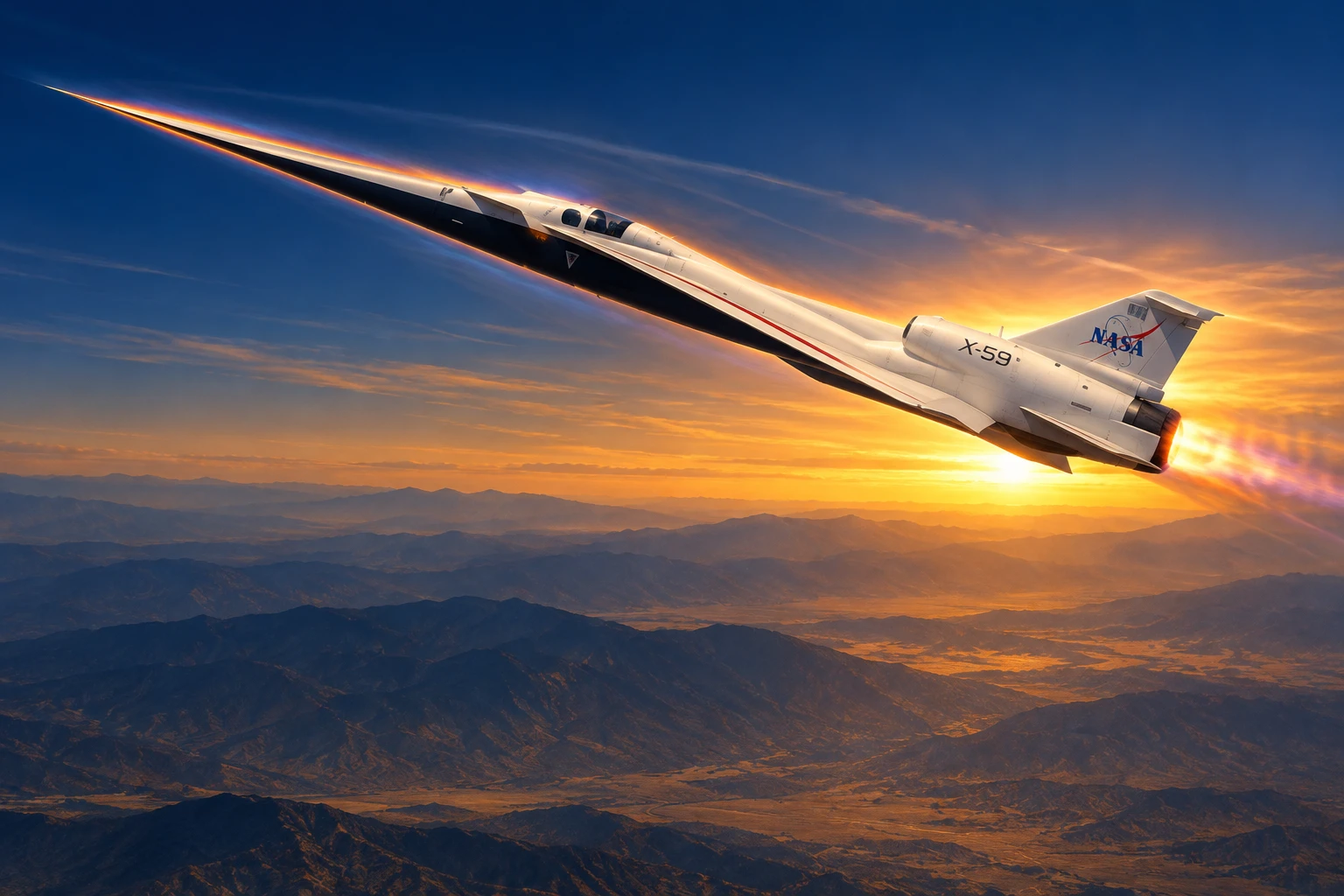
NASA’s X-59 reached Mach 1.4 (925 mph) at 55,000 feet over Edwards Air Force Base on June 12, 2026. That is the speed and height the jet will use when it finally flies over towns to ask how a quieter sonic thump feels.
The plane’s job is not a new airliner. It is a noise sample for regulators who have blocked civil Mach 1 flight over land since 1973. In July 2026, those regulators moved first.
Twenty-Five Flights Have Put the X-59 Past Mach 1
Lockheed Martin Skunk Works assembled the 99.7-foot research jet in Palmdale, California. NASA test pilot Nils Larson lifted it off U.S. Air Force Plant 42 at 11:14 a.m. EDT on October 28, 2025, flew 67 minutes at about 230 mph and 12,000 feet with the gear down, and landed at Armstrong Flight Research Center. The X-59 is experimental only. NASA says it will never carry passengers.
Envelope expansion ate the next months. NASA Administrator Jared Isaacman said that by the first supersonic flight on June 5, the team had flown 16 times in 90 days. Jim “Clue” Less took off from Edwards at 11:08 a.m. PDT, stayed up 81 minutes, and reached Mach 1.1 (713 mph) at 43,400 feet. A NASA F-15 chase jet flew nearby. Its conventional booms covered whatever the X-59 made. Less had the gauges, not a jolt in the seat, to tell him he had crossed Mach 1, which is what the shaping is supposed to do.
NASA Aeronautics posted the same milestone that afternoon.
✈️ JUST IN: The X-59 has gone supersonic!
The X-59 achieved supersonic speeds for the first time ever today — a major milestone for NASA’s Quesst mission and an important step toward upcoming flights that will demonstrate its quiet supersonic technology ahead of future… pic.twitter.com/mwblICs4vN
— NASA Aeronautics (@NASAaero) June 5, 2026
One week later the jet hit the community-overflight profile, Mach 1.4 at 55,000 feet. Cathy Bahm, project manager for the Low Boom Flight Demonstrator, said flight data on flying qualities, stability margin, and loads has tracked the models. Larson called the sorties “exciting but uneventful,” the phrase a test pilot wants.
THE X-59 FLIGHT MARKS
| Date | Event | Speed and height | What the flight showed |
|---|---|---|---|
| October 28, 2025 | First flight, Palmdale to Edwards | 230 mph, 12,000 feet | Systems check, landing gear down |
| June 5, 2026 | First time past Mach 1 | Mach 1.1, 43,400 feet | Supersonic handling with a chase F-15 |
| June 12, 2026 | Mission conditions | Mach 1.4, 55,000 feet | The profile planned for town overflights |
| August 21, 2026 | 25th flight | Mach 1.2, about 49,000 feet | Envelope work still paired with a chase jet |
The 25th test flight on Aug. 21 lasted 72 minutes. NASA says acoustic validation, when microphones and an F-15 shock-sensing probe will try to capture the X-59’s own signature, comes later in 2026. Until that phase, every public boom near Edwards still has a louder jet in the formation.
The FAA Moved to Lift the Ban Anyway
On July 2, 2026, the Federal Aviation Administration published a notice of proposed rulemaking titled Enabling Supersonic Overland Flight. The draft would replace the overland Mach 1 ban with an interim noise test: sonic boom overpressure at the surface must not exceed 0.11 pounds per square foot.
That number did not come from X-59 town surveys. Those flights are still on a 2027 calendar. The FAA said it drew 0.11 psf from older NASA datasets, FaINT and NTSC, as the point where booms were “sufficiently abated at the surface.” The proposal also says Quesst “holds the potential” to cut boom impact and that more research is needed before the same shaping is trusted on airliners.
The political clock started earlier. A June 6, 2025, White House order, Leading the World in Supersonic Flight, told the FAA to repeal the prohibition in 14 CFR 91.817 within 180 days and to set an interim noise-based standard. Isaacman tied the June 5 Mach run to that push. Michael Kratsios, director of the Office of Science and Technology Policy, called the flight part of work “to unleash supersonic flight.”
WHAT THE JULY 2026 DRAFT WOULD REQUIRE
- Ground pressure: Primary and secondary sonic boom overpressure at the surface stays at or below 0.11 psf.
- A finding: The operator shows that limit by measurement, modeling, or another FAA-approved method, and the Administrator agrees before Mach 1 operations.
- Limits in force: The aircraft then flies only under conditions the FAA issues for that operator.
The docket counts five aircraft operators already looking at that kind of approval. The draft is still a proposal. The eCFR display of the old section, updated through September 22, 2026, still carries the Mach 1 bar.
What the 1973 Speed Limit Still Forbids
The present civil aircraft sonic boom rule is a speed limit with a permit hatch. No one may operate a civil aircraft in the United States at a true flight Mach number greater than 1 except under an authorization issued under § 91.818. A second clause bars aircraft whose maximum operating Mach exceeds 1 from flying to or from a U.S. airport unless the crew has limits that keep a boom from reaching U.S. soil, or they hold that same authorization.
NASA dates the overland ban’s effect to April 27, 1973. Public surveys in cities under military supersonic paths had already soured people on rattled windows. Concorde, when it flew, was kept to ocean tracks for the same reason. Fifty-three years later the text is still a Mach number, not a sound number. Peter Coen, who has managed NASA’s quiet-supersonic work, has said the agency’s aim is to swap that speed cap for a sound cap: if the noise on the ground does not bother anyone, the airplane can go past Mach 1.
FROM BAN TO DRAFT RULE
- April 27, 1973: The overland civil Mach 1 prohibition takes effect after boom complaints under military jets.
- April 2018: NASA awards Lockheed Martin a $247.5 million cost-plus contract to design and build the low-boom X-plane.
- June 6, 2025: The White House orders the FAA to repeal 14 CFR 91.817 and write an interim noise standard.
- October 28, 2025: The X-59 flies for the first time, still subsonic.
- June 5 and June 12, 2026: The jet goes supersonic, then matches the Mach 1.4 / 55,000-foot survey profile.
- July 2, 2026: The FAA proposes 0.11 psf as an interim overland limit.
- 2027 and after: NASA plans the community survey campaign that was supposed to feed a durable standard.
Coen’s X-plane method, described across 80 years of NASA test jets, is to pick one proof and build the cheapest airframe that can deliver flight data for that proof. For the X-59 the proof is a quieter boom, on a budget, and nothing else. The second-order product is a rule written in pounds per square foot.
Community Surveys Are Scheduled for 2027
Jonathan Rathsam, technical co-lead for Quesst’s community-response phase at NASA Langley, has put the hierarchy in plain order. To replace the ban you need a new standard, proof of a new shaping method, and, most of all, data on how people hear the quieter booms. Older community studies measured noise that was already too loud to use. The new sample has to cover different towns, buildings, climates, and groups, and it has to be shared with the International Civil Aviation Organization as well as the FAA.
NASA’s own timeline keeps planning through 2026 and puts execution in 2027 and beyond. The first month-long test is slated to launch from Armstrong over a neighboring community that does not usually hear test-range booms. NASA has not named that town. Each site may hear a mix of quieter and louder thumps for about a month, long enough, the survey team argues, for people to stop treating every pass as a novelty.
A 2023 checkout of the survey system in Nashville enrolled about 600 people. That was a dry run of phones and questionnaires, not an X-59 overflight. Coen has said the aircraft should sound “like a car door being closed across the street” when it goes past Mach 1, around 660 mph at airliner height. Whether a month of those thumps reads as a car door or as a new kind of nuisance is the dataset the plane was funded to produce.
QUESST IN THREE PHASES
- Phase 1: Build, ground test, and expand the flight envelope. That work is in progress at Edwards.
- Phase 2: Acoustic validation with ground arrays and airborne probes, still ahead in 2026.
- Phase 3: Community overflights, surveys, and a data drop to U.S. and international regulators from 2027.
Larry Cliatt, acoustic validation technical lead, is already looking past the 25 handling sorties.
This is the phase we’ve been working toward. Building and flying a brand-new aircraft is an extraordinary accomplishment, but the next phase is where the real research begins.
Larry Cliatt, Acoustic Validation Technical Lead, NASA Quesst
He said that campaign will test the design tools that could sit in every future quiet supersonic airliner. It will also be the first time NASA tries to show, in the open, that the X-59 makes the thump it was drawn to make.
130 Airline Orders Still Need Overland Routes
Boom Supersonic lists 130 orders and pre-orders for its Overture airliner from United Airlines, American Airlines, and Japan Airlines. The company describes a 64-to-80-seat jet meant to cruise at Mach 1.7, with a 2029 service target. Those positions are commercial interest, not a certified airplane. Without a legal way to keep supersonic speed over land, a U.S. transcontinental timetable still has to slow to subsonic over the continent, which is the hole Concorde never filled.
The July draft would not certify Overture. It would let an operator who can hold 0.11 psf on the ground apply for Mach 1 over the United States without a one-off special authorization for each flight. Boom has also talked about “boomless cruise,” using Mach and altitude so that a conventional boom never reaches the dirt. The FAA text allows that path too, as long as the pressure cap holds. Five operators, in the agency’s paperwork estimate, are already in that conversation.
A sound-based rule is the entire U.S. business case for overland speed. Ocean tracks already exist. The money is in cutting coast-to-coast time, which only works if the shock wave on the ground is small enough for the FAA to live with, and then for city halls to live with after NASA’s surveys. If those surveys come back angry, the 0.11 psf interim figure will be the first number under review, not the last.
A Cockpit Camera Instead of a Windshield
The X-59 looks wrong because the shock system is the airplane. The long nose, almost a third of the 99.7-foot length, is there to keep pressure waves from stacking into a classic N-wave. The engine sits on top of the fuselage so the underside stays smooth. An aft deck under the nozzle is meant to send leftover waves up, not down. Span is 29.5 feet. Power is a single General Electric F414 in the 22,000-pound-thrust class, the same family that powers the F/A-18 Super Hornet.
To hold cost, Lockheed raided the spare-parts bin. The cockpit and ejector seat come from a T-38 trainer, the landing gear from an F-16, the engine from the Hornet line. The pilot sits so far aft that there is no useful forward window. A camera-fed eXternal Vision System paints the view on a screen, with computers keeping the picture in time with the jet. NASA looked at flying the research task with no one aboard and dropped it. Certifying a robot to run fast over cities would have added cost, and the airframe had to be large enough to stand in for an airliner shock system, which left room for a seat.
NASA awarded that build as a $247.5 million cost-plus-incentive-fee contract in 2018, with first flight then aimed at late 2021. The jet flew in October 2025. The agency’s fiscal 2027 budget request puts the Low Boom Flight Demonstrator’s current-year development cost estimate at $766.9 million, up $57.7 million from a $709.2 million baseline, with first flight slipped 12 months in that table. The spend is for one proof: a measurable thump, then a file of how people react to it.
Chase Planes Still Hide the Quiet
On September 24, 2026, flight trackers followed tail number NASA859 east from Edwards into southern Nevada and back across the Frazier Park area at more than 40,000 feet. People on the ground heard a boom. NASA has said every test so far has carried a chase aircraft whose own shock waves mask the X-59. A quieter pass on another day does not yet equal a measured thump. That isolation is the acoustic phase Cliatt described, still ahead, with ground arrays and a shock-sensing probe on the F-15.
The plane was built so Washington could trade a 53-year speed limit for a sound limit backed by people who actually heard the new noise. The FAA has already written 0.11 psf into a draft, using older tests, while the X-59 is still paired with a louder jet. Community questionnaires remain a 2027 job. Until the chase plane peels off and the surveys run, the rule and the thump are still two different projects that happen to share one needle-nosed airplane.

Final Fantasy Resonance Turns a Dead Gacha Into HD-2D

PHP2Shell Forced Sites Offline While Exploits Stalled

Kindle+ Folds AI Audiobooks Into the Page-Read Fund

Chip Stocks Fall as the Bond Rally Cheapens AI Spend

Comcast’s Record Odyssey Quarter Doubles as the Exit

Microsoft 365 Auth Fault Took Down Exchange and Teams

Xbox Caps Game Pass Cloud Gaming at 15 Hours

OpenClaw 2.0 Ships a Team Workplace With Host-Trust Defaults

OpenAI Unveils GPT-6 Astra With a Critical Cyber Label

Diesel Breaks Its Record as the White House Claims Credit
-
 NEWS2 months ago
Microsoft 365 Auth Fault Took Down Exchange and Teams
-
 GAMING2 months ago
Xbox Caps Game Pass Cloud Gaming at 15 Hours
-
 NEWS2 months ago
OpenAI Unveils GPT-6 Astra With a Critical Cyber Label
-
 NEWS2 months ago
OpenClaw 2.0 Ships a Team Workplace With Host-Trust Defaults
-
 BUSINESS2 months ago
Diesel Breaks Its Record as the White House Claims Credit
-

 LIFESTYLE2 months ago
Squishy Dumpling Toys Recalled After Hiding Illegal Water Beads
-

 BUSINESS2 months ago
ChargePoint Stock Rally Prices Wilmer’s Three-Year Cash Plan
-

 AUTO2 months ago
Tesla Puts Its Wheel-Free Cybercab on Austin Streets