
NEWS
Two New Paulinella Species Surface in Ordinary Marsh Water
A $300 hobby microscope and a North Carolina marsh added two photosynthetic Paulinella species.

Two new photosynthetic amoebae from a North Carolina marsh lifted the known count of such Paulinella species from four to six. Julia Van Etten spotted the cells in May 2021 in roadside water on a family trip to the Outer Banks, then spent years going back to the same brackish stretch of Roanoke Sound in Nags Head.
The wire version of the find dwells on an $80 motel and a cheap microscope. The paper behind it argues something quieter: these amoebae are scarce in a given drop and still likely missed across much of the globe, which matters because Paulinella is the only living group that captured a cyanobacterium as a solar organ in evolutionary recent time.
Two Unnamed Cells in a Roadside Marsh
Van Etten joined the University of Maryland as an assistant professor of biology in summer 2026. She already treated ponds, puddles and roadside water as legitimate collecting sites, a habit built through Couch Microscopy, the art-and-science project she started before graduate school. The account now has more than 30,000 followers.
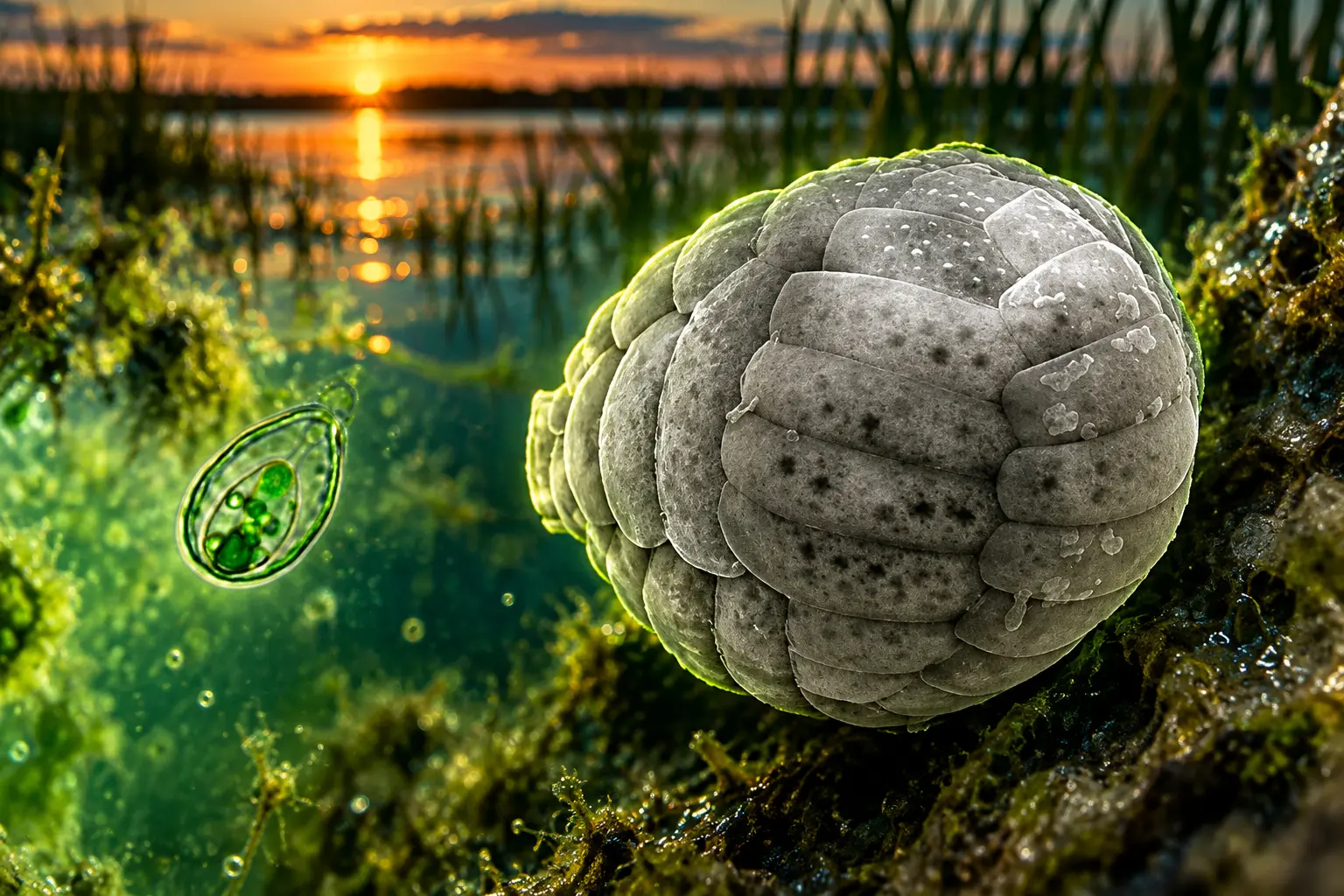
On that Outer Banks trip she carried a hobby-grade $300 microscope and a $198 camera back to a rental house, not a university bench. In the marsh sample she found two cells she had never seen, each about 15 micrometers long. Their silica shells and green sausage-shaped organs put them in photosynthetic Paulinella, and the two forms did not match any named species.
I don’t think that you have to go to the ends of the Earth or to exotic locations to find cool life. I get the most joy out of finding interesting-looking things and interesting-behaving organisms in very ordinary locations.
Julia Van Etten, assistant professor of biology, University of Maryland
Few labs even knew where to collect these amoebae, or how to keep them alive. The vacation sample gave her a site she could revisit. She later named them after family members who were with her and pushed her to sample that marsh.
Follow-Up Work Filled an $80 Motel Room
The first look happened in a rental house. The grinding work happened later in an $80 motel room in Nags Head, close enough to Roanoke Sound that freshly collected water could go under a lens the same day. Andrew C. Willoughby, then a postdoctoral researcher at Duke University, and John A. Burns of Bigelow Laboratory for Ocean Sciences were among the colleagues who joined her. Debashish Bhattacharya, her doctoral advisor at Rutgers University, is a coauthor, with S. Han, D. Lhee, T.G. Stephens, E. Chille, R.S. Sleith and H.S. Yoon.
Photosynthetic Paulinella was so scarce in those samples that the team generally did not find more than one cell in an individual drop. Isolation had to be done by hand, cell by cell, before anyone could score shell shape or send material for genomes and electron microscopy.
THE MOTEL ISOLATION KIT
- Pulled glass: Individual cells were lifted with pulled Pasteur pipettes and ordinary micropipettes.
- Pencil tools: Other picks were made by supergluing toothbrush bristles onto colored pencils.
- Split preps: Chosen cells went into separate setups for culturing, genomic work and scanning electron microscopy.
- Short survival: Some cells lived and divided for up to about a month in filtered ambient water and culture medium; a stable axenic culture did not take.
The kit looks like a joke until you remember the biology. These amoebae crawl, they do not bloom, and a water sample that sits too long is a sample that lost its target. Working in the motel kept the lag between marsh and microscope in hours, not shipping days. The National Science Foundation logged the later write-up under award 2410358.
How Paulinella marae Differs From P. murrayi
Paulinella marae and Paulinella murrayi lived at the same Nags Head site, in brackish water with salinity of about 10 to 14, and they stayed rare there across several years of visits. They still split on shell shape and on how their silica scales overlap and sit.
P. marae has an elongated shell about 15 to 19.1 micrometers long, a measured range for that species rather than the first-look size of both cells. P. murrayi differs in scale arrangement and orientation. NCBI now lists a holotype deposited as CHRB 0145024 for P. marae (taxonomy ID 3701295) and CHRB 0145025 for P. murrayi (3701296), with working names B8128-1 and B8128-2 behind them.
PHOTOSYNTHETIC PAULINELLA NOW ON THE BOOKS
| Species | Named | Setting |
|---|---|---|
| P. chromatophora | 1895 | Freshwater and brackish sediment |
| P. micropora | Established before 2025 | Freshwater |
| P. longichromatophora | 2016 | Marine |
| P. acadia | 2025 | Brackish beach, Spanish Banks, B.C. |
| P. marae | 2026 | Brackish Roanoke Sound, Nags Head, N.C. |
| P. murrayi | 2026 | Same Nags Head site |
The full Journal of Phycology species description appeared on September 4, 2026, under the title “Crawling under the radar: Two novel Paulinella species expand knowledge about the ecology and evolution of a primary plastid-containing amoeba lineage.” That is the count jump from four photosynthetic species to six.
These Amoebae Replay How Plants Got Photosynthesis
Almost every chloroplast on Earth traces to one ancient bargain, in which a host cell kept a cyanobacterium and, over time, turned it into an organ. That event sits about 1.6 billion years back and produced the green plants, red algae and glaucophytes. Later algae such as diatoms got photosynthesis secondhand, by swallowing those already-green cells.
Paulinella did the first kind of deal again. Biologists Luis Macorano and Eva C.M. Nowack described it as the only known repeat of primary endosymbiosis, and they dated chromatophore capture at about 90 to 140 million years ago. The swallowed partner was an α-cyanobacterium from the Synechococcus/Prochlorococcus group, not the line that became plant chloroplasts, so the organ is a separate experiment with the same outcome: a cell that lives on light.
The organ is called a chromatophore. Its genome is still about 1 million base pairs, roughly 5 to 10 times the DNA in a typical plastid, even after it lost about three quarters of its original genes. Proteins now move in from the host nucleus. The cell no longer hunts bacteria the way its non-green cousins do. Because the merger is young in evolutionary terms, researchers can still see steps that are long gone in plants, which is why two extra species from one marsh are not a stamp-collecting exercise.
Van Etten’s own program is built on DNA that jumps species, including the transfers that follow this kind of merger. Maryland wants the new amoebae as working cultures so those transfers can be measured, not only inferred from a wild cell that appeared once in a drop.
A Split Between Nuclear and Organelle Family Trees
The team did not stop at shell photos. They assembled complete chromatophore genomes and mitochondrial data for both new species and found gene content that is largely conserved, with structure that is not. Rearrangements and inversions mark the organelle chromosomes even where the gene list looks familiar.
Family trees built from nuclear DNA did not match trees built from the organelles. The authors point to substitution saturation, thin taxon sampling and mixed signals across loci, which is a polite way of saying the host genome and the captured genome are not telling the same story at the same speed. Extra species in the clade give those tests more branches. Until 2025 the photosynthetic side of the genus was a three-taxon problem; it is now a six-taxon problem, which is still small, and already less blind.
That is the payload the motel story keeps skipping. Adding P. marae and P. murrayi does not only lengthen a list. It adds two more independent records of how a captured cyanobacterium and its host diverge after the merger, including cases where the cell’s own nucleus and its solar organ disagree about relatedness.
Hobby Sightings Point to a Wider Range
The Nags Head cells were rare and still present on repeat visits. The authors fold that local pattern together with records from hobby microscopists and naturalists, and they treat photosynthetic Paulinella as globally distributed yet under-sampled. Low count in a drop is not the same as a tiny global range. It can mean the collecting net is wrong.
A separate group had already shown how easy the miss is. In 2025, researchers described Paulinella acadia from a brackish beach near Vancouver, the fourth photosynthetic species, and noted that it looks like P. chromatophora under a light microscope even though electron microscopy and DNA place it with marine P. longichromatophora. That beach was already a known protist site. The fourth species had been sitting in plain view as the wrong name.
The circulating posts about the North Carolina work sell the $300 microscope and the motel bill. They rarely mention the 2025 beach paper, or the hobby records, or the claim that the map is empty because people have not looked. Cheap optics do not magically create species. They lower the cost of looking in ordinary water, which is where these amoebae actually live.
THE NAGS HEAD RECORD
- May 2021: Van Etten takes a roadside marsh sample on an Outer Banks family trip and finds two unmatched Paulinella cells on a hobby microscope.
- 2021 onward: The group returns to Roanoke Sound in Nags Head and keeps finding both forms at low numbers.
- August 18, 2025: A separate team publishes P. acadia from Spanish Banks, British Columbia, raising the photosynthetic count to four.
- September 4, 2026: The Nags Head species are formally named, moving that count from four to six.
- Summer 2026: Van Etten starts as an assistant professor at Maryland and begins culture attempts plus a hobbyist consortium.
Robert Lauterborn first described P. chromatophora in 1895 from freshwater sediment. More than a century later the photosynthetic side of the genus still fit on one hand, which is the sampling failure the new paper is actually about.
Lab Cultures at Maryland Are Still Uncertain
Van Etten is trying to grow both new species at Maryland. If those cultures hold, the lab can move to genome and transcriptome work on how the chromatophore was built, including DNA that arrived from other organisms. She is also pulling in hobby microscopists and natural historians who have already seen Paulinella in other places, hoping that shared eyes will turn scattered sightings into new, properly named samples.
The published Nags Head material did not yield a lasting axenic line. That earlier failure and the new campus attempt are different runs, not a contradiction. These amoebae divide slowly, they clump, and they do not freeze well, which is why a wild site that reliably produces even one cell per drop is a research asset. The authors flag Roanoke Sound as a place to study Paulinella ecology, population genetics and evolution without waiting for a perfect lab strain.
The marsh is still there, and so is the cheaper path that found it: a portable microscope, fresh water and the patience to search ordinary edges instead of famous field stations. Van Etten is now trying to keep both species alive in Maryland, so the next measurements do not have to start from a single drop of sound water.
Frequently Asked Questions
What Is a Chromatophore in Paulinella?
A chromatophore is the photosynthetic organ that started as a captured cyanobacterium, still wrapped in a peptidoglycan wall and still using phycobilisomes and a carboxysome to handle light and carbon, features most plant chloroplasts lost. Each mature photosynthetic Paulinella cell keeps two of them, and they divide in step with the host, which is part of why biologists treat the structure as an organelle rather than a tenant.
Why Is Paulinella Hard to Grow in the Lab?
Cells double only about every 6 to 7 days, they cannot be cryopreserved, they clump in liquid and they will not grow on nutrient agar, while the nuclear genome of P. chromatophora has been estimated at about 10 billion base pairs and is heavy with repeats. Those traits have blocked the usual genetic tools, so new wild isolates still matter even after a species has a name.
Do Non-Photosynthetic Paulinella Species Still Exist?
Yes. Heterotrophic relatives such as P. ovalis, P. intermedia and P. indentata lack chromatophores and still prey on bacteria, using filose pseudopods through a mouth-like opening in a silica shell. The photosynthetic lineage is the one that gave up that hunting life after the cyanobacterium was kept.
Where Are the Type Specimens for the New Species Held?
NCBI lists the holotype of Paulinella marae as CHRB 0145024 and the holotype of Paulinella murrayi as CHRB 0145025, with the names attributed to J. Van Etten, D. Bhattacharya, J.A. Burns, S. Han and H.S. Yoon, 2026. Those records are the nomenclatural anchors if later workers re-collect the Nags Head forms or synonymize them.

Final Fantasy Resonance Turns a Dead Gacha Into HD-2D

PHP2Shell Forced Sites Offline While Exploits Stalled

Kindle+ Folds AI Audiobooks Into the Page-Read Fund

Chip Stocks Fall as the Bond Rally Cheapens AI Spend

Comcast’s Record Odyssey Quarter Doubles as the Exit

Microsoft 365 Auth Fault Took Down Exchange and Teams

Xbox Caps Game Pass Cloud Gaming at 15 Hours

OpenClaw 2.0 Ships a Team Workplace With Host-Trust Defaults

OpenAI Unveils GPT-6 Astra With a Critical Cyber Label

Diesel Breaks Its Record as the White House Claims Credit
-
 NEWS2 months ago
Microsoft 365 Auth Fault Took Down Exchange and Teams
-
 GAMING2 months ago
Xbox Caps Game Pass Cloud Gaming at 15 Hours
-
 NEWS2 months ago
OpenAI Unveils GPT-6 Astra With a Critical Cyber Label
-
 NEWS2 months ago
OpenClaw 2.0 Ships a Team Workplace With Host-Trust Defaults
-
 BUSINESS2 months ago
Diesel Breaks Its Record as the White House Claims Credit
-

 LIFESTYLE2 months ago
Squishy Dumpling Toys Recalled After Hiding Illegal Water Beads
-

 BUSINESS2 months ago
ChargePoint Stock Rally Prices Wilmer’s Three-Year Cash Plan
-

 AUTO2 months ago
Tesla Puts Its Wheel-Free Cybercab on Austin Streets