
NEWS
Six Gravel Bikes in Squamish Show the Category Has Split
A Squamish field test of six gravel bikes, from an aero racer to a 32-inch Salsa, shows the old one-bike category is already gone.

A Squamish field test of six gravel bikes, priced from a $3,499 frameset to $12,999, shows the category has already split. Host Mike Levy and editors Josh Ross and Logan Jones-Wilkins ran an aero racer, an ultra bike, a drop-bar mountain bike, and a 32-inch Salsa on one British Columbia loop.
They fitted the same 50 mm Schwalbe G-One RX tires at the same pressure. They still were not arguing about the same bicycle.
Six Bikes and No Shared Future
The Velo Field Test premiered on October 8, 2026, as a three-part video series with a later review of each bike. The brief was blunt. Gravel design has moved faster than the word gravel, so the crew brought six progressive machines that barely share a silhouette.
At one pole sits the Argon 18 Anti Matter, an aero race bike with SRAM Red XPLR and 55 mm of tire clearance, listed at $12,999. Next to it is Giant’s Revolt Advanced SL 0, the all-rounder they treated as a control, at $12,000 with 53 mm of claimed room and a tested weight of 7.84 kg in ML. At the other pole is the Pivot Les SL Drop Bar, an XC hardtail with drop bars, SRAM GX Eagle Transmission, and a 100 mm Fox 32 Step-Cast fork, at $6,399.
We assembled 6 gravel bikes that couldn't be more different from each other and put them through the wringer to figure out the future of gravel. 🤝 Check back in to Velo for the 3 part series dropping this month, plus individual reviews for every bike. pic.twitter.com/i6h3KRQ0EO
— Velo (@velovelovelo__) October 8, 2026
Factor’s Sarana is the ultra-distance bet. Obed’s GVR is the progressive race bike, sold as a custom build. Salsa’s Fargo 32 Ti is the 32-inch question, sold as a frameset. Beyond a shared need for 50 mm or more of tire room, the testers said nobody agrees on slack versus steep, aero versus slack mountain geometry, or whether a suspension fork belongs on a drop-bar bike.
THE SIX BIKES ON THE SQUAMISH LOOP
| Bike | Role on test | Claimed clearance | Tested weight | Listed price |
|---|---|---|---|---|
| Giant Revolt Advanced SL 0 | All-rounder | 53 mm | 7.84 kg (ML) | $12,000 |
| Factor Sarana | Ultra endurance | 56 mm | 9.58 kg (M) | $8,499 |
| Argon 18 Anti Matter | Aero race | 55 mm | 8.5 kg (M) | $12,999 |
| Obed GVR | Progressive race | 56 mm | 9.12 kg (M) | $9,075 |
| Pivot Les SL Drop Bar | Drop-bar mountain | 29 x 2.4 in | 9.78 kg (M) | $6,399 |
| Salsa Fargo 32 Ti | 32-inch adventure | 60 mm | 9.48 kg (M) | $3,499 frameset |
Complete bikes in the group run from $6,399 to $12,999, a $6,600 spread, before the Salsa frameset undercuts the lot. The race bikes use SRAM Red or Force XPLR. The Pivot and the Salsa use GX Eagle Transmission, a mountain group. Even the parts bins have split.
The Only Agreement Is 50 mm Tires
The testers treated 50 mm-plus clearance as the last consensus in gravel. Every bike on the trip clears at least that, and most claim more. Giant stops at 53 mm. Argon claims 55 mm. Factor and Obed claim 56 mm. Salsa claims 60 mm. Pivot simply lists a 29 x 2.4 inch mountain tire.
To stop the test turning into a tire test, they mounted 50 mm Schwalbe G-One RX rubber on Easton EC90 ALX wheels and ran one pressure across the fleet. That choice is the honest core of the series. If the frames still ride like different sports on the same tire, the split is in the chassis, the fork, and the wheels, not in the tread.
It also clips the outliers. Pivot’s party trick is a 2.4 inch tire. Salsa designed the Fargo 32 around a 32 x 2.4 inch casing, and the company says the frame cannot run 700c wheels at all. Putting 50 mm rubber on both bikes is fair for a head-to-head. It is also a reminder that the interesting bikes in 2026 are the ones this control setup cannot fully show.
Shops have already felt that squeeze. A 45 mm race bike from a few seasons ago now looks dated next to this group, and a rider shopping “a gravel bike” has to pick a clearance band before picking a color.
Suspension Forks Arrive in 30, 40, and 100 mm
Three of the six bikes bring a squishy fork, and they do not bring the same amount of it. That range is the cleanest proof the category is no longer one product with options. A 30 mm gravel fork and a 100 mm XC fork are not two trims of the same idea.
THE THREE FORK BETS
- Factor, 30 mm: The Sarana is sold with a rigid fork or a RockShox Rudy, and Factor designed 30 mm travel without a geometry change so the bike stays an ultra racer either way.
- Obed, 40 mm: The GVR uses suspension-corrected geometry and is the first North American OEM build around the 40 mm DT Swiss F 132 ONE, with a remote lockout for pavement and chatter.
- Pivot, 100 mm: The Les SL Drop Bar is an XC hardtail with drop bars, so the fork is a Fox 32 Step-Cast with a full 100 mm of mountain travel and room for a 29 x 2.4 inch tire.
Factor built the Sarana with 2025 Unbound XL winner Rob Britton, and it is meant for events measured in days. Industrial designer Mike McGinn put the brief in one line.
We were designing for the way a rider feels on hour twenty, not hour two.
Mike McGinn, Factor industrial designer, on the SARANA
Obed lists a raw medium GVR frame at 886 grams and opened front clearance to a 61 mm tire, with 56 mm at the rear on a 1x setup. Pivot did not start from a gravel drawing at all. It took a lightweight hardtail and put flared bars on it. Salsa’s Fargo 32 can take an 80 mm fork, but on this test it stands for wheel size, not another travel figure.
A rider who wants comfort now has to say how much. Thirty millimetres is a gravel add-on. One hundred millimetres is a mountain bike that happens to have drops.
How Much Difference Do 32-Inch Wheels Make?
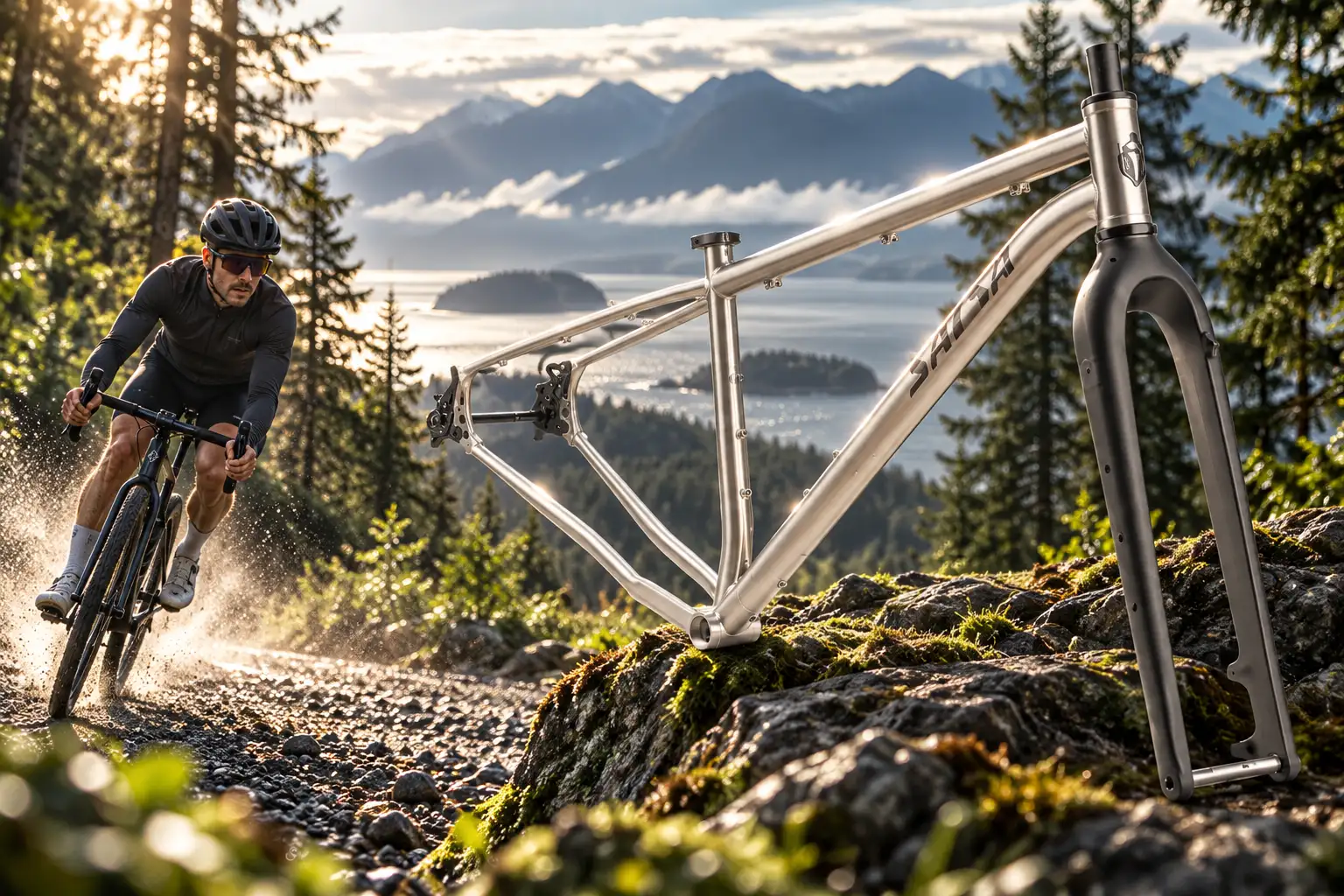
Salsa’s Fargo 32 Ti is the bike in the group that forces a new parts list. The titanium frameset is $3,499, the tested medium weighed 9.48 kg with SRAM GX Eagle Transmission, and the claimed clearance is 60 mm. The geometry is a drop-bar mountain bike’s, not a racer’s: 67 degree head angle, 75 degree seat angle, 106 mm of bottom bracket drop, and 481.9 mm chainstays.
Salsa designed the frame around 32 x 2.4-inch tire clearance. On the geometry chart, that casing measures 818.5 mm in diameter. The company says you cannot put another wheel size in the frame. The small size is aimed at riders down to 5 feet 2 inches, which is the usual knock on 32-inch bikes, that they only fit tall people. The frame, with axles, collar, headset, and uncut steerer, is listed at 6 lb 8 oz.
THE 32-INCH SALSA IN BRIEF
- The product: Fargo 32 Ti frameset at $3,499, carbon fork, UDH Alternator dropouts, 148 mm rear spacing.
- The wheel lock: 32-inch only, with tire sizes from 50 mm to 2.4 inches, no 700c swap.
- The fork option: Rigid carbon at 503 mm axle to crown, or an 80 mm suspension fork.
- The fit: Four sizes, SM to XL, with drop-bar stems of 50 to 70 mm, or flat bars with a longer stem.
Levy kept the 32-inch bike when the trip ended. The Squamish recap is clear that it was not because it won the test. He wanted to keep tinkering. That is a useful tell. The 32er is still a specialist object, and the only big-brand bike in this group, the Giant, stayed on 700c. Small builders and Salsa are carrying the wheel-size bet. Until a Trek or Specialized ships one, shops will treat 32-inch rims and tires as a second inventory, not a new default.
Squamish Mixes Champagne Gravel With Singletrack
They flew the bikes to Squamish because the place can be a mountain-bike town in the morning and a gravel town after lunch. Episode 1 is a mixed loop: smooth “champagne” roads, loamy dirt, rocky singletrack, climbing, and descending. Later episodes add timed climbing, timed descending, and a flat-road efficiency run, plus a long scenic day on one bike before the swap for the ride home.
That sequence matters more than the scenery. A mixed first loop is how you find out whether an aero bike still makes sense when the group is underbiking on singletrack, and whether a 100 mm hardtail still feels like a tax on smooth gravel. The timed stages, which had not run in public as of the October 8 premiere, are how you stop the argument being only vibes.
THE FIELD TEST CALENDAR
- Summer 2026: The crew rides the six bikes in Squamish, including a long scenic day and the mixed loop that becomes episode 1.
- August 19, 2026: Josh Ross publishes the Squamish recap and says Levy has already kept the 32-inch Salsa.
- October 6, 2026: The series account teases episode 1 for that Thursday.
- October 8, 2026: Episode 1 lands, with episode 2 slated for the following week and the rest of the three-part run due in October, plus individual bike reviews.
Endura supplied kits and helmets. Schwalbe supplied the control tires. Easton supplied the control wheels. Bici in Squamish handled shop support. The test is built to isolate frames, geometry, and forks. It is not a shootout of stock wheelsets.
A Roadie, a Racer, and a Converted Mountain Biker
The bikes were chosen to disagree. So were the riders. Josh Ross came in as the long-distance roadie who still wants speed when the pavement ends, the person who will ride through a Pacific Northwest night if the route asks. Logan Jones-Wilkins finished 18th overall at the Unbound 200 and looks at gravel as a race problem first, then as a way into country he has not seen. Mike Levy is the converted mountain biker who now lives on drop bars and wants chunky roads, technical lines, and routes that leave the fire road.
Ross wrote after the trip that the future is more than one bike and more than one point of view. That line is the series in miniature. A Midwest efficiency rider, an Unbound racer, and a technical descender can share a parking lot and still be shopping in different aisles.
The future of gravel is not only more than one bike, but it’s also more than one point of view, and that is exactly what we bring to the table as a well-rounded team.
Josh Ross, senior tech editor, Squamish recap, August 19, 2026
They argued about what “progressive race bike” even means, then argued about which bike belonged in which bucket. That is not behind-the-scenes fluff. If three full-time testers cannot sort the field without a fight, a shop floor with one “gravel” hangtag is already lying a little.
Buyers Now Have to Choose a Lane
The practical cost of this split sits on riders and shops, not on YouTube. A store that once stocked two gravel sizes now needs an aero racer, a 50 mm-plus all-rounder, a short-travel fork bike, a drop-bar hardtail, and, if it believes Salsa, a 32-inch wheel and tire program that cannot borrow 700c stock. SRAM XPLR and Eagle Transmission are both “1x,” and they are not the same box on the wall.
The upside is real. A 200-mile racer can buy the Argon or the Giant and stop pretending a slack bikepacking frame is a race bike. An ultra rider can spec the Sarana with a 30 mm fork and in-frame storage and stop borrowing from mountain bikes. Someone who actually rides singletrack on drops can buy the Pivot instead of underbiking a 45 mm racer until the rim hits a rock. The 32-inch Salsa is for people who want rollover and cargo mounts more than a start-line weight.
The downside is the old promise, that one gravel bike does Unbound, the commute, and a weekend in the woods. That bike is still for sale, and the Revolt is in this test to represent it. It is no longer the whole category. It is one lane with five others painted beside it.
The series schedule puts episode 2 in the week after the October 8 premiere, with timed climbing, descending, and a flat-road efficiency test still to come. Those stages will rank the bikes on Squamish dirt. They will not put six futures back into one product.

Final Fantasy Resonance Turns a Dead Gacha Into HD-2D

PHP2Shell Forced Sites Offline While Exploits Stalled

Kindle+ Folds AI Audiobooks Into the Page-Read Fund

Chip Stocks Fall as the Bond Rally Cheapens AI Spend

Comcast’s Record Odyssey Quarter Doubles as the Exit

Microsoft 365 Auth Fault Took Down Exchange and Teams

Xbox Caps Game Pass Cloud Gaming at 15 Hours

OpenClaw 2.0 Ships a Team Workplace With Host-Trust Defaults

OpenAI Unveils GPT-6 Astra With a Critical Cyber Label

Diesel Breaks Its Record as the White House Claims Credit
-
 NEWS2 months ago
Microsoft 365 Auth Fault Took Down Exchange and Teams
-
 GAMING2 months ago
Xbox Caps Game Pass Cloud Gaming at 15 Hours
-
 NEWS2 months ago
OpenAI Unveils GPT-6 Astra With a Critical Cyber Label
-
 NEWS2 months ago
OpenClaw 2.0 Ships a Team Workplace With Host-Trust Defaults
-
 BUSINESS2 months ago
Diesel Breaks Its Record as the White House Claims Credit
-

 LIFESTYLE2 months ago
Squishy Dumpling Toys Recalled After Hiding Illegal Water Beads
-

 BUSINESS2 months ago
ChargePoint Stock Rally Prices Wilmer’s Three-Year Cash Plan
-

 AUTO2 months ago
Tesla Puts Its Wheel-Free Cybercab on Austin Streets