
GAMING
The Disc That Made PlayStation Is Now a Mentality Issue
Ken Kutaragi built PlayStation on CD-ROMs, then called the fight to keep discs a mentality issue as Sony ends new physical games in January 2028.

Ken Kutaragi called the backlash to killing PlayStation discs a mentality issue. He is 76, left Sony in 2007, and still talks like the engineer who once forced a CD-ROM console through a hostile board.
He said it at Game Republic New Horizons in Middlesbrough, while Sony’s own calendar still ends new physical games in January 2028. The sting is older than that date. PlayStation’s first hit ran on the same shiny discs he now treats as optional.
PlayStation Was a Compact Disc Project
Sony’s company history is blunt about why the first PlayStation worked. Nintendo cartridges took months to restock once a hit sold out. Compact discs did not.
In early 1990 Sony and Nintendo signed a deal for a Super NES CD-ROM machine, tentatively named the PlayStation. The partnership collapsed. Kutaragi kept a secret 3D graphics project alive anyway. At a 1992 management meeting, Sony president Norio Ohga slammed the table and told him, in English, “Do it!”
HOW THE DISC CONSOLE GOT BUILT
- Early 1990: Sony and Nintendo finalize a contract on a Super NES CD-ROM console, tentatively named the PlayStation.
- 1992: Ohga green-lights Kutaragi’s independent CD-ROM machine after the Nintendo deal dies.
- October 27, 1993: Sony and Sony Music announce Sony Computer Entertainment, to launch in November.
- November 16, 1993: SCE is founded, with Kutaragi as a director.
- December 3, 1994: The PlayStation goes on sale in Japan at 39,800 yen.
The first 100,000 units went quickly. A million sold within half a year. By the end of November 1996 the hardware had reached 10 million, a company record at the time. Shigeo Maruyama’s music group already pressed CDs, so a game order could be filled in a maximum of six days, the same turnaround as a music disc, even in small lots.
SCE president Norio Ozawa put the bet in writing at the founding: just as the CD had changed the music market, PlayStation would change games. The cheap, fast disc was the product. It was also the distribution system.
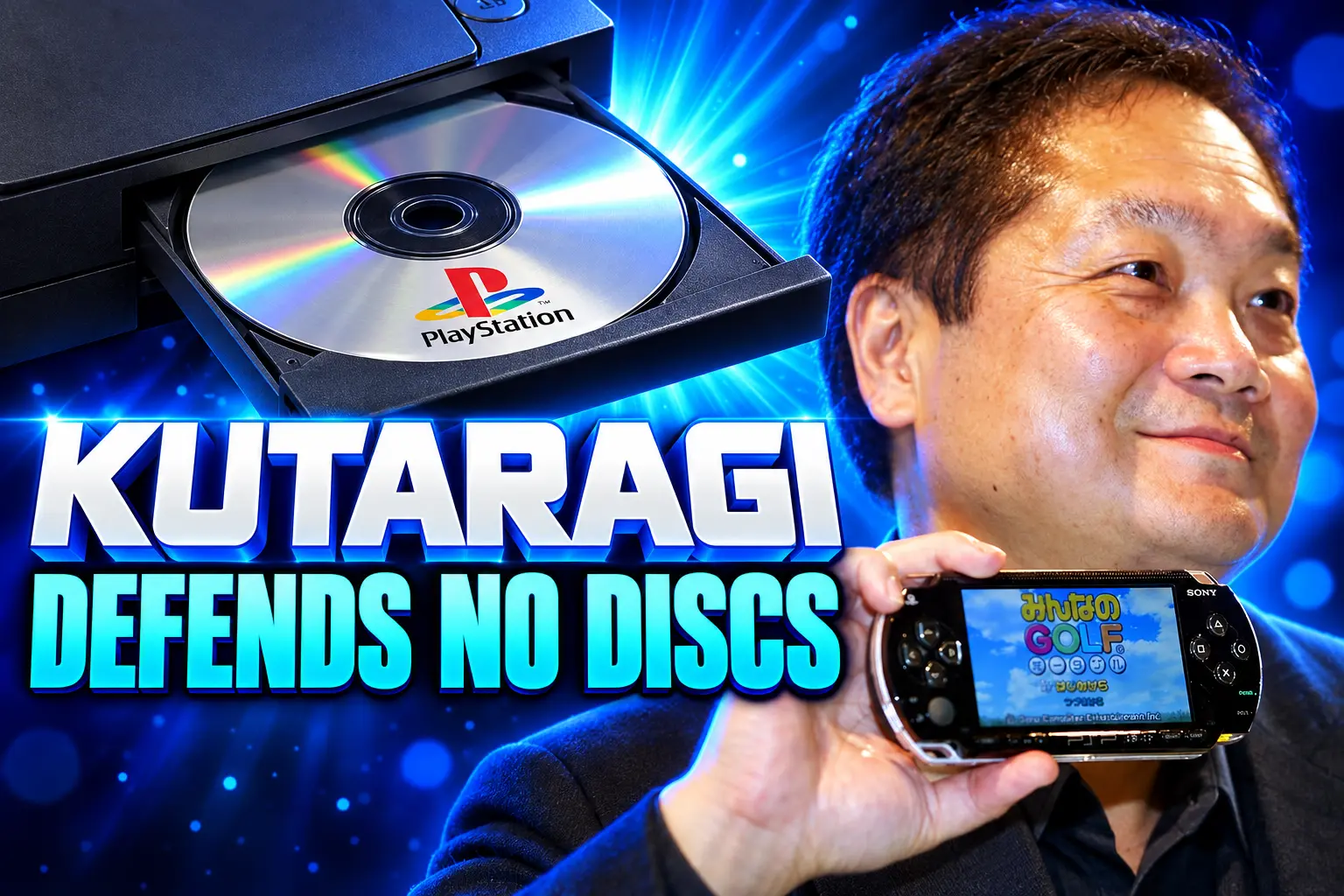
Kutaragi Still Calls Disc Loyalty a Mentality Issue
That is the man now telling players the plastic is a feeling. He oversaw the first three PlayStation consoles, then left in 2007. He runs Ascent Robotics and Cyber AI Entertainment, and he has been saying for years that networks would swallow the box.
In Middlesbrough he granted the emotional case and then waved it off. Network features existed on PS2 and PS3, he said, but they were not common. They are common now.
I understand that physical discs have become a metaphor for ‘owning’ games. I really understand that mentality… But nobody thinks [physical media] is necessary for a networked device like a smartphone, for example, because people feel that they will keep their content. So it’s a mentality.
I really understand [why some people are upset], but I don’t think it’s economically reasonable. Maybe it’s a mentality issue.
Ken Kutaragi, former Sony Interactive Entertainment chairman and group CEO, Game Republic New Horizons, Middlesbrough
The smartphone line only holds if the store behaves like a phone locker. Game consoles have a worse record. Publishers sell a license, then delist a title, close a server, or freeze an account, and the file you paid for stops being yours.
Kutaragi is not wrong about factory math. Pressing, boxing, shipping, and running a second SKU costs money the download does not. He is wrong if he thinks that cost gap settles the ownership question he named and then dismissed.
January 2028 Ends New PlayStation Discs
Sony already wrote the cutoff. Sid Shuman, senior director of content communications at Sony Interactive Entertainment, posted the rule on July 1, 2026. Physical disc production for all new games on PlayStation consoles will be discontinued starting January 2028.
WHAT THE CUTOFF DOES
- New games: After January 2028 they sell on PlayStation Store and at retailers in digital formats only.
- Older discs: Games already out, or due on disc before that month, stay untouched by the factory change.
- Retail: Shops can still sell new titles, just without a pressed disc in the box.
- Sony’s reason: The post calls this a natural direction because digital preference “significantly outpaces” discs.
That last clause is the whole public case. Sony did not publish a cost-per-disc figure in the post. It did not say the laser assembly is too expensive to keep in the next machine. It said taste had moved, so the pressings would follow.
Players who still buy a case are not confused about lasers. They are buying a copy that does not vanish when a storefront listing does.
Streaming Hires Recast the Box as a Terminal
Kutaragi aimed the next remark at the people inside Sony Interactive Entertainment, not at the fans. He is not CEO, he said, but he still shares some views with the current shop. Many staff came from outside, “like from Gaikai or streaming companies.”
Those hires, in his telling, look at a connected PlayStation and see a content terminal. A terminal is a pipe. A console, for the people who grew up on his hardware, is a box that runs a disc you put in it. He said that gap has caused friction with game enthusiasts.
He also placed himself on the network side of the argument. When PlayStation 2 shipped, people asked what came next, and he said merging with the network. “That’s what’s happening right now.” The disc fight is a lagging chapter of a shift he wanted in the early 2000s.
A terminal that streams other people’s catalogues does not need a tray. It also does not need to promise that a 70-dollar file will still boot in 2032. That is the trade hiding under mentality.
What a Disc Still Does That a License Does Not
The plastic is not the point. The rights attached to the plastic are. A disc you already own still plays if Sony locks the account that bought a matching digital copy. You can lend it. You can sell it. You can leave it to a sibling. A store license usually dies with the login, the listing, or the server.
Digital storefronts can be decent when the seller treats a purchase as durable. Steam gets cited for that reason, not because a download feels romantic. PlayStation’s store can freeze a library, and a live-service title can go dark when the company is done with it. The smartphone comparison skips that part.
DISC VERSUS STORE LICENSE
| What you can do | Physical disc | Typical store license |
|---|---|---|
| Play after an account ban | Yes, if the disc is complete | Usually no |
| Lend or sell the copy | Yes | No |
| Keep a single-player game after delisting | Yes, on the disc | Only if the download remains authorized |
| Keep playing after servers die | If the game runs on-disc | Often no, unless an offline mode exists |
Kutaragi called the disc a metaphor for owning games. The table is why the metaphor stuck. Ownership, in the cartridge and CD years, meant the copy in the house still worked after the publisher moved on. A license that can be pulled is a rental with a purchase button.
The Bronx Bill Wants the Old Ownership Deal
On October 15, 2026, Rep. Ritchie Torres of New York’s 15th District said he will introduce the Power To The Players Act. The bill would tell the Federal Trade Commission to write rules so that paying for a game grants ownership, not a revocable license. Games with online features would have to ship an offline mode before those servers go dark. The text also aims to preserve the ability to resell.
Torres pointed at NBA 2K25. The standard edition retailed for $69.99 and the All-Star Edition for $99.99. His office says the game will be delisted from digital storefronts on October 30, 2026, with online servers shutting down on December 31, 2026, which he described as only two years after release.
When you pay for a game, you should own it. Consumers must have the right to own, play, and transfer the games they buy. A game that can be taken away the moment a company pulls the plug is not a purchase. It is a rental disguised as a sale.
Rep. Ritchie Torres, NY-15, announcing the Power To The Players Act
He wants players to own, play, and transfer games they already paid for. The bill has been announced, not passed, and it covers games rather than films or music. It is still the first serious attempt in Congress to write the disc-era bargain into a digital rulebook, at the same moment Sony is retiring the disc for new releases.
Families in the Bronx, Torres said, save up for these games and deserve better than a license that can vanish. That sentence sits one day away from Kutaragi’s mentality line. One man is describing a feeling. The other is describing a receipt.
PCs Now Cost as Much as a Car
Kutaragi’s deeper worry in Middlesbrough was the price of the machine, not the tray. Hardware is “super expensive,” he said, and that is not a healthy situation. Architecture has drifted from consoles toward PC designs that were supposed to be easier to build, “but right now PCs are so expensive. It’s the price of a car!”
Makers, he said, need elegant solutions. If firms use AI and cloud computing well enough, “we won’t need any console.” Then he added the disclaimer that this is not an official comment from Sony Computer Entertainment, the old name he still used for the company he left.
That is the road the disc decision is on. First the pressing plant stops for new games in January 2028. Then the box becomes a pipe for whatever the store, the cloud, and the account still permit. Kutaragi helped invent the cheap disc that let Sony outrun cartridges. He now wants players to treat the loss of that copy as a habit they should drop, while a House bill tries to put the old deal back on paper.

Final Fantasy Resonance Turns a Dead Gacha Into HD-2D

PHP2Shell Forced Sites Offline While Exploits Stalled

Kindle+ Folds AI Audiobooks Into the Page-Read Fund

Chip Stocks Fall as the Bond Rally Cheapens AI Spend

Comcast’s Record Odyssey Quarter Doubles as the Exit

Microsoft 365 Auth Fault Took Down Exchange and Teams

Xbox Caps Game Pass Cloud Gaming at 15 Hours

OpenClaw 2.0 Ships a Team Workplace With Host-Trust Defaults

OpenAI Unveils GPT-6 Astra With a Critical Cyber Label

Diesel Breaks Its Record as the White House Claims Credit
-
 NEWS2 months ago
Microsoft 365 Auth Fault Took Down Exchange and Teams
-
 GAMING2 months ago
Xbox Caps Game Pass Cloud Gaming at 15 Hours
-
 NEWS2 months ago
OpenAI Unveils GPT-6 Astra With a Critical Cyber Label
-
 NEWS2 months ago
OpenClaw 2.0 Ships a Team Workplace With Host-Trust Defaults
-
 BUSINESS2 months ago
Diesel Breaks Its Record as the White House Claims Credit
-

 LIFESTYLE2 months ago
Squishy Dumpling Toys Recalled After Hiding Illegal Water Beads
-

 BUSINESS2 months ago
ChargePoint Stock Rally Prices Wilmer’s Three-Year Cash Plan
-

 AUTO2 months ago
Tesla Puts Its Wheel-Free Cybercab on Austin Streets