
AUTO
GM Bets Eyes-Off Driving on the Trucks It Sells
GM will put eyes-off highway driving on trucks after Super Cruise, using one central computer and OnStar AI, while software deferred revenue approaches $7.5 billion.

General Motors said on October 21, 2026, that eyes-off highway driving will start on the 2028 Cadillac Escalade IQ and then move into the pickup trucks that already carry Super Cruise. Chair and CEO Mary Barra, President Mark Reuss, and Chief Product Officer Sterling Anderson laid that out at the second GM Forward event in New York.
A day earlier, Barra told shareholders the company is on track to approach $7.5 billion in deferred software revenue from OnStar and Super Cruise for full-year 2026. The show in New York was a plan for how that book grows, not a new company.
Super Cruise Already Prints the Software Money
Super Cruise, GM’s hands-free highway system, went on sale in 2017. By late September 2026 the company said customers had logged more than 1.2 billion hands-free miles on it, more than a million miles a day, with nearly 70 percent of those owners using it at least once a month.
OnStar, the 1996 crash-button service that now carries Super Cruise, counts over 12 million subscribers across 22 markets. GM says roughly 1 million vehicles will have Super Cruise by the end of 2026.
The October 20 letter is blunter about where the next jump comes from. Trucks will drive Super Cruise adoption in 2027, Barra wrote, because the system becomes standard on high-end Chevrolet Silverado and GMC Sierra trims and optional on most others. She said GM expects Super Cruise penetration in the truck portfolio to grow 4-5x next year.
SUPER CRUISE AND ONSTAR AT GM SCALE
| Measure | GM figure |
|---|---|
| Hands-free Super Cruise miles | More than 1.2 billion |
| Hands-free miles per day | More than 1 million |
| Share of owners who use it monthly | Nearly 70% |
| Super Cruise vehicles by end of 2026 | Roughly 1 million |
| OnStar subscribers | Over 12 million in 22 markets |
| Advisor calls in North America per year | More than 20 million |
| Emergency and stolen-vehicle calls in 2025 | More than 675,000 |
| Software and services deferred revenue, 2026 | On track to approach $7.5 billion |
| Truck Super Cruise penetration, 2027 | Expected to grow 4-5x |
That is already a paid highway product with a truck plan attached. Eyes-off driving is the next SKU on the same customers, if GM can certify it.
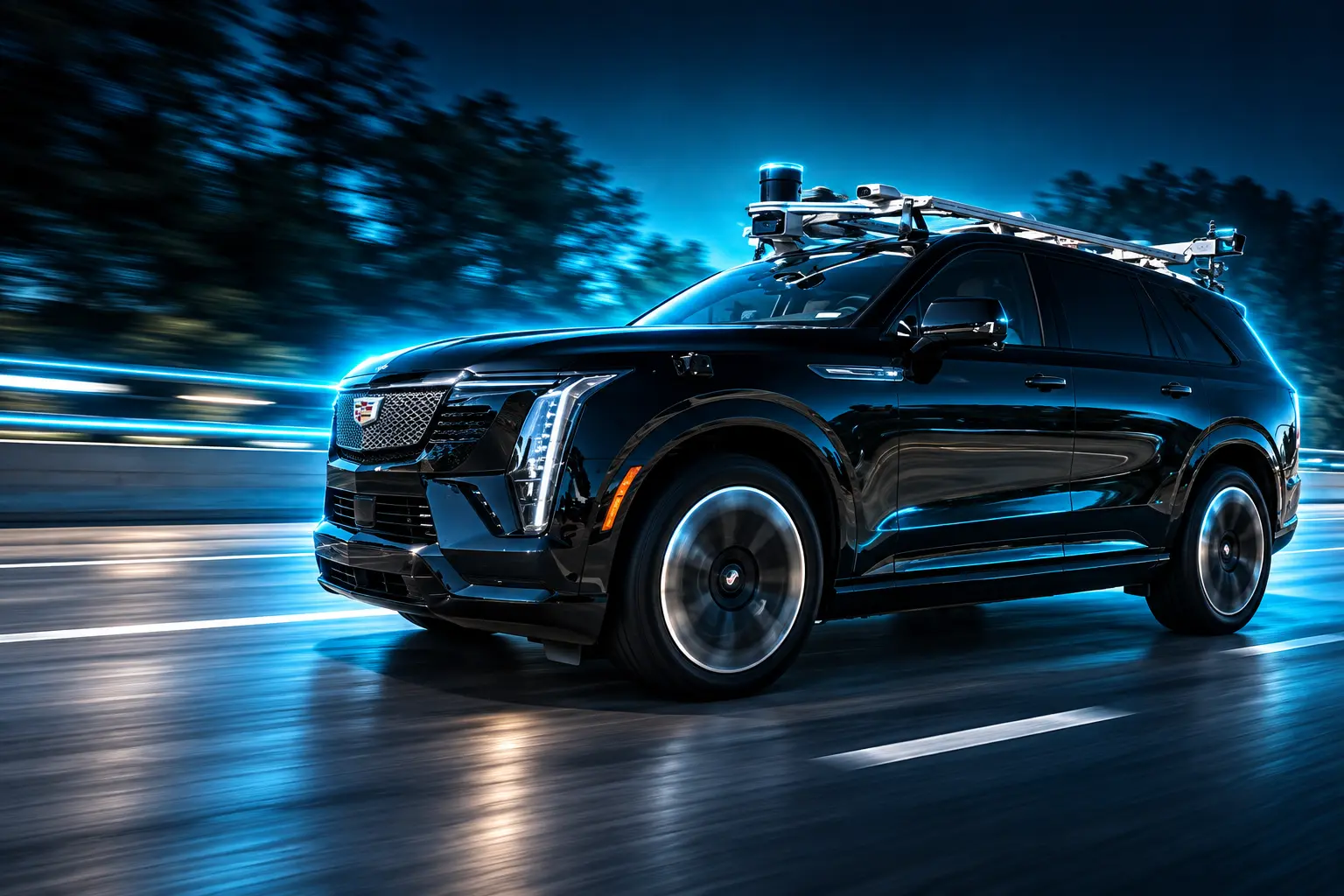
What GM Put on the Table in New York
Anderson told the room that AI is already inside GM’s development loop. Vehicle programs that ran on a traditional five-year clock are supposed to be cut in half. Aerodynamics work that took 60 hours can now take 60 seconds, he said, and structural analysis that used to take months can now take hours.
“You can imagine what that does for iteration speed,” Anderson said. He also argued that GM’s old data pile is the point. “The size and scale of GM with its data isn’t an anchor, it’s an advantage. Decades of data and experience. Smaller players can build models, but can’t match GM’s data.”
Asked whether those savings will show up as cheaper cars, Barra did not answer directly. She noted that GM already sells a wide lineup of vehicles for $30,000 or less at a profit.
The autonomy half of the pitch is a pivot, not a debut. GM spent more than $10 billion on Cruise, its robotaxi unit, then stopped funding that work in December 2024 and bought the remaining Cruise interests in February 2025. Barra has been plain about the change in job description.
We’re not in the taxi business. We’re not in the bus business. About not continuing with Cruise, we looked at the capital that we were going to need. It was the right decision. We think we’re going to be well-positioned from a personal autonomy perspective.
Mary Barra, Chair and CEO, on Mad Money
Cruise’s stack did not go in the trash. GM has said the unit logged more than 5 million driverless miles, and in March 2026 it began supervised public-road testing of the next highway system in California and Michigan. Anderson said the same system will land in light-duty pickups and crossovers after the Escalade IQ, starting on highways and then expanding off them.
FROM ROBOTAXI WRITE-OFF TO CABIN FEATURE
- 1996: OnStar launches as embedded crash notification and a live advisor link.
- 2017: Super Cruise goes on sale as hands-free, eyes-on highway assist.
- December 2024: GM ends funding for Cruise robotaxi development after spending more than $10 billion.
- February 2025: GM buys the remaining Cruise interests and folds the technical work into personal-vehicle programs.
- March 2026: Supervised public-road testing of the next highway system begins in California and Michigan.
- October 20, 2026: Barra’s shareholder letter puts software deferred revenue on a $7.5 billion path and flags a 4-5x Super Cruise jump on trucks.
- October 21, 2026: GM Forward in New York ties eyes-off driving, OnStar AI, and a new central computer to that truck plan.
- 2027: OnStar AI is due on the Cadillac Lyriq; Super Cruise is due as standard on high-end Silverado and Sierra trims.
- 2028: The Escalade IQ is due to debut eyes-off highway driving and the new compute stack.
Tesla drivers who already use supervised highway systems treat 2028 as a late date. That complaint misses the buyer GM is actually aiming at. A Silverado owner who will pay for highway eyes-off is a different sale from a robotaxi seat, and GM has already chosen the first one.
One Brain and Three Silent Hubs
The hardware story is easy to oversell as a single magic box. GM’s own description is a liquid-cooled central compute unit, using processors such as NVIDIA Thor, tied to three aggregators that act as zone hubs. The aggregators move signals and commands and run no control logic. Sensor fusion, arbitration, and machine-learning inference sit on the Thor-powered core.
NVIDIA lists more than 1,000 INT8 TOPS of AI compute on DRIVE AGX Thor, plus 2,000 FP4 TFLOPs, as a platform meant to cover assisted driving through full autonomy. GM says the 2026 architecture consolidates dozens of electronic control units into that unified core, on a high-speed Ethernet backbone, for both gas and electric vehicles.
More than 4.5 million GM vehicles can already take over-the-air system updates, a base the company says grows by about 2 million a year. Last year, 1.6 million vehicles got coordinated software updates. The new stack is supposed to raise that capacity by 10 times and bandwidth by 1,000 times.
WHAT THE 2028 ELECTRICAL STACK CHANGES
- The core: A liquid-cooled central compute unit runs the vehicle’s control logic on processors such as NVIDIA Thor.
- The hubs: Three aggregators translate sensor and actuator traffic and execute zero control logic.
- The wiring: GM says the fourth-generation EV platform uses 30% less wiring than today’s EVs.
- The headroom: The same platform is rated at 40 times more processing power for AI features.
- The update path: GM says the design supports 10 times more software updates and 1,000 times more bandwidth than its prior system.
- The mix: The architecture is built to run on electric and gas vehicles, so a Cadillac feature can move onto a Sierra without a second electrical system.
That last line is the industrial point. A stack that only works on a $120,000 electric SUV is a press photo. A stack that also works on the gas trucks GM already builds in huge numbers is how Super Cruise becomes a company-wide software product.
Why GM Will Not Call It Level 3
Super Cruise today is eyes-on. The driver can take hands off the wheel on mapped highways and still has to watch the road. The 2028 system is supposed to let the driver look away on the highway, read, send messages, or watch a movie, with turquoise light across the dash and exterior mirrors as the cue that the car is in control.
GM says the system will use lidar, radar, and cameras, and that it will work on highways the company has not mapped. Human takeover, in the company’s telling, is for exits and similar edge cases, not for sudden incidents. Anderson refused the SAE badge that usually attaches to that description.
“We’re not developing L3 autonomy. We’re developing a system that can operate safely without continuous supervision,” he said at GM Forward. “L3 was a convenient plug that made SAE’s levels of autonomy look like a continuous spectrum. They are not. There is this middle ground that is a kind of awkward, uncanny valley. We will not pass through that valley.”
The legal paper does not care about that speech. Michigan, GM’s home state, bans holding or using a phone while driving, then carves an exception for Level 3, 4 or 5 systems when the automated driving system is engaged, using SAE J3016. GM’s own 2025 product note on eyes-off driving already carried a six-word footnote: availability and permissible use by state. Anderson will not call the system Level 3. The statute that lets an Escalade IQ owner answer a text in Michigan turns on that label.
WHERE THE LEVEL FIGHT SITS
- Anderson’s line: GM is building a system that can run without continuous supervision and will not certify it as SAE Level 3, which he calls an uncanny valley of handback risk.
- The statute’s line: Michigan’s phone ban lifts for a Level 3, 4 or 5 automated driving system, or a vehicle equipped with one, only while that system is engaged.
WHAT WE KNOW
- First vehicle: Eyes-off highway driving is scheduled for the 2028 Cadillac Escalade IQ, then light-duty pickups, full-size SUVs, and crossovers, gas and electric.
- Sensors: Lidar, radar, and cameras, with redundant steering, braking, and 12-volt power described by GM engineers on the test vehicles.
- The cue: Turquoise lighting on the dashboard and exterior mirrors is the signal that the system is in control.
WHAT IS UNCONFIRMED
- Price: GM has not said whether eyes-off driving will be standard, optional, or a Super Cruise-style subscription.
- The SAE sticker: The company has not said which SAE level it will certify, and Anderson has said it will not be Level 3.
- State use: Permissible phone and screen use will vary by state, and GM has not published a state-by-state list.
Mercedes already sells an eyes-off highway system in the United States, limited to certain mapped roads in California and Nevada and to low-speed traffic. GM is trying to clear a wider highway domain. Until a regulator, an insurer, and a state police handbook agree on the label, the turquoise light is a product cue, not a legal one.
The Blue Button Becomes an AI Assistant
Owners will not wait until 2028 to meet the software company GM is describing. A new in-vehicle OnStar AI assistant is due later in 2026 on the 2027 Cadillac Lyriq, then on a wider mix of gas and electric models. Drivers are supposed to say “Hey OnStar” and ask what an earlier warning chime meant, or tell the car to start and warm up 15 minutes before a calendar alert.
GM says it is coding the assistant against real vehicle systems, not a generic chatbot bolted onto the screen. Live advisors stay. OnStar still runs more than 20 million North American calls a year, including roadside, theft, medical, and weather events. The human channel is the inheritance. The AI layer is the upsell.
A single OnStar phone app is due in 2027 to replace the separate Chevrolet, Cadillac, Buick, and GMC apps. One login is supposed to cover every GM vehicle in a household, with permissioned tracking of cars and people, including Find My on iPhone. That is how a 30-year emergency brand becomes the account that owns the relationship, whichever badge is on the grille.
GM has already put Google Gemini into in-car conversation tools. The 2026 assistant is branded OnStar anyway. The name on the wake word is the product strategy. The model behind it can change.
LMR Cells Aim at Range Without a Bigger Pack
The fourth-generation EV platform sits further out than OnStar AI, and GM still will not put an on-sale year on it. What it will put on paper is chemistry, parts, and a shorter development clock.
The pack is lithium manganese-rich prismatic cells from Ultium Cells, the GM joint venture with LG Energy Solution, in Spring Hill, Tennessee. LMR is designed for 33% more energy density than lithium iron phosphate at a comparable cost, which GM does not use in its current EVs. Combined with new drive units and aerodynamics, the company says the platform should deliver about 20% more range on every kilowatt-hour.
GM simulated more than 300,000 battery designs before building a physical prototype, then moved from first pack concept to formal program approval in one month. A new family of motors and power electronics cuts the parts inside each drive unit by 40%. On the factory side, GM says its battery-pack lines already move packs through 30% faster with the same digital tools, and that a vehicle on the new electrical architecture can test its own connections as it rolls down the line.
The development claim is the same “better-faster” loop Anderson described for the whole company: concurrent design instead of a relay race, and a traditional five-year vehicle program cut in half. Chinese makers already work on shorter clocks. GM is now saying the quiet part in a New York ballroom. Saying it is not the same as stamping a Silverado EV on that clock.
Eyes-off driving, the central computer, and OnStar AI all have dates owners can circle. The fourth-generation EVs do not. They are the cost-cut that is supposed to make the electric half of this stack cheap enough for the same high-volume segments the gas trucks already occupy.
The Escalade IQ in 2028 is the first cabin where GM wants you to look away. The letter on October 20 already told shareholders who pays for the rest of the lineup.

Final Fantasy Resonance Turns a Dead Gacha Into HD-2D

PHP2Shell Forced Sites Offline While Exploits Stalled

Kindle+ Folds AI Audiobooks Into the Page-Read Fund

Chip Stocks Fall as the Bond Rally Cheapens AI Spend

Comcast’s Record Odyssey Quarter Doubles as the Exit

Microsoft 365 Auth Fault Took Down Exchange and Teams

Xbox Caps Game Pass Cloud Gaming at 15 Hours

OpenClaw 2.0 Ships a Team Workplace With Host-Trust Defaults

OpenAI Unveils GPT-6 Astra With a Critical Cyber Label

Diesel Breaks Its Record as the White House Claims Credit
-
 NEWS2 months ago
Microsoft 365 Auth Fault Took Down Exchange and Teams
-
 GAMING2 months ago
Xbox Caps Game Pass Cloud Gaming at 15 Hours
-
 NEWS2 months ago
OpenAI Unveils GPT-6 Astra With a Critical Cyber Label
-
 NEWS2 months ago
OpenClaw 2.0 Ships a Team Workplace With Host-Trust Defaults
-
 BUSINESS2 months ago
Diesel Breaks Its Record as the White House Claims Credit
-

 LIFESTYLE2 months ago
Squishy Dumpling Toys Recalled After Hiding Illegal Water Beads
-

 BUSINESS2 months ago
ChargePoint Stock Rally Prices Wilmer’s Three-Year Cash Plan
-

 AUTO2 months ago
Tesla Puts Its Wheel-Free Cybercab on Austin Streets