
GAMING
Final Fantasy Resonance Turns a Dead Gacha Into HD-2D
Final Fantasy Resonance is out at $49.99 as the first HD-2D Final Fantasy, a rebuilt Brave Exvius story with 26 Visions and no gacha pulls.

Final Fantasy Resonance launched on October 22, 2026, as the first HD-2D game in the Final Fantasy series. Square Enix put it on PlayStation 5, Nintendo Switch 2, Nintendo Switch, Xbox Series X|S, and PC the same day.
The new boxed RPG is a rebuild of Final Fantasy Brave Exvius, a mobile gacha that opened in 2015 and went dark in 2025. Square Enix is selling that afterlife as a return to crystals, chocobos, and turn order, at the Standard Edition for $49.99.
Square Enix Rebuilt a Dead Mobile Game
Square Enix’s London press hub said the game launched on all major platforms, with a free demo whose save carries over everywhere. Lancarse is the co-developer. Xbox Play Anywhere covers Series X|S and Xbox on PC, so one purchase covers both of those stores.
The pitch on the official Resonance product page asks what Final Fantasy would look like if pixel art had kept moving. That line is doing a lot of work. Resonance is also what a ten-year phone game looks like after the servers die and the combat is written again for a single payment.
Square Enix already ran this playbook once, turning Octopath Traveler: Champions of the Continent into Octopath Traveler 0. Resonance is the flagship-brand version of the same move: keep the story world, throw out the gacha loop, ship it as a premium RPG. Producer Keisuke Nakashima was an assistant producer on Brave Exvius. He has said for years that people called the mobile game interesting and then skipped it because it lived on a phone.
Personally, FINAL FANTASY BRAVE EXVIUS meant a lot to me because I worked on the title as an Assistant Producer. Back then, I remember hearing comments like, “FINAL FANTASY BRAVE EXVIUS looks interesting but it’s a mobile game, so I won’t play it,” and honestly, I always found that frustrating.
Keisuke Nakashima, producer
The launch trailer Square Enix posted with the press note is the version of that argument made of camera moves and pixel dust.
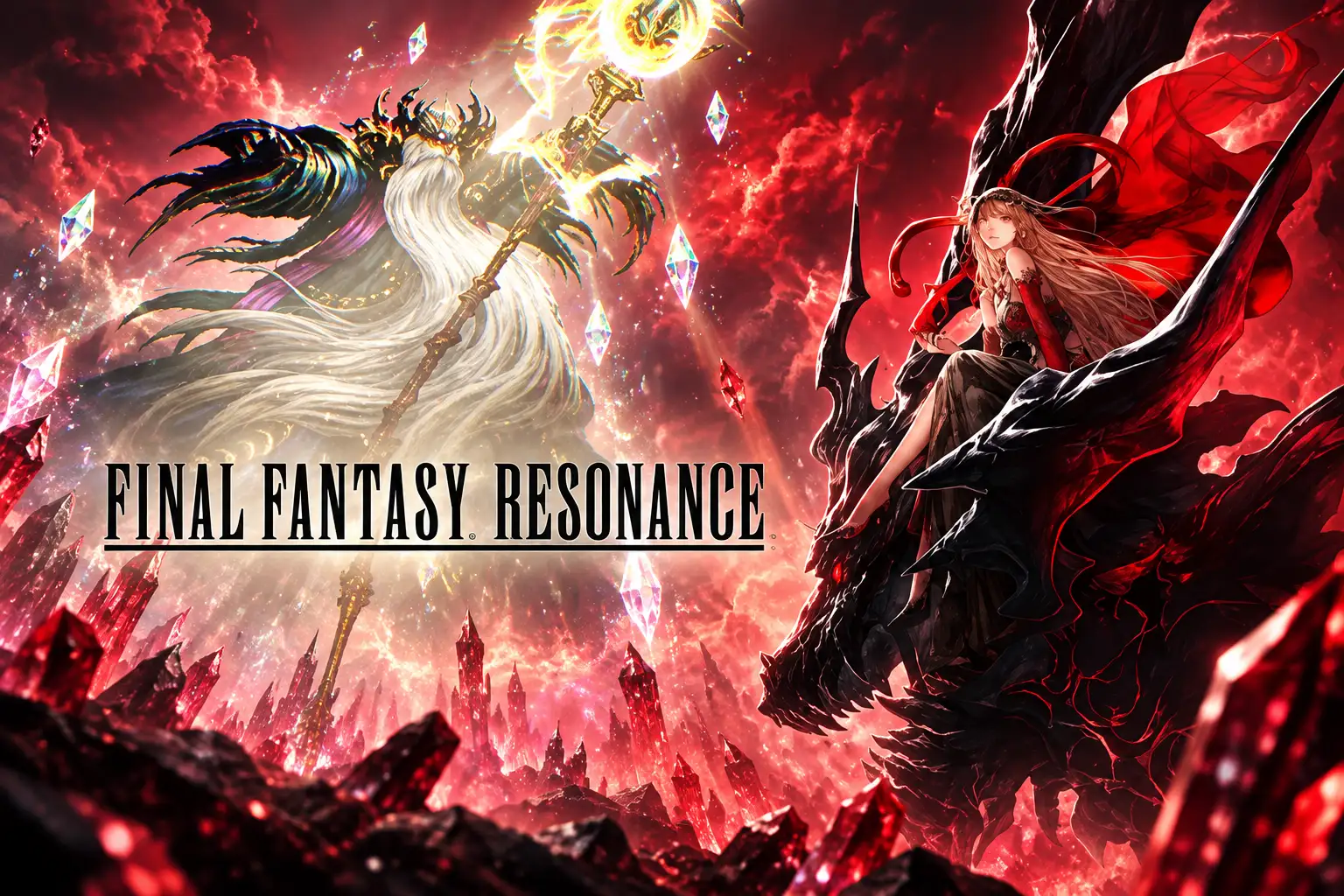
An Anniversary Hidden in the Launch Date
Brave Exvius opened in Japan on October 22, 2015. Resonance opened worldwide on October 22, 2026. That is eleven years to the day, and the press note never mentions it. The calendar is doing the memorial work the marketing copy assigned to “classic roots.”
The mobile game’s global version ended on October 30, 2024. Japan followed on October 31, 2025, after a Grand Finale run and a Memorial Edition for browsing old units. Resonance was announced in the June 9, 2026 Nintendo Direct and arrived four months later as a full-price console game, not a companion app.
FROM PHONE SERVERS TO STOREFRONTS
- October 22, 2015: Final Fantasy Brave Exvius launches in Japan as a free-to-play gacha RPG.
- June 30, 2016: The global version opens on iOS and Android.
- October 30, 2024: Global service ends.
- October 31, 2025: Japanese service ends, closing the mobile run.
- June 9, 2026: Square Enix unveils Final Fantasy Resonance in a Nintendo Direct.
- October 22, 2026: Resonance launches on consoles and PC, eleven years after the Japanese mobile debut.
Nakashima has said 3D action now sits at the center of Final Fantasy, and that a lot of players still want pixel art, turn-based fights, and the old shape of the series. Resonance is the company answering that wish with a world it already owned, on a date that belongs to the phone game first.
How Much of Brave Exvius Survived?
Resonance keeps the first Brave Exvius story arc, set on Lapis, and drops the rest. Rain, a young airship commander for the Kingdom of Grandshelt, and his friend Lasswell watch a man in armor shatter the Earth Crystal. They pick up Fina, an amnesiac spellcaster tied to that attack, and chase the force going after the other elemental crystals. Side content now includes Gilgamesh, a Colosseum, the Chamber of Arms, and Ultima Weapon.
Director Hiroto Furuya said the team wanted the job-system freedom of Final Fantasy V and the character-specific kits of Final Fantasy VI. Brave Exvius combat could not carry both, so they threw it out. Story tied to the gacha calendar did not make the trip. Characters whose backgrounds start in season 2 stayed out because this game stops at the first arc.
WHAT CROSSED OVER, AND WHAT DID NOT
- Kept: The Lapis story, Rain, Lasswell, Fina, crystals, espers, chocobos, airships, and the idea of Visions as echoes of other heroes.
- Rebuilt: Battles, progression, dungeons, and the side quests, which the team wrote as new scenarios for a continuous console campaign.
- Cut: Random pulls, a live cash shop, the 2,500-plus unit pool, and later mobile seasons, which are not in development as sequels.
- Added: Fast travel to visited spots outside dungeons, a visible turn timeline, battle speed options, skippable summon scenes, and weaknesses that stay revealed once you find them.
The official Final Fantasy account told players they do not need Brave Exvius knowledge, and that every Vision is sitting in the world or in side content. That is the cleanest admission of what this is. The mobile plot is the chassis. The phone economy is gone. The hunt for more heroes is the part they refused to bury.
Twenty-Six Visions and Zero Gacha Pulls
Brave Exvius let you pull from over 2,500 Visions. Resonance ships 26. Nakashima said the early plan was wilder: more than 100 characters slowly boarding the airship. The team cut that down so players could actually attach to each one, and so no Vision felt like a weak cameo.
Each party member equips one Vision at a time and borrows its kit. Mastery earned with a Vision unlocks skills you can park on a point budget even after you swap to someone else. A sweeping stagger, when every living enemy is broken in the same round, lets you fire that Vision’s Resonance attack, complete with a 3D summon-style cutscene. Square Enix has shown Cloud, Tidus, and the Warrior of Light in that role, with more waiting in shrines.
Furuya said legacy picks started with mainline protagonists, then Brave Exvius originals were chosen if they deepened the world or filled a combat job. Popularity votes from the mobile years also counted. Nakashima said there are no extra Visions planned as paid drops, because the budget went into the boxed game. If sales are strong, he left that door unlatched, which is the one remaining gacha reflex in an otherwise closed product.
Players coming out of the opening hours on October 23 kept circling the same observation the systems already imply. The pleasure is still collection, only the pull is a shrine and a side quest instead of a banner. For anyone who spent a decade on Brave Exvius, that is either a relief or a ghost of the old loop, depending on how much they miss the rush of a rare unit.
Stagger Meters Do the Real Fighting
Resonance is fully turn-based. There is no Active Time Battle bar. A timeline across the top shows who moves next, so you can steal a turn, dump a healer, or break a boss before it acts. Every enemy has a stagger meter. Every attack tells you how hard it hits health and how hard it hits that meter.
Break the meter and the target loses its round and takes more damage. The character who lands the stagger gets a bonus action at the end of the round. Break every surviving enemy and you trigger a sweeping stagger, which hands the whole party a bonus round and opens the Resonance finisher. Elemental holes and status effects (poison, blind, silence, charm) feed both bars, so the old-school weakness chart is doing modern break work.
Characters still level along a fixed track of stats, skills, and spells. The Vision layer is where you actually build. That is why the fights hold attention even when the script thins out. You are always solving a small puzzle about who is holding which ghost, and whether this dungeon wants lightning, steel, or a healer who can also stagger.
The friction the 1990s games left on the table is mostly gone. Repeat battles can be sped up. Summon scenes can be skipped. Once a weakness is identified, it stays on the UI. You can skip trash fights by fast travelling between known points when you are not inside a dungeon. The result plays like a memory of early Final Fantasy that never made you walk back across the same marsh for the fifteenth time.
HD-2D Reaches the Flagship Series
HD-2D is Square Enix’s hybrid of 2D pixel sprites and 3D spaces, the look of Octopath Traveler and Triangle Strategy. Resonance is the first time that look is on a Final Fantasy. Nakashima pointed at a nearly horizontal camera that gives castles and airships real mass on town maps. Furuya pointed at more cuts, bolder camera moves, and the original Brave Exvius sprites’ tall proportions, which let the team stage longer sword exchanges and jumps.
Furuya does not want that read as a universal upgrade to HD-2D. He said each team picks the camera that fits the game, and this one needed Final Fantasy scale, plus fights that are about colliding ideas of justice rather than a flat good-versus-evil cartoon. Pixel heroes still cast real shadows on 3D ground. Depth of field and particle light do the rest. Several critics called it the best the style has looked, which is the part of the “classic roots” pitch that is not a stretch.
WHAT YOU ARE BUYING ON DAY ONE
- The platforms: PlayStation 5, Nintendo Switch 2, Nintendo Switch, Xbox Series X|S, Steam, and Xbox on PC, with Play Anywhere on the Microsoft stores.
- The prices: $49.99 for Standard, $59.99 for Digital Deluxe, and $14.99 for the Deluxe upgrade if you already own Standard.
- The extras: A Squire Kickstart Pack (Blessed Cuirass and a Mist Ether) for purchases made by November 5, 2026, at 11:59 p.m. local time, claimed later from the postbox in Mitra.
- The series behind it: Square Enix says Final Fantasy has sold over 212 million units across nearly 40 years of games.
Digital Deluxe adds a magitek-armor chocobo key, the Archwitch’s Grimoire for one character’s Fel Meteor Limit Burst, a Mastery Ring, and a pile of tents, mist items, Phoenix Downs, and Remedies. Pre-order buyers also got a magitek airship skin and a starter kit that post-launch shoppers do not. Xbox Store listings rate the game Everyone 10+ for fantasy violence, suggestive themes, language, and alcohol reference, and they flag eight supported languages.
An 85 With a Soft Middle
OpenCritic has Resonance at an 85 Top Critic Average, with 90% of 82 tracked reviews recommending it. That is a warm launch for a $49.99 mid-tier RPG. It is also a split grade hiding inside a single number. Reviewers keep handing the art, the music, and the stagger system the high marks, then docking the script.
WHERE THE SCORES ACTUALLY SIT
| Voice | Score | Where they landed |
|---|---|---|
| OpenCritic aggregate | 85 | 90% of 82 reviews recommend the game |
| Michael Higham | 8/10 | New HD-2D high-water mark, solid battles, music, thinner story |
| Mitch Vogel | 8/10 | Old-school structure, flexible Vision jobs, overworld that invites wandering |
| Heidi Kemps | 7/10 | The Brave Exvius saga made playable without a live-service shell |
| Dom Peppiatt | 3/5 | Battle rewrite works; the writing is the drag |
Higham’s line is the cleanest summary of the whole release: retooling Brave Exvius set a new HD-2D bar, and the story is what you carry. Peppiatt called the combat a model for turning mobile scraps into a full RPG, then spent his low score on the words around it. Kemps, who wanted the Brave Exvius tale saved from live-service oblivion, got that wish and still found the package short of a great Final Fantasy epic. DualShockers went to 10/10 on the comfort of old design. That range is the game. The systems are the product. The script is the leftover mobile serial, dressed for a living-room TV.
Nakashima has said the company wants more regular, smaller Final Fantasy games between the giant numbered productions, and that Resonance is one of those. He also said he hopes it is someone’s first Final Fantasy. Furuya said the cameos are there so a new player might wander into the older titles those ghosts came from. That is a sincere hope sitting on top of a recycling job, and both things can be true at once.
The first HD-2D game in the FINAL FANTASY series is now available!
Embark on an epic journey to protect the eight Crystals with Rain, Lasswell, and their companions.Final Fantasy Resonance is available now on Nintendo Switch 2, Nintendo Switch, PlayStation 5, Xbox Series X|S,… pic.twitter.com/jDi29psVAC
— FINAL FANTASY (@FinalFantasy) October 22, 2026
The Squire Kickstart Pack stays on the table through November 5, 2026, at 11:59 p.m. local time. After that, the only version of this world still in stores is the one you pay $49.99 to keep.
Frequently Asked Questions
Is Final Fantasy Resonance Included With Xbox Game Pass?
No. The Xbox Store lists cloud play through Game Pass Essential, Premium, or Ultimate, and it states that a game purchase is required, so Resonance is not a catalog drop. Xbox Play Anywhere still lets a single paid copy move between Series X|S and Xbox on PC.
Does the Free Demo Carry Over on Every Platform?
Yes. Square Enix’s launch note says the demo is on all platforms Resonance ships on, and that save data carries over when you buy the full game, so a chapter-one run on Switch 2, PS5, Xbox, or PC is not thrown away.
How Do You Unlock Visions in Final Fantasy Resonance?
You find them in the world, mostly in shrines, and by finishing side content. The official Final Fantasy account said every Vision is obtained that way, with no gacha banner and no paid roster DLC announced at launch.
What Does the Digital Deluxe Edition Add?
For $59.99 it bundles the base game with the Magitek & Grimoire Deluxe Pack: a Magitek Armor Key that recuts your chocobo, the Archwitch’s Grimoire that unlocks one character’s Fel Meteor Limit Burst, a Mastery Ring, plus five each of Tent, Mist Potion, Mist Ether, and Phoenix Down, and three Remedies. Owners of Standard can buy that pack later as a $14.99 upgrade.
What Is the ESRB Rating for Final Fantasy Resonance?
The Xbox Store lists it as Everyone 10+, with descriptors for fantasy violence, suggestive themes, language, and alcohol reference. That is the North American rating on the Microsoft storefronts at launch.
Does Resonance Cover Later Brave Exvius Seasons?
No. It adapts only the first story arc on Lapis. Furuya said characters whose stories start in season 2 could not be included, and the team has described the console game as a closed ending rather than a platform for later mobile seasons.

Final Fantasy Resonance Turns a Dead Gacha Into HD-2D

PHP2Shell Forced Sites Offline While Exploits Stalled

Kindle+ Folds AI Audiobooks Into the Page-Read Fund

Chip Stocks Fall as the Bond Rally Cheapens AI Spend

Comcast’s Record Odyssey Quarter Doubles as the Exit

Microsoft 365 Auth Fault Took Down Exchange and Teams

Xbox Caps Game Pass Cloud Gaming at 15 Hours

OpenClaw 2.0 Ships a Team Workplace With Host-Trust Defaults

OpenAI Unveils GPT-6 Astra With a Critical Cyber Label

Diesel Breaks Its Record as the White House Claims Credit
-
 NEWS2 months ago
Microsoft 365 Auth Fault Took Down Exchange and Teams
-
 GAMING2 months ago
Xbox Caps Game Pass Cloud Gaming at 15 Hours
-
 NEWS2 months ago
OpenAI Unveils GPT-6 Astra With a Critical Cyber Label
-
 NEWS2 months ago
OpenClaw 2.0 Ships a Team Workplace With Host-Trust Defaults
-
 BUSINESS2 months ago
Diesel Breaks Its Record as the White House Claims Credit
-

 LIFESTYLE2 months ago
Squishy Dumpling Toys Recalled After Hiding Illegal Water Beads
-

 BUSINESS2 months ago
ChargePoint Stock Rally Prices Wilmer’s Three-Year Cash Plan
-

 AUTO2 months ago
Tesla Puts Its Wheel-Free Cybercab on Austin Streets