
BUSINESS
Comcast’s Record Odyssey Quarter Doubles as the Exit
Comcast posted Universal’s biggest film and a second Peacock profit in the quarter it is spinning those assets off from a shrinking cable business.

Nearly $1.8 billion for The Odyssey and a second Peacock profit hit Comcast’s third quarter, the same stretch it confirmed the studio spin is on track. Co-CEOs Brian Roberts and Mike Cavanagh reported the third-quarter results for the period ended September 30 on October 22, and the stock closed up 3.4% at $22.84.
Those hits will travel with NBCUniversal and Sky after a mid-2027 split, while Comcast keeps the broadband unit that lost another 144,000 U.S. residential customers. The earnings call already sounded like two companies sharing a microphone.
Two Sets of Books in One Earnings Call
Reported revenue fell 6.1% to $29.3 billion because Versant left on January 2 and Sky’s German operations were sold on May 31. On a pro forma basis that backs both deals out, revenue rose 0.5% and adjusted EBITDA rose 0.8% to $9.1 billion. Adjusted earnings were $1.07 a share, down 4.0% from a year earlier and $0.08 above the $0.99 estimate.
The split inside those totals is the part the combined stock still hides. Connectivity and Platforms, the broadband, wireless, video and business unit that will keep the Comcast name, did $19.66 billion of revenue, down 2.7%, and $7.59 billion of adjusted EBITDA, down 4.4%. Content and Experiences, the media, studio and parks group that will leave with Sky, did $10.54 billion of revenue, up 6.5%, and $1.80 billion of adjusted EBITDA, up 29.3%.
THE QUARTER AS TWO COMPANIES
| Group | Revenue | Adjusted EBITDA | After the split |
|---|---|---|---|
| Connectivity and Platforms | $19.66 billion, down 2.7% | $7.59 billion, down 4.4% | Stays as Comcast |
| Content and Experiences | $10.54 billion, up 6.5% | $1.80 billion, up 29.3% | Goes with NBCU and Sky |
The cash engine is still the cable side. The growth story, and the one Wall Street has been trying to price on its own since the June 29 plan for a tax-free spin-off of NBCUniversal and Sky, is the smaller profit pool. Roberts and Cavanagh said they are making meaningful progress on that separation, which remains on track for two independent companies. Cavanagh, the current co-CEO, will run NBCUniversal. Former chief financial officer Michael Angelakis, now a strategic advisor, will become chief executive of Comcast. Roberts stays involved in both, and NBCUniversal keeps the dual-class shares. Comcast plans to hold a stake of up to 19.9% for up to a year after close and sell it down in a tax-efficient way, which is the cleanest tell that the media shares are expected to find a bid.
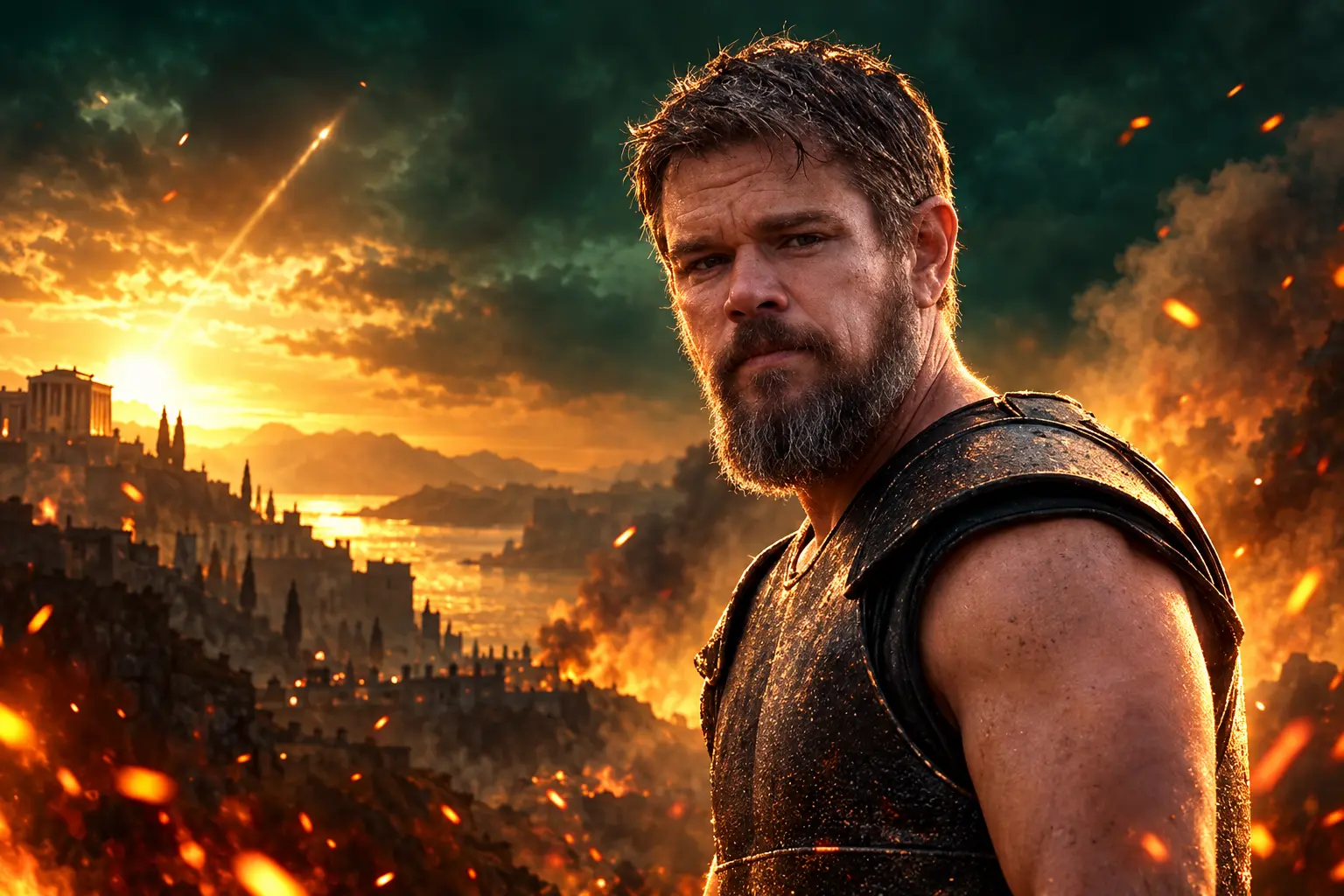
Nolan’s Epic Becomes Universal’s All-Time Leader
Christopher Nolan’s take on Homer, which opened in July, is now Universal’s highest-grossing film, with nearly $1.8 billion worldwide year to date. Universal also became the first studio to reach $5 billion at the global box office in 2026. Theatrical revenue at the studios unit jumped 76.6% to $1.13 billion, helped by Minions and Monsters and by carryover from Obsession.
Studio revenue still slipped 1.1% to $2.97 billion because content licensing fell 23.7% to $1.55 billion, a timing issue in the television pipeline. Adjusted EBITDA at studios still rose 18.6% to $402 million, as lower film-sale costs and a calmer marketing bill more than covered the licensing dip. The film that is doing the reputational work is the one that already passed 2015’s Jurassic World, whose $1.677 billion had been the studio mark until mid-September.
WHAT THE ODYSSEY ALREADY HOLDS
- Worldwide cume: Nearly $1.8 billion year to date, per Comcast’s October 22 release.
- Studio record: It cleared Jurassic World’s $1.677 billion and is Universal’s highest-grossing film.
- Year for the lot: Universal was the first studio to $5 billion worldwide in 2026.
- Other titles: Minions and Monsters and Obsession also fed the 76.6% theatrical jump.
Donna Langley, chairman of NBCUniversal Entertainment, called the film one of the most ambitious and brilliantly executed in cinematic history, a generational event that galvanizes moviegoing itself. That is a wonderful problem for a studio that will soon have to sell itself to public investors without Comcast’s broadband cash next to it on the same slide.
48 Million Subscribers and a Second Profit
Peacock delivered its second consecutive profitable quarter, generating 48 million paid subscribers, up 17% from a year earlier, and $261 million of adjusted EBITDA on $1.8 billion of revenue. A year earlier the service lost $217 million on $1.4 billion of revenue, a $478 million swing. Subscriber count held steady from the second quarter, so the profit is coming from distribution rates and mix more than from a fresh land grab.
Media revenue rose 13.0% to $5.36 billion and media adjusted EBITDA rose to $769 million from $247 million. Strip out $224 million of incremental FIFA World Cup revenue and media still grew 8.3%. Domestic advertising rose 14.6%, but only 0.3% without the tournament, which means the ad print was a World Cup print. Domestic distribution rose 22.4%, and Comcast tied that gain to Peacock’s higher average rates and the extra paid subscribers. The World Cup will not be in the next stand-alone NBCU quarter. Peacock’s second profit will.
That is the brochure problem in miniature. A streamer that has finally turned the corner is being written into a new public company just as the easy sports spike fades, and just as parks, which travel in the same box, are going the other way.
What Comcast’s $1 Billion-Plus Charge Buys
Cavanagh told investors the company has embarked on the most significant operating and cost transformation in its history, with an opportunity he believes will ultimately amount to billions of dollars over time. Chief financial officer Jason Armstrong put a number on the near-term bill.
We expect to have a significant charge in the fourth quarter related mostly to our transformation efforts, and I would quantify that at over $1 billion.
Jason Armstrong, Chief Financial Officer, on the third-quarter earnings call
Armstrong said the work is meant to simplify the organization so it can move faster and free capacity to invest, and he resisted calling it a cost-cutting exercise. People familiar with the plan have said the jobs at risk sit in cable, broadband and wireless, not at NBCUniversal. The charge, in other words, is being booked on the side that remains. Fiber rivals offered $30 to $40 monthly broadband in some markets in the quarter, pricing Armstrong called irrational because deploying fiber costs $1,500 or more per home and is getting more expensive in suburban and rural builds.
THE LINES THAT STILL MOVE
- Broadband: Domestic residential customers fell by 144,000 to 28.3 million, worse than the 91,000 lost a year earlier, and broadband revenue fell 4.7% to $6.24 billion on lower rates and fewer homes.
- Wireless: Lines rose by 368,000 to 10.6 million, with 1.6 million added over 12 months, and wireless service revenue rose 14.7% to $1.05 billion as free lines converted to paid plans.
- Video: Domestic video customers fell by 274,000 to 10.4 million, and video revenue fell 8.7% to $5.91 billion.
- Business: Business Services connectivity revenue rose 2.7% to $2.65 billion and adjusted EBITDA rose 1.7% to $1.48 billion, a 55.9% margin led by enterprise.
Nearly 45% of broadband customers are now on gig-plus tiers, up almost 10 percentage points from a year earlier, which is the quality mix Comcast wants as the raw count falls. Wireless has reached about 18% of domestic residential broadband homes. Free cash flow was still $4.2 billion, down 14.8%, and the company paid $1.2 billion in dividends. Share buybacks remain paused through the proposed split. The remaining Comcast is being asked to fund a rebuild and a separation at the same time it is losing the product that used to define it.
London Still Holds Sky’s ITV Purchase
Sky, which travels with NBCUniversal in the spin, agreed on July 6 to acquire ITV Media and Entertainment for up to £1.6 billion ($2.1 billion). The package is £1.2 billion in cash, Sky’s Love Productions business at an agreed £200 million, and up to £200 million of earn-out. A separate £2.1 billion content supply deal with ITV Studios would run five years after close. Sky Group chief executive Dana Strong called it a defining moment for British media. ITV chief executive Carolyn McCall said Sky would be a strong and responsible custodian, with Channel 3 public-service duties kept through 2034.
Completion is expected in the second half of 2027, the same window as the NBCU spin, and only if regulators agree. On October 15, UK culture secretary Lisa Nandy said she was minded to intervene on news plurality grounds, including on-demand programming. Sky said it remained confident the deal would create a stronger British media business. The longstop date is July 6, 2028, with an £80 million break fee if clearance fails, subject to exceptions.
THE SKY-ITV CLOCK
- January 2, 2026: Versant, the cable-network spin that kept Bravo at NBCU, closes.
- June 29, 2026: Comcast announces it will separate NBCUniversal and Sky as a tax-free spin to shareholders, targeted about a year out.
- July 6, 2026: Sky agrees to buy ITV’s channels and ITVX for up to £1.6 billion, with a £2.1 billion studios content pact to follow at close.
- October 15, 2026: Nandy says she is minded to intervene; the companies were given days to respond.
- Mid-2027 / H2 2027: Targeted close for the NBCU-Sky spin and for the ITV purchase, both still subject to approvals and financing.
A stand-alone NBCUniversal that already owns Sky and then owns ITV’s broadcast arm would be a different animal from the NBCU inside Comcast today. It would also be a company whose first big deal as a public target is stuck in Whitehall while Cavanagh is still building the public-company plumbing. He told analysts the work is well into the execution phase, including that stand-alone infrastructure, and that a clear path to completion is in place even with significant work ahead.
After the Credits, a Price War
Theme parks will leave with NBCUniversal, softness included. Parks revenue fell 4.4% to $2.60 billion and adjusted EBITDA fell 17.1% to $780 million, as admissions declined and promotions rose, with higher operating costs at the domestic parks. Management called the pressure cyclical and pointed to the new Fast and Furious: Hollywood Drift coaster at Universal Studios Hollywood, the park’s first high-speed outdoor coaster. Parks are still a large earnings line, larger this quarter than studios, which is why a 17.1% profit drop travels into the spin math rather than staying behind with the cable company.
Angelakis inherits the other ledger. Domestic broadband is still shrinking, video is still shrinking, and the wireless offset, while real, is a 10.6 million-line business sitting next to 28.3 million broadband homes. The Q4 charge over $1 billion is the down payment on making that company smaller and faster before it has to report as itself. Roberts told analysts there is energy and excitement about the proposed separation in both organizations. The stock, down more than 20% this year before the print, could absorb a 3.4% bounce without settling the argument the quarter posed.
The Odyssey’s run and Peacock’s second profit are genuine. They also belong to the company Comcast is preparing to hand to its own shareholders, while the name on the remaining door is the one still arguing with $30 fiber and a charge it has not yet taken.
Disclaimer: This article is news reporting and analysis of Comcast’s third-quarter results and planned separation, and it is for information only. It is not investment advice, a recommendation to buy or sell CMCSA or any future NBCUniversal shares, or a forecast of the spin, the ITV deal, or the Q4 charge. Readers should consult a qualified financial adviser or licensed broker before making any investment decision. Figures, subscriber counts, box-office totals and deal statuses reflect company statements and related primary documents dated through October 22, 2026, and they can change with later filings, regulatory rulings and market moves.

Final Fantasy Resonance Turns a Dead Gacha Into HD-2D

PHP2Shell Forced Sites Offline While Exploits Stalled

Kindle+ Folds AI Audiobooks Into the Page-Read Fund

Chip Stocks Fall as the Bond Rally Cheapens AI Spend

Comcast’s Record Odyssey Quarter Doubles as the Exit

Microsoft 365 Auth Fault Took Down Exchange and Teams

Xbox Caps Game Pass Cloud Gaming at 15 Hours

OpenClaw 2.0 Ships a Team Workplace With Host-Trust Defaults

OpenAI Unveils GPT-6 Astra With a Critical Cyber Label

Diesel Breaks Its Record as the White House Claims Credit
-
 NEWS2 months ago
Microsoft 365 Auth Fault Took Down Exchange and Teams
-
 GAMING2 months ago
Xbox Caps Game Pass Cloud Gaming at 15 Hours
-
 NEWS2 months ago
OpenAI Unveils GPT-6 Astra With a Critical Cyber Label
-
 NEWS2 months ago
OpenClaw 2.0 Ships a Team Workplace With Host-Trust Defaults
-
 BUSINESS2 months ago
Diesel Breaks Its Record as the White House Claims Credit
-

 LIFESTYLE2 months ago
Squishy Dumpling Toys Recalled After Hiding Illegal Water Beads
-

 BUSINESS2 months ago
ChargePoint Stock Rally Prices Wilmer’s Three-Year Cash Plan
-

 AUTO2 months ago
Tesla Puts Its Wheel-Free Cybercab on Austin Streets