
NEWS
Apple Cut the Fitness+ Team Behind Time to Walk
Apple cut Fitness+ Time to Walk staff after shipping Watch readiness scores, slowing the workouts that lived in your ear.

Apple laid off a handful of Fitness+ employees in mid-September, and the cuts hit the teams behind Time to Walk and Time to Run, Mark Gurman said.
New audio episodes will keep arriving, just less often. The formats are not being killed. Inside the Fitness+ group, Gurman said, the move is seen as the start of deeper cost cuts and other major changes in the months and years ahead.
A Handful of Cuts on the Audio Team
The jobs sat on the audio side of Fitness+, the $9.99-a-month workout service built around Apple Watch. Time to Walk and Time to Run are the shows you play from the wrist with AirPods, without parking in front of a TV for a studio class. Gurman, who has covered Apple’s services for years, said this was the first staff cut inside Fitness+ and that it was separate from the company’s August round, which affected more than 200 people, including about 100 on Vision Pro.
Apple has not issued a public comment on the Fitness+ cuts. In August, when it trimmed Vision Pro and Siri-related roles, the company said it would create new jobs as part of the change and that a limited number of existing roles would be affected.
WHAT WE KNOW
- The cuts: A handful of Fitness+ employees lost jobs in mid-September, with Time to Walk and Time to Run staff among them.
- The shows: New audio episodes will come out less often, and the formats are not being discontinued for now.
- The earlier round: August’s cuts hit more than 200 Apple workers, including about 100 on Vision Pro, and were a different action from this audio-team reduction.
WHAT IS UNCONFIRMED
- A shutdown: Gurman has not said Apple is closing Fitness+, and the company has not said that either.
- A Health merger date: A later fold into Health has been discussed inside Apple, but no timetable has been announced.
- The next round: People inside Fitness+ expect more cost cutting, and the size of that next step is not public.
Gurman posted the news himself on September 20, tying the jobs to a review of Fitness+ he had already described months earlier.
Several months ago I reported that Apple is reevaluating the future of Fitness+. Now it’s making job cuts at the division. Here’s what’s happening – https://t.co/2IeDJdKnlY
— Mark Gurman (@markgurman) September 20, 2026
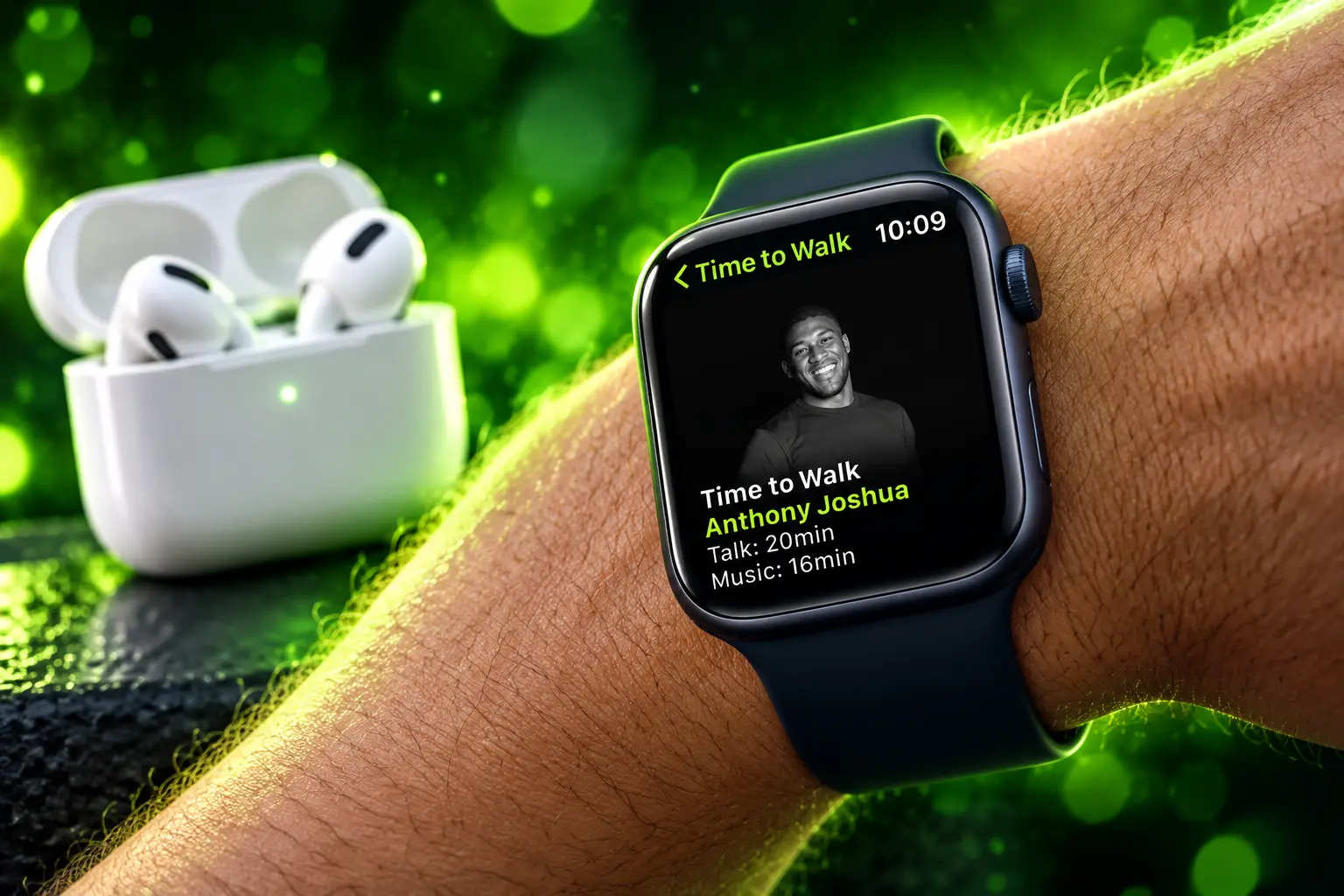
Time to Walk Lived Entirely on the Watch
Time to Walk was never the HIIT class on Apple TV. It was a 25- to 40-minute outdoor walk that started the moment you picked an episode on Apple Watch, with photos timed to a guest’s stories and a short playlist at the end. Apple launched those celebrity-hosted walks on Apple Watch on January 25, 2021, with Dolly Parton, Draymond Green, Shawn Mendes, and Uzo Aduba. Wheelchair users got the same show as Time to Push.
Walking is the most popular physical activity in the world, and one of the healthiest things we can do for our bodies. A walk can often be more than just exercise: It can help clear the mind, solve a problem, or welcome a new perspective.
Jay Blahnik, then Apple’s senior director of Fitness Technologies, January 25, 2021
Parton recorded her episode thinking about the Smoky Mountains. “I’ve loved walking ever since I was a little girl in the Smoky Mountains,” she said. Green talked about failure. Mendes talked about slowing down. Aduba talked about walking with her dog. New episodes landed each Monday through the end of that first April, then the guest list kept growing. By January 2022 Apple said Time to Walk had already featured 41 guests, among them Jane Fonda, Naomi Campbell, Ruby Bridges, and Prince William.
Time to Run arrived on January 10, 2022, with a different idea. Trainers, not celebrities, coached audio runs along routes in London, Brooklyn, and Miami Beach, with city-matched playlists and photos of sights along the way. Cory Wharton-Malcolm, Emily Fayette, and Sam Sanchez led those first three. Apple still tells subscribers they can start a Time to Walk episode from the Workout app, and two recent episodes still auto-download when a Watch is charging on Wi-Fi.
The catalog was still being fed in 2026. In January, Fitness+ lined up new Time to Walk guests including Penn Badgley, Mel B, and Michelle Monaghan. The product page still sells 12 workout types, new sessions every week from 5 to 45 minutes, and trainers who include Wharton-Malcolm. The audio shows were the part that did not need a screen in the living room. They are also the part that now gets fewer new episodes.
February’s Decision to Break Up Mulberry
The audio cuts sit on a longer rewrite of Apple’s health group. After longtime chief operating officer Jeff Williams retired in late 2025, services chief Eddy Cue took over health, and Sumbul Desai, Apple’s vice president of Health, added Fitness+ to her portfolio. Gurman wrote that November that Fitness+ was under review. He called it one of Apple’s weaker digital products, with high churn and little room to grow revenue, even though a small group of users still like it enough that killing the brand outright would be noisy.
Cue then stopped a separate paid plan. For years Apple had been building an AI health coach known internally as Mulberry, also discussed as Health+. The company had aimed it at iOS 26, then at spring, then at iOS 27. In February 2026, Gurman reported that Cue told colleagues Apple needed to move faster in health, and that Oura and Whoop offered more useful features, especially in their iPhone apps. The standalone coach did not meet that bar. Pieces of the project were to ship over time inside Health instead, including education videos, gait analysis with the iPhone camera, and AI suggestions based on data people already log.
Cue was also weighing changes to Fitness+. That was seven months before the audio-team cuts. The paid Health+ bundle that some of those February stories described as a 2026 launch did not arrive as a new subscription on September 9. What arrived was hardware scoring and a Health app that Apple says will absorb the coaching ideas for free.
What Apple Put in Health Instead
On September 9, Apple put a recovery number on the two new watches and promised a redesigned Health app coming later this year, starting in U.S. English. Series 12 starts at $399 and Ultra 4 at $799. Both reached stores on September 18. watchOS 27 had already landed on September 14 for Series 9 and later, SE 3, and Ultra 2 and later. The readiness feature itself is tied to the new Health Sensing System on Series 12 and Ultra 4.
Desai, now titled vice president of Health and Fitness, framed the launch as scores and guidance, not as a new celebrity walk.
By combining breakthrough sensing on Apple Watch with Apple Intelligence in the Health app, we’re able to translate complex biometric data into clear guidance for users.
Sumbul Desai, M.D., vice president of Health and Fitness, September 9, 2026
The new watches measure heart rate every five seconds all day, and they sample heart-rate variability as often as every five minutes, which Apple says is 24 times more often than before. A company study of more than 1,000 people is the backing Apple cites for calling the new heart-rate sensing the most accurate in a wearable. That is the Oura and Whoop fight, fought with LEDs and a morning number.
WHAT THE SEPTEMBER 9 EVENT SHIPPED
- Readiness: A daily readiness score from 0 to 10 with four labels, Recover at 0 to 1, Pace Yourself at 2 to 4, Ready at 5 to 7, and Go For It at 8 to 10.
- Health Age: A Longevity tab that compares Watch metrics such as VO2 max, resting heart rate, sleep, and HRV with a person’s actual age, and can take lab values such as A1c and LDL.
- Insights: A tab that updates through the day across heart, sleep, readiness, fitness, vitals, and cycle tracking, plus a For You section with recommendations.
- At-home tests: Movement evaluations that use the iPhone camera and Apple Watch on the device, with no video stored, plus Quest lab panels of more than 50 biomarkers for $119 at about 2,000 U.S. locations.
Health will also add perimenopause and menopause tools in Cycle Tracking, and Workout Buddy on the Watch now runs without the iPhone nearby, in English and Spanish. That is not a Dolly Parton story in your ears. It is a dashboard that tells you whether to push today, then sells you a blood draw and a video about your LDL.
$9.99 a Month Since 2020
Fitness+ launched in 2020 and, as of late 2025, had never changed its U.S. price. That $9.99 monthly fee, or $79.99 a year, can be shared with up to six family members, and the service still sits inside Apple One Premier. Apple does not publish a Fitness+ subscriber count. Across all of its own services and App Store subscriptions, it said in July 2026 that it had passed 1.5 billion paid subscriptions, a company-wide figure that does not isolate workouts.
FITNESS+ AT A GLANCE
- The fee: $9.99 a month or $79.99 a year, unchanged since launch, shareable with up to six people.
- The audio shows: Time to Walk episodes run 25 to 40 minutes; Time to Run launched with three city routes.
- The video library: 12 workout types, with new sessions from 5 to 45 minutes added each week.
- The churn problem: Gurman has described high subscriber turnover and limited revenue, which is the pressure behind a service that still needs new filmed classes every week.
People who try Fitness+ for a month often meet a library of studio videos that do not change once they are shot. That is a weak reason to keep paying after the free trial on a new Watch runs out. Time to Walk was the odd format in that bundle: it asked you to go outside, and it gave you a voice. Slowing that pipeline does not fix churn on the video side. It trims the one show that did not look like a static class.
THE FITNESS+ TO HEALTH SHIFT
| Date | Move |
|---|---|
| 2020 | Apple launches Fitness+ at $9.99 a month or $79.99 a year. |
| January 25, 2021 | Time to Walk debuts with Dolly Parton, Draymond Green, Shawn Mendes, and Uzo Aduba. |
| January 10, 2022 | Time to Run debuts with London, Brooklyn, and Miami Beach episodes. |
| November 2025 | Fitness+ moves under Sumbul Desai; Eddy Cue takes health; the service is described as under review. |
| February 2026 | Cue scales back the Mulberry health-coach plan and folds pieces into the Health app. |
| September 9, 2026 | Apple announces readiness scores, Health Age, and a rebuilt Health app for later in the year. |
| Mid-September 2026 | A handful of Fitness+ audio staff are laid off; new Time to Walk and Time to Run episodes slow. |
Read that list as one bet replacing another. Celebrity walks were how Apple tried to make a Watch feel like a companion in 2021. Morning scores and lab panels are how it is trying to keep a Watch on your wrist in 2026.
The Coaching Job Apple Just Handed Away
Oura and Whoop already sell a daily verdict on whether to train. Cue named those two when he broke up Mulberry. On September 9 Apple answered them with readiness, recovery HRV, and Health Age. That fight is about the number. It is not about who talks to you at mile three.
Time to Run was Apple’s attempt at that voice, with trainers and city routes. Time to Walk was a famous person in your ears for people who were never going to take a 45-minute HIIT class. Nike, Peloton, Strava, and a long list of free run podcasts still fill that slot. Apple is not announcing a partnership with any of them. It is announcing fewer new episodes of its own.
The Watch still starts an Outdoor Walk or Outdoor Run when an episode plays, and it still records the usual time, pace, heart rate, and distance. Hardware tracking was never the fragile part. The fragile part was paying writers, trainers, and celebrity bookings for a weekly drop that a small, loyal group actually finished. Gurman has said that loyal group is why Apple has been reluctant to kill the brand. A slower drop schedule is how you keep the brand without keeping the production line at 2022 speed.
New Walks Will Arrive on a Slower Clock
Subscribers who open Time to Walk this week will still find Parton, Green, and the later seasons. They will still find London, Brooklyn, and Miami Beach in Time to Run. Apple has not pulled the shows, and Gurman said it is not shutting Fitness+ down. What changes is how often a new voice shows up on the charger.
Desai’s group now owns both the Health scores and the workout service. Cue wanted Apple to move faster than Oura and Whoop. The Watch got a 0-to-10 readiness number for that fight. The audio team got smaller. The next new walk will just take longer to land on the Watch.

Final Fantasy Resonance Turns a Dead Gacha Into HD-2D

PHP2Shell Forced Sites Offline While Exploits Stalled

Kindle+ Folds AI Audiobooks Into the Page-Read Fund

Chip Stocks Fall as the Bond Rally Cheapens AI Spend

Comcast’s Record Odyssey Quarter Doubles as the Exit

Microsoft 365 Auth Fault Took Down Exchange and Teams

Xbox Caps Game Pass Cloud Gaming at 15 Hours

OpenClaw 2.0 Ships a Team Workplace With Host-Trust Defaults

OpenAI Unveils GPT-6 Astra With a Critical Cyber Label

Diesel Breaks Its Record as the White House Claims Credit
-
 NEWS2 months ago
Microsoft 365 Auth Fault Took Down Exchange and Teams
-
 GAMING2 months ago
Xbox Caps Game Pass Cloud Gaming at 15 Hours
-
 NEWS2 months ago
OpenAI Unveils GPT-6 Astra With a Critical Cyber Label
-
 NEWS2 months ago
OpenClaw 2.0 Ships a Team Workplace With Host-Trust Defaults
-
 BUSINESS2 months ago
Diesel Breaks Its Record as the White House Claims Credit
-

 LIFESTYLE2 months ago
Squishy Dumpling Toys Recalled After Hiding Illegal Water Beads
-

 BUSINESS2 months ago
ChargePoint Stock Rally Prices Wilmer’s Three-Year Cash Plan
-

 AUTO2 months ago
Tesla Puts Its Wheel-Free Cybercab on Austin Streets