
BUSINESS
Bank of Japan Hikes to 1.25% as the Yen Slips
The Bank of Japan lifted its policy rate to 1.25%, a 31-year high, but the yen sold off after a 7-2 vote and a still-wide gap with U.S. rates.

The Bank of Japan raised its policy rate to 1.25% on September 18, the highest since 1995, and the yen fell. The nine-member board voted 7-2 at the end of a two-day meeting, with Toichiro Asada and Ayano Sato, both appointed this year by Prime Minister Sanae Takaichi, opposing the increase.
The quarter-point move had been fully priced. It still left Japan’s overnight rate far below the Federal Reserve’s 3.75% to 4.00% band, and traders sold the yen as soon as the split was public.
The Bank Pushed the Overnight Rate to 1.25%
Governor Kazuo Ueda’s board met on September 17 from 2:00 p.m. and again on September 18 from 9:00 a.m., wrapping at 11:47 a.m. in Tokyo. The overnight call rate at around 1.25 percent is the new operating target, released at 11:54 a.m.
That is 25 basis points above the 1.0% rate set on June 16 and the highest setting since 1995. The complementary deposit rate paid on current-account balances, excluding required reserves, moves to 1.25% as well. The basic loan rate on the complementary lending facility is 1.5%.
THE NEW POLICY RATES
- Overnight call: The Bank will encourage the uncollateralized overnight call rate to remain at around 1.25%.
- Deposit facility: The rate on current-account balances, excluding required reserves, is 1.25%.
- Lending facility: The basic loan rate is 1.5%.
- Climate operations: The loan rate on climate-response funds-supplying operations switches to a floating rate, a change the board passed unanimously.
The statement said Japan’s economy has recovered moderately, with some weakness tied to the situation in the Middle East, and that it should keep growing at a moderate pace, helped by government measures and global AI-related demand. Producer prices remain high on a year-on-year basis because of crude oil, the weak yen, and that AI demand. Consumer prices excluding fresh food, the Bank said, have been in a 1.5% to 2.0% range as wholesale pressure spills into store prices and firms keep passing wage increases into selling prices.
On that basis the Bank judged it right to reduce the degree of monetary ease so the 2% price-stability target can be met in a stable way. It also said financial conditions would stay easy after the change, and that it “will continue to raise the policy interest rate and adjust the degree of monetary accommodation.”
Yen Weakness Survived a 31-Year High
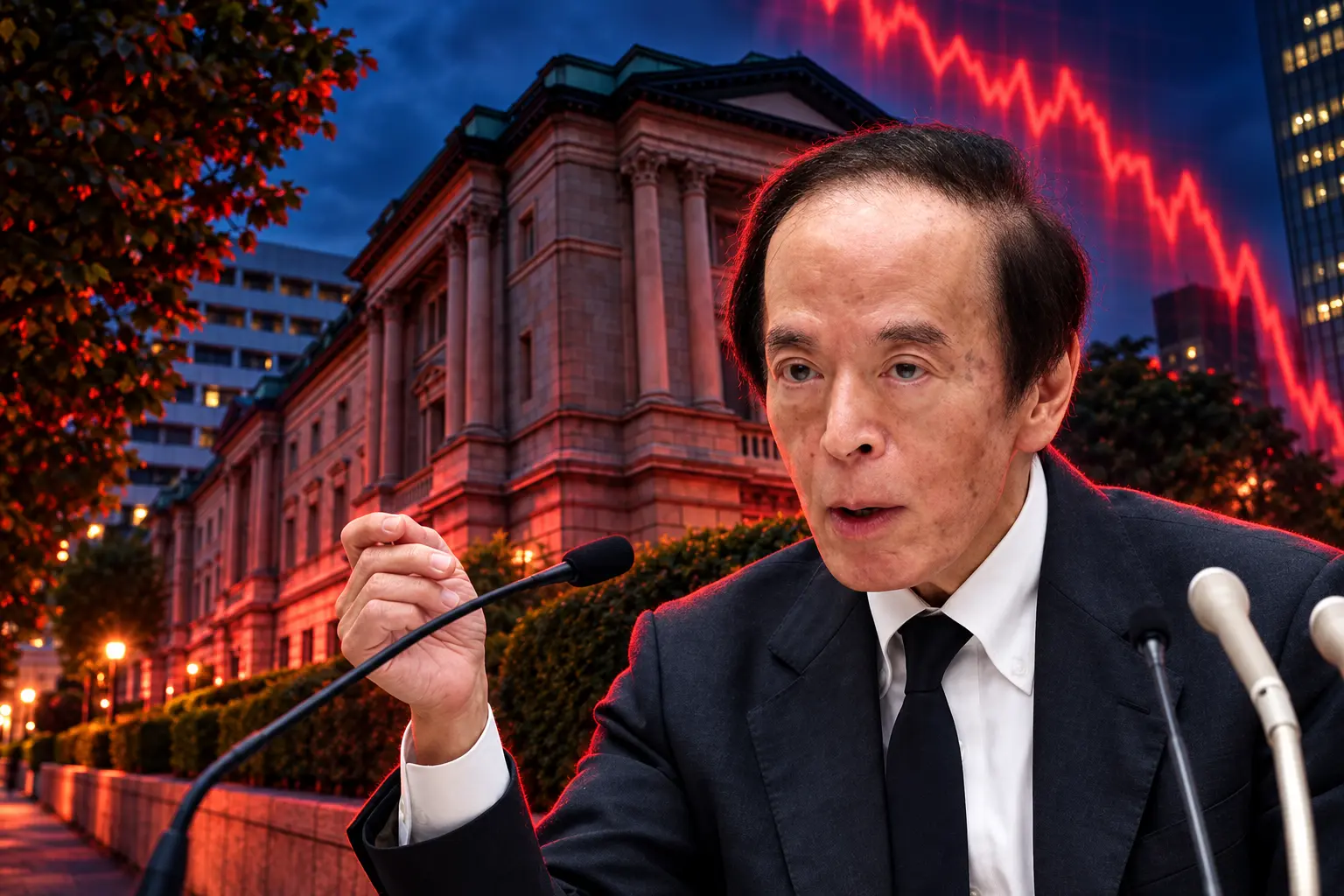
The yen traded as weak as 157.09 per dollar after the announcement, a drop of as much as 0.7%. The 10-year Japanese government bond yield slipped 4.9 basis points to 2.947%. A currency that is supposed to firm when its central bank tightens did the opposite, because the hike itself was not news and the 7-2 tally was.
Hirofumi Suzuki, chief FX strategist at SMBC in Tokyo, said the increase matched what the market had built in, and that the two nays were a modest surprise that “tempered expectations for further rate hikes and conveyed a dovish impression.” Fred Neumann, chief Asia economist at HSBC, said the tone of the statement plus the dissenters left doubts that the Bank would tighten further at speed. Chidu Narayanan, chief APAC strategist at Wells Fargo, called the outcome not hawkish enough, and said it should push the dollar-yen rate higher and front-end yen yields lower.
Two days earlier the Federal Reserve had lifted its target range to 3.75% to 4.00%. After both quarter-point moves, the gap between the Fed midpoint of 3.875% and Japan’s 1.25% is 2.625 percentage points, the same gap that existed before either bank acted. A yen that had rallied earlier in September on hopes of faster Japanese tightening gave those gains back once it became clear the dollar’s yield advantage was not shrinking.
Rate increases since 2024 have not produced a durable yen rally, which is why Tokyo has leaned on foreign-exchange intervention more often than on the policy rate. A 25-basis-point step does not close a gap of more than two and a half points, and it does not kill a yen-funded carry trade that still pays. Traders who wanted a signal of another increase as soon as October did not get one. Prashant Newnaha, senior rates strategist at TD Securities in Singapore, said he saw no smoking gun for a back-to-back hike and stuck with a roughly quarterly path, with the next 25 basis points in December.
Takaichi’s Board Picks Voted No
Asada and Sato are the two members Takaichi placed on the board this year. Both are viewed as reflationists, closer to the prime minister’s preference for easy money and large fiscal spending than to Ueda’s slow march toward a normal rate. Asada, the first of the two appointments, already voted against the June increase to 1.0%. He argued this time that core inflation was below 2% and that the economy might not be strong, and he wanted a hold. Sato said economic and price developments did not appear to have substantially accelerated compared with before.
While we may observe some risk of inflation overshooting, I do not believe that an inflationary norm has yet become firmly established.
Ayano Sato, Bank of Japan board member, inaugural press conference in Tokyo
Sato, a former Aoyama Gakuin University professor, succeeded Junko Nakagawa and began a five-year term in late June. Kento Minami, senior economist at Daiwa Securities in Tokyo, said the overall impression of the September statement was dovish, and that Takaichi’s choices “suggest difficulties in raising rates in the future as the BOJ will have new board members going forward.” Two of the board’s more hawkish seats come up in about a year, which would give the prime minister more room to shift the nine-member group.
The political tension is already visible inside the building. On September 18, State Minister of Finance Shinichi Nakatani and Minister of State for Economic and Fiscal Policy Minoru Kiuchi sat in on the morning session. Takaichi still leans on the Abenomics mix of low rates and heavy spending. The Bank is now lifting the cost of that mix while two of her own appointees record their objections in the vote.
Core Inflation Slowed to 1.7% in August
Hours before the decision, the Statistics Bureau of Japan published August prices. Headline inflation held at 1.9%. The core prices excluding fresh food rose 1.7%, down from 1.8% in July and below the 1.8% forecast. That core series, the one the Bank aims at 2%, has now sat below target for an eighth straight month. Fuel subsidies have offset some of the oil shock from the Middle East. The index that also strips out energy, the Bank’s preferred read on demand-driven prices, was 1.9%, unchanged from July.
THE AUGUST PRICE GAUGES
| Gauge | August 2026 | July 2026 | 2% target |
|---|---|---|---|
| Headline CPI | 1.9% | 1.9% | Below |
| Core (ex fresh food) | 1.7% | 1.8% | Below, 8th month |
| Core-core (ex fresh food and energy) | 1.9% | 1.9% | Below |
The Bank is not reacting to last month’s print so much as to its own forecast. It said underlying CPI inflation has been approaching 2%, and that there is a risk it “will deviate upward to a level above the price stability target of 2 percent” as firms shift toward raising wages and prices and as medium- to long-term inflation expectations rise. It expects the year-on-year increase in CPI excluding fresh food to accelerate to a level clearly above 2% from the second half of fiscal 2026, then ease back toward around 2% later in the July 2026 outlook window. Underlying inflation, in that baseline, gets generally in line with the target between the second half of fiscal 2026 and fiscal 2027.
That is the overshoot the hike is meant to head off. Asada’s dissent is the other reading of the same numbers: core at 1.7% and cooling, energy help from the government, and an economy the statement itself described as only moderately recovering, with weak spots. The majority is tightening into a forecast. The minority is waiting for demand-driven inflation it does not yet see.
A Hiking Cycle That Left the Yen Cheap
Ueda took office in April 2023 and began dismantling the prior decade of radical stimulus in March 2024. The path from negative rates to 1.25% has been slow by global standards, and the yen has spent much of that climb near multi-decade lows. Staff estimates put Japan’s nominal neutral rate, the level that neither cools nor overheats growth, in a 1.1% to 2.5% range. At 1.25% the policy rate has only just entered the bottom of that band.
THE HIKES SINCE NEGATIVE RATES ENDED
- March 19, 2024: Sets the overnight call rate around 0 to 0.1% and ends negative rates.
- July 31, 2024: Raises the policy rate to 0.25%.
- January 24, 2025: Raises the policy rate to 0.5%.
- December 19, 2025: Raises the policy rate to 0.75%.
- June 16, 2026: Raises the policy rate to 1.0%, with Asada dissenting.
- September 18, 2026: Raises the policy rate to 1.25%, with Asada and Sato dissenting.
The June-to-September gap is three months, shorter than the roughly half-year spacing that marked earlier steps in this cycle. Analysts still see 1.5% by the end of March 2027 and 1.75% in the second quarter of 2027, with most putting the terminal rate at least at 1.75%. That would still leave Japan below the European Central Bank’s 2.5% key rate and far below the Fed.
Hajime Takata, a hawkish board member, had already argued in a September 2 speech in Sapporo that 2026 should be a turning point after two hikes a year in 2024 and 2025, and he had proposed 1.25% at the July meeting. He got the level on September 18. He did not get a board that looks united behind a faster clip.
Bessent Asked for Decisive Steps in Asheville
Washington has been blunt. On August 30, U.S. Treasury Secretary Scott Bessent met Ueda on the margins of the G20 finance ministers and central bank governors gathering in Asheville, North Carolina. The Treasury readout said Bessent stressed sound policy and communication “to anchor inflation expectations and avoid excess exchange rate volatility,” and that he expressed strong support for Japan’s decisive market and monetary steps to address what it called the substantial undervaluation of the yen.
Secretary Bessent also expressed strong support for Japan’s decisive market and monetary steps to address the substantial undervaluation of the yen and noted the role of yen weakness in contributing to domestic inflationary pressures in Japan.
U.S. Department of the Treasury readout, Asheville, August 30, 2026
Bessent has also pressed Takaichi’s government to hold back fiscal stimulus that works against the Bank’s inflation fight, and the United States joined Japan in yen-buying intervention after the July hold. Finance Minister Satsuki Katayama had sought that help. The price, as officials have described it, was consistency between monetary and fiscal policy: raise rates, and stop spending against the hike.
September 18 delivered the rate. It did not deliver the yen. A coordinated intervention and a 31-year-high policy rate are still competing with a 2.625-point dollar gap, a prime minister who wants easy money, and a board that just advertised a 7-2 split.
What Ueda Still Has to Sell
Ueda was due to brief reporters at 3:30 p.m. in Tokyo on September 18. The market wanted him to keep December in play without promising an October move the statement did not support. Sarah Hammoud, a currency strategist at Commonwealth Bank of Australia, said he would need to convince markets the Bank is inclined to hike at a faster pace, and that the risk is he fails to match those hawkish hopes. Chris Weston, head of research at Pepperstone Group in Melbourne, said traders would look for confirmation that further normalisation remains on the table, and whether the Bank sees any urgency to move again.
The Summary of Opinions from the meeting is due on October 1, and the minutes on November 5. Until then the public record is a 1.25% rate, a 7-2 vote, a forecast of inflation clearly above 2% in the second half of fiscal 2026, and a yen that treated the highest Japanese policy rate in 31 years as a reason to sell.
Disclaimer: This article is news reporting and analysis of a Bank of Japan policy decision, currency moves, and related bond-market prices, and it is for information only. It is not investment advice, a recommendation to buy or sell yen, Japanese government bonds, equities, or any other instrument, and it is not a forecast you should trade on. Readers should consult a licensed financial adviser or other qualified professional before making any investment or currency decision. Policy rates, inflation prints, and market levels reflect the official statements and data cited here as of September 18, 2026, and they can change at the next meeting or the next print.

Final Fantasy Resonance Turns a Dead Gacha Into HD-2D

PHP2Shell Forced Sites Offline While Exploits Stalled

Kindle+ Folds AI Audiobooks Into the Page-Read Fund

Chip Stocks Fall as the Bond Rally Cheapens AI Spend

Comcast’s Record Odyssey Quarter Doubles as the Exit

Microsoft 365 Auth Fault Took Down Exchange and Teams

Xbox Caps Game Pass Cloud Gaming at 15 Hours

OpenClaw 2.0 Ships a Team Workplace With Host-Trust Defaults

OpenAI Unveils GPT-6 Astra With a Critical Cyber Label

Diesel Breaks Its Record as the White House Claims Credit
-
 NEWS2 months ago
Microsoft 365 Auth Fault Took Down Exchange and Teams
-
 GAMING2 months ago
Xbox Caps Game Pass Cloud Gaming at 15 Hours
-
 NEWS2 months ago
OpenAI Unveils GPT-6 Astra With a Critical Cyber Label
-
 NEWS2 months ago
OpenClaw 2.0 Ships a Team Workplace With Host-Trust Defaults
-
 BUSINESS2 months ago
Diesel Breaks Its Record as the White House Claims Credit
-

 LIFESTYLE2 months ago
Squishy Dumpling Toys Recalled After Hiding Illegal Water Beads
-

 BUSINESS2 months ago
ChargePoint Stock Rally Prices Wilmer’s Three-Year Cash Plan
-

 AUTO2 months ago
Tesla Puts Its Wheel-Free Cybercab on Austin Streets