
NEWS
Bennu and Ryugu May Be Twins From Jupiter’s Ice Line
Bennu’s OSIRIS-REx sample matches Ryugu and CI meteorites, pointing to a Jupiter ice-line nursery, and the next returns may not sample that same factory.

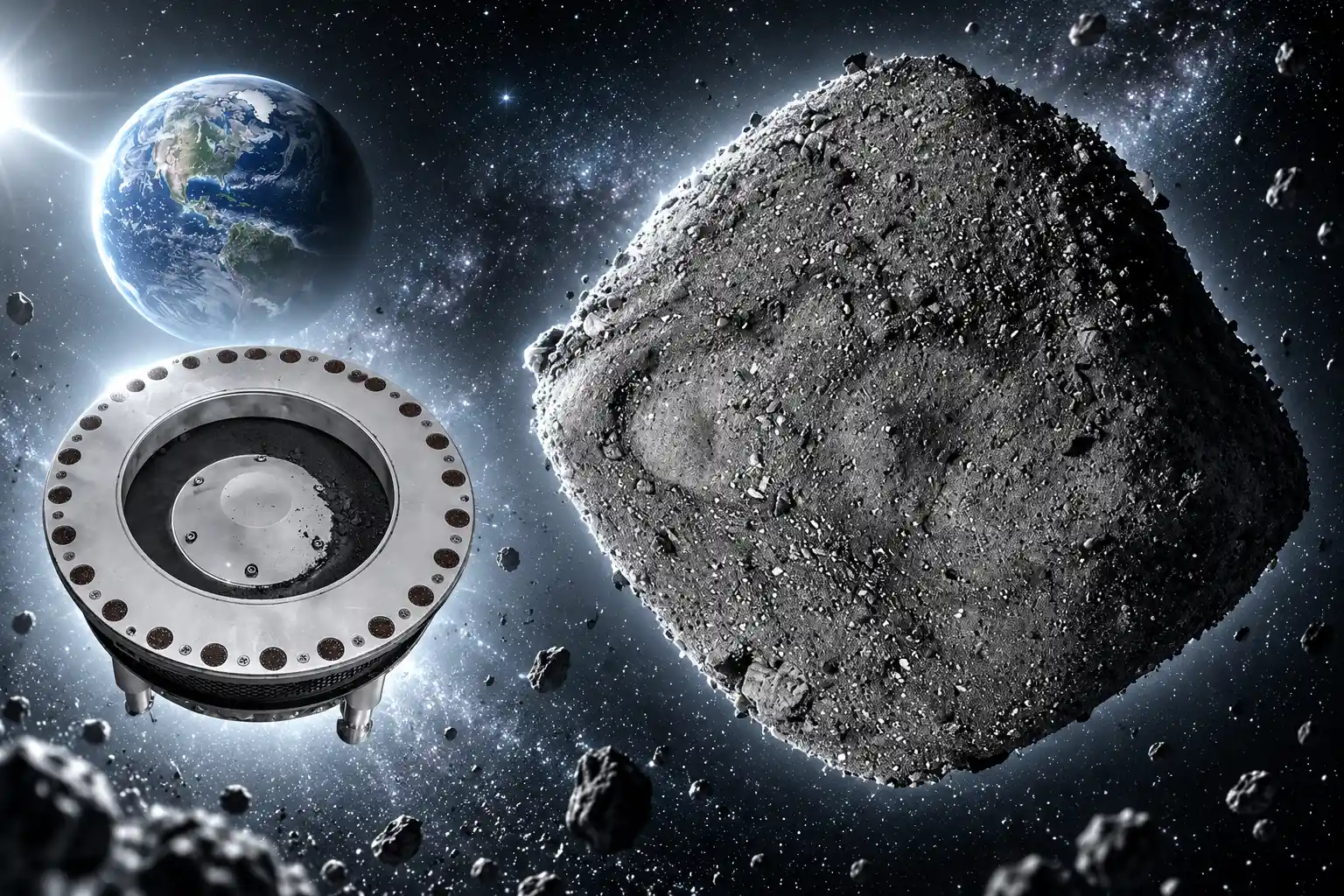
Iron and titanium in NASA’s Bennu sample match Ryugu and rare CI meteorites, a September 23 study finds. The ETH Zurich team places their parent bodies near the water-ice line, inside the orbit of a still-growing Jupiter.
Bennu and Ryugu are also the only two carbonaceous asteroids sampled in space. That twin fingerprint may mean both missions drew from one factory, so the next returns will not automatically confirm a disk-wide mix.
Bennu, Ryugu, and the Rare CI Fingerprint
NASA’s OSIRIS-REx capsule delivered 121.6 grams of Bennu material on September 24, 2023, more than twice the 60 grams the mission needed and the largest asteroid sample ever brought back. Maria Schönbächler, professor of isotope geochemistry at ETH Zurich, received half a gram of that dust.
Her group published iron, titanium, and chromium isotope data in Science Advances. At bulk sizes above 20 milligrams, the iron and titanium fingerprints are even throughout Bennu and match Ryugu, sampled by Japan’s Hayabusa2 mission, plus Ivuna-type CI meteorites. Those three sit apart from other asteroid groups, other meteorite classes, and the planets.
Chromium is the exception. Small shifts between aliquots likely record water that once flowed through the parent rock, not a second birthplace. Japan’s Hayabusa2 return from Ryugu was about 5.4 grams, a much smaller haul that already pointed at the same CI-like chemistry.
THREE BODIES, ONE DUST BATCH
| Body | How labs got it | Iron and titanium | What still differs |
|---|---|---|---|
| Bennu | OSIRIS-REx, 121.6 grams | Match Ryugu and CI above 20 milligrams | Chromium shifts with water alteration |
| Ryugu | Hayabusa2, about 5.4 grams | Same bulk fingerprint | A smaller returned mass |
| CI meteorites | Rare falls on Earth | Same bulk fingerprint | Altered and scarce compared with returned dust |
Dynamical studies have already tied both near-Earth asteroids to the inner main belt’s Polana or Eulalia families. If those links hold, the isotope match is what you would expect from two fragments of one clan, not a fresh census of the whole disk.
Jupiter Let Fine Dust Through and Stopped the Rest
Until this paper, a common reading put Bennu’s parent far out, late, and near the comet zone, where growth is slow. The even iron and titanium mix points instead to fine dust, not coarse clumps. Water-bearing minerals in the same sample put ice in the recipe.
Schönbächler’s team says the parents of Bennu, Ryugu, and the CI meteorites formed near the water-ice line, the frost boundary in the planet-forming disk where water vapor froze. That zone sat roughly where Jupiter orbits now. Material from the hot inner disk and the cold outer disk met there about 4.5 billion years ago. Ice bound the finest grains.
Bennu is a hybrid: the material does not clearly match either the inner or the outer Solar System.
Maria Schönbächler, Professor of Isotope Geochemistry, ETH Zurich
Jupiter is the filter in this account. The giant planet grew within one million years of the Sun. As it took over its orbit, it blocked heavier, coarser clumps. Fine dust could still flow around it into the ice-line zone and mix until it looked a lot like the Sun’s own makeup.
HOW THE ICE-LINE PARENT WAS BUILT
- Early Jupiter: The planet grew fast enough to stand in the disk as a barrier to coarse grains.
- Fine dust: Smaller particles streamed around that barrier and mixed from both sides of the frost line.
- Ice as glue: Frozen water stuck those grains into larger bodies.
- Recondensed vapor: Ice just inside the line turned to vapor, then some of that water fed the same zone, which is why the Bennu sample is wet.
That path also explains the solar-like chemistry. Fine dust in the young disk mixed the way household dust ends up everywhere, Schönbächler’s group notes. Bennu, in that reading, is a leftover of the batch that built the rocky planets, including Earth.
A Rival Map That Still Points Outward
The ice-line story is not the only map still in print. A 2025 Nature Astronomy study of Bennu’s accreted mix, with Schönbächler and Jessica J. Barnes of the University of Arizona among the authors, still argued for a shared but patchy reservoir in the outer disk. That paper leaned on organics, ammonia, and nitrogen-15 enrichments that look like cold, distant chemistry, and it left open a birthplace beyond Saturn.
The new work does not throw those organics out. It uses a different clock. Iron, titanium, and chromium record which stellar dust the rock was built from, and those three elements, taken together, pull the parent inward to Jupiter’s ice line. Water chemistry can travel. The nucleosynthetic mix is harder to fake.
WHERE EXPERTS DISAGREE
- Ice-line inside Jupiter: Schönbächler and colleagues, Science Advances, September 23, 2026, read the even Fe and Ti mix plus water minerals as formation near the frost line while Jupiter was still growing.
- Outer disk, farther out: The 2025 Nature Astronomy analysis of organics, anhydrous silicates, and light potassium and zinc still favored a common reservoir beyond the snow line, possibly past Saturn.
- One parent or one neighborhood: The 2026 paper says the three bodies sampled similar dust, or may even trace to a single primordial parent; it does not close that choice.
The split is a shift in weight more than a feud. Several names sit on both papers. What changed is which measurements they treat as the location pin.
Kamo’oalewa Will Test a Different Kind of Rock
Schönbächler asked in the ETH release whether other asteroids share Bennu and Ryugu’s isotopic signature. The next sample on the calendar is not a third CI-like rubble pile. China’s Tianwen-2 reached 469219 Kamo’oalewa in July 2026 after a launch on May 28, 2025. First close images came on July 2 from about 20 kilometres. The rock is a few tens of meters across and spins once every 28 minutes.
Telescope work has compared its spectrum with the Moon and with LL ordinary chondrites linked to the Flora family, the same broad class as Itokawa. Yang Li and colleagues at the Chinese Academy of Sciences have argued it is probably not a lunar chip. Either way, it is not a carbonaceous twin of Bennu. Tianwen-2 is due to leave in April 2027 and drop a capsule at Earth in November 2027, then send the mothership on toward comet 311P/PANSTARRS.
If labs wanted a third draw from the ice-line factory, this is the wrong target. It is still a useful target. A lunar shard would show how often Earth-Moon debris hangs in quasi-satellite orbits. An LL-like Flora fragment would extend the Hayabusa Itokawa story, not the OSIRIS-REx story.
WHAT THE NEXT RETURNS CAN ACTUALLY TEST
| Mission | Target | Sample timing | The test it runs |
|---|---|---|---|
| Tianwen-2 | Kamo’oalewa | Capsule in November 2027 | Lunar chip or ordinary-chondrite NEA, not a CI-like match |
| MMX | Phobos | Earth return in 2031 | Captured asteroid versus Mars impact debris |
| OSIRIS-REx (done) | Bennu | Landed September 24, 2023 | CI-like ice-line dust, 121.6 grams |
| Hayabusa2 (done) | Ryugu | Returned 2020 | Same CI-like fingerprint, about 5.4 grams |
The louder public story around Bennu is still water, organics, and the chemistry of life, which the sample does hold. The quieter result from ETH is a sorting problem. Two successful carbonaceous landings lined up on one isotopic neighborhood. The next rock in the queue sits in a different neighborhood.
Half a Gram Was Enough to Map the Dust
Bennu passes Earth every six years, coming within about 300,000 kilometres, and it orbits the Sun every 1.2 years. NASA used that geometry. OSIRIS-REx launched on September 8, 2016, arrived on December 3, 2018, and grabbed the sample on October 20, 2020, then started home on May 10, 2021.
THE OSIRIS-REX SAMPLE CLOCK
- September 8, 2016: Launch of OSIRIS-REx toward Bennu.
- December 3, 2018: Arrival at the asteroid.
- October 20, 2020: Touch-and-Go collection with a nitrogen-gas blast into the TAGSAM head.
- September 24, 2023: Capsule landing in Utah with 121.6 grams (4.29 ounces).
- September 23, 2026: Science Advances paper on Bennu’s nucleosynthetic origin.
The ETH measurements used five Bennu aliquots, including angular, hummocky, and mottled particle types plus two homogenized powders of 20.7 milligrams and 1,288 milligrams. Iron and titanium stayed even across that set. Chromium did not. The paper reads those chromium shifts as later water alteration on the parent, which is why the team treats Fe and Ti as the birthplace tracers.
NASA is distributing the Bennu suite to more than 200 scientists. The ETH allocation was 0.5 grams. That is a reminder of how little mass an isotope lab needs once the sample is already off the asteroid, and of how much of the argument now sits in a few milligrams of powder.
Phobos Dust, 2031, and a JAXA Application
Schönbächler named the mission she wants next, and it is not Tianwen-2. JAXA set an MMX launch date of October 20, 2026, at 4:41:03 JST on H3 flight 10 from Tanegashima, with a reserved period from October 21 through November 7. The craft is built to bring a sample of Phobos back to Earth in 2031, at least 10 grams if the sampler works, after years at Mars.
It would be exciting to also obtain this material to analyse it in my laboratory.
Maria Schönbächler, Professor of Isotope Geochemistry, ETH Zurich
Phobos may be a captured asteroid, in which case its dust could sit closer to Bennu than to Mars. It may instead be leftover from a giant impact on Mars, in which case the isotopes should look planetary. NASA’s MEGANE instrument on MMX is there to help sort that origin from orbit. The returned grams are what close it.
Schönbächler said she will apply to JAXA and that she will need patience. The Bennu paper is already a finished measurement. The open question it leaves is whether that measurement sampled the solar system’s original mix, or one well-mixed neighborhood that two missions happened to visit. Phobos is the next rock that can answer her in the lab, and it is not due until 2031.
Frequently Asked Questions
What is the water-ice line in the early solar system?
It is the frost boundary in the planet-forming disk where water vapor froze into ice, near where Jupiter orbits today. Inside that line, ice turned to gas or liquid; outside it, ice could stick dust together. The line moved as the disk cooled, so “near the ice line” names a temperature zone, not a fixed street address.
What does OSIRIS-REx stand for?
Origins, Spectral Interpretation, Resource Identification, and Security, Regolith Explorer. It was NASA’s first mission to bring an asteroid sample to Earth, and the spacecraft is now on an extended cruise to Apophis under the name OSIRIS-APEX.
How much of the Bennu sample is stored for later work?
NASA will keep at least 70% of the 121.6 grams at Johnson Space Center for scientists who have not yet requested it, including future teams. The rest is already moving through a cohort of more than 200 researchers, with shares also set aside for partner agencies.
Could Phobos be a captured asteroid like Bennu?
That is one of the two standard ideas. The other is that Phobos and Deimos are debris from a large impact on Mars. MMX is designed to decide between those options with orbital chemistry and a returned sample; a captured carbonaceous body would be the case that could overlap Bennu’s ice-line fingerprint.

Final Fantasy Resonance Turns a Dead Gacha Into HD-2D

PHP2Shell Forced Sites Offline While Exploits Stalled

Kindle+ Folds AI Audiobooks Into the Page-Read Fund

Chip Stocks Fall as the Bond Rally Cheapens AI Spend

Comcast’s Record Odyssey Quarter Doubles as the Exit

Microsoft 365 Auth Fault Took Down Exchange and Teams

Xbox Caps Game Pass Cloud Gaming at 15 Hours

OpenClaw 2.0 Ships a Team Workplace With Host-Trust Defaults

OpenAI Unveils GPT-6 Astra With a Critical Cyber Label

Diesel Breaks Its Record as the White House Claims Credit
-
 NEWS2 months ago
Microsoft 365 Auth Fault Took Down Exchange and Teams
-
 GAMING2 months ago
Xbox Caps Game Pass Cloud Gaming at 15 Hours
-
 NEWS2 months ago
OpenAI Unveils GPT-6 Astra With a Critical Cyber Label
-
 NEWS2 months ago
OpenClaw 2.0 Ships a Team Workplace With Host-Trust Defaults
-
 BUSINESS2 months ago
Diesel Breaks Its Record as the White House Claims Credit
-

 LIFESTYLE2 months ago
Squishy Dumpling Toys Recalled After Hiding Illegal Water Beads
-

 BUSINESS2 months ago
ChargePoint Stock Rally Prices Wilmer’s Three-Year Cash Plan
-

 AUTO2 months ago
Tesla Puts Its Wheel-Free Cybercab on Austin Streets