
NEWS
This Dolphin Steals Reef Meals by Making Fish Vomit
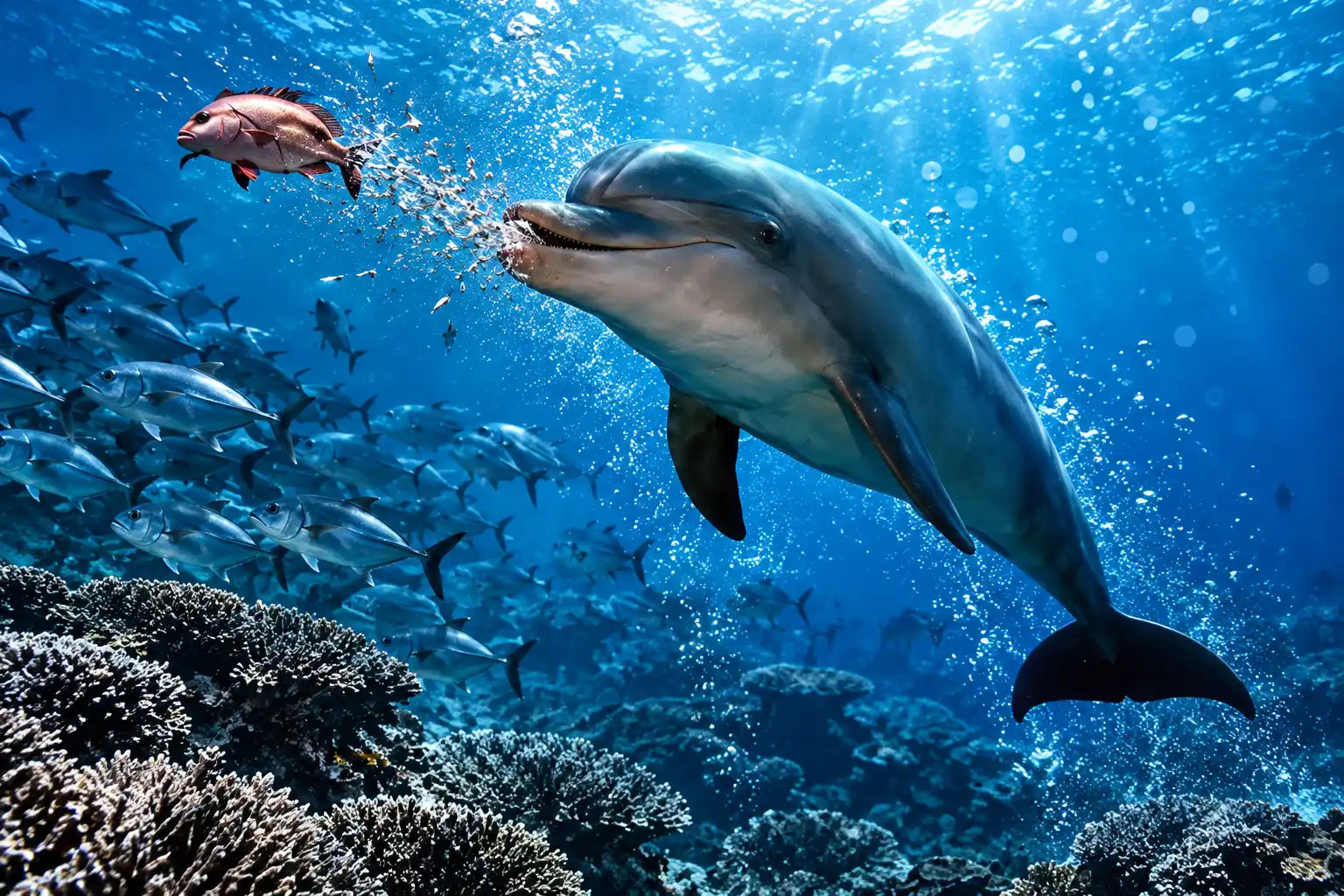
Bubbles, a Great Barrier Reef dolphin, was filmed 11 times making bigeye trevally vomit so he could eat their stolen catch.

An adult bottlenose dolphin off Lady Elliot Island ate another animal’s meal 11 times on camera, and never the fish that caught it. Locals call him Bubbles. Between June 2021 and October 2025, researchers logged 20 foraging records of the same male among schools of bigeye trevally. In 11 of those records, the trevally threw up and he swallowed the expelled prey while the fish swam off.
The study, published 13 September 2026 in Ecology and Evolution, treats that sequence as the first detailed case of kleptoparasitism in a cetacean, the group that includes dolphins, whales and porpoises. The gross part is easy to share. The harder point is that a solo dolphin found a way to farm work other fish had already done, in water too shallow and too brief for most surveys to notice.
Eleven Meals Taken From Someone Else’s Hunt
Lead author Romney Edwards-Francis, a PhD student at the University of the Sunshine Coast, first heard about the habit from master reef guide Pieter Demmers and marine biologist Jacinta Shackleton, then saw it while snorkelling for the Leaf to Reef project. GoPro 9 and GoPro 10 cameras, plus clips from resort guests, supplied the record. Photo-identification matched every tape to one animal: notches on the trailing edge of the dorsal fin and a V-shaped scar on the right flank.
Staff at Lady Elliot Island Eco Resort have watched him on the western side of the cay since at least 2017. The compiled scientific record is thinner than that reputation, and it skips a calendar year.
THE FIVE DAYS ON CAMERA
| Date | Foraging records | Feeding events |
|---|---|---|
| 28 August 2021 | 4 | 4 |
| 6 June 2022 | 3 | 1 |
| 26 October 2024 | 3 | 2 |
| 10 October 2025 | 7 | 3 |
| 16 October 2025 | 3 | 1 |
| Total | 20 | 11 |
Those 11 meals are 55% of the taped foraging records. The paper’s authors, including corresponding author Asia Armstrong at UniSC and marine ecologist Jeremy J. Kiszka at Florida International University, argue the repeat is what matters. A one-off chase that ended in vomit could be a hunt that failed. The same steps, year after year, look like a tactic.
He Picks One Fish and Waits
Kleptoparasitism is stealing food already caught by another. Frigatebirds do a version in air, harrying other seabirds until they disgorge. Bubbles does it in less than 10 metres of reef, and he does not take the trevally. Shackleton, who is also an underwater photographer on the paper, boiled the routine down for guests long before the journal issue came out.
He basically chases this one fish. The fish throws up. He eats the vomit.
Jacinta Shackleton, marine biologist and underwater photographer, Lady Elliot Island
The team turned the tapes into an ethogram, a list of named moves, so the sequence could be scored the same way each time.
THE CHASE SEQUENCE
- Scanning: Slow swimming with sharp turns, the head swinging side to side while echolocation clicks run.
- Targeting: The head locks onto one trevally and stops sweeping the school.
- Chasing: He speeds up, stays close, and mirrors the fish’s turns, even after a breath at the surface.
- Ingestion: The trevally regurgitates; he grabs the expelled food, eats it, and lets the fish leave.
A fifth move, rushing, is a lunge that does not produce vomit. After a successful swallow he goes back to the school and starts again, up to 10 times in 30 minutes. He was never filmed eating a bigeye trevally, or any other prey, during these bouts. The 11 kleptoparasitic interactions on video always played out as a solitary hunt, even though he has been seen with other dolphins at the island.
Lady Elliot Island Gives Him a Standing Buffet
The stage is a 0.35 square kilometre coral cay about 80 km off the Australian mainland, ringed by an 84-hectare reef flat. All of the observations sat off the western side, in water less than 10 metres deep and within 100 metres of shore. Bigeye trevally, Caranx sexfasciatus, gather there with a regularity the paper treats as the ecological condition that makes theft pay. They grow to 85 cm in length, blue-green above and silver below, and they hunt smaller fish that they often swallow whole.
That last detail is the quiet mechanic. What comes back out of a stressed trevally is likely a recent catch, not a slurry. Bubbles is intercepting prey another predator has already packed into its gut, which is a different job from sprinting down a live fish in open water. Edwards-Francis said common bottlenose dolphins tend to forage in groups, yet Bubbles was always observed foraging alone, and that a specialised tactic may cost less than chasing fast prey without help.
Armstrong said the years of repetition suggest he may have learnt to target the fish with the fullest bellies. Resort staff estimate they see the behaviour for 4 to 5 consecutive days at least twice a month, which is anecdotal and sits outside the 20 scored records. Edwards-Francis has also said the vomit may be an easy snack on days when hunting has gone badly, because the trevally school is in the same place nearly every day. The paper is blunter about the accounting: nobody has measured whether stolen guts return more energy than catching fish himself.
Vivienne Foroughirad, a marine biologist at Texas A&M University who was not on the study, has pointed out that a hefty trevally takes time and effort to handle, so expelled food may simply be easier. That still leaves the trevally paying twice, once to catch the meal and again to lose it, which is the definition of a host in this kind of theft.
The Sounds on a 75-Second Tape
One high-quality GoPro clip from 28 August 2021 was stripped to audio and scored in Raven. In 75 seconds the dolphin produced 200 calls lasting 32.85 seconds in total. Most of that sound is not the click train people picture when they hear the word echolocation.
WHAT THE 75-SECOND TAPE CAUGHT
- Low-frequency tones: 182 of the 200 calls were low-frequency tonal sounds, in 15 bouts, at 2.4 calls per second, only while he was pursuing a trevally.
- Tone length: Those tones averaged 88.5 milliseconds, with a mean peak frequency of 498.5 Hz.
- Click trains: Between the tone bouts he produced 18 echolocation bouts averaging 0.88 seconds (range 0.36 to 2.14 seconds).
- Bout size: Tone bouts held 12.1 calls on average, and ran from 2 to 27 calls.
Armstrong has said echolocation lets dolphins tell small differences in a target’s shape, size and structure, so he may be picking the fish most likely to yield a meal. The paper also floats a second job for the mid-chase clicks and tones: raising stress until the gut empties. Both ideas are still hypotheses. The sample is one tape from one animal, and the authors say more recording is needed before anyone can treat the sounds as a tool that forces vomit.
There is another reading that the tapes cannot kill. A trevally that throws up may be dumping a decoy, the way some prey animals shed food to make a predator stop. If that is the fish’s move, Bubbles has learned to wait for it. If the sounds help, he has learned to push. Either way, the fish leaves alive and lighter.
Earlier Whale Chases Never Showed a Stolen Meal
The claim of a first detailed cetacean case is narrower than the headlines. The paper itself lists two earlier reports in which false killer whales, Risso’s dolphins and northern right whale dolphins charged sperm whales, and the sperm whales were seen regurgitating. Palacios and Mate described one such meeting in 1996. Smultea and colleagues described another in 2014. Nobody filmed the attackers eating what came up, so kleptoparasitism stayed unverified.
Janet Mann, a marine biologist at Georgetown University, has separately described a dolphin taking fish from cormorants. That is theft from a bird, on or near the surface, which is easier to watch than a gut being emptied under a reef. Bottlenose dolphins already run a long list of local hunting styles, from mud-ring feeding and crater feeding to herding fish against barriers and taking catch from gill nets. The Lady Elliot tapes add a style that looks less like teamwork and more like pickpocketing.
BUBBLES ON THE WESTERN REEF
- 2017: Resort staff already know the male on the western flat; the paper dates anecdotal kleptoparasitism to December of that year.
- 12 July 2018: Video shows him with another adult and a calf around bigeye trevally, possibly scanning. No feeding is scored.
- 28 August 2021: First fully scored feeding day, four records and four meals in 33 minutes 11 seconds of tape.
- June 2022 to October 2025: Four more camera days, no 2023 row, last meals on 10 and 16 October 2025.
- 13 September 2026: The Nature Notes paper appears in Ecology and Evolution, volume 16, issue 9. UniSC issued its statement two days later.
Armstrong has little patience for the idea that the method stains a friendly species. She said the picture of dolphins as the good guys of the sea has more to do with anthropomorphism, and perhaps with the fact that they appear to be smiling. Dolphins are predators, she said, and they hunt whether the prey was stolen from another species or not. Shackleton has watched guests wrinkle their faces and then lean in, caught by the cleverness more than the mess.
What Other Dolphins May Already Be Doing
Jason Bruck, a marine biologist at Stephen F. Austin State University who was not involved, called the repeated tapes compelling evidence that this was more than a lucky leftover. He still will not grant the inner plot.
We can’t yet say the dolphin is pursuing the fish because it expects it to regurgitate.
Jason Bruck, marine biologist, Stephen F. Austin State University
That caution sits next to the authors’ own limits. They have one specialist, a predictable school, and a few dozen minutes of scored video. They have not shown that other dolphins at Lady Elliot Island, or anywhere else, run the same play. They have not shown that the 2018 adult and calf learned it. They have not weighed a stolen gut against a hunted fish. The paper still argues that rare foraging tactics in cetaceans are likely underreported because watching them underwater, for long enough, is hard.
Edwards-Francis put the practical problem in the university statement: the work is monitoring animals underwater over long periods, and drones plus underwater surveys may be how to close the gap. The authors also point to animal-borne video tags. They posted open video files of the chases with the paper and asked other field teams to say if they have seen the same thing. Clips of the Lady Elliot hunts were still moving around in late September 2026, weeks after the issue date, which is how a Nature Note becomes a public argument about what counts as hunting.
The second cost sits with the trevally. A school that is reliable for a dolphin is also a school that can be mined, fish by fish, without a single trevally being killed on camera. If the trick is unique to Bubbles, the reef has one clever thief. If it is only unique on tape, then a lot of meals are changing mouths where nobody is holding a GoPro.
Frequently Asked Questions
What Is Kleptoparasitism in Animals?
It is facultative theft, used when the thief can find a dense, predictable host and when stealing beats hunting alone, a pattern most often scored in seabirds near nesting sites rather than as a species-wide rule. Roseate terns, common terns and magnificent frigatebirds have all been studied doing it close to colonies, and in those papers only some individuals bother; the rest keep fishing offshore. Shackleton has compared the aerial version to a V8 supercar race, with a frigatebird locking onto a white-capped noddy until the smaller bird throws up fish that get plucked off the surface.
How Did Researchers Know It Was the Same Dolphin?
Small cetaceans are identified by permanent nicks on the dorsal fin, especially the trailing edge, a method laid out by Würsig and Jefferson, plus scars that hold their shape across years. Bubbles was also sexed as male by the distance between the genital slit and the anus and by the absence of mammary slits. Figure 1 in the paper lines up photographs from 6 July 2022, 26 October 2024, 10 October 2025 and 16 October 2025, credited to Jayne Jenkins, Pieter Demmers, Victoria Kronsell and Michael Ingram.
Do Bottlenose Dolphins Usually Eat Trevally?
Other Tursiops populations do. The Lady Elliot paper cites diet work from Western Australia, Florida and the Comoros archipelago in which bottlenose dolphins eat several Caranx and Pseudocaranx species, so the surprise is not that trevally are on the menu but that this male was never seen taking the fish themselves during the scored hunts. The authors suggest he may have started by chasing trevally as prey and then switched after an “easier meal” came back up, which remains a reconstruction, not a filmed origin story.
Has Food Stealing Been Seen in Other Whales or Dolphins?
Only as incomplete scenes, until this study. The sperm-whale chases from 1996 and 2014 produced regurgitation without a filmed payoff, and Mann’s cormorant case is a surface theft from a bird. Reef sharks, European eels and some cichlids have been recorded stealing in water, which is why the authors think the scarcity in marine mammals is partly an observation problem. Leaf to Reef, the UniSC-led monitoring programme that caught Bubbles, is funded through the Reef Trust Partnership with the Great Barrier Reef Foundation, the Queensland government, Lendlease and the Fitzgerald Family Foundation, a reminder that this record exists because people were already in the water for something else.
The tape that still nags is the one from 12 July 2018, when Bubbles shared the school with another adult and a calf and nobody scored a meal. If that calf ever starts chasing trevally until they throw up, the shortcut will have left the one animal who made it famous.

Final Fantasy Resonance Turns a Dead Gacha Into HD-2D

PHP2Shell Forced Sites Offline While Exploits Stalled

Kindle+ Folds AI Audiobooks Into the Page-Read Fund

Chip Stocks Fall as the Bond Rally Cheapens AI Spend

Comcast’s Record Odyssey Quarter Doubles as the Exit

Microsoft 365 Auth Fault Took Down Exchange and Teams

Xbox Caps Game Pass Cloud Gaming at 15 Hours

OpenClaw 2.0 Ships a Team Workplace With Host-Trust Defaults

OpenAI Unveils GPT-6 Astra With a Critical Cyber Label

Diesel Breaks Its Record as the White House Claims Credit
-
 NEWS2 months ago
Microsoft 365 Auth Fault Took Down Exchange and Teams
-
 GAMING2 months ago
Xbox Caps Game Pass Cloud Gaming at 15 Hours
-
 NEWS2 months ago
OpenAI Unveils GPT-6 Astra With a Critical Cyber Label
-
 NEWS2 months ago
OpenClaw 2.0 Ships a Team Workplace With Host-Trust Defaults
-
 BUSINESS2 months ago
Diesel Breaks Its Record as the White House Claims Credit
-

 LIFESTYLE2 months ago
Squishy Dumpling Toys Recalled After Hiding Illegal Water Beads
-

 BUSINESS2 months ago
ChargePoint Stock Rally Prices Wilmer’s Three-Year Cash Plan
-

 AUTO2 months ago
Tesla Puts Its Wheel-Free Cybercab on Austin Streets