
NEWS
China’s 2028 Mars Map Comes With a New Geologic Clock
China will complete a 1:5 million Mars geologic map by 2028 and bid to set a Chinese time scale from Zhurong’s water dates.

China plans to complete a 1:5 million geologic map of Mars by the end of 2028, and to publish a Chinese scheme for dividing Martian geologic time. Hou Zengqian revealed the plan on September 28, 2026, at a symposium of the Institute of Geology under the Chinese Academy of Geological Sciences.
The sheet is due the same year Tianwen-3 is slated to launch. Hou, who leads that sample-return mission as chief scientist, said China wants the new time scheme to become an international consensus.
Hou Tied the Map to a New Martian Clock
Hou is an academician of the Chinese Academy of Sciences. He told the symposium that the map will reconstruct the planet’s watery past and, on that basis, lay out a Chinese scheme for dividing Martian geologic time.
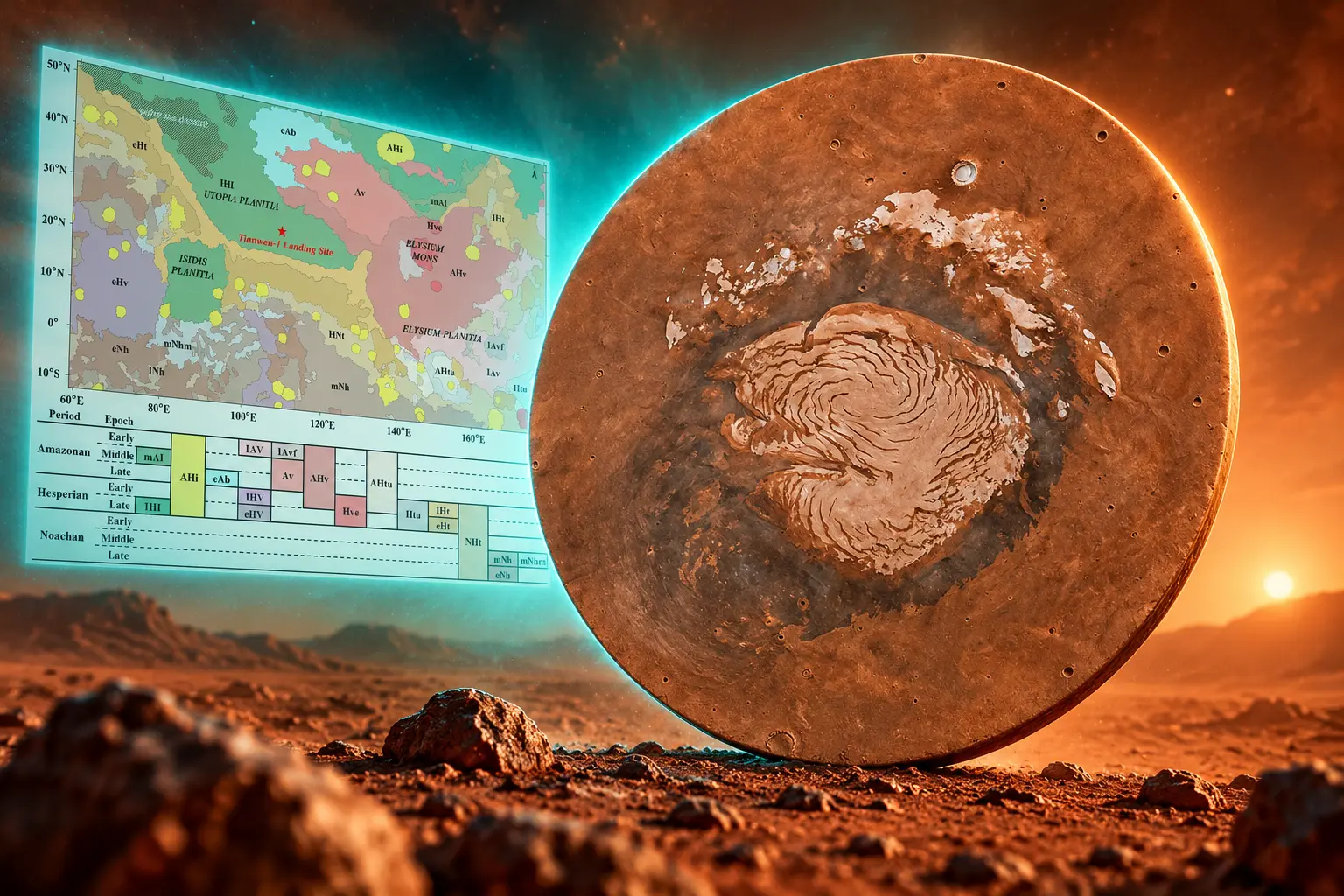
That is the bid inside the cartography. The current timeline splits Mars into the Noachian, Hesperian and Amazonian periods, defined by densities of visible craters rather than absolute dates. Hou said China aims to make its new scheme an international consensus.
The work will draw first on Tianwen-1, including the Zhurong rover, and will add U.S. and European Space Agency probe data so orbital and ground records sit in one stack. Imagery, spectra, radar, gravity and magnetic readings are to be fused into a global database that couples those physical fields.
Artificial intelligence will interpret the stack. Geologists’ rules will be written into large models so a unit remains explainable, and multi-scale attention is meant to move from local mineral identification to global tectonic units. The team said it will also release what it calls the world’s first intelligent geologic map of Mars.
Yang Zhiming, director of the Institute of Geology, said geologic mapping has been a core task there for 70 years, with charts running from regional and national sheets to the Moon and now Mars. That work, he said, has given China’s planetary program the scientific grounding to decide where to go, what to explore and why.
Three Periods Still Rest on Crater Counts
The clock Hou wants to revise is not a blank page. For half a century, mappers have dated Martian ground by how densely it is pocked with craters: older surfaces collect more hits, younger ones look cleaner. The three-period scheme grew out of that method.
Noachian time is the early, heavily cratered crust. Hesperian time covers the middle volcanic and flood plains. Amazonian time is the long, cold stretch that still runs. Those names are the shared language of almost every paper on Mars geology.
Crater counts give relative order. They do not pin a lava flow or a shoreline to a calendar year. Hou’s point is that rover data now offer dates in billions of years, and those dates are what he wants written onto the new sheet.
A Chinese time scale that won citations would sit beside the crater-count eras, or slowly replace them in papers that use Chinese landing data. It would not erase the older maps. It would decide which clock a sample from Tianwen-3 is said to have come from.
What Zhurong Radar Found Under Utopia Planitia
Zhurong landed on May 15, 2021, in southern Utopia Planitia at 109.925°E, 25.066°N, and drove toward proposed ancient shorelines. It went into forced hibernation on May 18, 2022, after travelling 1,921 metres. Hou said its findings will be written into the 2028 map: a vast ancient ocean still existed some 3.5 billion years ago, and short-lived floods possibly occurred 1.6 billion years ago.
Those two figures are the dates the new clock is being asked to carry. On the crater-count scale, 3.5 billion years falls in the Hesperian, and 1.6 billion years falls deep in the Amazonian. A flood that late is exactly the kind of event a three-period crater scheme does not resolve on its own.
THE ZHURONG RADAR CUT
- 76 reflectors: Low-frequency rover radar picked out 76 subsurface dipping layers along the drive.
- Depth band: The layers sit 10 to 35 metres down, imaged along an uninterrupted 1.3 km northward traverse.
- Dip angles: Inclinations run from 6° to 20°, with an average of 14.5°, pointing toward the northern lowlands.
- Reading: The geometry matches terrestrial coastal deposits and argues against a short, local melt pond.
A February 24, 2025, paper in the Proceedings of the National Academy of Sciences describes those dipping coastal deposits under Utopia Planitia as evidence of an ancient ocean in the northern plains during the Late Hesperian. The authors compared the dips with beach and tidal deposits on Earth and discarded fluvial, wind-blown and lava origins for that stretch of ground.
A Short Flood Long After the Ocean
Hou’s 1.6 billion year floods are a separate claim from that coastal geometry. They sit on earlier rover radar that showed stacked sedimentary sequences under the same basin, and they are the date he said the new map will absorb. If that late pulse holds, Amazonian Mars was not only ice and dust.
The map team is treating both the older ocean and the later floods as missing rungs in the climate evidence chain. Once they are drawn as units, a Chinese time scheme can hang named intervals on them instead of leaving them inside broad crater-count bins.
A paper atlas will not settle the argument by itself. The version that labs will actually use is a queryable sheet, which is why the group is wrapping geologic rules around the models rather than handing the mapping to a black box.
A Finer Globe Than the 2014 USGS Sheet
Mars already has a global geologic map. The U.S. Geological Survey posted its 1:20 million global geologic map of Mars on July 14, 2014, as Scientific Investigations Map 3292, prepared for NASA and led by Kenneth L. Tanaka. That sheet used post-Viking topography, thermal infrared mosaics, spectra and radar sounding, and it sorted the surface into 44 geologic units.
China’s planned global sheet is 1:5 million, four times finer than that 2014 globe. The landing-area map at 1:50,000 is 100 times finer than China’s own global product. Those scales are the difference between a wall chart and a site survey.
HOW THE SHEETS COMPARE
| Product | Scale | Who issued it | Status |
|---|---|---|---|
| Global Mars geologic map | 1:20 million | USGS, Tanaka and others | Posted July 14, 2014 |
| Global Mars geologic map | 1:5 million | China, Version 1.0 | Due end of 2028 |
| Landing-area geologic map | 1:50,000 | China | Due end of 2028 |
| Lunar geologic atlas | 1:2.5 million | Chinese Academy of Sciences | Unveiled April 21, 2024 |
The 2014 USGS globe remains the reference most researchers open. China’s 2028 set does not retire it. It adds a tighter global cut, a site map for Tianwen-3, thematic atlases, and a time scheme the authors want other labs to adopt.
The Same Institute Already Mapped the Moon
Hou said the Mars project will provide a template for future mapping of the Moon, Venus and asteroids. The Institute of Geology has already been down that road. On April 21, 2024, Chinese teams unveiled a 1:2.5 million geologic atlas of the Moon, in Chinese and English, after work that began in 2012.
WHAT THE LUNAR ATLAS ALREADY DID
- Craters and basins: The atlas marks 12,341 impact craters and 81 impact basins across the whole Moon.
- Rocks and structures: It maps 17 types of rocks and 14 types of structures, plus landing sites.
- Quadrangles: Thirty standardized sub-maps make up the full lunar set, with a separate lithologic map and a tectonic map.
- Time scale: The compilers used an updated lunar time scale rather than copying Apollo-era period names wholesale.
The Institute of Geology of the Chinese Academy of Geological Sciences was one of the groups on that lunar atlas, alongside the Institute of Geochemistry of the Chinese Academy of Sciences and several universities. Yang’s 70-year mapping shop is the through line. The Moon sheet was the method. Mars is the next body. Venus and asteroids are the ones Hou named after that.
A Chinese standard for planetary legends, already used on the Moon, is what makes a Martian time scheme more than a caption. If the same shop draws both worlds, papers that cite the lunar atlas already sit one step from citing the Mars clock.
Life Search Is the Reason the Samples Matter
On September 4, 2026, in Hefei, Hou said searching for potential signs of life is the top scientific goal of Tianwen-3, planned for launch around 2028. He said China expects to finalize the landing site by the end of 2026, while Version 1.0 of the 1:5 million map is scheduled for the end of 2028. The map and the launch share a year. They are not the same deadline.
Regardless of whether signs of life are found, the returned Martian samples will have irreplaceable scientific value.
Hou Zengqian, chief scientist of Tianwen-3, 2026 International Deep Space Exploration Conference, Hefei
Hou said Tianwen-3 aims to accomplish sampling and return in a single mission, unlike NASA’s Perseverance rover, which has collected shallow surface samples and still needs a follow-up flight to bring them home. He said the Chinese mission has entered the stage of developing engineering prototypes.
Over the past half-century, he said, 47 Mars exploration missions have been conducted worldwide, yet sample return has not landed. Candidate sites are being scored on geologic age, water history, habitability and the chance of preserving biosignatures. China, he added, will build a planetary protection laboratory to keep Earth life off Mars and to isolate whatever comes back.
FROM ROVER TO RETURN
- May 15, 2021: Zhurong lands in southern Utopia Planitia and begins its drive toward proposed shorelines.
- May 18, 2022: The rover enters forced hibernation after 1,921 metres on the surface.
- April 21, 2024: China unveils the 1:2.5 million lunar geologic atlas that the Institute of Geology helped compile.
- February 24, 2025: The Utopia radar paper publishes the 76 dipping coastal reflectors.
- September 4, 2026: Hou says Version 1.0 of the Mars map is due at the end of 2028 and the landing site by the end of 2026.
- September 28, 2026: He presents the full mapping plan, including the Chinese time scheme, at the Institute of Geology.
- End of 2026: China expects to lock the Tianwen-3 landing site.
- End of 2028: The 1:5 million map, the 1:50,000 site map and the thematic atlases are due, in the same year as the planned launch.
- Around 2031: Samples, if the mission holds, are due on Earth.
Hou said analyses at microscopic, molecular and isotopic scales could deepen knowledge of Mars geology and habitability even if no biosignature appears. He also said Tianwen-3 will work with scientists around the world. The map is the document that tells a foreign lab, and a Chinese one, which unit a scoop came from and which interval on the new clock that unit is said to occupy.
The landing site is still open until the end of 2026. After that, the 1:50,000 sheet has a target. The 1:5 million globe and the time scheme are due at the end of 2028, the year Hou still gives for launch, with samples on Earth around 2031 if the flight holds.

Final Fantasy Resonance Turns a Dead Gacha Into HD-2D

PHP2Shell Forced Sites Offline While Exploits Stalled

Kindle+ Folds AI Audiobooks Into the Page-Read Fund

Chip Stocks Fall as the Bond Rally Cheapens AI Spend

Comcast’s Record Odyssey Quarter Doubles as the Exit

Microsoft 365 Auth Fault Took Down Exchange and Teams

Xbox Caps Game Pass Cloud Gaming at 15 Hours

OpenClaw 2.0 Ships a Team Workplace With Host-Trust Defaults

OpenAI Unveils GPT-6 Astra With a Critical Cyber Label

Diesel Breaks Its Record as the White House Claims Credit
-
 NEWS2 months ago
Microsoft 365 Auth Fault Took Down Exchange and Teams
-
 GAMING2 months ago
Xbox Caps Game Pass Cloud Gaming at 15 Hours
-
 NEWS2 months ago
OpenAI Unveils GPT-6 Astra With a Critical Cyber Label
-
 NEWS2 months ago
OpenClaw 2.0 Ships a Team Workplace With Host-Trust Defaults
-
 BUSINESS2 months ago
Diesel Breaks Its Record as the White House Claims Credit
-

 LIFESTYLE2 months ago
Squishy Dumpling Toys Recalled After Hiding Illegal Water Beads
-

 BUSINESS2 months ago
ChargePoint Stock Rally Prices Wilmer’s Three-Year Cash Plan
-

 AUTO2 months ago
Tesla Puts Its Wheel-Free Cybercab on Austin Streets