
LIFESTYLE
Home Depot’s EcoSmart Ant Killer Skips EPA Review
EcoSmart insect killer granules at Home Depot are 2% clove oil, unregistered by EPA, and the label says heavy rain can mean buying the bag again.

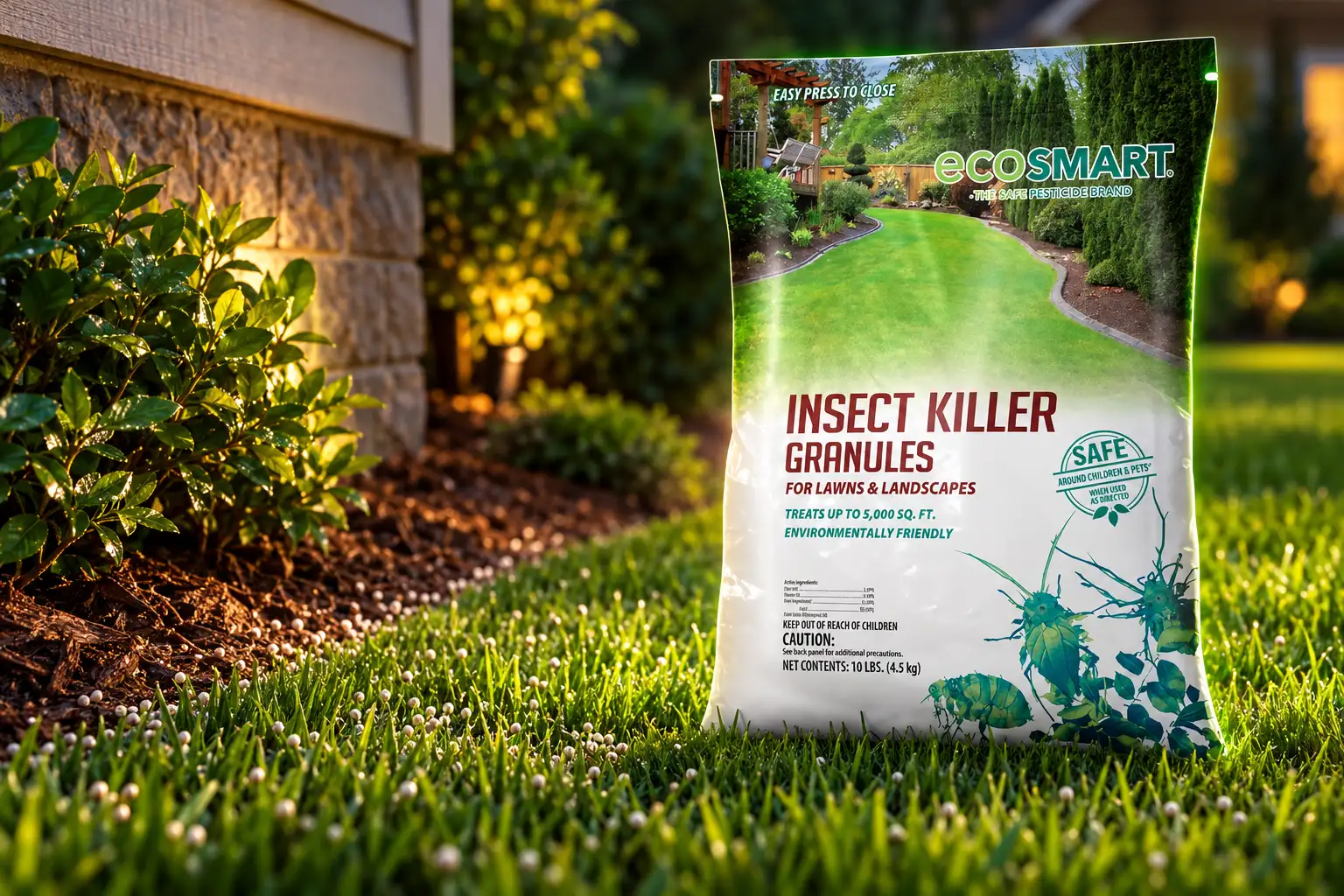
Kittrich’s EcoSmart insect killer, a 10-pound Home Depot granule bag priced at $29.98, is 2 percent clove oil and has not been registered by EPA. Thyme oil makes up another 0.60 percent. Corn cobs and wintergreen oil fill the rest.
The listing carries a 4-star average from 97 reviews. Spreading needs no water to start, and the company says the mix is safe around children and pets when used as directed. The same label tells you to keep the bag out of children’s reach, skip food plants, and buy more after a heavy rain.
A $29.98 Bag of Clove Oil and Corn Cobs
Home Depot sells the 10-pound sack as EcoSmart Natural Plant-Based Insect Killer Granules for Lawns and Foundations, model ECSM-33631-01EC. Kittrich Corporation of Pomona, California, makes it. The front of the bag promises coverage up to 5,000 square feet and a plant-oil formula.
The formula is thin. Active ingredients are clove oil at 2.00% and thyme oil at 0.60%. Inert ingredients are 97.40 percent, named on the label as corn cobs and wintergreen oil. EcoSmart, a division of Kittrich, says the granules kills by contact and do not need watering to work.
THE BAG IN FIGURES
- Store price: Home Depot lists the 10-pound bag at $29.98.
- Oil load: 2.00% clove oil and 0.60% thyme oil on ground corn cobs.
- Light-rate coverage: 5,000 square feet when you put down 2 pounds per 1,000 square feet.
- Heavy-rate coverage: 2,000 square feet when you put down 5 pounds per 1,000 square feet.
On lawns the label calls for 2 to 5 pounds per 1,000 square feet, with a criss-cross pass so the spreader hits the stated rate. At the light end, one bag matches the 5,000-square-foot claim. At the heavy end, used for bad infestations, the same bag covers 2,000 square feet. That gap is the first place the “one bag, whole yard” pitch bends.
EPA Has Not Registered This Insect Killer
The back panel is plainer than the aisle card. Kittrich prints a sentence most shoppers never read:
This product has not been registered by the US Environmental Protection Agency. Kittrich Corporation represents that this product qualifies for exemption from registration under the Federal Insecticide, Fungicide, and Rodenticide Act.
EcoSmart Insect Killer Granules label, Kittrich Corporation
That exemption is FIFRA section 25(b), the minimum-risk rule. Since 1996, EPA has let certain plant oils and other listed ingredients skip federal registration if a product meets six conditions for minimum-risk pesticides. Clove oil and thyme oil are on the allowed active list. Corn cobs and wintergreen oil are the named inerts on this bag.
WHAT THE 25(B) SKIP MEANS
- Allowed actives only: Every killing ingredient must already sit on EPA’s short 25(b) list.
- Named inerts: Every other ingredient must be a listed inert, and the label must name them all.
- No disease claims: The bag may say it kills ticks. It may not say it kills ticks that carry Lyme disease.
- No EPA blessing: A line such as “recommended by EPA as safe and exempt” is treated as misleading, because the agency never signed off on the SKU.
EPA says it does not review those products and does not check their labels. The producer decides the mix meets the rule. States can still demand their own registration before the bag is sold. Shoppers who read “environmentally friendly” and “won’t contaminate groundwater” are reading Kittrich’s marketing, not an EPA finding on this granule.
The agency also warns that “chemical-free” can mislead, because a 25(b) bag is still a mix of listed chemicals. Some store copy around this product uses that kind of line anyway. The label itself does not.
Grams of Clove Powder, Not a 2 Percent Granule
A 2013 paper in the Journal of Economic Entomology is the study most often used to dress clove oil as a fire-ant tool. Lekhnath Kafle and Cheng Jen Shih tested clove powder and clove compounds on workers of the red imported fire ant, Solenopsis invicta. Clove powder killed fire ants in six hours at 3 and 12 milligrams per square centimeter, with 100 percent mortality, and repelled 99 percent of workers within three hours. Eugenol, the main clove compound, acted fastest. The authors wrote that clove compounds “may provide another tool” where ordinary insecticides do not fit.
That lab rate is not the Home Depot bag. Three milligrams per square centimeter is 2.79 grams of clove powder on each square foot. Twelve milligrams is 11.15 grams per square foot. EcoSmart at the light lawn rate puts down about 0.907 grams of granules per square foot, and only 2.00 percent of that is clove oil, or about 18.1 milligrams of oil on each square foot. The powder in the paper and the oil on the cob are different materials, so the numbers are not a head-to-head dose. They still show the gap between a lab dusting of clove and a 2 percent granule meant to be walked on by kids and dogs.
The paper also used fire ants, a mound-building species with a different biology than the pavement and odorous house ants most suburban lawns actually host. Kittrich’s label says “ants.” It does not name species. A separate fire-ant drench sits in the same brand family, which is a clue that the broadcast granule is not sold as a mound cure.
What the Label Says It Kills
The kill line on the 2020 label is short: ants, aphids, brown dog ticks, crickets, fleas, flies, and mealybugs. That list is the legal claim. Longer pest rosters on some store pages are sales copy, not the panel Kittrich filed as the directions.
Aphids, fleas, flies and ticks are why the “invite the birds, keep the ants” pitch sits on a contact insecticide. Birds can eat around the granules, per the company’s wildlife line. The invertebrates those birds hunt are on the target list. The bag also tells users to keep any insecticide off spots where they want insects, which is the quiet limit on the bird story.
Use sites are lawns, a 2-foot band around the house, and ornamental or flower beds. Spreader charts name Scotts Turf Builder and Earthway models, with a note that settings are approximate and the spreader should be calibrated. Hand broadcasting is allowed if you wear a glove and wash after.
LABEL RATES AND REAPPLY WINDOWS
| Where you spread it | Rate on the label | Reapply window |
|---|---|---|
| Lawns | 2 to 5 lb per 1,000 sq ft | Every 2 to 4 weeks, or as needed |
| Ornamental landscapes | 1 to 2 lb per 500 sq ft | Every 4 to 6 weeks, or as needed |
| Foundation band | 1 to 2 lb per 500 linear ft, 2 ft wide | Every 2 to 4 weeks, or as needed |
Brown dog ticks, not “ticks,” is the 25(b) claim style. Naming a disease those ticks carry would push the product out of the exemption and into a full EPA file, with data to match. The bag stays on the pest, as a pest.
Heavy Rain Sends Buyers Back for Another Bag
The granules are not watered in. The label says they should not be watered after you spread them, and that they “may need to be re-applied after a heavy rainfall.” Lawn users are told to come back every two to four weeks anyway. Landscape beds stretch to four to six weeks. The product is a contact film on corn cob, not a bait that workers carry into a nest, so rain and mowing both work against it.
That is the treadmill inside the eco pitch. A 12-week summer on the two-week lawn interval is six bags. At $29.98, that is $179.88 before tax, and that math assumes you stay at one 10-pound sack per round. The four-week interval is three bags, or $89.94, if rain does not dump you back at the store. A quarter-acre of turf at the heavy 5-pound rate would need more than one bag each time, because 10 pounds then covers 2,000 square feet.
Owners keep running into the same limit. A four-star review put it in one line: “Worked pretty well but heavy rains cause the product to be reapplied fairly soon after. Could be costly to keep up. It does work though.” Other buyers say the first storm moved the granules off the grass, or that the mix was “useless if it rains.” Some Florida users wrote that they hit fire-ant mounds directly and saw activity drop the next morning. Others said ants walked over the spread and kept going. Four stars from 97 Home Depot reviews is that split, not a wipeout and not a miracle.
Wet climates turn the bag into a subscription. Dry spells let a single pass last through the printed window. The label already told you which kind of yard you have.
Kid-and-Pet Safety Comes With a Caution Line
Kittrich’s selling point is the yard with a toddler and a dog. “Safe to use around children and pets when used as directed” is on the brand site and on the store listing. The panel still opens with Keep Out of Reach of Children and CAUTION. Wintergreen oil, the scent in the inert mix, “may be harmful if swallowed and may irritate skin,” and vapors “may trigger breathing difficulty in asthmatics and others with allergies.” If it gets on skin, the first-aid block says to rinse for 15 to 20 minutes. If swallowed, do not make the person vomit unless a poison center says so.
WHAT THE DIRECTIONS ACTUALLY ASK
- Food plants: Do not use on vegetables, fruits, or other food-producing plants.
- Hands: Wear a glove for hand spreading and wash with soap after.
- Water: Do not water the granules in; wait out rain, then spread, and plan to repeat after a heavy storm.
- Storage: Keep the bag cool and dry, reseal the press strip, and throw empty bags in the trash.
The groundwater and wildlife lines are Kittrich’s. EPA has not scored this SKU for birds, fish, or wells. Thymol, the thyme compound, is used in some registered hive mite treatments and has a separate, reviewed file in that use. Thyme oil in an unregistered lawn granule is not that file. The practical rule on the bag is narrower: follow the rates, keep it off the tomato row, and treat pollinator beds as off-limits if you still want those insects.
What you are buying, then, is a corn-cob carrier with a small oil load, sold in the kid-safe aisle because the ingredients sit on a federal skip list, not because this bag went through the test battery a registered lawn insecticide faces. It can knock down crawling pests on contact. It also asks you to keep paying for that contact each time the sky opens.
Kittrich’s own panel is the part that holds up. Reapply every two to four weeks on lawns, and again after a heavy rainfall.
Frequently Asked Questions
Is EcoSmart Insect Killer Registered With EPA?
No. Kittrich states on the bag that EPA has not registered the granules and that the company believes the mix qualifies for the FIFRA 25(b) minimum-risk exemption. EPA does not confirm individual 25(b) products and does not review their labels. Some states still require their own registration before the product can be sold, so a legal bag in one state is not automatic proof it is cleared in another.
What Are the Active Ingredients in EcoSmart Granules?
The 10-pound label lists clove oil at 2.00 percent and thyme oil at 0.60 percent as the actives, with corn cobs and wintergreen oil as the 97.40 percent inert fraction. A 2016 safety sheet from Kittrich gives the same oil percentages and the CAS numbers 8000-34-8 for clove oil and 8007-46-3 for thyme oil. Wintergreen is the ingredient behind the mint smell and the swallow-and-skin first-aid notes.
Does EcoSmart Insect Killer Need to Be Watered In?
No. The directions say the granules should not be watered after you spread them, which is the opposite of many fertilizer and residual insecticide labels that want a light irrigation to move the active into the thatch. Kittrich’s mix is a contact treatment on the surface of corn cob pieces, so extra water is framed as a waste of product, not a step that turns it on.
Can You Use EcoSmart Granules in a Vegetable Garden?
The label says no. Allowed sites are lawns, a perimeter band around the house, and ornamental or flower gardens. Vegetables, fruits, and other food-producing plants are carved out. If ants are in a kitchen garden, this bag is the wrong tool on its own terms, even before you get to residue rules for food crops.
How Often Should EcoSmart Lawn Granules Be Reapplied?
On lawns and along the foundation, the printed window is every two to four weeks, or as needed, with a separate note to repeat after a heavy rainfall. Ornamental beds are every four to six weeks. Those are calendar instructions, not a promise the ants stay gone. A yard that gets weekly summer storms will hit the “as needed” clause sooner than a dry one.
Why Does the Bag Say Caution If It Is Marketed as Pet Safe?
The pet-and-child line is always qualified with “when used as directed.” The hazard block still lists CAUTION, Keep Out of Reach of Children, and wintergreen oil’s swallow and breathing risks, including trouble for people with asthma. Those two voices are both on the same package: the aisle claim is about skipping conventional lawn chemistry, and the caution block is about an essential-oil mix that can still irritate skin and lungs.
The 10-pound sack at $29.98 is still a contact oil on corn cob, sold without an EPA product review. Kittrich’s panel already names the bill: every two to four weeks on the lawn, and again after a heavy rain.

Final Fantasy Resonance Turns a Dead Gacha Into HD-2D

PHP2Shell Forced Sites Offline While Exploits Stalled

Kindle+ Folds AI Audiobooks Into the Page-Read Fund

Chip Stocks Fall as the Bond Rally Cheapens AI Spend

Comcast’s Record Odyssey Quarter Doubles as the Exit

Microsoft 365 Auth Fault Took Down Exchange and Teams

Xbox Caps Game Pass Cloud Gaming at 15 Hours

OpenClaw 2.0 Ships a Team Workplace With Host-Trust Defaults

OpenAI Unveils GPT-6 Astra With a Critical Cyber Label

Diesel Breaks Its Record as the White House Claims Credit
-
 NEWS2 months ago
Microsoft 365 Auth Fault Took Down Exchange and Teams
-
 GAMING2 months ago
Xbox Caps Game Pass Cloud Gaming at 15 Hours
-
 NEWS2 months ago
OpenAI Unveils GPT-6 Astra With a Critical Cyber Label
-
 NEWS2 months ago
OpenClaw 2.0 Ships a Team Workplace With Host-Trust Defaults
-
 BUSINESS2 months ago
Diesel Breaks Its Record as the White House Claims Credit
-

 LIFESTYLE2 months ago
Squishy Dumpling Toys Recalled After Hiding Illegal Water Beads
-

 BUSINESS2 months ago
ChargePoint Stock Rally Prices Wilmer’s Three-Year Cash Plan
-

 AUTO2 months ago
Tesla Puts Its Wheel-Free Cybercab on Austin Streets