
AUTO
Geely Takes 30% of Nio Power With Swap Assets
Geely takes 30% of Nio Power with Yiyi fleet-swap assets and 640 million yuan, opening the swap network while Geely’s own swap cars stay unagreed.

Geely Holding will take a 30% stake in Nio Power for its Yiyi fleet-swap unit plus 640 million yuan in cash. The Hong Kong filing sets a post-money valuation of about 16 billion yuan ($2.37 billion) for the swap-and-charge company.
Most of that price is not cash. Geely is folding a taxi-and-ride-hail swap operator into Nio’s stations, and the consumer Geely cars that would use those stations are still only a plan.
NIO and Geely Enter into Comprehensive Strategic Partnership in Charging and Battery Swapping
On September 28, 2026, NIO and Geely Holding Group entered into a comprehensive strategic cooperation in charging and swapping. The two sides have reached broad agreement on cooperation… pic.twitter.com/pPjHjTO9W0
— NIO (@NIOGlobal) September 28, 2026
How Geely’s 30% Stake in Nio Power Is Structured
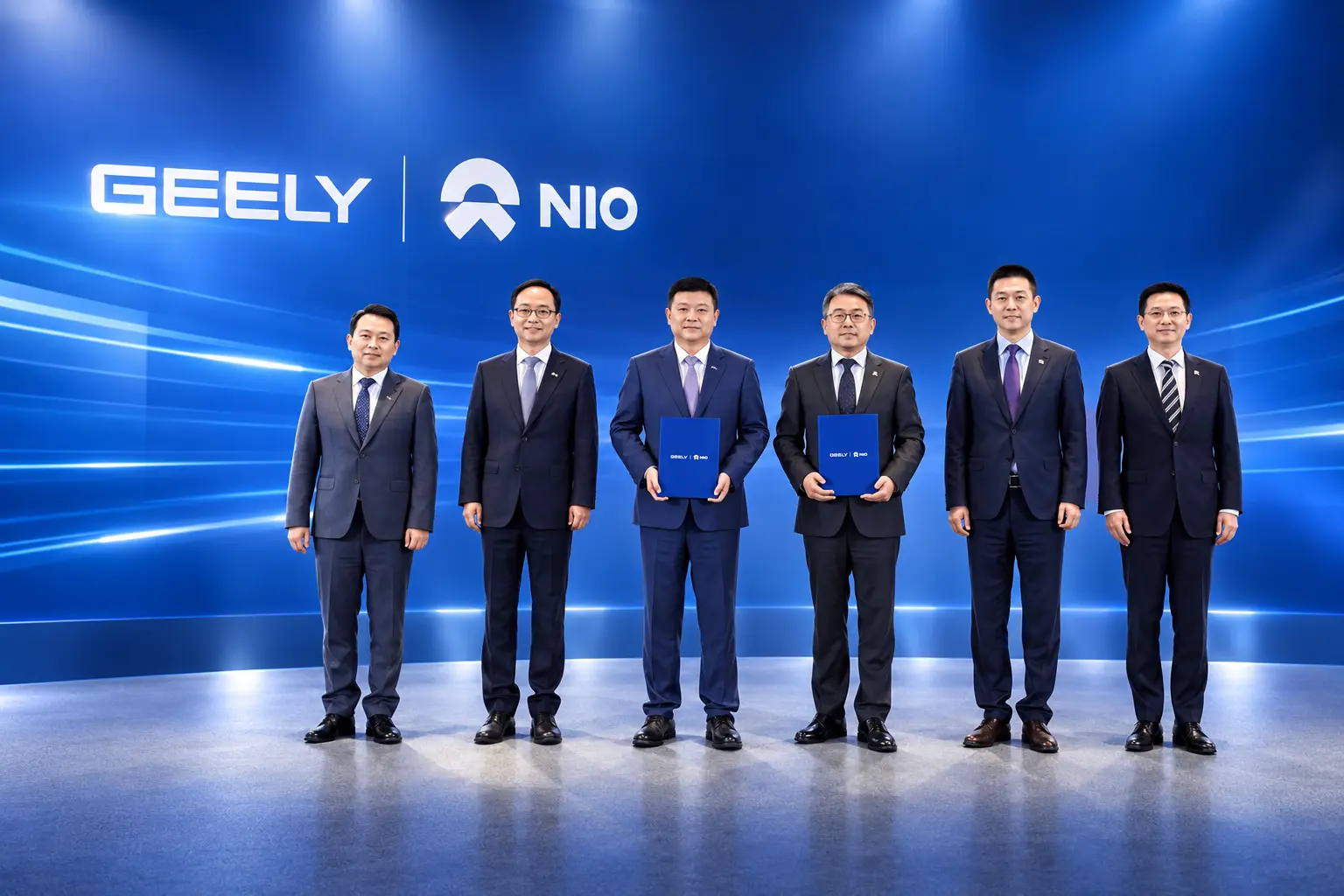
Nio Inc. said on September 28, 2026, that it had signed definitive agreements with subsidiaries of Zhejiang Geely Holding Group. The signing was in Hangzhou. Stanley Qu, Nio’s chief financial officer and head of Nio Power, and Ron Dai Qing, rotating president of Geely Holding, exchanged the papers. William Li, Nio’s founder, chairman and chief executive, and Andy An Conghui, chief executive of Geely Holding, watched, with Nio president Qin Lihong and Geely Automobile Group chief executive Gan Jiayue.
A Geely subsidiary will subscribe for new shares in NIO Energy Investment (Hubei) Co., Ltd., the legal name of Nio Power, using 100% of Yiyi Internet Technology (Chongqing) Co., Ltd. plus 640 million yuan in cash. After closing, NIO Holding Co., Ltd. (NIO China) keeps a controlling 63.6%. The Wuhan Guangchuang Emerging Technology Phase I Venture Capital Fund Partnership, the existing outside investor, keeps 6.4%.
NIO POWER OWNERSHIP AFTER CLOSING
| Holder | Stake | Condition |
|---|---|---|
| NIO China | 63.6% | Controlling interest |
| Geely Holding subsidiary | 30.0% | Can fall to 20% if milestones are missed |
| Wuhan Guangchuang fund | 6.4% | Held since the 2024 round |
Thirty percent of 16 billion yuan is 4.8 billion yuan of implied value. Only 640 million yuan of that is cash, so the rest of Geely’s ticket is Yiyi’s equity. Geely’s holding is tied to operating milestones and may be cut after closing, though not below 20%. Geely also received an option to put in another 640 million yuan in cash, which would lift its stake to 34% and cut NIO China’s holding to 60%, ignoring any milestone cut. That option expires at the earlier of two years after closing or the day Nio Power signs a new financing round.
Both legs still need regulatory approvals and other closing conditions. Nio did not give a closing date. Listed Nio Inc. shareholders sit one layer above NIO China, so the new Geely slice is of the energy unit, not of the listed company itself.
Yiyi’s Fleet Stations Fold Into Nio Power
Yiyi Power is Geely Holding’s swap company for commercial mobility, not a second Nio-style passenger network. After closing, its fleet swap business is to be integrated into Nio Power, which will keep tuning that network for commercial drivers. An Conghui said at the Hangzhou signing that Geely’s swap network had served only CaoCao Mobility’s commercial fleets, and that CaoCao’s swappable vehicles will move onto Nio Power’s network once the deal is in force.
Yiyi’s own site, with figures dated June 2025, listed 436 stations in 44 cities, 103,078 swap vehicles sold and 45,662 swaps a day. Those counts are more than a year older than Nio’s September 27, 2026, tally. They still show the shape of what Geely is contributing: a smaller, taxi-heavy net, not a matching set of passenger stations.
THREE NETWORKS IN THE DEAL
| Network | Footprint | Job | Date of figure |
|---|---|---|---|
| Nio Power Swap | 4,126 stations | Passenger swap for Nio, ONVO and firefly | September 27, 2026 |
| Yiyi Power | 436 stations, 44 cities | Commercial fleet swap | June 2025 |
| Haohan Energy | 2,500 stations, more than 12,000 connectors, 232 cities | Geely-group charging | Nio statement, September 28, 2026 |
Qin Lihong told the Hangzhou room that commercial fleets are a clean way to fill swap stations, because the cars work inside a tight city grid. He used Hangzhou as the example. Nio Power already runs 80 swap stations there, Geely has more than 20, and together that is over 100. With dispatch, he put the theoretical gap from a point in urban Hangzhou to the nearest station at about 1.5 km. He also said a decent swap net could save a fleet vehicle as much as 90 minutes a day, and that separating the battery from the car, in a rental model like Nio’s BaaS, could cut related costs over a commercial vehicle’s life by as much as 40%.
An Conghui added that Geely is developing robotaxi models that will use battery swap from the start, and that those cars will be rolled out on the combined network. That is the volume Nio Power is buying with the 30% it is giving up: taxis, ride-hail and robotaxis that swap several times a day, not a one-off cash cheque.
Nio’s Swap Stations Were Already Opening to Other Brands
Nio has spent more than a decade and more than 20 billion yuan building a swap system that started as a perk for its own drivers. As of September 27, 2026, that system is no longer a single-brand garage. Nio’s newsroom counted 4,126 Power Swap Stations across China, plus 5,307 charging stations with 30,598 piles, for 9,433 sites in all. The company said it had delivered over 125 million battery swaps and over 99 million charging sessions, and put the combined total at more than 220 million services.
Fifth-generation swap stations went live on August 7, 2026, and already serve the Nio, ONVO and firefly brands. Li said those bays can take the body size of more than 95% of passenger cars on the market, which is how a Geely, or anyone else, gets in without a new station design. On the plug-in side, more than 85% of the electricity Nio’s charging net has supplied already went to drivers of other brands.
THE NETWORK NIO IS OFFERING TO SHARE
- Three house brands: Nio, ONVO and firefly already use the same fifth-generation swap stations.
- Body fit: Li said the new stations cover more than 95% of passenger vehicles on sale.
- Charging already open: More than 85% of electricity through Nio’s charging net has gone to other brands.
- Open invite: Li said the charging and swap work with Geely is open to more carmakers.
Nio Power wants 10,000 Power Swap Stations in operation by 2030, with yearly electricity use across the net above 10 billion kWh. Reaching that figure means more than doubling the 4,126 stations it had on September 27, 2026. Li said Geely’s resources would speed that build and that he was more confident in the 10,000-station target because of the tie-up. He also said swap stations can store power for the grid, for peak shaving and frequency work, which is a second use for a site that already holds several packs.
The collaboration between NIO and Geely in charging and battery swapping is open to the broader industry. We welcome and look forward to more industry peers joining us in creating a better recharging experience for users, supporting the industry’s transition to low-carbon, green energy, and shape a sustainable and brighter future.
William Li, Founder, Chairman and CEO of Nio, Hangzhou signing, September 28, 2026
Li put the industrial case in plainer words at the same event, asking how carmakers can cut duplicate spending and build, share and connect the kit together. That is the second move inside the 30% sale. Nio is not only taking a partner’s assets. It is telling the rest of the industry that the stations are available.
CATL Never Took the Nio Power Stake It Was Offered
Nio Power has been raising outside money for the same reason Li wants 10,000 stations: the net is expensive. The unit was set up in Wuhan in May 2017 and was wholly owned by Nio Holding until the first outside cheque.
HOW OUTSIDE MONEY ENTERED NIO POWER
- November 2023: Nio and Geely Holding enter a battery-swap strategic partnership on standards and sharing, short of equity.
- March 2024: The same pair extend the work to charging-network links.
- May 31, 2024: The Wuhan Guangchuang fund leads a 1.5 billion yuan strategic investment in Nio Power, the unit’s first outside capital. Nio later said it still held about 90% after that round.
- March 2025: Nio says CATL is advancing an investment of up to 2.5 billion yuan in Nio Power, alongside a plan to build a joint passenger swap net.
- September 28, 2026: Geely agrees to take 30% of Nio Power for Yiyi Power plus 640 million yuan in cash. CATL is not on the ownership table Nio published.
The CATL cheque, if it had landed at the top of the range, would have been almost four times Geely’s cash. It did not appear in the cap table issued with Monday’s filing. What arrived instead is a rival carmaker bringing fleet stations and a smaller cash line, with a clawback if Yiyi’s operations miss their marks. That mix fits a unit that needs cars through the bays more than it needs a single large cash investor sitting on the register.
Geely, for its part, launched a new AI-powered charging system on September 23, 2026, five days before the signing, and is selling the idea of a very short plug-in stop. Buying into swap anyway only makes sense if the target is fleets that cannot sit on a cable, and a station map in Chinese cities that Nio already paid to plant.
Charging Assets Move the Other Way Through Haohan Energy
The swap sale is only one side of the paper. At the same time, NIO China agreed to subscribe in cash for new shares in Zhejiang Haohan Energy Technology Co., Ltd., Geely’s charging company, and will hold 10.0% after closing. Haohan will use that cash to buy some charging assets from Nio. The filing does not say how much Nio will pay, or which sites change hands.
Haohan Energy has 2,500 charging stations and more than 12,000 connectors in 232 cities, per Nio’s September 28 statement. Geely’s group plan is much larger: more than 22,000 charging stations and more than 100,000 connectors by the end of 2027, including more than 15,000 smart charging stations and over 50,000 smart connectors, with a goal of covering every county-level city in China. Li said some of Nio’s charging resources will be folded into Haohan after close, and that the two will work together on technology, sites, building and operations to support that 22,000-station goal.
Nio already has 5,307 charging stations of its own, more than Haohan’s current count, and most of the power those sites sell already goes to other brands. The 10% slice in Haohan is how Nio keeps a claim on a charging build that Geely wants to take nationwide, while moving some of its own chargers onto a partner’s books. Swap stays inside Nio Power, under Nio’s control. Charging is the piece the two are willing to mix more freely.
Recharging networks are public infrastructure that serve society as a whole. They should be built together, shared openly, and connected across networks, so that users ultimately benefit the most.
Andy An Conghui, CEO of Geely Holding Group, Hangzhou signing, September 28, 2026
Geely’s Consumer Swap Cars Stay on Paper
The press language is broader than the filing. Nio’s newsroom said the two sides will jointly develop unified swap technology and standards for consumer models, that Geely Holding will develop battery-swappable passenger cars, and that Nio Power will serve those cars. The Hong Kong announcement is tighter. It says Nio and Geely Holding have made preliminary plans for swap technology and related services on both Geely consumer models and Geely commercial mobility businesses, and that finishing and carrying out those plans depends on further talks.
WHAT WE KNOW
- Signed terms: Definitive agreements dated September 28, 2026, set Geely at 30% of Nio Power for Yiyi’s equity plus 640 million yuan in cash, at about 16 billion yuan post-money.
- Control: NIO China stays at 63.6% after closing, with a 20% floor on Geely’s stake if operations miss targets.
- Fleet path: Yiyi’s commercial swap business is to be integrated into Nio Power, and An Conghui said CaoCao’s swappable vehicles will use that net.
WHAT IS UNCONFIRMED
- Closing: No date. Both the Nio Power issue and the Haohan subscription still need regulatory approvals.
- Haohan cheque: Nio did not disclose how much cash it will pay for 10% of Haohan, or which charging assets Haohan will buy.
- Passenger cars: Geely’s consumer swap models, and the services around them, remain preliminary and subject to more talks.
- Second cheque: Geely’s extra 640 million yuan option has not been exercised and is time-limited.
Until those passenger cars exist, the 30% stake is a fleet-and-infrastructure deal with an option on a wider standard. Geely can still build plug-in cars that never visit a Nio Power bay. Nio can still run ONVO and firefly through stations that no Geely badge ever enters. The filing leaves that door open on purpose.
Hangzhou Shows How Shared Stations Fill In
Qin’s Hangzhou arithmetic is the concrete version of Li’s peer invite. If 50 stations sat evenly across that city, he said, a driver would usually be within 5 km of one. The two companies already have over 100 there, which is why he could talk about a 1.5 km gap once dispatch is working. That density is what a CaoCao car, or a robotaxi that An Conghui says will swap by design, needs in order to stay on the road without a long charge. It is also what a private Geely swap model would need, if that model ever leaves the “further discussions” line in the filing.
Nio Inc. had delivered 1,260,485 vehicles across its three brands as of September 1, 2026. That installed base is why the 4,126 stations already see over 125 million lifetime swaps. Geely’s volume sits in a different channel, taxis and, later, robotaxis, that can put more swaps on the same concrete. The 640 million yuan cash does not build 10,000 stations. The bet is that shared use will.
Geely’s extra 640 million yuan option stays open for two years after closing, or until Nio Power signs a new financing, whichever comes first. The passenger Geely swap cars are still a discussion. The fleet stations, and the 30% of Nio Power that pays for them, are the part written into the agreements.
Disclaimer: This article is news reporting and analysis of a corporate transaction and is for information only. It is not investment advice, a solicitation to buy or sell Nio Inc. securities, Geely-related securities, or any interest in Nio Power or Haohan Energy, and it is not legal advice on the agreements described. Readers should consult a qualified financial adviser and, where needed, a securities lawyer before acting on any deal term, valuation or stake figure. The figures and statuses here reflect company filings and statements as of the article’s date and may change with closing, milestone tests, option exercise or later financing.

Final Fantasy Resonance Turns a Dead Gacha Into HD-2D

PHP2Shell Forced Sites Offline While Exploits Stalled

Kindle+ Folds AI Audiobooks Into the Page-Read Fund

Chip Stocks Fall as the Bond Rally Cheapens AI Spend

Comcast’s Record Odyssey Quarter Doubles as the Exit

Microsoft 365 Auth Fault Took Down Exchange and Teams

Xbox Caps Game Pass Cloud Gaming at 15 Hours

OpenClaw 2.0 Ships a Team Workplace With Host-Trust Defaults

OpenAI Unveils GPT-6 Astra With a Critical Cyber Label

Diesel Breaks Its Record as the White House Claims Credit
-
 NEWS2 months ago
Microsoft 365 Auth Fault Took Down Exchange and Teams
-
 GAMING2 months ago
Xbox Caps Game Pass Cloud Gaming at 15 Hours
-
 NEWS2 months ago
OpenAI Unveils GPT-6 Astra With a Critical Cyber Label
-
 NEWS2 months ago
OpenClaw 2.0 Ships a Team Workplace With Host-Trust Defaults
-
 BUSINESS2 months ago
Diesel Breaks Its Record as the White House Claims Credit
-

 LIFESTYLE2 months ago
Squishy Dumpling Toys Recalled After Hiding Illegal Water Beads
-

 BUSINESS2 months ago
ChargePoint Stock Rally Prices Wilmer’s Three-Year Cash Plan
-

 AUTO2 months ago
Tesla Puts Its Wheel-Free Cybercab on Austin Streets