
AUTO
GM Keeps CarPlay in a Window on Its 2027 Trucks
GM will put new software on 2027 Silverado and Sierra trucks later in 2026, with CarPlay in a card so native apps stay on screen.

General Motors will put new cabin software on the 2027 Chevrolet Silverado 1500 and GMC Sierra 1500 later in 2026, with CarPlay running in a card beside native truck apps. The automaker is launching that layout on its highest-volume pickups first, then using over-the-air updates to change what does not work.
Buyers who already own a Silverado or Sierra stay on the older software.
GM Is Shipping the New Interface on Its Bestselling Trucks
On Sept. 15, 2026, GM said the new user interface will debut on those light-duty pickups, the company’s highest-volume vehicles, before it spreads through the rest of the brands. Executive Director of Software Product Management Michael Wahlstrom said the truck market used to shrug at cabin software. He said infotainment now ranks among the top three reasons people buy a new vehicle, and truck shoppers have started to care about screens the way car shoppers already do.
U.S. buyers took 588,709 Silverados and 356,218 Sierras in 2025, or 944,927 trucks under those two nameplates, including heavy-duty and electric versions. That was nearly one in three of the 2,853,299 vehicles GM sold in the country that year. The 1500s that actually get this software are the light-duty twins: 362,909 Silverado 1500s and 230,156 Sierra 1500s, or 593,065 trucks.
THE VOLUME BET
- Light-duty 1500s: 593,065 U.S. sales in 2025, the first trucks to get the new interface.
- All Silverado and Sierra: 944,927 U.S. sales in 2025 across light-duty, heavy-duty, and electric versions.
- Who gets it: new 2027 1500s only; current owners keep the previous software.
- How it changes: GM said over-the-air updates will rewrite the first version after those buyers start using it.
Colin McCormick, group product manager for Google built-in, projection, and profiles at GM, said the usual move is to try a new experience on a lower-volume vehicle first. The company flipped that. It wants as many truck owners as possible on the new layout so the first round of complaints arrives fast.
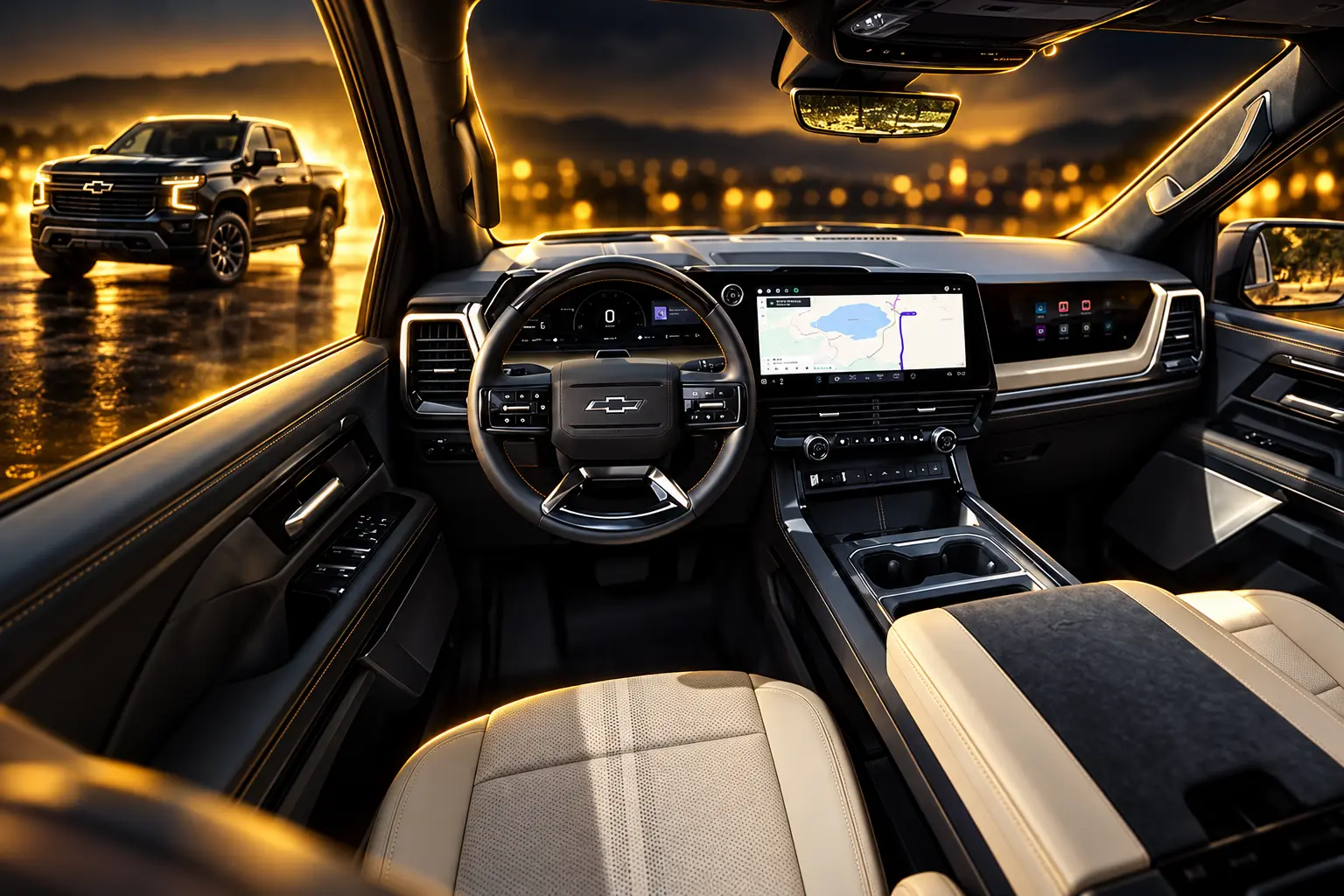
A Large Card for CarPlay on the Center Screen
Phone mirroring still works in these gas trucks. It no longer owns the glass. When an iPhone connects, the phone icon on the home screen becomes a CarPlay icon. Tap it and Apple’s apps open inside a large card. Android Auto uses the same window. The native home button puts the split home view back, with GM’s own trailering and vehicle tools still in reach.
GM’s own wording is blunt about the hierarchy. Content from CarPlay and Android Auto “appears in a large card window alongside native apps like trailering and vehicle status.” McCormick said the old full-screen takeover forced drivers to hop back and forth when they needed a truck function that phone software cannot see.
I think we’re landing in a spot where we don’t have a customer that has to decide, “Oh, I’m going to use projection, or, oh, I want to use the native system.” That’s our sweet spot.
Colin McCormick, group product manager for Google built-in, projection, and profiles, GM
Truck owners have spent years asking for the opposite: CarPlay stretched across the big center screen, the way Ford and Ram already let it run. This layout answers a different complaint, the one GM’s own executives have used to defend killing mirroring in electric models, that jumping between Apple’s world and the truck’s world feels clunky. The card keeps Google built-in on stage. The phone is a guest that does not get the house keys.
WHAT STAYS ON SCREEN WITH CARPLAY
- Trailer tools: hitch data, brake-controller gain, and trailer tire pressures can sit in the left pane while CarPlay occupies the larger right pane.
- The home map: the default split view keeps a large native map up, with media, fuel use, or trailer numbers beside it.
- Climate: physical HVAC buttons remain; airflow direction opens as a flyout instead of wiping the whole display.
- Calls: an incoming call shrinks to a timer bar at the top rather than seizing every pixel.
- Quick settings: a swipe down from a line at the top of the screen, in the style of a phone shade, reaches device switching, privacy, and a microphone mute.
Wahlstrom described the goal as one room, not a hallway of rooms. People like CarPlay and Android Auto because those systems are built around the phone they already know, he said, and they still want the truck’s own tools without a scavenger hunt.
As we evolve our UI systems, we want customers to feel like they’re interacting with a single experience rather than moving from room to room inside a house.
Michael Wahlstrom, executive director of software product management, GM News Q&A
Why the Company Started With Light-Duty Pickups
Wahlstrom gave two reasons. Light-duty pickups are the volume play, so the new interface reaches a lot of people quickly. The second reason is cultural. Cabin software used to be a car-shopper problem. He said that has changed in trucks, which is why GM is willing to put a new design system on the Silverado and Sierra instead of a low-run EV or a luxury sedan.
The interface is built as a shared kit. Wahlstrom said common parts across GM’s screen shapes should let the company spend less time redrawing the same menus for each model. A press summary of the launch said the same foundation is meant to cover electric, gas, and diesel vehicles. That is the longer wager sitting under the CarPlay card: get the interaction model right on the trucks America already buys, then stamp it onto the rest of the roster.
HOW GM GOT TO A CARPLAY CARD
- March 2023: GM says future electric models will drop Apple CarPlay and Android Auto, starting with the 2024 Chevrolet Blazer EV, and will lean on Google built-in instead.
- October 22, 2025: CEO Mary Barra says new gas vehicles should lose phone mirroring too as the company moves toward a centralized computing platform, a change she tied to a major rollout.
- Late October 2025: spokesperson Malorie Lucich says existing vehicles will not lose CarPlay or Android Auto, and both “will remain available in all GM gas-powered vehicles for the foreseeable future.”
- June 16, 2026: Chevrolet shows the next-generation 2027 Silverado 1500, with a digital cockpit standard across the seven-trim lineup and an expected on-sale date at the end of 2026.
- June 25, 2026: GMC shows the 2027 Sierra 1500, with first trucks due at dealers before the end of 2026.
- September 15, 2026: GM details the new interface, including picture-in-picture phone mirroring, for those 2027 1500s.
- 2028: GM plans to put its next computing platform, and later eyes-off Super Cruise, on the Cadillac Escalade IQ first.
The 2027 trucks sit in the gap Barra opened and Lucich narrowed. They still offer CarPlay. They also train drivers to treat it as a pane inside GM’s own home screen, which is the habit the company will need if it ever does cut mirroring on gas models.
More Than 60 Inches of Glass, and Some Real Buttons
Every 2027 Silverado 1500 and Sierra 1500 gets a class-leading 16.3-inch center display and a 12.2-inch driver information center, including the Work Truck. Upper trims add an 11.5-inch passenger screen, a 15-inch head-up display, and an 8.5-inch rear camera mirror. GMC says Denali Ultimate packs more than 60 inches of combined digital displays, the most in the half-ton class. Chevrolet makes the same “over 60 inches” claim on ZR2 and High Country.
McCormick, who lives in Michigan, said the extra area is there so tap targets can grow. Small buttons on a bouncing truck are a miss waiting to happen. Executive Director of Human Interface Design Sebastian Bauer said local backlight dimming on those panels is meant to pack in information without turning the cabin into a billboard. All of the new truck screens use full-array local dimming.
WHERE THE INCHES GO
| Display | Size | Fitment |
|---|---|---|
| Center touchscreen | 16.3 inches | Standard on every 2027 Silverado 1500 and Sierra 1500 |
| Driver cluster | 12.2 inches | Standard on every trim |
| Passenger screen | 11.5 inches | Standard on Silverado ZR2 and High Country, and on Sierra Denali Ultimate |
| Head-up display | 15 inches | Higher trims, including Denali Ultimate |
| Rear camera mirror | 8.5 inches | Part of the Denali Ultimate display stack |
GM kept physical buttons for core HVAC. Airflow direction is the function that moved onto a flyout. A few once-physical checks are now on screen; oil level is a virtual reading on the status page. A persistent light control still lives on the glass, which is the kind of choice that makes fleet drivers groan, and it sits next to climate switches that still have hardware.
UI designer Jace Stokes said research found owners like to live in split view. Older GM Android screens put the small pane on the right, farther from the driver, which is a long reach when you only want to skip a track. The new layout flips that. The small pane sits on the left. CarPlay, when you want it, takes the larger pane on the right, with trailer numbers or other truck data in the near pane. A garage-door control can appear in the bottom row when the truck is near home and disappear when it is not.
The passenger screen is a different product. Chevrolet fixes it in place. GMC hides the lower half behind an articulating cover and tucks storage behind the main display. Video on that panel is masked from the driver. Apps that already run on GM passenger glass, including YouTube, Disney+, Hulu, and SiriusXM, can land there, on top of a Google Play catalog GM expanded by over 200 new apps on Google Play for vehicles with Google built-in.
Trailer Dimensions Ride in the GM Account
The software brief spends unusual time on towing, because that is the job these trucks are paid to do. Plug in a trailer and the truck identifies it. Trailering numbers show up in the cluster and as a home-screen card. Owners type in the trailer’s size once; those figures can follow them to another GM vehicle through the same account. Google Maps can then build a route that fits the trailer.
The cluster also changes when a trailer is connected. Oil and transmission temperatures come forward. A hitch camera is there for lining up the ball. Off-road modes on ZR2 and AT4X pull pitch, roll, tire pressures, and transfer-case status into the driver’s display, with underbody cameras on those trims. Super Cruise visualization in the cluster now draws the truck and the vehicles in the next lanes, Bauer said, so a driver using hands-free can see that the system is looking at the same traffic.
Hands-free towing stays in the package on equipped trucks. Super Cruise is included for three years upon purchase of equipped vehicles, then a paid plan starts at $39.99 a month, with a cheaper yearly rate. GM said nearly 750,000 Super Cruise-equipped vehicles are on the road, across more than 20 models. On Denali Ultimate, the three-year plan is standard and GM cites more than 600,000 miles of compatible roads in the United States and Canada. On equipped Chevrolets, Google Maps will find Super Cruise-compatible roads and show how many minutes of a trip can be driven with hands off the wheel.
No Phone Mirroring in GM’s Electric Trucks
The card on the 2027 1500s does not reopen CarPlay in GM’s electric trucks. The 2023 decision still stands on those models. GM has argued that a built-in Google system, tied to Super Cruise and to vehicle data, beats a phone that can drop a wired or wireless session. Barra later said switching between the native interface and CarPlay could be distracting. Lucich’s follow-up left gas trucks on CarPlay “for the foreseeable future” and pointed to a slow move toward a more integrated setup as the centralized computing platform arrives.
That platform is scheduled to show up on the Escalade IQ in 2028. Until then, the 2027 Silverado and Sierra are the high-volume proof that GM can keep Google Maps, Google Play, and its own trailer stack as the home OS while still selling a CarPlay pane to shoppers who would walk if the icon disappeared. Native software is also the surface for paid plans after the included Super Cruise years run out. Phone mirroring does not help that ledger.
Chevrolet Vice President Scott Bell called the 2027 Silverado the most capable and advanced Silverado 1500 the brand has offered, with next-generation 5.7-liter and 6.6-liter V8s and a 16.3-inch screen even on work-spec trucks. GMC’s Michael MacPhee, global vice president of Buick and GMC, put the same glass-and-V8 pitch on Sierra. The software launch is riding along with that metal, which is why a UI experiment that automakers often hide on a low-run EV is about to sit in hundreds of thousands of driveways.
Software Already on the Road Stays Put
McCormick was clear on the cutoff. The new interface is for new 2027 Chevy Silverado and GMC Sierra trucks. People who already hold the keys keep the previous-generation screens. There is no retrofit path in the announcement. Over-the-air updates will iterate the new system after launch, he said, because some parts of version one will work and some will not.
That split will show up on used lots and at dealers. A 2026 Silverado with the older Google built-in layout and full-screen phone mirroring will sit next to a 2027 with a 16.3-inch panel, a CarPlay card, a virtual dipstick, and a swipe-down shade. Fleet managers who spec Work Trucks will get the big screens whether they want them or not. Denali Ultimate and High Country buyers will get the full wall of glass, a 16-speaker Bose system on the GMC flagship, and a passenger screen that can play the same catalog already creeping into GM SUVs.
WHAT WE KNOW
- The first trucks: 2027 Silverado 1500 and Sierra 1500, on sale later in 2026, carry the new interface.
- CarPlay and Android Auto: they remain, in a large card, on these gas 1500s.
- Electric GM models: they still ship without phone mirroring.
- Current owners: they stay on the previous software.
WHAT IS UNCONFIRMED
- Pricing: Chevrolet said 2027 Silverado 1500 MSRP will be announced later in 2026.
- Other nameplates: GM said the design system will expand, without a date for Tahoe, Yukon, or the next gas SUVs.
- The 2028 cutoff: Lucich left CarPlay on gas vehicles for the foreseeable future; Barra still pointed to a later, consistent drop as new computing hardware lands.
The first 2027 1500s are due at dealers before the end of 2026. After that, the feedback GM said it wants will come from people who bought a truck to tow, not from a software clinic. If the card feels like a smaller CarPlay than owners asked for, the company will hear it at the volume only Silverado and Sierra can produce.

Liberty Parks MotoGP on Formula 1’s Austin Stage

The Salary Cap Fight That Can Freeze Baseball’s TV Payday

The 2027 Mercedes GLE and GLS Keep Alabama Busy

Margaret Hamilton Dies at 90 With a Harder Fight Unfinished

Unity Parks Its Engine Inside Google’s Prompt Games

Diesel Breaks Its Record as the White House Claims Credit

Microsoft 365 Auth Fault Took Down Exchange and Teams

Xbox Caps Game Pass Cloud Gaming at 15 Hours

IFA 2026’s Weird Gadgets Are Building a Sensor Home

Tesla Puts Its Wheel-Free Cybercab on Austin Streets
-
 BUSINESS2 months ago
Diesel Breaks Its Record as the White House Claims Credit
-
 NEWS2 months ago
Microsoft 365 Auth Fault Took Down Exchange and Teams
-
 GAMING2 months ago
Xbox Caps Game Pass Cloud Gaming at 15 Hours
-
 NEWS2 months ago
IFA 2026’s Weird Gadgets Are Building a Sensor Home
-
 AUTO2 months ago
Tesla Puts Its Wheel-Free Cybercab on Austin Streets
-

 LIFESTYLE2 months ago
Squishy Dumpling Toys Recalled After Hiding Illegal Water Beads
-

 NEWS2 months ago
OpenClaw 2.0 Ships a Team Workplace With Host-Trust Defaults
-
 NEWS2 months ago
OpenAI Unveils GPT-6 Astra With a Critical Cyber Label