
NEWS
iQOO 16 Puts Samsung’s New M16 Panel on a Gaming Phone
iQOO 16 is on sale in China with a co-developed Samsung M16 panel, an 8,400 mAh cell, and Extreme Gen 6 from 5,999 yuan.

The iQOO 16 went on sale in China on 29 September with an 8,400 mAh battery and a Samsung M16 panel the brand helped design. It starts at 5,999 yuan (about $894) and uses Qualcomm’s 2 nm Snapdragon 8 Elite Extreme Gen 6.
iQOO’s Shenzhen statement put Samsung Display in the room from the emitting layer through the driver chip, and that is the part of the launch the spec sheets bury.
Samsung’s Best New Panel Showed Up on an iQOO
iQOO said it defined the 2K 165 Hz “Everest” panel with Samsung Display, then built it on M16 emitting material and 2K LEAD 2.0. The company now describes itself as a party that sets targets in the high-end display supply chain, not only a buyer of finished glass.
The 6.85-inch sheet is a flat AMOLED at 1,440 by 3,168 pixels, 19.8:9, with 165 Hz covering the top 100 daily apps and more than 50 games. iQOO calibrates 9.12 million subpixels per unit on its own line and claims 1.24 times P3 coverage in vivid mode, plus a polarizer-free stack that is supposed to look closer to natural light.
Tech analyst Ice Universe, who had a unit before the event, posted a side-by-side viewing-angle test against a Galaxy S26 Ultra. He said the Ultra still uses M14 material and a privacy optical structure that tints skin once the phone tilts, even with the privacy mode off.
The S26 Ultra uses M14 OLED, while the iQOO 16 has moved on to the newer M16 OLED, so the latter already has an advantage at the panel level.
Ice Universe, tech analyst, on X
Both panels still come from Samsung. The split is the stack. iQOO kept a conventional, polarizer-free LEAD path. The Ultra’s privacy layer is the trade, and off-axis color shows up in a car mount, on a pillow, and on a desk even if nobody “uses a phone at an angle” on purpose.
A 2K Screen That Uses Less Power Than 1.5K
The reason a 2K 165 Hz panel can sit on an 8,400 mAh cell without looking reckless is the power claim. vivo’s lab says 2K LEAD 2.0, which drops the polarizer for a nano lithography filter, draws 31% less than a same-size 1.5K panel that still uses the old stack.
THE M16 PEAK NUMBERS
- Local peak: 10,000 nits on a very small area, with iQOO’s own sun algorithm driving the boost.
- Full-screen peak: 2,800 nits, the figure that matters outdoors more than the headline local burst.
- Manual peak: 1,100 nits, with full-range DC dimming and PWM up to 3,300 Hz.
- First-frame brightness: iQOO lists 100% of the target on the first frame, which is the anti-smear claim in fast pans.
Instant touch sampling hits 5,000 Hz, multi-finger sampling 500 Hz. A new gyro is also sampled at 500 Hz, and iQOO says Q-flex, which reaches into the game’s render path, cuts swipe delay 28% against the same phone with the feature off. Honor of Kings is listed for native 165 frames at extreme quality, which is the software half of the panel pitch.
8,400 mAh Lands in Bodies as Thin as 8.3 mm
The cell is the other half of that bargain. The 8,400 mAh fifth-generation silicon anode is rated at 908 Wh/L, which is how iQOO keeps a single pack inside a slab that still starts at 8.3 mm. Charging stays at 100W wired and 40W wireless, the same pair as last year’s 15, with a 24-layer charge guard and a bypass mode iQOO calls full direct supply.
vivo’s lab quotes 32 hours of video and 8.6 hours of 165 FPS play. Those are lab hours, not a reviewer’s mixed day, and they still tell you where the company spent its density budget. The iQOO 15 opened in October 2025 with 7,000 mAh in an 8.1 mm body at 215 g to 220 g, so the new phone is heavier and a little thicker while adding 1,400 mAh.
THREE FINISHES, THREE WEIGHTS
- Track: 8.3 mm and 222.5 g, the lightest and thinnest of the three.
- Legend: 8.4 mm and 227.9 g, the cooler white with sputtered plating.
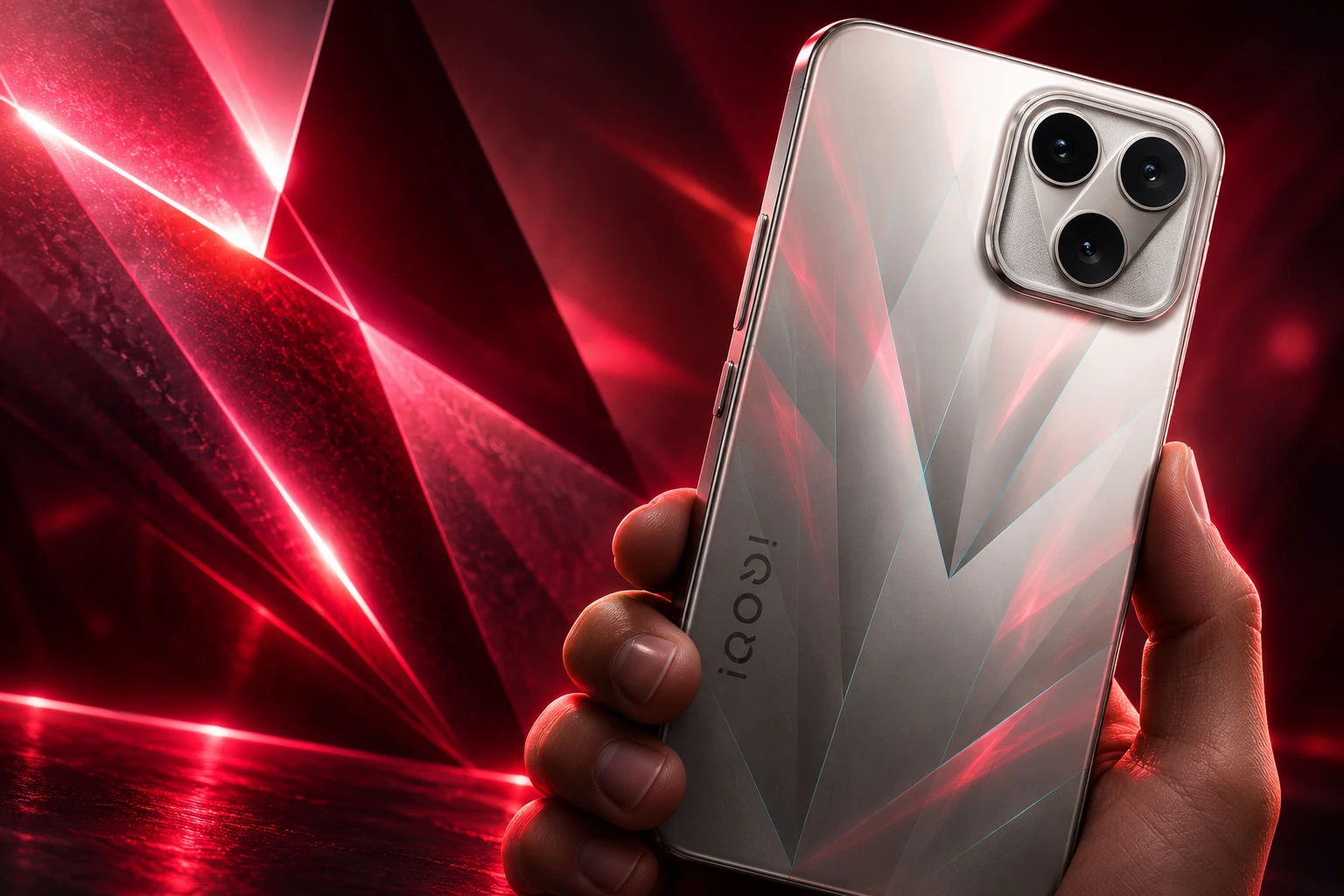
- Chasing Light: 8.55 mm and 229.8 g, the holographic glass that shifts red and blue with the viewing angle.
Chasing Light is the one in the teasers, and it is also the heaviest. Track is the one that makes the 8.3 mm claim true. IP68 is listed at 1.5 m for 30 minutes, and IP69 adds 80 C spray with the USB port facing down; liquid damage is still out of warranty, which is the usual fine print on those badges.
IQOO 16 AGAINST LAST YEAR’S 15
| Spec | iQOO 16 | iQOO 15 |
|---|---|---|
| Chip | Snapdragon 8 Elite Extreme Gen 6, 2 nm | Snapdragon 8 Elite Gen 5, 3 nm |
| Display | 6.85-inch 2K, 165 Hz, Samsung M16 | 6.85-inch 2K, 144 Hz, Samsung M14 |
| Battery and charge | 8,400 mAh, 100W wired, 40W wireless | 7,000 mAh, 100W wired, 40W wireless |
| China start price | 5,999 yuan | 4,199 yuan |
Heat plumbing grew with the cell. The vapor chamber is 8,500 mm², up 6% against the 15, with 29,453 mm² of three-layer graphite (up 20%) and 1,190 mm² of thermal gel (up 41%). That is the bill for running 165 Hz, 2K, and Extreme clocks in a body that is still under 9 mm.
The Extreme Chip Comes Without a Halo Tax
Qualcomm split its 2 nm flagship on 22 September into a standard Elite Gen 6 and an Extreme SKU. iQOO took Extreme, the same top bin Xiaomi and Honor have already put on sale, and did not hang a Pro or Ultra suffix on the phone. The digital series is the whole stack this year.
Qualcomm lists the Extreme Oryon cluster as two prime cores up to 5 GHz and six performance cores up to 4 GHz, and it calls the part the first mobile CPU to hit 5 GHz. Against last year’s Elite Gen 5, the company claims 13% more CPU throughput, 37% better CPU efficiency, 44% more GPU speed, 40% better GPU efficiency, 35% more NPU speed, and 33% better AI work per watt. vivo’s own AnTuTu 12.0.1 run on the 16 GB plus 1 TB unit printed 5,574,521.
WHAT EXTREME ADDS OVER LAST YEAR
- GPU extras: Adreno matrix cores and Adreno Neural Fusion, plus 18 MB of high-performance graphics memory on Qualcomm’s sheet.
- Video capture: 8K60 and 4K240 slow motion, with APV, which the standard Gen 6 chip does not list.
- NPU pool: 50% more shared memory than the last generation, which is the on-device model pitch.
- Memory on this phone: LPDDR5X Ultra at 9,600 Mbps, or Ultra Pro at 10,667 Mbps on the 1 TB model, with UFS 4.1 rather than the UFS 5.0 the chip can take.
That last line is the wrinkle. Extreme silicon arrived; the newest storage and LPDDR6 did not. iQOO still quotes a 30% UFS read gain against the 15, and it added a house Q4 gaming chip that it scores 15% faster, 19% quicker in cache, and 19% stronger in AI than Q3. Six titles get 2K plus 165 frames at once, which is the Q4 job the Snapdragon part is not doing alone.
A custom Monster scheduler sits under that, and iQOO has a Unreal Engine tie-in for Lumen and Nanite on mobile. Those are demo-reel words until a game ships them. The practical list is Honor of Kings at 165, a hundred-plus titles with 165 frame gen, and a vapor chamber that is only 6% larger than last year’s.
What Changed in the Triple 50-Megapixel Cameras
The rear module is still three 50 MP cameras, which is the same count as the 15, and iQOO still skips a 200 MP main. The main sensor is now a 1/1.3-inch type at f/1.68 with CIPA 5.5 stabilization, and iQOO claims 79% more light intake with NICE 3.0 reconstruction and its own HDR tone map. The selfie camera stays a 32 MP fixed-focus unit.
The 3x periscope is a Sony 1/1.95-inch type at f/2.65 with OIS, CIPA 5.0, 6x “lossless” zoom, and 100x digital. The ultrawide is a 1/2.75-inch type at f/2.05 with autofocus. Color modes match vivo’s own flagship set, and 4K Live shots can swap a cover frame after the fact. It is a night-and-zoom refresh, not a new camera architecture, and the 1/1.3-inch main is the one hardware step that will show up in dim rooms.
The “Tomorrow Porthole” island puts the three lenses on a mechanical-arm motif under clear glass. That is the design bet sitting next to the holographic Chasing Light back, and it is also why the heaviest finish picks up another 7.3 g over Track.
Five Apps Share One Screen in OriginOS 7
The phone ships OriginOS 7 on Android 17, the first iQOO number series to do so. Atomic Workbench holds five apps in one workspace. Xiao V can build a widget from a sentence, which is the on-device assistant pitch that Qualcomm’s larger NPU pool is supposed to feed.
iQOO also named the 16 as the next KPL match handset, and 16 league teams sent players to Shenzhen for a swap on launch day. Swimmer Pan Zhanle, listed as a product experience officer, said he had used an iQOO 10 and signed on because both sides “grind the last 1%.” That is launch-night theater, and it still tells you who the phone is for: ranked mobile games, not a camera blog.
A dual-axis Hammer MAX motor and a pair of 1511 speakers with 17% more rear volume round out that brief. Voice Bubble, Qualcomm’s name for on-device voice isolation, is listed as a first on a phone here, which matters more in a noisy ranked lobby than in a spec PDF.
How Much the iQOO 16 Costs in China
Four memory versions went on sale at 20:30 China time on 29 September through vivo’s site, JD, Tmall, Pinduoduo, Douyin, Kuaishou, and iQOO stores. A 500 yuan national or local subsidy applies across the line during the first-sale window, and interest-free plans run up to 24 months.
CHINA LIST AND SUBSIDY PRICES
| Memory | List price | After 500 yuan subsidy |
|---|---|---|
| 12 GB + 256 GB | 5,999 yuan | 5,499 yuan |
| 12 GB + 512 GB | 6,799 yuan | 6,299 yuan |
| 16 GB + 512 GB | 7,499 yuan | 6,999 yuan |
| 16 GB + 1 TB | 8,499 yuan | 7,999 yuan |
That 5,999 yuan open is 1,800 yuan above the iQOO 15’s 4,199 yuan launch price, before any subsidy. Memory costs have been rising across vivo’s own line this year, and the 16 is the first digital-series phone that has to carry Extreme silicon, an M16 165 Hz panel, and 8,400 mAh at once. Buyers in India are already running the yuan-to-rupee math in public, because no global or India date was named on stage.
THE WEEK THE EXTREME PHONES ARRIVED
- 22 September 2026: Qualcomm splits its 2 nm flagship into Elite Gen 6 and Elite Extreme Gen 6 at the Snapdragon Summit.
- 23 September 2026: Xiaomi’s Extreme phone goes on sale in China, six days before iQOO’s event.
- 29 September 2026: iQOO 16 and iQOO Pad Ultra are unveiled in Shenzhen, and the phone goes on sale the same night from 5,999 yuan.
Predecessors in this series did eventually leave China. iQOO has not said when, or whether, this one will. Until that date exists, the 16 is a China handset with a Samsung panel iQOO helped write, an 8,400 mAh cell that finally makes 165 Hz at 2K look sane, and a KPL sticker from the night 16 teams changed phones on stage.

Final Fantasy Resonance Turns a Dead Gacha Into HD-2D

PHP2Shell Forced Sites Offline While Exploits Stalled

Kindle+ Folds AI Audiobooks Into the Page-Read Fund

Chip Stocks Fall as the Bond Rally Cheapens AI Spend

Comcast’s Record Odyssey Quarter Doubles as the Exit

Microsoft 365 Auth Fault Took Down Exchange and Teams

Xbox Caps Game Pass Cloud Gaming at 15 Hours

OpenClaw 2.0 Ships a Team Workplace With Host-Trust Defaults

OpenAI Unveils GPT-6 Astra With a Critical Cyber Label

Diesel Breaks Its Record as the White House Claims Credit
-
 NEWS2 months ago
Microsoft 365 Auth Fault Took Down Exchange and Teams
-
 GAMING2 months ago
Xbox Caps Game Pass Cloud Gaming at 15 Hours
-
 NEWS2 months ago
OpenAI Unveils GPT-6 Astra With a Critical Cyber Label
-
 NEWS2 months ago
OpenClaw 2.0 Ships a Team Workplace With Host-Trust Defaults
-
 BUSINESS2 months ago
Diesel Breaks Its Record as the White House Claims Credit
-

 LIFESTYLE2 months ago
Squishy Dumpling Toys Recalled After Hiding Illegal Water Beads
-

 BUSINESS2 months ago
ChargePoint Stock Rally Prices Wilmer’s Three-Year Cash Plan
-

 AUTO2 months ago
Tesla Puts Its Wheel-Free Cybercab on Austin Streets