
NEWS
Microsoft Drops the Copilot+ Name From New Surfaces
Microsoft is dropping the Copilot+ PC name from new Surfaces as 40-TOPS NPUs become ordinary and Nvidia takes the local-AI stage on October 7.

Microsoft is no longer calling its new Surface PCs Copilot+ PCs, even though they clear the old AI hardware bar. Surface corporate vice president Brett Ostrum said the 12-inch Surface Pro and 13-inch Surface Laptop still meet that bar, and still will not wear the name.
The 40-TOPS NPU floor that once locked rivals out of a Windows AI tier is now ordinary silicon. The next Windows stage, on October 7, is built around Nvidia chips that run local models the old badge never described.
New Surfaces Meet the Bar and Lose the Name
Ostrum was asked at Qualcomm’s Snapdragon Summit why 2026 Surface PCs omit Copilot+ from the product name, after 2025 models had carried it. He did not hedge.
These are not called Copilot+ PCs. They do meet all the requirements of our previous bar for what Copilot+ devices are. We still lean into the narrative around AI on the edge and being able to have a hybrid solution out there.
Brett Ostrum, Corporate Vice President, Surface, at Snapdragon Summit
Kedar Kondap, Qualcomm’s senior vice president of compute, described the name as a finished job rather than a living product line. The point of Copilot+ PCs, he said, was to deliver NPU experiences and to mark “a certain bar and metric, like for example, a 45 TOPS NPU.” Microsoft’s published floor has been 40+ TOPS since launch; Kondap was citing the Snapdragon figure that sat just above it. From here, he said, it is “more offering the same experiences, probably without just using [Copilot+ PC] terminology now.”
The machines in question are the second-generation 12-inch Surface Pro and 13-inch Surface Laptop, announced on September 23, 2026. Both use a six-core Snapdragon X2 Plus with a Qualcomm Hexagon NPU rated at 80 TOPS, twice the original Copilot+ floor, with 16 GB or 24 GB of memory. Microsoft’s devices blog puts the Pro at $1,149.99 and the Laptop at $1,199, with shipping on October 13 in select markets. Ostrum’s post promises up to 18 percent more efficient battery use, over 60 percent faster graphics, and 95 percent faster on-device AI against the prior Snapdragon X Plus generation.
The 8 GB configuration that held the 2025 starting prices down is gone. In May 2025 those first compact Copilot+ Surfaces opened at $799 and $899 and used the name in the announcement. The 2026 refresh is faster on the NPU and silent on the badge.
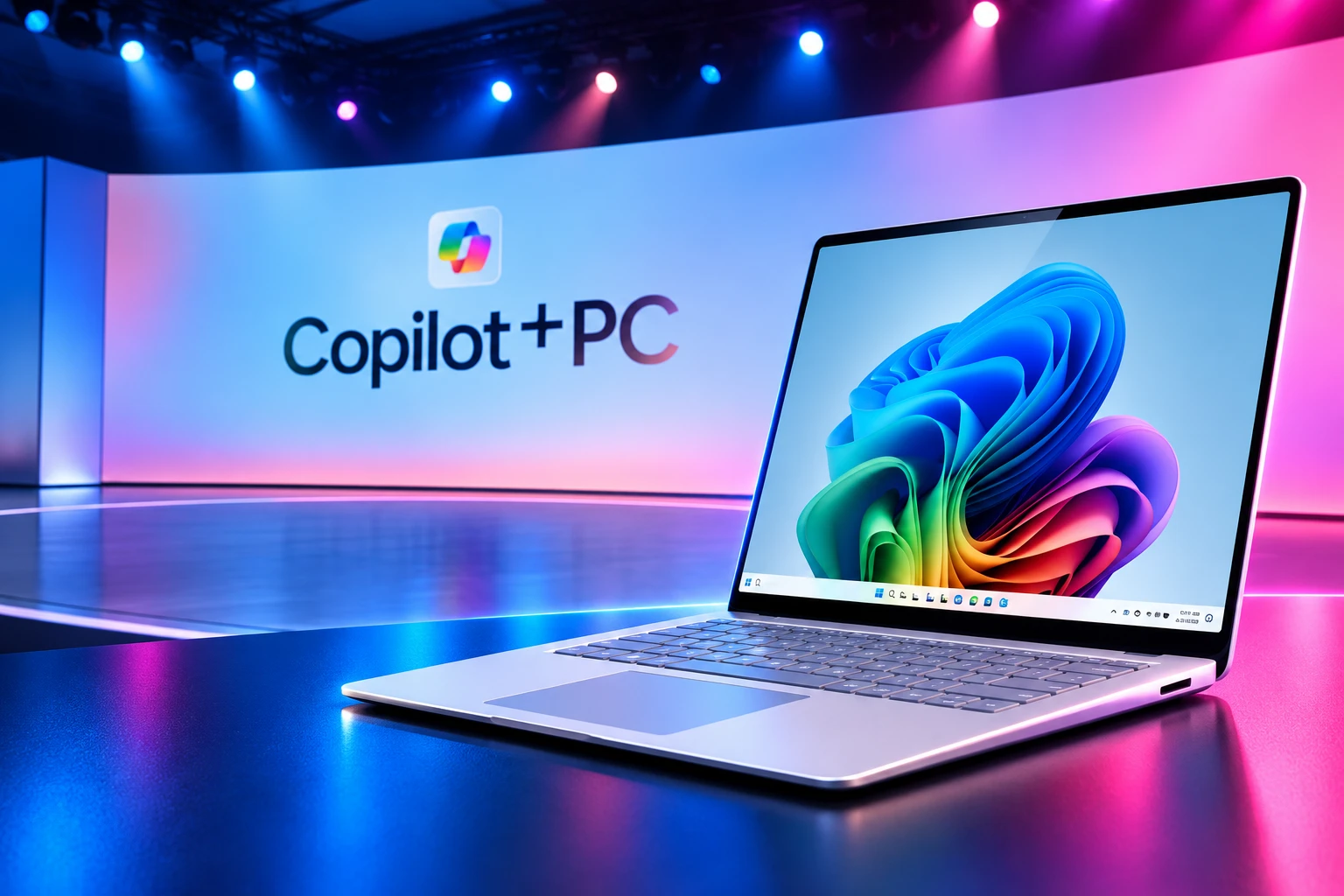
The 40-TOPS Floor Became Table Stakes
On May 20, 2024, Microsoft introduced a new category of Windows PCs designed for AI, with Yusuf Mehdi, then consumer chief marketing officer, calling Copilot+ PCs the fastest Windows PCs the company had built. The gate was an NPU above 40 TOPS, 16 GB of RAM, and 256 GB of storage. Pre-orders opened that day. Units were due June 18, starting at $999.
Qualcomm’s Snapdragon X Elite and X Plus were the only chips that cleared the line. Qualcomm said that week the Snapdragon X series was the exclusive platform to power Copilot+ at launch, with a 45 TOPS Hexagon NPU. Intel and AMD NPUs then sat well below the floor, so the badge did real sorting work for one season: if the box said Copilot+, it was a Snapdragon X machine.
That sorting did not last. Microsoft’s Windows 11 spec page now lists AMD Ryzen AI 300 and 400 series, Intel Core Ultra 200V and 300V series, and Snapdragon X series as chips with NPUs at 40+ TOPS. Once those families shipped, a midrange laptop could meet the Copilot+ bar without being a special object. The name still appeared on support pages. It stopped appearing on new Surface product names.
THE AI PC HARDWARE LADDER
| Machine or bar | On-device AI hardware | Memory | How Microsoft named it |
|---|---|---|---|
| Copilot+ PC requirement, May 2024 | NPU at 40+ TOPS | 16 GB minimum, 256 GB storage | Copilot+ PC |
| Surface Pro 12-inch and Laptop 13-inch, 2026 | Snapdragon X2 Plus Hexagon NPU, 80 TOPS | 16 GB or 24 GB | Not called Copilot+ PCs |
| Surface Laptop Ultra | NVIDIA Blackwell RTX, 1 petaflop of AI compute | Up to 128 GB unified memory | Surface Laptop Ultra; the May 31 announcement did not use Copilot+ |
The middle row is the tell. Microsoft is shipping an NPU twice as fast as the 2024 floor and still taking the sticker off. The top row is a software gate that still exists in documentation. The bottom row is a different class of machine, and it is the one getting a San Francisco stage.
Recall Landed First and Never Recovered
The brand had a flagship feature, and that feature became the first thing buyers associated with the name. Recall was sold as a searchable “photographic memory” of what had been on screen, built and stored on the device. Security researchers found the early design stored sensitive material in a way they did not trust. Microsoft made it opt-in, added Windows Hello, and then pulled it from the June 18, 2024 launch so it could go through the Windows Insider program first.
Copilot+ PCs still shipped that week with Studio Effects, Cocreator in Paint, and live caption translation. They shipped without the demo that had defined the keynote. A dedicated Copilot key landed on new keyboards in the same era, sometimes in place of Right Ctrl, and it took a later Windows 11 setting, under Settings, Bluetooth & devices, Keyboard, before Microsoft let people map that key back to Right Ctrl or the context menu.
By 2026 the complaint was no longer only privacy. It was that the AI PC pitch had been a sticker, a key, and a set of upsells, while the thing people actually liked on Snapdragon Surfaces was battery life. Ostrum has said as much in other Summit remarks: first-wave buyers praised performance, then repeated that the battery was the delight.
THE COPILOT+ TIMELINE
- May 20, 2024: Microsoft names Copilot+ PCs and sets the 40+ TOPS NPU, 16 GB, and 256 GB bar, with Qualcomm first and a $999 starting price.
- June 13, 2024: Recall is pulled from the June 18 launch and sent to Windows Insiders after the privacy fight.
- June 18, 2024: First Copilot+ PCs ship without the headlining feature.
- May 6, 2025: The 12-inch Surface Pro and 13-inch Surface Laptop launch as Copilot+ PCs at $799 and $899.
- May 31, 2026: Microsoft and Nvidia announce RTX Spark and Surface Laptop Ultra. A Windows blog still says those PCs will join the Copilot+ category.
- September 23, 2026: New X2 Plus Surfaces are announced without the Copilot+ product name.
- September 24, 2026: Ostrum says the new Surfaces are not called Copilot+ PCs.
- October 7, 2026: Satya Nadella, Pavan Davuluri, and Jensen Huang share a San Francisco stage on local AI.
- October 13, 2026: The new 12-inch Pro and 13-inch Laptop start shipping.
The May 31 Windows post is the hinge. Pavan Davuluri, executive vice president for Windows and Devices, still wrote that RTX Spark PCs would join the Copilot+ PC category, with NPUs plus the GPU. Ostrum’s Surface Laptop Ultra post the same day never used the phrase. Three months later, the compact Surfaces follow the Ultra’s naming habit.
Qualcomm’s Launch Window Did Not Survive the GPU Shift
Copilot+ was, for one shipping season, a Qualcomm marketing vehicle as much as a Microsoft one. Snapdragon X had the NPU, the battery story, and a Windows on Arm reboot that Microsoft had failed at before. Intel and AMD then put 40-plus TOPS NPUs in volume chips, and the exclusive window closed.
Nvidia never needed that sticker. RTX Spark is an Arm superchip with a Blackwell RTX GPU, a Grace CPU, unified memory, and native CUDA, aimed at local agents and large models, not at a 40-TOPS feature checklist. Nvidia’s own launch materials put 1 petaflop of AI performance and up to 128 GB of unified memory at the center, with slim Windows laptops and small desktops due this fall from Surface, ASUS, Dell, HP, Lenovo, and MSI.
That is why the Copilot+ name is coming off Microsoft’s own low-cost Surfaces first. If the badge no longer marks a rare NPU, it cannot mark the expensive GPU class either, and it cannot sit in between without looking like leftover packaging. The sharper split is now between everyday NPU laptops, which still run the old on-device features, and Spark machines built to hold models that never fit in a 40-TOPS pitch.
WHAT THE BADGE WAS SUPPOSED TO UNLOCK
- Recall: A local, searchable timeline of screen snapshots, delayed in June 2024 and later shipped as an opt-in preview.
- Cocreator: On-device image generation in Paint from ink and text, tied to the NPU.
- Live Captions: On-device captions with translation from more than 40 languages into English.
- Click to Do: Actions on text and images already on screen.
- Studio Effects: Camera blur, gaze correction, and voice cleanup on the NPU.
- Windows Search: Plain-language local search that Microsoft gated to the same hardware bar.
Cloud Copilot chat was never part of that list. It runs on ordinary Windows 11 PCs. The badge only ever paid for the on-device set, and that set now rides along on chips from three vendors. Keeping the sticker on the box would have meant charging a naming premium for hardware that is no longer scarce.
Microsoft Still Documents the Features
This is not a recall of the software. Microsoft’s Copilot+ support and business pages still describe a 40+ TOPS NPU, 16 GB of RAM, and 256 GB of storage, and they still attach Recall, Click to Do, Live Captions, and Studio Effects to that class. Developer pages on Microsoft Learn still tell app makers how to hit the NPU on Copilot+ PCs.
So the spec survived. The box language did not. That split is easy to miss if you only read a headline that says the brand is dead. A buyer who needs Recall or Click to Do still has to clear the same hardware gate. They will have to read a spec sheet instead of a logo, which is how most PC features already work.
The Copilot key is the small version of the same retreat. Microsoft spent a year putting a dedicated key on new laptops, then published a support article so people could turn it back into Ctrl. The company kept the assistant and gave up on making the hardware shout about it.
OEM catalogs have been sliding the same way. Some makers still print Copilot+ on a spec line because the Windows feature set is real. Fewer of them lead a consumer pitch with it. Dell spent CES 2026 talking up gaming and build quality rather than an AI PC crusade, even while Copilot keys remained on some decks. The quiet part is that a badge customers ignored is expensive to keep printing.
October 7 Puts Nvidia on the Windows Stage
Microsoft has called an October 7, 2026 event in San Francisco, at 10 a.m. Pacific, a conversation on how local AI will shape the next chapter of the PC. Nadella, Davuluri, and Nvidia chief executive Jensen Huang are on the bill, with Windows, RTX Spark, Surface, and the rest of the PC business in the invite language. It is the first large Windows stage show since the May 2024 Copilot+ launch.
Surface Laptop Ultra is the machine that post is written around. Ostrum’s May 31 devices blog calls it the most powerful Surface Laptop the company has built, engineered with Nvidia from the silicon up. It pairs a Blackwell RTX GPU with up to 128 GB of unified memory, full CUDA, and enough claimed AI compute to run 120 billion parameter models locally. The 15-inch mini-LED PixelSense Ultra panel is rated up to 2,000 nits. Microsoft has not posted a price. Availability was “later this year” in that post, which now means the fall window the October 7 show is built to fill.
SURFACE LAPTOP ULTRA, ON PAPER
- AI compute: 1 petaflop, theoretical FP4 with sparsity, per Nvidia’s footnote on Microsoft’s post.
- CPU and GPU: Up to 20 Grace CPU cores and up to 6,144 Blackwell RTX cores on RTX Spark.
- Memory: Up to 128 GB unified, shared across CPU and GPU.
- Display: 15-inch mini-LED, up to 2,000 nits peak HDR, 262 pixels per inch.
Shoppers looking at the compact Surfaces do not need that class of machine. The 12-inch Pro is rated up to 15.5 hours of local video and 13 hours of web use, at 1.5 pounds. The 13-inch Laptop is rated up to 22.5 hours of video and 18 hours of web use. Those are battery and carry numbers. They are also the numbers that sold Snapdragon Surfaces when the Copilot+ pitch was still loud.
The name on the 2024 boxes was a bet that a 40-TOPS NPU would stay rare long enough to be worth a category. It did not. Microsoft is still shipping the NPU, still gating a few Windows features on it, and still putting Qualcomm chips in the small Surfaces. It is putting Nvidia on the October 7 stage, and it is taking the Copilot+ line off the product name. The hardware bar remains. The sticker is out of work.

Final Fantasy Resonance Turns a Dead Gacha Into HD-2D

PHP2Shell Forced Sites Offline While Exploits Stalled

Kindle+ Folds AI Audiobooks Into the Page-Read Fund

Chip Stocks Fall as the Bond Rally Cheapens AI Spend

Comcast’s Record Odyssey Quarter Doubles as the Exit

Microsoft 365 Auth Fault Took Down Exchange and Teams

Xbox Caps Game Pass Cloud Gaming at 15 Hours

OpenClaw 2.0 Ships a Team Workplace With Host-Trust Defaults

OpenAI Unveils GPT-6 Astra With a Critical Cyber Label

Diesel Breaks Its Record as the White House Claims Credit
-
 NEWS2 months ago
Microsoft 365 Auth Fault Took Down Exchange and Teams
-
 GAMING2 months ago
Xbox Caps Game Pass Cloud Gaming at 15 Hours
-
 NEWS2 months ago
OpenAI Unveils GPT-6 Astra With a Critical Cyber Label
-
 NEWS2 months ago
OpenClaw 2.0 Ships a Team Workplace With Host-Trust Defaults
-
 BUSINESS2 months ago
Diesel Breaks Its Record as the White House Claims Credit
-

 LIFESTYLE2 months ago
Squishy Dumpling Toys Recalled After Hiding Illegal Water Beads
-

 BUSINESS2 months ago
ChargePoint Stock Rally Prices Wilmer’s Three-Year Cash Plan
-

 AUTO2 months ago
Tesla Puts Its Wheel-Free Cybercab on Austin Streets