
NEWS
Osavul’s €8.5M Raise Moves Wartime Intel Into Airports
Osavul’s €8.5 million Series A, led by 33N Ventures, takes NATO-tested hybrid threat software from defence ministries to energy, transport and finance firms.

Osavul has raised €8.5 million in Series A funding to sell its NATO-tested hybrid threat software to energy, transport and finance firms. 33N Ventures led the round, with Balnord, G+D Ventures and existing backer 42CAP also in. The company said the close takes total funding to more than €12 million.
The cheque is not only more fuel for a defence contractor. Co-founder and chief executive Dmytro Plieshakov is using it to put a wartime scorer of hostile campaigns inside the companies that run airports, ports, power and banks.
Osavul Will Sell to Energy and Transport
Osavul announced a $10m (€8.5m) Series A round on October 1, 2026, describing the money as capital to scale hybrid risk intelligence. Valuation was not disclosed. Headquarters are in Luxembourg, with a London presence as well.
The firm already has commercial work in defence, energy, transport and financial services, and it says the total value of its contracts grew fourfold in 2025. The new cash is earmarked for the AI, a larger commercial team, and buyers in energy, transport, logistics and defence, while state and military contracts stay on the books.
Hybrid attacks are no longer a government problem alone. The companies running energy, airports, ports, transport and finance now face the same adversaries, usually without the means to see them coming. We will keep working with governments and defence, where our intelligence is forged, and bring that capability to the businesses societies rely on.
Dmytro Plieshakov, co-founder and CEO, Osavul
Gabriele Poteliunaite, a principal at Balnord, put the same shift in investor language. She said Osavul refined the product beside government and defence institutions and can now apply it to civilian infrastructure and commercial companies, calling that dual-use in practice.
Osavul raised $10m (€8.5m) Series A round
We are happy to announce that Osavul has closed its Series A round.
€8.5m (~$10m) was invested in the company, bringing total funding to €12m+ (~$14m).
Details: https://t.co/qSDKLjfbfU— Osavul (@Osavulcompany) October 1, 2026
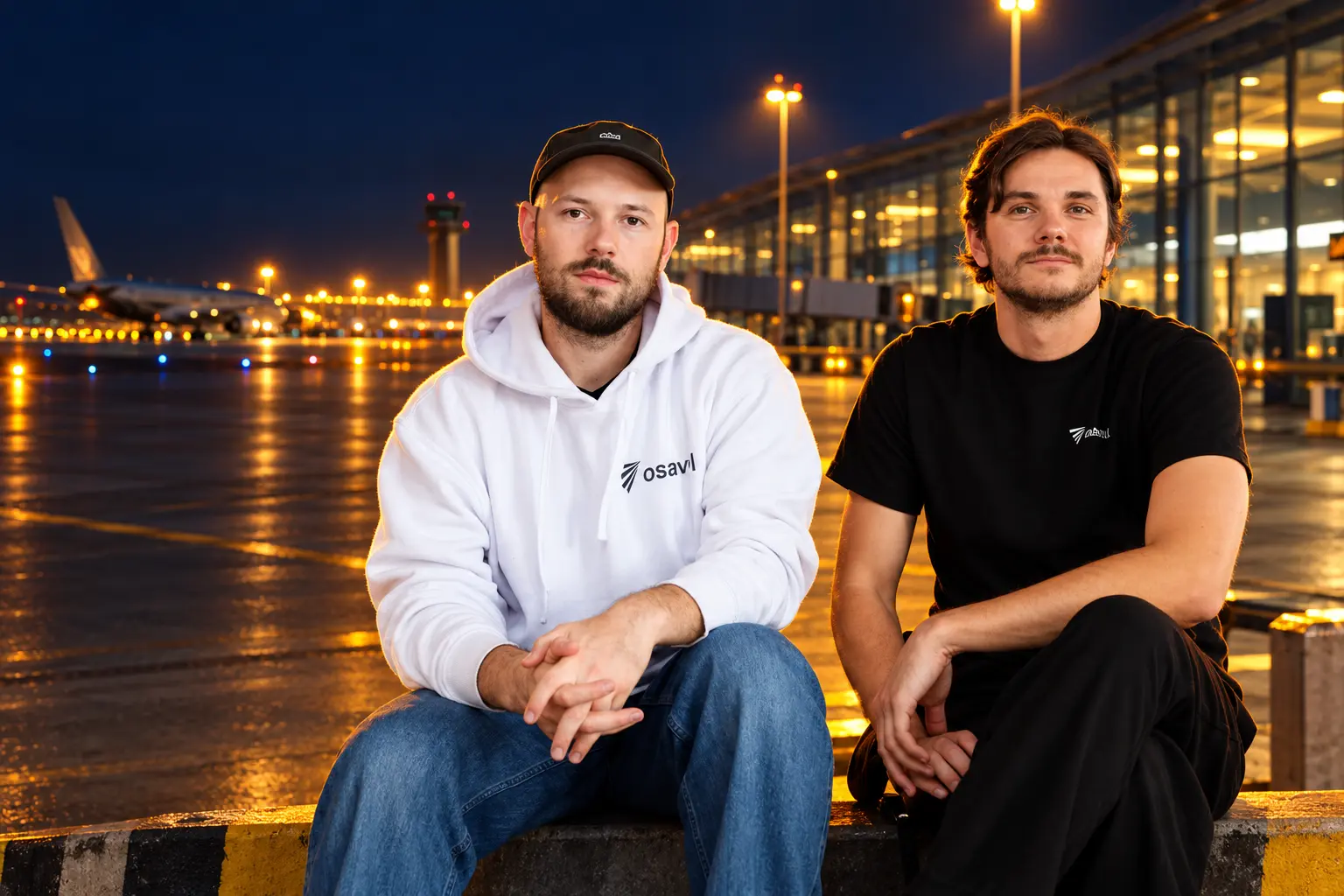
What the Platform Flags Before a Strike
Osavul’s site presents an AI platform that watches sabotage, espionage, cyber and influence operations, and physical threats, then tries to say who may hit a client, how, where and when. It fuses open-source and restricted-access data, including messaging apps and forums that ordinary media monitors miss, and maps those signals onto staff, sites and suppliers.
The company says the stack is live with 50-plus organizations across 10-plus countries, among them Poland, the United Kingdom, Germany, the Nordic states and the United States. Public cases on the site include a Western European rail operator treated as a hybrid-warfare target and a coordinated LinkedIn espionage effort aimed at NATO and EU officials.
OSAVUL IN FIGURES
- Coverage: More than 50 organizations in more than 10 countries, with 100-plus countries in the data set.
- Volume: 1 billion data points analysed a month across 10-plus data types.
- Contracts: Total contract value grew fourfold in 2025, the company said.
- Cash: €8.5 million in this round, taking funding to more than €12 million (about $14 million).
Human analysts still sign off each report, and the software can run on a client’s own servers so the feed never leaves the building. That on-site option is how a Luxembourg vendor sells into ministries that will not park targeting data in someone else’s cloud.
WHAT THE PRODUCT STACK DOES
- Threat intel: Tracks actors, tactics and campaigns across information, cyber and physical channels.
- Early warning: Alerts when a client appears in a hostile campaign, with analysts on the loop.
- Risk modelling: Scores who might strike next and which people, sites or suppliers sit in the path.
- Disruption: Adds mitigation plans and takedown work once a campaign is mapped.
Carlos Alberto Silva, managing partner at 33N Ventures, said adversaries already work those channels at once, while most security tools still treat them as separate problems.
Two Founders Built It Under Fire
Dmytro Plieshakov and Dmytro Bilash, both Ukrainian, started Osavul in Kyiv in 2022 after Russia’s full-scale invasion. They had already built and sold an AI marketing firm together. The new company began by tracking Russian disinformation for Ukrainian security bodies, including the Center for Countering Disinformation at the National Security and Defence Council, and by working with defence and cyber units under live fire.
Bilash has said his Kyiv flat was destroyed by two Russian missiles, and that a request from the Ukrainian government pulled the pair from advertising analytics into information security. The first version of the product was given free to Ukrainian state users. Paying customers came later.
HOW OSAVUL GOT HERE
- March 2022: Plieshakov and Bilash found Osavul in Kyiv and start feeding Ukrainian security bodies.
- May 2023: SMRK puts in $1 million, the first institutional cheque.
- September 2024: 42CAP, u.ventures and SMRK add €2.78 million to push the same tools toward business users.
- February 2026: Osavul begins deploying inside the Brandwatch-Blackbird.AI work for NATO.
- October 1, 2026: 33N leads an €8.5 million Series A aimed at energy, transport, ports and finance.
Bilash, now chief business development officer, said the company was built under live operational conditions and that the experience travels. From Luxembourg it serves customers worldwide, he said, including in regions facing conflict and instability, where sovereign, multi-language intelligence is in demand.
NATO Already Has Osavul in Its Stack
Osavul is a specialist partner in the Brandwatch and Blackbird.AI consortium that the NATO Communications and Information Agency picked, on behalf of the Alliance, to deliver an Information Environment Assessment Capability. The package is meant to give NATO secure, AI-enabled tools to monitor, analyse and interpret public and commercial data. Cision’s Trajaan search tools and Converseon sit in the same offering.
Osavul’s own note on the work, dated February 9, 2026, said it supplies hard-to-reach public data and AI assessment tech. Dmytro Bilash called the cooperation a way to support NATO’s need for timely situational awareness. The firm had already helped NATO’s Strategic Communications Centre of Excellence on a Virtual Manipulation Brief about generative AI in Russian propaganda.
Understanding the information environment is essential for effective planning and decision-making across the Alliance. This integrated Brandwatch and Blackbird.AI solution significantly enhances our ability to deliver data-driven insights at scale.
Chris Riley, Head of Plans and Insights, Office of Strategic Communications, NATO Headquarters
That is the forge Plieshakov is now selling to civilian operators. A system trained on state-backed campaigns against Ukraine and NATO is being packaged as early warning for a rail concession, a port, or a bank that has never had a hybrid-threat cell.
A European Cyber Fund Took the Lead
33N Ventures is a European cybersecurity specialist. Silva’s argument for the deal is the gap between how attackers work and how most companies still buy software: one tool for phishing, another for fences, almost nothing that ties a Telegram smear to a substation or a gate.
G+D Ventures is the corporate venture arm of German security group Giesecke+Devrient and invests in early European “TrustTech,” including cybersecurity and digital identity. 42CAP, a Munich early-stage firm, first backed Osavul in the September 2024 round and returned for Series A. Balnord’s Poteliunaite is the voice on the record for the civilian-infrastructure thesis.
OSAVUL FUNDING ROUNDS
| Date | Round | Amount | Investors |
|---|---|---|---|
| May 2023 | Seed | $1 million | SMRK |
| September 2024 | Late seed | €2.78 million ($3 million) | 42CAP, u.ventures, SMRK |
| October 2026 | Series A | €8.5 million (about $10 million) | 33N Ventures (lead), Balnord, G+D Ventures, 42CAP |
The three equity rounds, plus smaller grants along the way, are what the company now counts as more than €12 million. It has not published a price per share or a post-money value.
Firms Still Split Cyber From Physical Security
Silva’s silo point is the commercial opening. An energy operator can buy a SOC, a CCTV vendor and a PR monitor and still miss a campaign that starts as a fake leak, moves through a contractor’s inbox, and ends as a physical breach. Osavul’s pitch is to connect those traces before the strike lands.
Adversaries operate across information, cyber and physical channels at once; most security tools are still siloed.
Carlos Alberto Silva, managing partner, 33N Ventures
The same capability is the political problem. A platform that scores coordinated inauthentic behaviour for a defence ministry can also score a political campaign, a strike, or a protest outside a terminal. Osavul’s tools have already been cited in public arguments about election interference in Romania, and a former Polish government official on disinformation has called a Ukrainian vendor in that kind of national monitoring stack too risky. Luxembourg residency, on-premises installs and multi-language coverage are Osavul’s answers to the sovereignty worry. They do not retire it.
Putting that scorer inside an airport or a grid operator still means a private firm, born in a war, holds an early picture of who is targeting the site and how. That is what this Series A pays to scale.
Open Jobs Point at UK and Nordic Buyers
The hiring board already reads like a route map. Osavul is advertising senior business development roles for the Nordics and the United Kingdom. The Nordic brief asks for defence procurement skill and a tender track record. The UK brief asks for Ministry of Defence networks, intelligence sales and public procurement. Those seats are how a Luxembourg shop turns NATO-adjacent credibility into multi-year enterprise contracts.
WHERE THE NEW MONEY IS POINTED
- Product: Further AI work on hybrid campaigns that mix cyber, information and physical moves.
- Sales: A larger commercial team aimed at critical-infrastructure operators.
- Markets: New countries and sectors, with energy, transport, logistics and defence named first.
- State work: Existing government and military contracts kept, not swapped out.
Osavul is still a small company selling a sensitive feed. The €8.5 million round buys time to put that feed in more civilian operations rooms, on more client servers, in more languages. The open UK and Nordic jobs are the concrete next step: people who already know how defence and infrastructure buyers purchase software, tasked with taking a Kyiv-born scorer into those rooms.
Frequently Asked Questions
Who Founded Osavul and What Did They Sell Before?
Ukrainians Dmytro Plieshakov and Dmytro Bilash founded Osavul in March 2022. Before the war they built Captain Growth, an AI marketing startup, and sold it to Israeli adtech firm Perion for up to $3.75 million, which is why the pair arrived in information security as operators who had already exited once rather than as first-time founders.
Can Osavul Run on a Customer’s Own Servers?
Yes. The company says the platform can be deployed on-premises so government, defence and enterprise clients keep the data inside their own infrastructure, with human analysts still checking each report before it is treated as finished intelligence.
Which NATO Body Selected the Consortium Osavul Supports?
The NATO Communications and Information Agency (NCIA), acting for the Alliance, selected Brandwatch and Blackbird.AI to deliver the Information Environment Assessment Capability; Osavul and Converseon are named as specialist partners that add extra data and analysis, not as the prime contractors.
Is Osavul a Luxembourg Company or an American One?
Operational headquarters are in Luxembourg, from which Bilash says the firm serves customers worldwide, and it also has a London presence. Its public SaaS terms still describe the provider as a Delaware corporation, so buyers are contracting with a US legal entity even when the work is run from Europe.

Final Fantasy Resonance Turns a Dead Gacha Into HD-2D

PHP2Shell Forced Sites Offline While Exploits Stalled

Kindle+ Folds AI Audiobooks Into the Page-Read Fund

Chip Stocks Fall as the Bond Rally Cheapens AI Spend

Comcast’s Record Odyssey Quarter Doubles as the Exit

Microsoft 365 Auth Fault Took Down Exchange and Teams

Xbox Caps Game Pass Cloud Gaming at 15 Hours

OpenClaw 2.0 Ships a Team Workplace With Host-Trust Defaults

OpenAI Unveils GPT-6 Astra With a Critical Cyber Label

Diesel Breaks Its Record as the White House Claims Credit
-
 NEWS2 months ago
Microsoft 365 Auth Fault Took Down Exchange and Teams
-
 GAMING2 months ago
Xbox Caps Game Pass Cloud Gaming at 15 Hours
-
 NEWS2 months ago
OpenAI Unveils GPT-6 Astra With a Critical Cyber Label
-
 NEWS2 months ago
OpenClaw 2.0 Ships a Team Workplace With Host-Trust Defaults
-
 BUSINESS2 months ago
Diesel Breaks Its Record as the White House Claims Credit
-

 LIFESTYLE2 months ago
Squishy Dumpling Toys Recalled After Hiding Illegal Water Beads
-

 BUSINESS2 months ago
ChargePoint Stock Rally Prices Wilmer’s Three-Year Cash Plan
-

 AUTO2 months ago
Tesla Puts Its Wheel-Free Cybercab on Austin Streets