
NEWS
Ozempic Vision-Loss Suits Fill a Gap U.S. Labels Left
Federal NAION cases against Ozempic and Wegovy now number 216, while Europe already lists sudden vision loss and U.S. labels still omit it.

Federal judges in Philadelphia are now managing 216 vision-loss cases against the makers of Ozempic and related shots. Patients say the drugs caused a rare optic-nerve injury called NAION, and that U.S. labels never warned them. Europe, Britain, and Australia already tell users to stop the medicine if that injury is confirmed.
The argument in court is failure to warn. The quieter failure is that a patient can lose one eye, keep injecting, and then lose the other, because the American insert still does not name the condition.
Federal NAION Cases Now Number 216 in Philadelphia
The Judicial Panel on Multidistrict Litigation created MDL No. 3163 on December 15, 2025, and sent the vision cases to U.S. District Judge Karen S. Marston in the Eastern District of Pennsylvania. The panel said the suits share facts about testing, promotion, and labeling of GLP-1 receptor agonists, and about whether those drugs can cause non-arteritic anterior ischemic optic neuropathy, or NAION.
The court’s own federal NAION docket in Philadelphia lists Novo Nordisk’s Ozempic, Wegovy, and Saxenda, plus Eli Lilly’s Trulicity. Complaints on file also name Mounjaro and Zepbound. This is the second GLP-1 injury docket in that courthouse. MDL No. 3094, also before Judge Marston, covers stomach injuries such as gastroparesis.
THE TWO GLP-1 DOCKETS
- Vision-loss track: 216 NAION cases were pending in MDL 3163 as of the September 2026 JPML count.
- Stomach-injury track: 4,022 cases were pending in MDL 3094 on the same tally, a separate proceeding.
- State court: Nearly 100 NAION suits have been filed in New Jersey since 2025.
- Resolutions: No GLP-1 injury case has produced a verdict or a settlement.
Judge Marston held a Science Day on June 2, 2026. On July 2 she allowed early motions on general causation and preemption, the two questions that can end a failure-to-warn case before a jury hears a patient. Proposed plaintiff fact sheets are due September 25, 2026. A master complaint is due October 28, 2026.
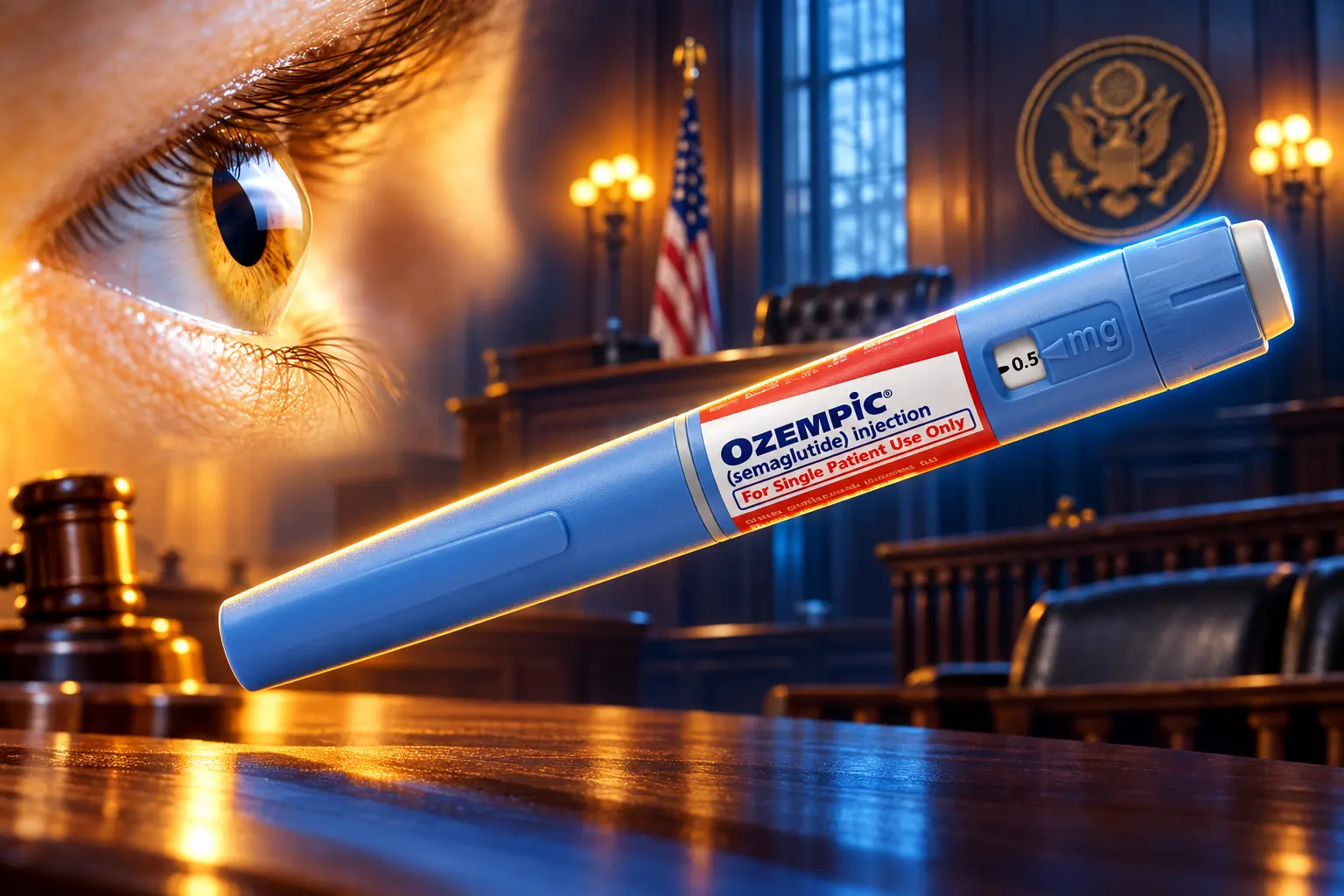
He Lost Sight in One Eye and Stayed on Ozempic
NAION is a sudden, usually painless drop in sight in one eye, caused by a loss of blood flow to the front of the optic nerve. There is no proven treatment that brings the lost field back. Patients often notice it on waking. The other eye can follow later.
One man, 63, was prescribed Ozempic for diabetes in 2023. Four months later he woke with vision gone in one eye. He did not know the shots were in the conversation, so he kept taking them. He lost the other eye in 2024 and is now legally blind.
A Pennsylvania complaint described another patient’s sight as looking through a “fishbowl.” Maria Raciti, a personal injury attorney at Phillips Law Group in Phoenix, said her firm has 18 GLP-1 injury clients and a wave of vision-loss calls this summer.
It’s scary.
Maria Raciti, personal injury attorney, Phillips Law Group
Raciti said the office has taken around 200 calls. The Phoenix docket is a local slice of a national filing spike, not a census. What the calls share is the same gap: people who already had a dark morning and were never told the European label now treats that morning as a reason to stop the drug.
Europe, Britain and Australia Already Warn Patients
On June 6, 2025, the European Medicines Agency’s safety committee, PRAC, finished a review of semaglutide, the active drug in Ozempic, Wegovy, and Rybelsus. After clinical trials, post-marketing reports, and large epidemiology studies, the committee listed NAION as a very rare side effect of semaglutide, meaning it may affect up to 1 in 10,000 people who take it.
PRAC said adults with type 2 diabetes on semaglutide had about a two-fold rise in NAION risk, or about one extra case per 10,000 person-years of treatment. If a patient gets a sudden loss of vision or rapidly worsening sight, they should call a doctor at once. If NAION is confirmed, semaglutide should be stopped. The June 6 notice was revised on June 13, 2025, to drop a line about a European Commission decision. The medical advice did not change.
Britain followed on February 5, 2026. The Medicines and Healthcare products Regulatory Agency told clinicians that anyone with sudden vision loss on semaglutide, including partial loss, should be urgently referred for ophthalmological examination, and that the drug should be stopped if NAION is confirmed. Other GLP-1 agonists were not in that review. The MHRA is still looking at them.
From first UK authorisation in 2018 through August 1, 2025, the Yellow Card scheme logged three spontaneous reports suggestive of NAION with semaglutide. In the five years to late 2025, about 10.2 million packs were dispensed. A report to Yellow Card means a suspected link, not a proven one.
Australia went further. On July 23, 2026, the Therapeutic Goods Administration issued class-wide product warnings in Australia that cover Ozempic, Wegovy, Mounjaro, Trulicity, and Saxenda. The TGA said NAION may cause permanent visual impairment, including blindness, and that no treatment has been shown to improve visual acuity once it develops. Patients are told to seek urgent care for sudden vision loss, including partial loss. National adverse-event records listed 36 NAION reports tied to the class: 23 for Ozempic or Wegovy, 10 for Mounjaro, 3 for Saxenda, and none for Trulicity.
WHO PUT NAION ON THE LABEL
| Regulator | Date | Drugs named | Instruction if NAION is confirmed |
|---|---|---|---|
| EMA (PRAC) | June 6, 2025 | Ozempic, Wegovy, Rybelsus | Stop semaglutide |
| UK MHRA | February 5, 2026 | Ozempic, Wegovy, Rybelsus | Stop semaglutide; urgent eye exam |
| Australia TGA | July 23, 2026 | Whole GLP-1 class, including Mounjaro | Stop the medicine; seek urgent care |
| U.S. FDA | No NAION warning as of September 2026 | None for NAION | U.S. inserts do not name NAION |
U.S. diabetes labels for Ozempic and Mounjaro already mention changes in vision, a different problem tied to diabetic retinopathy. Weight-loss labels for Wegovy and Zepbound tell patients with type 2 diabetes to call a doctor if their sight changes. Neither set of U.S. prescribing information lists NAION or optic neuropathy by name.
HOW THE WARNINGS LANDED OVERSEAS
- June 6, 2025: EMA’s PRAC concludes NAION is a very rare semaglutide side effect and says treatment should stop if the diagnosis is confirmed.
- February 5, 2026: The MHRA updates UK product information and tells clinicians to send sudden vision-loss patients for an urgent eye exam.
- July 23, 2026: Australia extends the warning across the GLP-1 class, including tirzepatide (Mounjaro).
That last step matters for Lilly’s drugs. The European and British reviews were limited to semaglutide. Australian regulators still wrote the caution onto Mounjaro’s paperwork after 10 local reports. U.S. patients on tirzepatide do not get that sentence.
What the Studies Show About NAION Risk
The paper that put this risk on the map came from Massachusetts Eye and Ear. In July 2024, Jimena Tatiana Hathaway, MD, MPH, and colleagues at Harvard Medical School published a matched cohort study of 16,827 patients seen in that neuro-ophthalmology clinic. Among people with type 2 diabetes, those prescribed semaglutide had a fourfold higher NAION risk than patients on other diabetes drugs (hazard ratio 4.28; 95% CI 1.62-11.29). In a separate overweight or obesity group, the hazard ratio was 7.64 (95% CI 2.21-26.36).
Those percentages look huge because the clinic is where NAION cases go. Over 36 months, the cumulative incidence in the diabetes semaglutide group was 8.9%, against 1.8% in the comparison group. That is not a population rate. Later, larger files found a smaller relative rise and a much smaller absolute one.
NAION FINDINGS BY STUDY TYPE
| Study | Who was counted | What it found |
|---|---|---|
| Hathaway et al., JAMA Ophthalmology, 2024 | 16,827 patients at one Boston eye clinic | HR 4.28 in diabetes; HR 7.64 in overweight or obesity |
| U.S. veterans target-trial emulation, JAMA Ophthalmology, 2026 | 102,361 veterans with type 2 diabetes | HR 2.33 vs SGLT2 inhibitors; 123 vs 67 cases per 100,000 person-years |
| JAMA Network Open, 2025 | 159,398 matched patients with type 2 diabetes on semaglutide or tirzepatide | HR 1.76; 0.04% vs 0.02% had NAION over two years |
| Novo-funded pooled trials, 2026 | 96,829 trial participants, 205,777 participant-years | 3 confirmed NAION cases on GLP-1 drugs vs 5 on placebo |
The veterans study compared 11,478 new semaglutide users with 90,883 new users of an SGLT2 inhibitor. Over a median 2.1 years, 173 NAION events occurred. After overlap weighting, the incidence was 0.29% on semaglutide and 0.13% on SGLT2 inhibitors. The authors called the absolute risk low.
The 2025 JAMA Network Open analysis folded tirzepatide in with semaglutide. During two years of follow-up, 35 patients (0.04%) in the GLP-1 group and 19 (0.02%) in the matched comparison group received a NAION diagnosis. The hazard ratio was 1.76 (95% CI 1.01-3.07). That file is one of the few large looks at Lilly’s dual GIP/GLP-1 drug, and the extra risk was still measured in hundredths of a percent.
Diabetes itself raises NAION risk. So do smoking, high blood pressure, high cholesterol, a crowded optic disc, and sleep apnea. Every observational paper is trying to pull a drug signal out of that pile. Coding errors and leftover confounding are the standard critiques, and they are fair. They are also why a label fight has become a courtroom fight.
Novo’s Trial Pool Found Three Cases Against Five on Placebo
Novo Nordisk’s answer sits in randomized trials, where NAION was too rare to show up cleanly. A pooled analysis of placebo-controlled studies of semaglutide and liraglutide counted 96,829 participants, 64,917 on a GLP-1 receptor agonist and 31,912 on placebo, followed for 205,777 participant-years. Ophthalmologist-confirmed NAION occurred in three people on the drugs and five on placebo, about three versus six cases per 100,000 person-years of observation. The difference was not statistically significant.
That is the core of the defense: the studies built to prove these drugs work did not show extra NAION. In statements on the new suits, Novo has said it is fighting them vigorously and that the claims lack merit. Eli Lilly has said patient safety is its top priority and that it is reviewing the data. In a joint 2024 court filing, the companies wrote that the safety profile of GLP-1 receptor agonists “has been well-established in hundreds of clinical trials, large-scale observational studies, and nearly two decades of real-world use,” and that known risks are already on FDA-approved labeling the agency has reviewed more than 40 times.
A July Pennsylvania complaint against Lilly put the other side in one sentence, alleging the companies tried to create the impression that these were “magic pills” to help a person lose weight. That is a pleading, not a finding. Causation has not been tried. Preemption has not been decided. The first question in front of Judge Marston is still whether the medicine can cause the injury at all.
Why the U.S. Label Still Omits the Eye Warning
The Food and Drug Administration has said it is reviewing evidence of a possible link between semaglutide and NAION. It has not concluded that the drug causes the condition and has not added a safety warning. In a statement on the lawsuits, the agency said it identifies safety signals from many sources, evaluates the data, and takes regulatory action when it judges that appropriate.
U.S. eye specialists have not lined up behind a blanket warning either. In May 2026, the North American Neuro-Ophthalmology Society and the American Academy of Ophthalmology issued a consensus statement. They said current evidence, mostly retrospective claims and electronic-record studies, points to a possible association with semaglutide, that some papers find no link, and that the overall chance of NAION stays low. They warned against stopping GLP-1 therapy on autopilot, even after an episode, because dropping the drug can carry metabolic and heart risks. They asked for a shared decision among the patient, the eye doctor, and the prescriber.
WHERE EXPERTS DISAGREE
- Novo Nordisk: Pooled randomized trials show no increase in confirmed NAION versus placebo, and the company is defending the U.S. suits as without merit.
- EMA and MHRA: Observational studies plus post-marketing reports are enough to call NAION a very rare semaglutide side effect and to tell patients to stop if it is diagnosed.
- NANOS and the American Academy of Ophthalmology: A possible association exists, absolute risk is small, causality is not established, and therapy should not be halted by default.
People already using the shots often learn the word NAION from a lawsuit headline, not from a pharmacist. That is the practical cost of the split. A patient can pick up a filled pen, see a celebrity ad on the way home, and only later read that overnight vision loss is printed on a European leaflet they were never handed. The U.S. insert they did get talks about gut side effects, thyroid tumors in rodents, and retinopathy in diabetes. It does not tell them that a dark curtain in one eye is a reason to stop and get a same-day dilated exam.
Fellow-Eye Loss Is the Harm a Warning Could Interrupt
NAION usually hits one eye. Having it once raises the chance it will hit the other. In general NAION series, not limited to GLP-1 users, the five-year risk to the fellow eye runs about 15% to 24%. A repeat attack in the same eye is uncommon. About 40% of people with a big drop in central acuity get some of that center back; the missing field usually does not.
That is why the 63-year-old’s course is the part a label can still change. He lost one eye, stayed on Ozempic, and then lost the other. British advice now tells clinicians that privately supplied semaglutide may not even appear in a hospital chart, so they should ask. Australian consumer advice says to stop the medicine and get prompt care if sight changes. The American bottle still does not say that.
WHAT A NAION WARNING TELLS A PATIENT TO DO
- The symptom: Sudden, usually painless blurring, cloudiness, or loss of sight, typically in one eye, often noticed on waking.
- The next step: Same-day emergency eye care, not a wait-and-see message to the clinic inbox.
- The drug decision: If NAION is confirmed, European, British, and Australian labels say to stop the GLP-1 medicine.
- The other eye: Watch the remaining eye, because NAION can arrive there later, and no drug reverses the damage already done.
None of that settles whether semaglutide or tirzepatide caused any one patient’s injury. It does settle what information is sitting in which country. Plaintiff fact sheets in the Philadelphia NAION docket are due September 25, 2026. Until the FDA moves, or a court does, U.S. patients are still starting these shots without the sentence Europe already printed.
Disclaimer: This article is news reporting on lawsuits, regulator actions, and published studies. It is not medical advice, a diagnosis, or a recommendation to start, stop, or change any medicine, and it is not legal advice about any claim. Readers who have sudden vision changes should seek urgent in-person eye care and discuss GLP-1 therapy with the clinician who prescribed it. Anyone considering a lawsuit should consult a licensed attorney who handles drug-injury cases in their state. Figures, docket counts, and label language reflect the public sources cited here and can change as the FDA, foreign regulators, and the courts act.

Final Fantasy Resonance Turns a Dead Gacha Into HD-2D

PHP2Shell Forced Sites Offline While Exploits Stalled

Kindle+ Folds AI Audiobooks Into the Page-Read Fund

Chip Stocks Fall as the Bond Rally Cheapens AI Spend

Comcast’s Record Odyssey Quarter Doubles as the Exit

Microsoft 365 Auth Fault Took Down Exchange and Teams

Xbox Caps Game Pass Cloud Gaming at 15 Hours

OpenClaw 2.0 Ships a Team Workplace With Host-Trust Defaults

OpenAI Unveils GPT-6 Astra With a Critical Cyber Label

Diesel Breaks Its Record as the White House Claims Credit
-
 NEWS2 months ago
Microsoft 365 Auth Fault Took Down Exchange and Teams
-
 GAMING2 months ago
Xbox Caps Game Pass Cloud Gaming at 15 Hours
-
 NEWS2 months ago
OpenAI Unveils GPT-6 Astra With a Critical Cyber Label
-
 NEWS2 months ago
OpenClaw 2.0 Ships a Team Workplace With Host-Trust Defaults
-
 BUSINESS2 months ago
Diesel Breaks Its Record as the White House Claims Credit
-

 LIFESTYLE2 months ago
Squishy Dumpling Toys Recalled After Hiding Illegal Water Beads
-

 BUSINESS2 months ago
ChargePoint Stock Rally Prices Wilmer’s Three-Year Cash Plan
-

 AUTO2 months ago
Tesla Puts Its Wheel-Free Cybercab on Austin Streets