
NEWS
Pennsylvania’s Fifth Measles Death Leaves Infants Unprotected
Pennsylvania’s fifth measles-associated death is the third in Lancaster County, where two infants too young for MMR already died as federal counts diverge.

Pennsylvania health officials reported a fifth measles-associated death on Sept. 30, an unvaccinated Lancaster County resident whose identity they will not release. It is the third such death in that county in 2026, after two infants who were too young for a routine MMR shot.
Three of the five people the state has placed on that list lived in Lancaster County, the long-time center of Pennsylvania Dutch Country. Two of them never reached the age when the vaccine schedule offers a first dose.
A Fifth Associated Death, Still Without a Name
The Pennsylvania Department of Health told the Centers for Disease Control and Prevention that the latest case met its fifth measles-associated death definition. Press secretary Neil Ruhland said he could not give the person’s age or say whether they had other illnesses. Lancaster County Coroner Dr. Stephen Diamantoni said his office did not handle the death and that state officials had not given him details.
PENNSYLVANIA OUTBREAK SNAPSHOT
- Confirmed cases: 943 across 39 counties as of Sept. 30, including 40 new positives since Sept. 28.
- Hospital stays: 176 people with measles have been admitted.
- Deaths on the state list: 5, all in people the department listed as unvaccinated.
- Vaccinated cases: 4, which the department said is less than 1% of the total.
The CDC’s national page, updated with data as of Sept. 24, listed 850 Pennsylvania cases in that earlier snapshot, a lag that is normal when states keep adding names after the federal cut-off. Amesh Adalja, a senior scholar at the Johns Hopkins Center for Health Security, said every one of these deaths was preventable, noting how few of the state’s cases have been in vaccinated people.
Two Lancaster Infants Were Too Young for MMR
The first two names on Pennsylvania’s 2026 list were babies. After a Right-to-Know request, Diamantoni identified them as Ivan S. Miller and Mary S. Stoltzfus. The department had already said both were unvaccinated. They were also months away from the age when a first MMR dose is routinely given.
THE FIVE DEATHS ON PENNSYLVANIA’S LIST
- August 14, 2026: Ivan S. Miller, a newborn, dies shortly after birth at a birthing center in Strasburg Township. He tests positive for measles. Diamantoni says the cause is a ruptured spleen with massive blood loss, and that the spleen showed no swelling that would tie the tear to measles.
- August 18, 2026: Mary S. Stoltzfus, just over a month old, dies at home in Fulton Township. Diamantoni says doctors caring for her determined that measles caused cardiac arrest. She also had Amish lethal microcephaly, a rare inherited condition seen in about 1 in 500 Old Order Amish births; those infants are typically placed on palliative care and often live only 5 or 6 months.
- August 25, 2026: Gov. Josh Shapiro and Health Secretary Dr. Debra Bogen announce two measles-associated deaths in Lancaster County, the first the state had recorded in 35 years, dating to 1991.
- September 15, 2026: The department confirms two more associated deaths after reviews with the Jefferson and Mifflin County coroners: a 40-year-old woman and an 18-year-old, both unvaccinated.
- September 30, 2026: The department reports a fifth associated death, again in an unvaccinated Lancaster County resident, and withholds further identifying facts.
Bogen said after the August announcement, “My deepest sympathies are with the loved ones who are facing this unimaginable loss.” Diamantoni later confirmed Mary’s death as measles and kept Ivan’s death as a spleen injury. The state still counts both, because both infants tested positive and died inside its surveillance window.
Alan Shuldiner, co-director of the University of Maryland Amish Research Clinic, said the surge is not a mystery, and that many people have not been vaccinated for measles. That is a different problem from the one the two babies faced. An 18-year-old and a 40-year-old can walk into a clinic. A newborn cannot.
When Can Infants Get the MMR Shot?
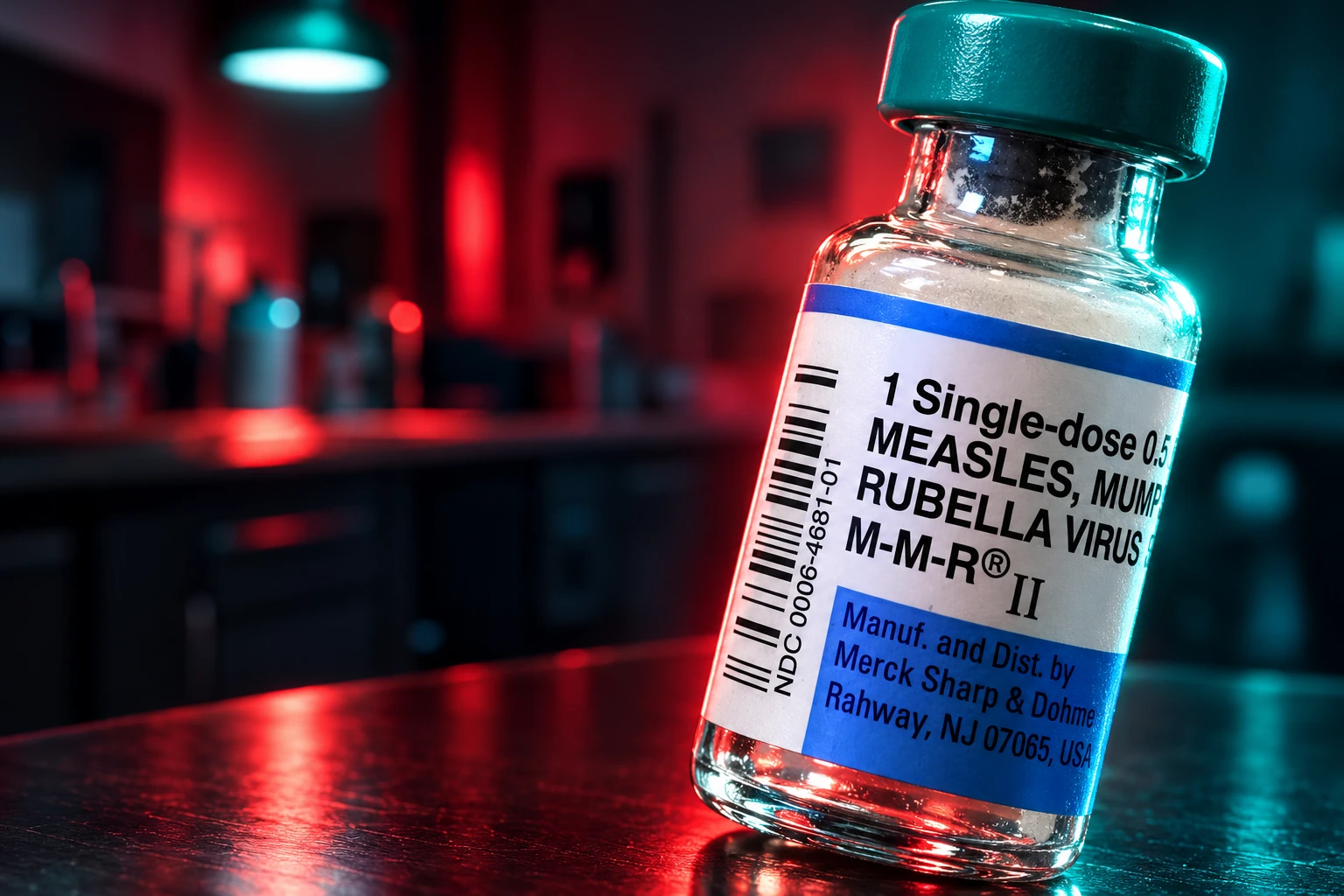
The CDC’s childhood schedule sets the first dose at 12 through 15 months and the second at 4 through 6 years. Two doses are about 97% effective at preventing measles for life; one dose is about 93% effective. During a community outbreak, health departments may offer an extra early dose to infants 6 through 11 months old, then still give the two routine doses after the first birthday. Mary was about 6 weeks old. Ivan died the day he was born. Neither had reached even the outbreak early-dose window.
Calling those infants unvaccinated is accurate as a shot record. It is a poor description of a choice. The people who skipped MMR, and the babies who were not yet allowed to receive it, got folded into one word, then into a fight over whether Harrisburg had overreached.
What a Measles-Associated Death Means in Pennsylvania
The department built its own surveillance definition because the Council of State and Territorial Epidemiologists had not yet finished national guidance on measles deaths. The state’s rule is modeled on existing associated-death definitions used for flu and RSV.
HOW PENNSYLVANIA CLASSIFIES AN ASSOCIATED DEATH
- The clock: The death occurs within 30 days of clinically relevant symptom onset.
- The illness: There is clinical evidence of measles, such as fever and a spreading rash, or other symptoms the department treats as relevant.
- The lab: A positive test, including PCR, virus isolation, or a qualifying antibody result.
- The exclusion: The death is not from an unrelated event, such as a motor vehicle crash, and public health officials do not agree on a different cause after review.
A death more than 30 days after rash onset, or after a person had measles and then fully recovered, would not count. Diamantoni has said it matters to say when someone has died from measles, because the disease can cause pneumonia or an infection of the brain. His office and the state still disagree on Ivan. On Mary, they now agree.
92.4 Percent, and 280,000 Kindergartners Unprotected
Measles spreads when an infected person breathes, coughs, or sneezes, and the virus can remain infectious in the air and on surfaces for up to 2 hours. People are typically contagious from 4 days before the rash through 4 days after it appears. Symptoms can start 7 to 21 days after exposure. The department says death, though uncommon, occurs in 1 to 3 patients per 1,000 cases.
Stopping that chain in a community depends on coverage above 95%. Kindergarten MMR coverage in the United States was 92.4% in the 2025-2026 school year, according to CDC school reports, down from 92.5% the year before and from 95.2% in 2019-2020.
KINDERGARTEN MMR AND EXEMPTIONS
| School year | MMR coverage | Exemptions, one or more vaccines | Kindergartners without documented 2-dose MMR |
|---|---|---|---|
| 2019-2020 | 95.2% | 2.5% | Not stated in the 2025-26 release |
| 2024-2025 | 92.5% | 3.6% | Not stated in the 2025-26 release |
| 2025-2026 | 92.4% | 4.2% (about 155,000 children) | About 280,000 |
Exemptions rose in 41 states and the District of Columbia. Twenty-four states now report exemption rates above 5%, a level that makes the 95% target mathematically out of reach in those places. Nonmedical exemptions account for almost all of the rise, at 4.0%, with medical exemptions holding at 0.2%. Only 10 states still sit at or above 95% MMR coverage. Andrew D. Racine, president of the American Academy of Pediatrics, said more than a quarter of a million children started kindergarten last year without protection from the MMR vaccine.
Those kindergarten figures describe children old enough for school shots. They do not describe Mary or Ivan. They do describe the older children and adults whose missed doses leave infants in the same towns with no buffer.
Death Certificates Versus Outbreak Ledgers
As of Sept. 24, the CDC had recorded 3,659 confirmed measles cases in the United States in 2026, already above the 2,289 cases logged for all of 2025 and the highest annual total since 1991, when a Congressional Research Service brief citing CDC data counted 9,643 cases. Ninety-five percent of the 2026 cases are in people who are unvaccinated or whose status is unknown. Six hundred fifty-six of the cases, 18%, are in children under 5, and 91 of those young children have been hospitalized.
The same CDC page lists 2 measles deaths in 2026, with an asterisk, and 3 in 2025. Pennsylvania’s list is already at 5. Health Secretary Robert F. Kennedy Jr. first called Shapiro’s August announcement premature and said the deaths “may even have been altogether fabricated.” After Diamantoni confirmed measles as Mary’s cause of death, Kennedy said measles caused “only the second infant’s death” and that the National Center for Health Statistics did not then have 2026 records listing measles as the underlying cause.
Health policy researchers Josh Michaud and Jennifer Kates, in a Oct. 1 analysis, described the shift: CDC said it would count measles deaths from death records when NCHS reports measles as the underlying cause, rather than taking state outbreak reports in real time. CDC Director Erica Schwartz carried that change onto the agency’s public tally. The agency is also working with CSTE on a standard death definition.
WHERE THE COUNTS DIVERGE
- Pennsylvania Department of Health: A measles-associated death is a surveillance finding for an active outbreak, based on timing, clinical signs, a positive test, and the exclusion of unrelated causes. The state’s 2026 count is 5.
- CDC measles dashboard: Deaths are posted when NCHS verifies measles as the underlying cause on a death record. The dashboard shows 2 for 2026 and notes the number can change as reviews finish.
- Lancaster County Coroner Stephen Diamantoni: Mary died of measles. Ivan died of a ruptured spleen, with measles present on testing but not, in his pathologist’s view, the injury that killed him. His office did not investigate the fifth death.
NCHS mortality files often lag months. NCHS also suppresses death counts between 1 and 9 in public files to protect identities, which means a small measles death total can stay invisible on some federal tables until it crosses 10. Outbreak desks used to accept state epidemiologists on a weekly cadence. The new rule privileges the slower certificate. Emily Hilliard, a spokesperson for the Department of Health and Human Services, said the department was deeply saddened to hear of another death in Pennsylvania, and that Kennedy and Schwartz continue to recommend the MMR vaccine as the most effective way to prevent measles infection.
Clinics Doubled the Usual MMR Month in September
The state’s own numbers show people are still showing up for shots, even as the case line keeps rising. In a typical month, Pennsylvania providers give about 25,000 MMR doses. They gave more than 49,000 in August 2026 and more than 53,000 in September, more than double the usual monthly volume. State health center staff have given more than 5,500 MMR doses at 180 pop-up clinics in affected communities since the outbreak began in late April, and department nurses have given more than 8,500 doses at pop-up sites and state health centers combined in 2026.
I think it’s important to identify if somebody has died from measles because I think it kind of emphasizes the risk of that disease.
Dr. Stephen Diamantoni, Lancaster County coroner
The clinics cannot retroactively cover a 6-week-old. They can raise the share of older children and adults who will not carry the virus into a kitchen, a church bench, or a birth center. Four of 943 confirmed infections in people with documented shots is the record of that protection inside this outbreak. The other 939 are the record of everyone else.
The November Meeting That Can End Elimination Status
The United States declared measles eliminated in 2000, meaning the virus was no longer spreading on its own inside the country. The Pan American Health Organization has scheduled a review of measles elimination status for the United States and Mexico in November 2026, at the regular meeting of the Regional Verification Commission for measles, rubella, and congenital rubella syndrome. For the United States, the analysis period runs one year from Jan. 20, 2025, the start of the reported outbreak. Endemic transmission means the same virus genotype and lineage has circulated without a break for 12 months or more in a defined area.
The region already lost its measles-free standing in November 2025 after the commission found that endemic transmission had returned in Canada. Under the regional rules, the Americas lose that status when endemic spread is documented in any country in the region. A U.S. finding in November would be a separate, country-level classification, sent by the commission to PAHO Director Dr. Jarbas Barbosa, who then informs national authorities.
Nationally, 95% of 2026 cases are outbreak-associated. Forty outbreaks have been reported this year, and 1,384 of the year’s cases are still tied to outbreaks that began in 2025. Genomic sequencing is the tool U.S. officials have said they will use to argue that some chains were new importations rather than one unbroken lineage. The commission will read that file against a year of weekly cases and against Pennsylvania’s five associated deaths, only some of which the federal dashboard currently displays.
Mary Stoltzfus will not be on that agenda as a named child. The question in front of the commission is whether the virus kept moving for a year. The question in Lancaster County is already smaller, and finished: two infants who could not yet be vaccinated died during an outbreak that older, eligible people had left open.
Disclaimer: This article is news reporting and analysis of public health data, official statements, and coroner findings. It is informational only and is not medical advice, a diagnosis, or a recommendation about any individual’s vaccination, treatment, or pregnancy care. Readers who have questions about measles exposure, infant immunization, or whether they need an MMR dose should consult a licensed physician, pediatrician, or local health department before acting. Case counts, death classifications, and outbreak maps reflect the Pennsylvania Department of Health, CDC, and PAHO figures cited above and can change as investigations and certificate reviews continue.

Final Fantasy Resonance Turns a Dead Gacha Into HD-2D

PHP2Shell Forced Sites Offline While Exploits Stalled

Kindle+ Folds AI Audiobooks Into the Page-Read Fund

Chip Stocks Fall as the Bond Rally Cheapens AI Spend

Comcast’s Record Odyssey Quarter Doubles as the Exit

Microsoft 365 Auth Fault Took Down Exchange and Teams

Xbox Caps Game Pass Cloud Gaming at 15 Hours

OpenClaw 2.0 Ships a Team Workplace With Host-Trust Defaults

OpenAI Unveils GPT-6 Astra With a Critical Cyber Label

Diesel Breaks Its Record as the White House Claims Credit
-
 NEWS2 months ago
Microsoft 365 Auth Fault Took Down Exchange and Teams
-
 GAMING2 months ago
Xbox Caps Game Pass Cloud Gaming at 15 Hours
-
 NEWS2 months ago
OpenAI Unveils GPT-6 Astra With a Critical Cyber Label
-
 NEWS2 months ago
OpenClaw 2.0 Ships a Team Workplace With Host-Trust Defaults
-
 BUSINESS2 months ago
Diesel Breaks Its Record as the White House Claims Credit
-

 LIFESTYLE2 months ago
Squishy Dumpling Toys Recalled After Hiding Illegal Water Beads
-

 BUSINESS2 months ago
ChargePoint Stock Rally Prices Wilmer’s Three-Year Cash Plan
-

 AUTO2 months ago
Tesla Puts Its Wheel-Free Cybercab on Austin Streets