
NEWS
Shimano SPD-SLR Pedals Split a 23-Year Road Standard
Shimano SPD-SLR cuts stack by 2.3 mm and ends SPD-SL interchange, so two-bike garages and SPD-SL power pedals now sit on a split standard.

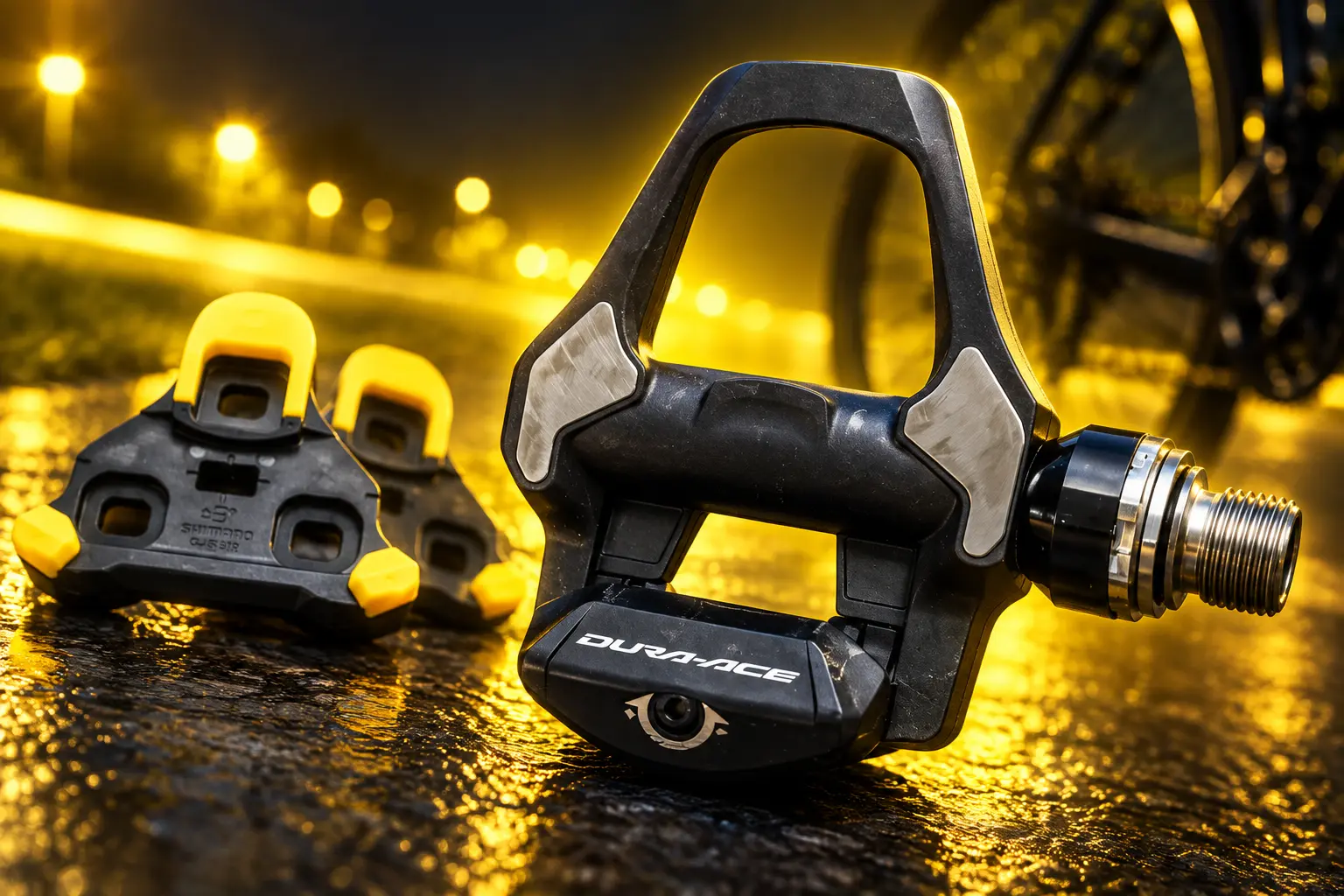
Shimano launched SPD-SLR on September 17, 2026, its first new road cleat system since 2003, cutting stack height by 2.3 mm. The kit is a Dura-Ace PD-R9300 pedal, an Ultegra PD-R8200 pedal, four dedicated cleats, and S-Phyre SH-RC910 shoes.
It is not a drop-in swap for SPD-SL. Old cleats stay out of the new pedals, new cleats stay out of the old ones, and Shimano is still selling the 2003 standard beside the new one.
SPD-SLR Drops the Foot 2.3 mm Closer to the Axle
Shimano rebuilt the cleat-to-pedal face as one interface and reduced stack height by 2.3 mm, the gap from pedal axle to the sole. Dura-Ace sits at 12.5 mm for pedal plus cleat, excluding the shoe. Ultegra sits at 13.3 mm.
That is still 4 mm above Wahoo Speedplay’s 8.5 mm claim on Dura-Ace, and 4.8 mm above it on Ultegra. The cut is small. Shimano says the shorter path steadies the foot on climbs, sprints, and threshold work, and that the pedal and cleat now meet with less gap when a rider pulls up.
By redesigning both the pedal platform and the cleat, we reduced stack height by 2.3 mm, bringing the rider’s foot closer to the pedal axle than ever before.
Shimano, SPD-SLR launch note
Clip-in is the change you will feel first. SPD-SL asked for a 15.5° swing to catch. SPD-SLR opens a wider catch zone and clips at 10.5°, five degrees less rotation, which is the motion you make rolling away from a light or kicking a sprint.
Shimano posted a short explainer of that catch, the new markings, and the four cleats.
High-contrast lines on the cleat are there so a fitter can copy a position without guessing. Fore-aft travel is no longer in a metal washer under the cleat. On the low-stack models it lives in the shoe’s slot, which is why the new S-Phyre last and the gray cleat exist at all.
Four Cleats, and a Gray One That Gives Height Back
The plastic still comes in the old traffic-light colors, with new codes and a fourth body for shoes that cannot move the nuts. Dura-Ace and Ultegra pairs ship with yellow. Low-stack cleats move sideways; front-to-back travel depends on the sole.
THE FOUR SPD-SLR CLEATS
- CL-SL100, red: Zero float, a fixed platform for riders who want the foot locked.
- CL-SL110, yellow: Six degrees of float, three each way, the wide-comfort option packed with both pedal grades.
- CL-SL120, blue: Two degrees of float, one each way, the stable middle that weighs 55 g against 71 g for an SM-SH12, a 16 g cut and 32 g a pair, which Shimano bills as up to 22% lighter.
- CL-SL130, gray: Six degrees of float plus extra fore-aft range for fixed-mount and most non-Shimano three-bolt soles, with none of the stack cut and none of the weight cut.
If your current shoes already give you the fore-aft you need, the red, yellow, or blue cleat can bolt to a three-bolt road sole and the new pedal. If you live at the extreme of the slot, gray is the escape hatch, and at that point you have paid for SPD-SLR without the 2.3 mm. UK list on the cleats is £24.99, up from £21.99 on the old set.
A One-Gram Dura-Ace Cut and a 20-Gram Ultegra Cut
The PD-R9300 uses an injection-molded carbon-composite body, an integrated stainless contact plate, and wider bearings. Shimano says that axle is 11% stiffer than the new Ultegra PD-R8200 and cuts rotational drag 53% against the same pedal. Both grades get a standard axle and a version 4 mm longer.
Ultegra is not a resin step-down. It uses the same SPD-SLR architecture in a carbon-composite body with the stainless plate, which is why clip-in feel is meant to match Dura-Ace. The old Ultegra road pair was 248 g. The new one is 228 g, a 20 g cut. Dura-Ace goes from 228 g to a 227 g Dura-Ace pair, one gram.
SPD-SL VERSUS SPD-SLR
| Measure | SPD-SL | SPD-SLR |
|---|---|---|
| Clip-in angle | 15.5° | 10.5° |
| Dura-Ace pair | 228 g | 227 g |
| Ultegra pair | 248 g | 228 g |
| Race cleat, hardware in | 71 g (SM-SH12) | 55 g (CL-SL120) |
List prices do not move the same way in every shop. Dura-Ace is $300 in the US, £199.99 in Britain, and €249.99 on Shimano’s European sheet. Ultegra is $200, £139.99, and €149.99. Britain is the cut: the outgoing Dura-Ace ticket was £239.99. Shimano’s US shop still lists the old PD-R9100 at $300, so the new flagship does not undercut itself there. The Ultegra code, R8200, sits one step above R8100, the number on current Ultegra parts.
S-Phyre RC910 Puts Fore-Aft Travel in the Sole
Shimano jumped the flagship shoe code from RC903 to SH-RC910 and cut a longer slot for the cleat nuts, which is how it took washers off the low-stack cleats without stranding riders who need range. The SH-RC810 gets the same SPD-SLR slot at the grade below.
The last is the other half of the shoe story. After more than a decade on Dynalast, the company moved to a Dynalast 2.0 last design that adds 3 mm at the toes and 2 mm at the ball, with narrow, regular, and wide shells. Dealers putting RC910 on the shelf the morning after the embargo were already telling riders that an old S-Phyre size is a poor map, because the toe box is simply a different shoe.
RC910 uses a carbon-fiber heel cup with anti-twist hold, a carbon hollow-core midsole, a surround-wrap upper, two BOA Li2 dials, and extra vent holes. Shimano’s European sheet puts it at €399.99. US list is $525 and UK list is £389.99, in blue, white, or black. RC810 keeps dual BOA Li2, an external heel stabilizer, a hollow-channel carbon midsole, and a replaceable heel pad the flagship does not get, at $400 and £319.99. New SPD-SLR cleats still bolt to older Shimano SPD-SL shoes; the full stack cut wants the new sole.
Van der Poel’s Arenberg Swap Exposed the New Cleat
The incompatibility is not a footnote. Alpecin-Premier Tech found it in a race where a spare bike is supposed to be a spare bike.
HOW THE SPLIT SHOWED UP
- 2003: Shimano launches SPD-SL, the three-bolt road system that still fills most of the catalog.
- March 25, 2025: A US trademark filing for SPD-SLR lists pedals, cleats, and a pedal that contains a bicycle power meter inside.
- April 12, 2026: Mathieu van der Poel punctures in the Arenberg Forest at Paris-Roubaix, jumps onto Jasper Philipsen’s bike, and cannot clip in because Philipsen is on prototype pedals.
- September 17, 2026: Shimano ships SPD-SLR as a closed system and keeps SPD-SL on sale beside it.
Philipsen, Florian Sénéchal, and Jonas Rickaert had been racing the prototypes. Van der Poel was still on current Dura-Ace. A teammate swap that had worked earlier in the spring at Kuurne-Brussel-Kuurne did not work on cobbles. Team boss Christophe Roodhooft took the blame for splitting the fleet.
They fit, but it’s not the same as normal. I should have thought of it, but I never imagined it would all come together in such a crucial way.
Christophe Roodhooft, Alpecin-Premier Tech
Shimano’s line now is cleaner than that spring test. SPD-SLR cleats are for SPD-SLR pedals only. Anyone with two road bikes cannot replace one worn pair and keep riding the other. The shoes have to pick a camp, or the rider has to swap pedals between frames.
Favero and Garmin Still Clip Into SPD-SL
The other party in this launch does not make shoes. After Shimano’s old road patents aged out, Favero and Garmin built meters that take SPD-SL cleats. Garmin’s Rally RS line still does. Favero’s current road meter is the SPD-SL compatible Assioma PRO RS, at 124.8 g per sensing pedal, with a 10.5 mm pedal stack and a +53 mm Q-factor, built around SM-SH10, SM-SH11, and SM-SH12 cleats.
None of those bodies takes an SPD-SLR cleat. Shimano has not put a meter in the PD-R9300 axle, even though last year’s trademark left room for one. A spokesperson said the company will keep a full SPD-SL cleat range as long as riders still need it. The pedal chart still lists the 105-level PD-R7000 at 265 g, on the old system.
That is the fork. Pro teams on Dura-Ace will move when the new groupset does. Club riders with one bike and worn pedals get a slightly lower foot and a cheaper British ticket. Everyone running Assioma, Rally, or a second road bike stays on yellow plastic that looks the same and will not click into the new body. Japanese shops already had PD-R9300 and RC910 on the counter on September 18. The old cleats are still in the bin next to them.
Frequently Asked Questions
Are SPD-SLR Cleats Compatible With Old SPD-SL Pedals?
No in both directions: SPD-SLR cleats stay out of SPD-SL pedals, and old SPD-SL cleats stay out of PD-R9300 and PD-R8200. The new cleats do bolt to existing Shimano three-bolt road shoes, including RC703 and RC503, and those soles keep whatever fore-aft slot they already had.
Do the New Pedals Come With a Longer Axle?
Yes. Dura-Ace PD-R9300 and Ultegra PD-R8200 are both sold in a standard axle and a version 4 mm longer, so Q-factor can be pushed out without changing the cleat.
Which Cleats Arrive in the Pedal Box?
Both the PD-R9300 and the PD-R8200 ship with yellow CL-SL110 cleats, the six-degree float option, not the blue pair Dura-Ace often packed in the SPD-SL era.
Is There a 105-Level SPD-SLR Pedal?
Shimano has not announced one. Its current pedal chart still lists the SPD-SL PD-R7000 at 265 g, so 105-level road bikes stay on the 2003 cleat unless a rider buys Ultegra or Dura-Ace SPD-SLR.
Does the Gray CL-SL130 Get the 2.3 mm Stack Cut?
No. CL-SL130 exists so fixed-mount and most non-Shimano three-bolt soles can still reach SPD-SLR pedals, with six degrees of float and extra fore-aft range, and it gives up both the stack cut and the weight cut of the red, yellow, and blue bodies.
Will Shimano Stop Selling SPD-SL?
Not on this launch. A Shimano spokesperson said the company will keep supporting SPD-SL with a full cleat range as long as riders and the market still need it, which is why Assioma, Rally, and a drawer of old yellow plastic remain usable.

Final Fantasy Resonance Turns a Dead Gacha Into HD-2D

PHP2Shell Forced Sites Offline While Exploits Stalled

Kindle+ Folds AI Audiobooks Into the Page-Read Fund

Chip Stocks Fall as the Bond Rally Cheapens AI Spend

Comcast’s Record Odyssey Quarter Doubles as the Exit

Microsoft 365 Auth Fault Took Down Exchange and Teams

Xbox Caps Game Pass Cloud Gaming at 15 Hours

OpenClaw 2.0 Ships a Team Workplace With Host-Trust Defaults

OpenAI Unveils GPT-6 Astra With a Critical Cyber Label

Diesel Breaks Its Record as the White House Claims Credit
-
 NEWS2 months ago
Microsoft 365 Auth Fault Took Down Exchange and Teams
-
 GAMING2 months ago
Xbox Caps Game Pass Cloud Gaming at 15 Hours
-
 NEWS2 months ago
OpenAI Unveils GPT-6 Astra With a Critical Cyber Label
-
 NEWS2 months ago
OpenClaw 2.0 Ships a Team Workplace With Host-Trust Defaults
-
 BUSINESS2 months ago
Diesel Breaks Its Record as the White House Claims Credit
-

 LIFESTYLE2 months ago
Squishy Dumpling Toys Recalled After Hiding Illegal Water Beads
-

 BUSINESS2 months ago
ChargePoint Stock Rally Prices Wilmer’s Three-Year Cash Plan
-

 AUTO2 months ago
Tesla Puts Its Wheel-Free Cybercab on Austin Streets