
BUSINESS
Diesel Hits a Record While Crude Starts to Flow Again
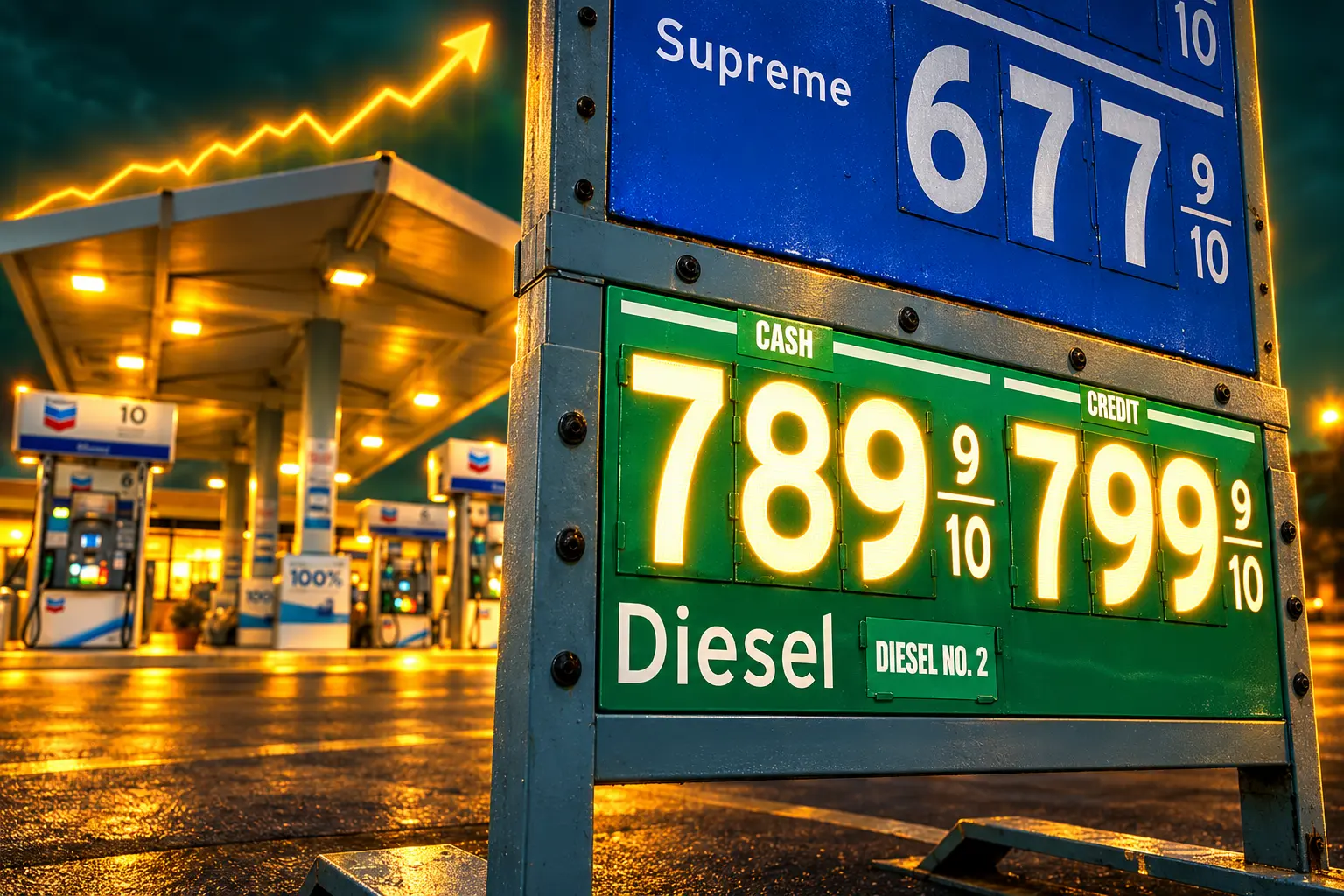
U.S. diesel hit a weekly record of $6.285 a gallon as full refineries, not crude flows, set the price for freight and heat.

The U.S. average for on-highway diesel rose to $6.285 a gallon in the week of September 14, a record in the Energy Information Administration survey that began in 1994. That is up 31.8 cents from the week before and $2.546 from $3.739 a year earlier.
The print is already inside freight contracts, farm diesel, and the winter fill for oil-heat homes. Crude is not the whole story. Energy Secretary Chris Wright said about 18 million barrels of oil left the Persian Gulf on September 15, near pre-conflict flows, and he named refining, not production, as the problem that still sets the pump.
The Official Weekly Average Just Cleared $6.285
The EIA’s weekly on-highway diesel prices are the index most fuel-surcharge schedules still track. For the week of September 14, every region in that table sat above $6. The Gulf Coast, closest to U.S. refining, was the cheapest reading. California was the high, more than $1.75 above the national average, which matches what Norfolk Southern’s chief commercial officer told a Morgan Stanley conference: California diesel was already at $8.
DIESEL BY REGION, WEEK OF SEPTEMBER 14
| Region | Sept. 14 | Sept. 7 |
|---|---|---|
| California | $8.039 | $7.764 |
| West Coast | $7.250 | $6.987 |
| Central Atlantic | $6.312 | $6.051 |
| Midwest | $6.250 | $5.946 |
| New England | $6.202 | $5.990 |
| Gulf Coast | $6.027 | $5.754 |
The next EIA release is September 22. Until then, the surcharge math that large fleets bill to shippers is running off a record weekly base, and independent drivers are paying that base in cash at the island.
Refineries Are Already Running at 98 Percent
Shuting Pomerleau, director of energy and environmental policy at the American Action Forum, wrote on September 11 that the U.S. Gulf Coast diesel crack spread past $100 a barrel on September 1, a fivefold jump from about $20 before the Middle East fighting. A crack spread is the gap between crude and the fuel a plant makes from it. When that gap is this wide, diesel is scarce relative to oil, and refiners that can still run are paid to keep every still full.
U.S. plants were already doing that. Operable utilization reached 98 percent in the last week of August, against 94.6 percent in the same week of 2025, which leaves almost no spare barrels of diesel if another unit trips offline. Wright, speaking on September 16, put the same split in plainer terms.
Oil production, we’re fixing that problem, refining is the bigger problem that is impacted by the Russian invasion of Ukraine and the loss of refining capacity in Russia.
Chris Wright, U.S. Secretary of Energy, September 16 remarks
He added that about 18 million barrels flowed out of the Gulf the day before, “basically pre-conflict levels.” That is a crude-lane bounce. It does not rebuild a damaged distillate plant, and it does not create spare hydrocrackers in the United States.
WHAT IS PINNING DISTILLATE
- Hormuz: Pomerleau described a six-month de facto closure of the strait, cutting off as much as 20 percent of global crude and petroleum products.
- Russian diesel: Moscow’s export ban was extended through September 30 after Ukrainian strikes; S&P Global estimated about half of Russia’s refining capacity was offline by the end of August, and Russia had supplied about 10 percent of seaborne-traded diesel.
- U.S. slack: At 98 percent utilization, extra diesel also needs room in hydrotreaters, hydrogen plants, and sulfur units that are already busy.
- Jet fuel: The same middle-distillate pool feeds jet, so high jet cracks compete with diesel for the next barrel through the unit.
Jack Buffington, an associate professor of supply chain management at the University of Denver, said nearly all of the world’s undamaged refining capacity is in use, and he put the offline share on the order of 20 percent. Steve Blough, chief supply chain strategist at Infios, pointed at Gulf Coast capacity cuts, Russian output, and strikes on Saudi lines as the stack that keeps diesel bid. Karim Fawaz, an executive director at S&P Global Energy, said the next test is winter demand against plants that have already been running hard for six months, and S&P no longer expects West Asian crude and refining to return to pre-war levels before the end of 2027.
Why Independent Truckers Cannot Wait Out the Spike
Diesel is the fuel of the haul. The EIA’s own explainer puts diesel at about 22 percent of transportation energy in the United States, and Pomerleau’s arithmetic from that series is blunt: on-highway use is about 120 million gallons a day, so every extra $1 a gallon is about $120 million a day in direct fuel cost. Against a year-ago pump of $3.739, the weekly national average is $2.546 higher.
Large fleets can bill a surcharge off the EIA print. Owner-operators buy retail and invoice later, if they can invoice at all. Independent drivers filling above $6 a gallon on the week of the record said some loads no longer cover the fuel, and that a slice of small fleets will park rather than run at a loss. David Russell, global head of market strategy at TradeStation Group, said diesel is the economy’s most universal tangible input, and that smaller players pushed to the sidelines take capacity with them, which then lifts shipping rates again.
That lag is why grocery aisles move after the pump. Carmit Glik, CEO of the freight forwarder Ship4wd, said diesel “moves through freight rates, farm equipment, food delivery, and home heating,” and that shoppers feel it a few weeks after the spike, once surcharges clear the chain. Jeff Lenard, vice president of media and strategic communications at the National Association of Convenience Stores, said the cost of getting gasoline to the station is already adding cents at the pump, and that retail gross margins have tightened by about 15 cents a gallon, about equal to a typical net margin, while stores still have to bring in chips and drinks on diesel trucks.
Big carriers are not insulated. J.B. Hunt CFO Brad Delco said the company has seen some of the most abnormal fuel swings in its history and called record diesel at least a $10 million headwind, with a warning of lower earnings. Blough said farmers get hit twice, in the tractor and in the grain truck, and those costs are hard to pass on in a harvest window. Construction sits in the same bind: the machines that move cement and gravel burn diesel, and many jobs were bid at older prices.
Oil-Heat Homes Face a 31.3 Percent Winter Jump
Heating oil is a distillate cousin of diesel, made from the same cut of the barrel, which is why a record on-highway print shows up in Northeast basements. The National Energy Assistance Directors Association, in a September 14 outlook, said U.S. households are projected to spend an average of $1,030 to heat from mid-November through mid-March, up $82, or 8.7 percent, more than 2.5 times the rate of inflation.
THE FUEL SPLIT INSIDE THE WINTER BILL
- Heating oil: NEADA’s analysis projects a 31.3 percent increase, with a seasonal bill around $2,297.
- Electricity: Bills are projected up 9 percent.
- Propane: Costs are projected up 8.7 percent.
- Natural gas: Costs are projected up 5.8 percent.
Oil heat is a small national share, on the order of 3 percent of households, more than 4 million homes, almost all in New England and the Mid-Atlantic. Mark Wolfe, NEADA’s executive director, said those families get hit three ways: the oil tank, gasoline, and delivery on everything else that still moves by diesel. He has asked Congress for more Low Income Home Energy Assistance Program money; the program had $4.1 billion for fiscal 2026, which ends September 30, and the chamber is out until November. Wolfe said that unless states step in, low-income and even middle-class households will make hard cuts to keep the tank from running dry.
A warmer Super El Niño winter in the Northeast would shave some gallons. It does not change the price of the gallons that still have to be delivered by truck.
Warsh Raised Rates to Keep the Shock From Spreading
On September 16 the Federal Open Market Committee voted 12-0 to raise the federal funds rate by a quarter point to a range of 3.75 percent to 4 percent, the first increase since July 2023. Chair Kevin Warsh said inflation remains too high, with 12-month PCE prices likely around 3.6 percent in August, and that too many categories are still rising above 3 percent. Asked how a quarter-point move reopens the Strait of Hormuz, he did not pretend it could.
We cannot affect any individual price, whether it be oil prices, whether it be food stuffs at the grocery store. But what we can do, and will do, is ensure that any change in relative prices don’t broaden out. Don’t have second and third order effects in the economy.
Kevin Warsh, Chair, Board of Governors of the Federal Reserve System, September 16 press conference
That is the policy channel for a diesel spike. The committee cannot print distillate. It can make credit dearer so a relative-price shock in freight and heat does not settle into rents, wages, and store shelves. The same households filling oil tanks and paying delivery fees now face a higher policy rate on top of the fuel bill. Warsh said the least well off have the most to gain from stable prices. They are also the households Wolfe said will ration heat.
Refiners and Big Carriers Collect the Spread
A $100 diesel crack is a loss for anyone who has to burn the fuel and a gain for anyone who can make it. Glik said the winners are refiners with strong distillate margins and larger carriers that buy fuel at wholesale while billing surcharges at retail. That is a structural edge a one-truck shop does not have. A big shipper can wait. A small owner has to decide the same day whether to eat the cost or pass it on.
WHO KEEPS THE MARGIN, WHO EATS THE FILL
- Refiners still running: Wide cracks pay the plants that have not been hit, converted, or shut.
- Surcharge fleets: The EIA weekly average is the benchmark in many contracts, so the record print becomes a line item on the invoice.
- Owner-operators: They buy retail, invoice late, and drop out when the haul no longer covers the tank.
- Oil-heat homes: They buy the same distillate family with no surcharge clause and a tank that has to be filled before the first freeze.
Railroads can pick up some freight because they burn less diesel per ton-mile, Russell said, and they can lose it again if the broader economy slows. Costco has already limited how much motor oil members can buy, a downstream product tied to crude and to the same tight refining system. Blough’s advice to shippers is the unglamorous kind: reroute, change modes, cut miles, because absorbing the bill is not a plan.
Prices Would Stay High Even If the Shooting Stopped
Buffington’s warning is the one that survives a ceasefire headline. Some people, he said, think diesel falls when the shooting stops. He said that is wrong, because the constraint is net refining capacity, and it could take a year or longer for prices to get back to $4 a gallon. Wright’s 18 million barrels speak to oil on the water. They do not speak to Russian stills, Gulf Coast units already at 98 percent, or winter heating oil drawing from the same tank farm as truck diesel.
Russell said that for the first time since the Iran fighting began, a lot of desks no longer have a baseline for the endgame. JPMorgan analysts wrote that the idea of a temporary disruption is getting harder to hold. Saudi steps to move more crude helped knock oil prices down on September 17; they did not rebuild distillate stocks. Independent drivers are already doing the math on whether the next load pays for the next fill, and oil-heat households in the Northeast are staring at a 31.3 percent jump with federal heat aid still stuck in a recess.
The weekly survey will print again on September 22. Until plants have spare barrels, the number that moves groceries, lumber, and basement tanks is the diesel crack, not the crude tape.

Final Fantasy Resonance Turns a Dead Gacha Into HD-2D

PHP2Shell Forced Sites Offline While Exploits Stalled

Kindle+ Folds AI Audiobooks Into the Page-Read Fund

Chip Stocks Fall as the Bond Rally Cheapens AI Spend

Comcast’s Record Odyssey Quarter Doubles as the Exit

Microsoft 365 Auth Fault Took Down Exchange and Teams

Xbox Caps Game Pass Cloud Gaming at 15 Hours

OpenClaw 2.0 Ships a Team Workplace With Host-Trust Defaults

OpenAI Unveils GPT-6 Astra With a Critical Cyber Label

Diesel Breaks Its Record as the White House Claims Credit
-
 NEWS2 months ago
Microsoft 365 Auth Fault Took Down Exchange and Teams
-
 GAMING2 months ago
Xbox Caps Game Pass Cloud Gaming at 15 Hours
-
 NEWS2 months ago
OpenAI Unveils GPT-6 Astra With a Critical Cyber Label
-
 NEWS2 months ago
OpenClaw 2.0 Ships a Team Workplace With Host-Trust Defaults
-
 BUSINESS2 months ago
Diesel Breaks Its Record as the White House Claims Credit
-

 LIFESTYLE2 months ago
Squishy Dumpling Toys Recalled After Hiding Illegal Water Beads
-

 BUSINESS2 months ago
ChargePoint Stock Rally Prices Wilmer’s Three-Year Cash Plan
-

 AUTO2 months ago
Tesla Puts Its Wheel-Free Cybercab on Austin Streets