
LIFESTYLE
What Does 925 K Mean on Silver?
A 925 K mark on silver means 92.5% sterling silver. The K is not a higher grade, and a lone 925 stamp is a maker’s claim, not a full legal hallmark.

You turned over a ring, a chain, or a spoon and found 925 stamped in the metal, sometimes with a K beside it. That stamp is the sterling silver mark, and the letter does not lift the metal into another grade.
This guide shows what 925 claims, how to read a K beside it, and how a British hallmark differs from a factory stamp. You will also see the other silver numbers, the marks that mean plate, and the US rule for the word sterling.
Sterling Silver and the 925 Number
The number 925 counts parts per thousand. Out of every 1,000 parts of the metal, 925 are pure silver, which is 92.5%. Makers add other metal, usually copper, because pure silver bends under ordinary pressure from a hand, a clasp, or a fork.
Some newer alloys swap part of that copper for another metal and still carry 925, as long as the silver share does not fall below the line. The digits are not a style code, a size, or a catalog number. A size or a design name on a tag sits apart from the metal stamp.
You will see the same claim written several ways. The punch may say 925,.925, S925, Ag925, SV925, Sterling, Ster, or STG. The S, and the letters Ag, point at silver, and Ag is the chemical symbol for the metal. None of those prefixes is a second purity sitting above 925.
On a ring, read the stamp inside the band. On a chain, check the clasp and any small tag beside it. On earrings, check the post and the back. A loupe helps, because the punch is small and a worn digit is easy to misread.
A place name does not change the alloy. A stamp such as 925 Italy, 925 Mexico, or 925 China adds a claimed country of manufacture to the same sterling number. Treat the country as its own fact, the way you would read an origin line on any other label.
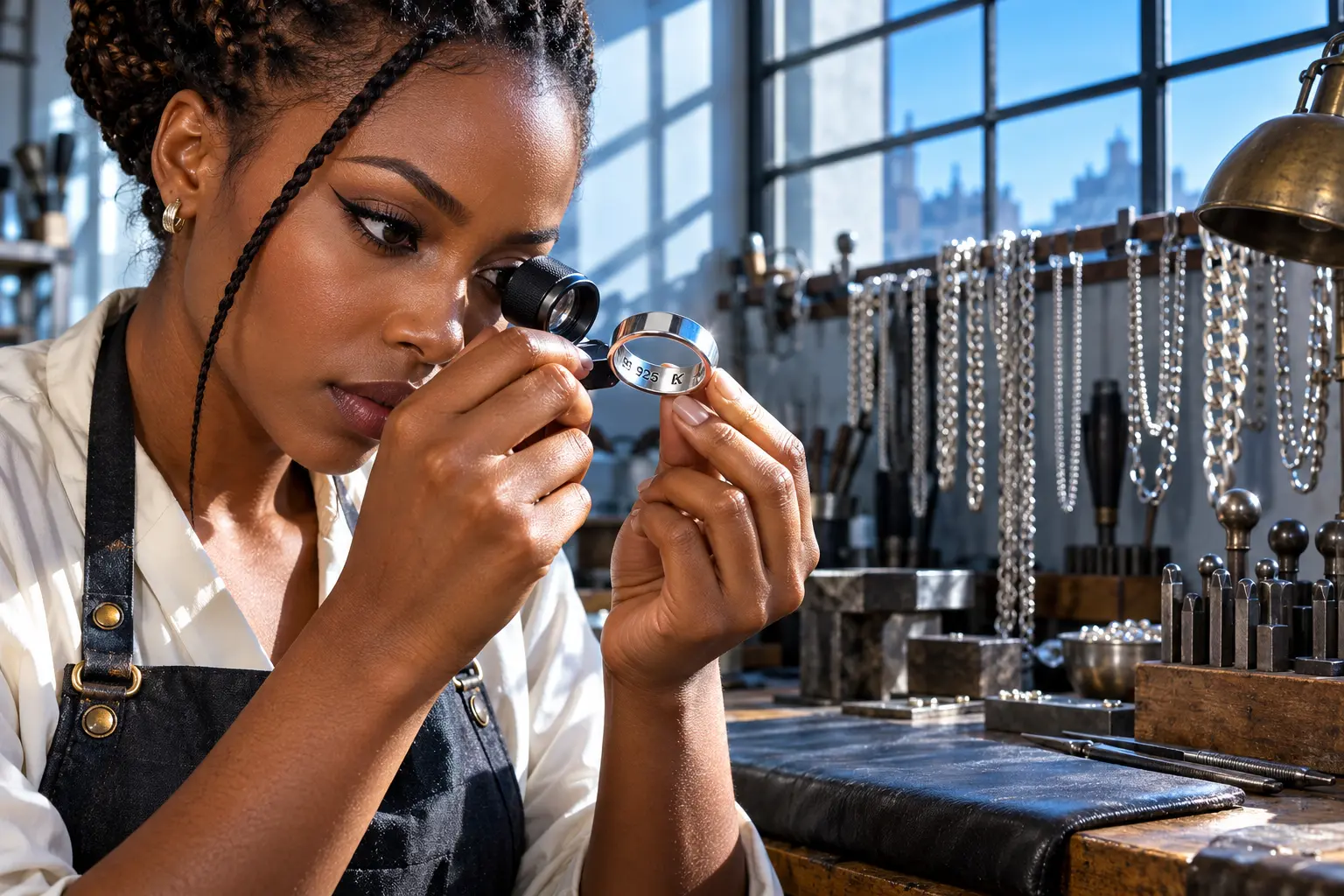
The Letter K Beside a Silver Stamp
K and KT are karat marks from gold, a scale that runs out of 24. On that scale, the top end is the purest gold. Silver does not use karats. The 925 already states the silver share in parts per thousand, so a K cannot raise it.
When the stamp looks like 925K or 925 K, split the characters before you decide anything. The number is the silver claim. The K is either a karat habit copied from gold stamps, the first letter of a maker’s name, or a worn punch that only looks like a K. A letter in its own little shield, sitting near the number, is doing a different job from the number.
A UK sponsor’s mark uses at least two letters, and each registered mark is unique. A lone K, with no second letter, is not that full sponsor’s mark. It is a reason to look at the rest of the stamp, not a purity bonus.
Other letters change the offer in a more serious way. If 14K, 18K, GP, GF, or RGP sits on the same piece as 925, those letters belong to gold. GP and its cousins name a gold-colored layer. The 925, if it is honest, names a sterling base under that color. Price the piece as silver with a coating, not as a gold alloy.
Sales lines make the same muddle. A product title can say 925 and plated in one breath, or even pair the word sterling with the word plate. Read those words the way you read the stamp. A plated piece is a different object from metal that is sterling all the way through.
UK Hallmarks and a Maker’s 925
A bare 925 is a maker’s claim. The factory, or whoever finished the piece, struck the number. A UK hallmark is the next step: an assay office tested the metal and struck its own marks. Many pieces are stamped 925 and still have no UK hallmark at all.
Three Marks Every UK Hallmark Includes
All three marks have to be present. Miss one, and the piece has not been properly hallmarked, whatever the 925 says. You can check the set in the UK hallmarking guidance for sellers.
| Mark | What it shows you |
|---|---|
| Sponsor’s mark | Who submitted the piece for testing. That can be the maker, a wholesaler, a retailer, or an importer. In the UK the mark has at least two letters, and each one is unique. |
| Fineness mark | The precious metal and its purity in parts per thousand. For sterling silver the number is 925. The shape around the number shows which metal it is. |
| Assay office mark | Which office tested and marked the piece. London uses a leopard’s head, Birmingham an anchor, Sheffield a rose, and Edinburgh a castle. |
Read them as who, what, and where. A date letter, when you see one, answers when, and it is optional. The Goldsmiths’ Company Assay Office films the set in a short clip, which is easier than guessing at a worn punch on a ring.
Optional Marks on a British Silver Piece
Extra marks can sit with the three required ones. They add history or an export route. They do not replace a missing sponsor’s mark or a missing office mark.
- Traditional symbol: A lion passant stands for sterling, a seated Britannia for the higher Britannia standard, and a lion rampant for sterling marked at Edinburgh.
- Date letter: The letter stands for the year the piece was hallmarked, and it changes on 1 January. It stopped being compulsory in 1999, so a modern piece can be fully hallmarked with no letter at all.
- Convention mark: Scales around the fineness number show a Common Control Mark. The UK recognizes these marks for sale without a second British hallmark.
The lion passant can still be struck on new sterling as an optional symbol. Match any date letter to the office that struck it, because the same letter means different years at different offices and in different cycles. Start with the Birmingham Assay Office silver guide if an anchor is the office mark on your piece.
WEIGHT LINES FOR A HALLMARK
| Metal | A hallmark is required at this weight and above |
|---|---|
| Silver | 7.78 grams |
| Gold | 1 gram |
| Palladium | 1 gram |
| Platinum | 0.5 gram |
Under the silver line, a manufacturer’s 925, S925, SV925, or Ag925 can be legal in the UK, and it is still only a manufacturer’s mark. Over the line, describing the piece as silver in a shop or online without a hallmark breaks the law. A kitchen scale can show that a heavy tray is obviously over the line. If the piece feels close to it, a jeweler’s scale is the one that matters.
Other Silver Fineness Numbers
925 is the jewelry standard, not the only solid-silver number. A lower number can still be silver all the way through. The third column applies each stamp to a piece that weighs 10 grams, so you can scale it to the weight in your hand.
| Stamp | Parts silver per 1,000 | Pure silver in 10 grams | What the stamp is claiming |
|---|---|---|---|
| 999 | 999 | 9.99 g | Fine silver, soft, used for bullion and some traditional pieces |
| 958 | 958 | 9.58 g | Britannia silver, the higher UK standard |
| 950 | 950 | 9.50 g | A 95% standard seen on some European silver, not a UK hallmark fineness |
| 925 | 925 | 9.25 g | Sterling silver, the jewelry standard |
| 900 | 900 | 9.00 g | Coin silver under US rules |
| 835 | 835 | 8.35 g | A lower standard on older European silver, including German pieces |
| 800 | 800 | 8.00 g | A legal UK standard and a common continental one |
If the piece shows a walking lion and no number, that lion is the sterling mark. If it shows the figure of Britannia, you are in the higher standard from the table, not in a different metal. Plate does not use these numbers. Plate uses letters, and those letters are the next thing to learn.
Solid Sterling, Silver Plate, and Gold Color
Letters, not a smaller number, separate plate from solid silver. EPNS means electroplated nickel silver, a thin silver skin over a white base metal. EP, EPBM, silver plate, and A1 point the same way. Nickel silver, German silver, and alpaca are old trade names for alloys that can contain no silver at all, which is why the name on the box is not the test.
A gold-colored surface on a 925 piece is a coating on sterling, not a gold alloy. Sellers often call a gold coating on sterling vermeil. If you also see GP, GEP, HGE, or RGP, the letters say the gold is a layer. Color that wears at the edges and shows a paler metal underneath fits that construction.
The number can be copied onto metal that is not silver. Assay offices report manufacturer’s stamps such as a plain 925 or S925 on pieces that are not precious metal, and some of those pieces have contained materials that can harm skin. A tidy stamp with no sponsor’s mark and no office mark is still a claim. For a piece you will wear against skin every day, that is the moment to ask for a test.
US Rules for the Word Sterling
In the United States, a workshop does not have to send a ring to an assay office before it stamps 925. The words around the number are still regulated. Under the FTC rule on silver wording, sterling, sterling silver, solid silver, and Ster. are reserved for silver that meets the sterling line in the fineness table. Coin silver is the separate 900 line in that same table, not a nickname for sterling. The word silver, with no number beside it, is not a finished quality mark under that rule.
How far a stamped piece is allowed to sit under its number is set out in the US silver fineness statute. The gap depends on whether the test includes solder. Silver-plated articles are barred from the word sterling altogether.
HOW FAR UNDER THE STAMP
| What gets tested | Largest shortfall below the marked fineness |
|---|---|
| A part that contains no solder | 4 parts per thousand |
| The whole article, solder included | 10 parts per thousand |
A US 925 stamp is a legal claim with that narrow gap, not a British hallmark. Put a UK spoon and a US ring side by side and the number can match while the proof behind it does not. One was tested at an assay office. The other rests on the firm that struck the punch.
Checks Before You Trust a 925 Stamp
You do not need a lab for the first pass. You need the whole stamp, a decent light, and a clear split between a claim and a test.
READ THE STAMP IN ORDER
- Every character: Write down the full stamp, not only the 925, including letters, shields, and any second number.
- The K: Split it off from 925 and decide whether it is a karat-style letter, part of a name, or a worn punch.
- Plate words: Reprice the piece if you see EPNS, EP, GP, GF, or the word plate.
- A UK set: On a heavier British piece, look for two or more sponsor letters and an assay office symbol beside the fineness number.
- A test: If the price, the weight, or a family story makes the piece matter, ask a jeweler to test it. UK offices use X-ray fluorescence before they apply a hallmark.
After that reading you know the claimed purity, whether a K or a plate code changes the offer, and whether an assay office has put its own marks on the piece. Take that note with you if you are about to pay more than a casual price.
Frequently Asked Questions
Does 925 Silver Leave a Mark on Skin?
A green or gray line on the skin does not, by itself, prove the stamp is fake. The alloy metal beside the silver, usually copper, is what reacts with sweat on some people. Wash the spot, dry the ring, and ask a jeweler about a rhodium coating if the line keeps coming back. A rash, rather than a colored line, is a reason to stop wearing the piece and talk to a doctor.
Can You Wear 925 Silver in the Shower?
Take it off for the shower when you can. Water left to dry on sterling dulls the bright surface, so rinse the piece with clean water and dry it if it gets wet. The silver content does not wash out. You are protecting the finish, not the purity the stamp claims.
What Does Carat Mean Next to a 925 Stamp?
Carat, spelled with a C, is a weight used for gemstones. Karat, spelled with a K, is the gold purity scale. Neither one changes the silver share in a 925 alloy. A one-carat stone in a 925 setting is a stone weight plus a sterling mounting, and the stone needs its own description.
Is Fine Silver Better Than 925 for a Ring?
Fine silver, stamped 999, is softer than sterling. A ring in fine silver bends and scratches sooner than the same ring in 925, which is why jewelry makers alloy the silver. Bars, coins, and some traditional pieces use that softer metal. For a ring you wear on a hand, the sterling alloy holds its shape better.
Once the stamp is written out in full, you can see the claimed silver share, any K or plate code that changes the offer, and whether an assay office added marks of its own. For a piece with a real price or a family story, that note is what you hand to a jeweler before money changes hands.
Disclaimer: This article is an educational guide to silver stamps and hallmarks, and it is informational only. It is not a legal opinion, an appraisal, or a promise about the metal in any specific piece you own. Ask a qualified jeweler or assayer to test a piece, and a solicitor if you are selling precious metal in the course of trade, before you rely on a stamp. Fineness rules, weight thresholds, and hallmark requirements reflect the official sources reviewed here and can change.

Final Fantasy Resonance Turns a Dead Gacha Into HD-2D

PHP2Shell Forced Sites Offline While Exploits Stalled

Kindle+ Folds AI Audiobooks Into the Page-Read Fund

Chip Stocks Fall as the Bond Rally Cheapens AI Spend

Comcast’s Record Odyssey Quarter Doubles as the Exit

Microsoft 365 Auth Fault Took Down Exchange and Teams

OpenAI Unveils GPT-6 Astra With a Critical Cyber Label

Xbox Caps Game Pass Cloud Gaming at 15 Hours

OpenClaw 2.0 Ships a Team Workplace With Host-Trust Defaults

Squishy Dumpling Toys Recalled After Hiding Illegal Water Beads
-
 NEWS2 months ago
Microsoft 365 Auth Fault Took Down Exchange and Teams
-
 NEWS2 months ago
OpenAI Unveils GPT-6 Astra With a Critical Cyber Label
-
 GAMING2 months ago
Xbox Caps Game Pass Cloud Gaming at 15 Hours
-
 NEWS2 months ago
OpenClaw 2.0 Ships a Team Workplace With Host-Trust Defaults
-
 LIFESTYLE2 months ago
Squishy Dumpling Toys Recalled After Hiding Illegal Water Beads
-

 BUSINESS2 months ago
Diesel Breaks Its Record as the White House Claims Credit
-

 BUSINESS2 months ago
ChargePoint Stock Rally Prices Wilmer’s Three-Year Cash Plan
-

 NEWS2 months ago
IFA 2026’s Weird Gadgets Are Building a Sensor Home