
BUSINESS
Scotland Bets Public Cash on Unsold Ferguson Tugboats
Holyrood will fund Ferguson Marine to build tugboats for sale, while four promised ships still wait on subsidy law and 70 jobs hang in the gap.

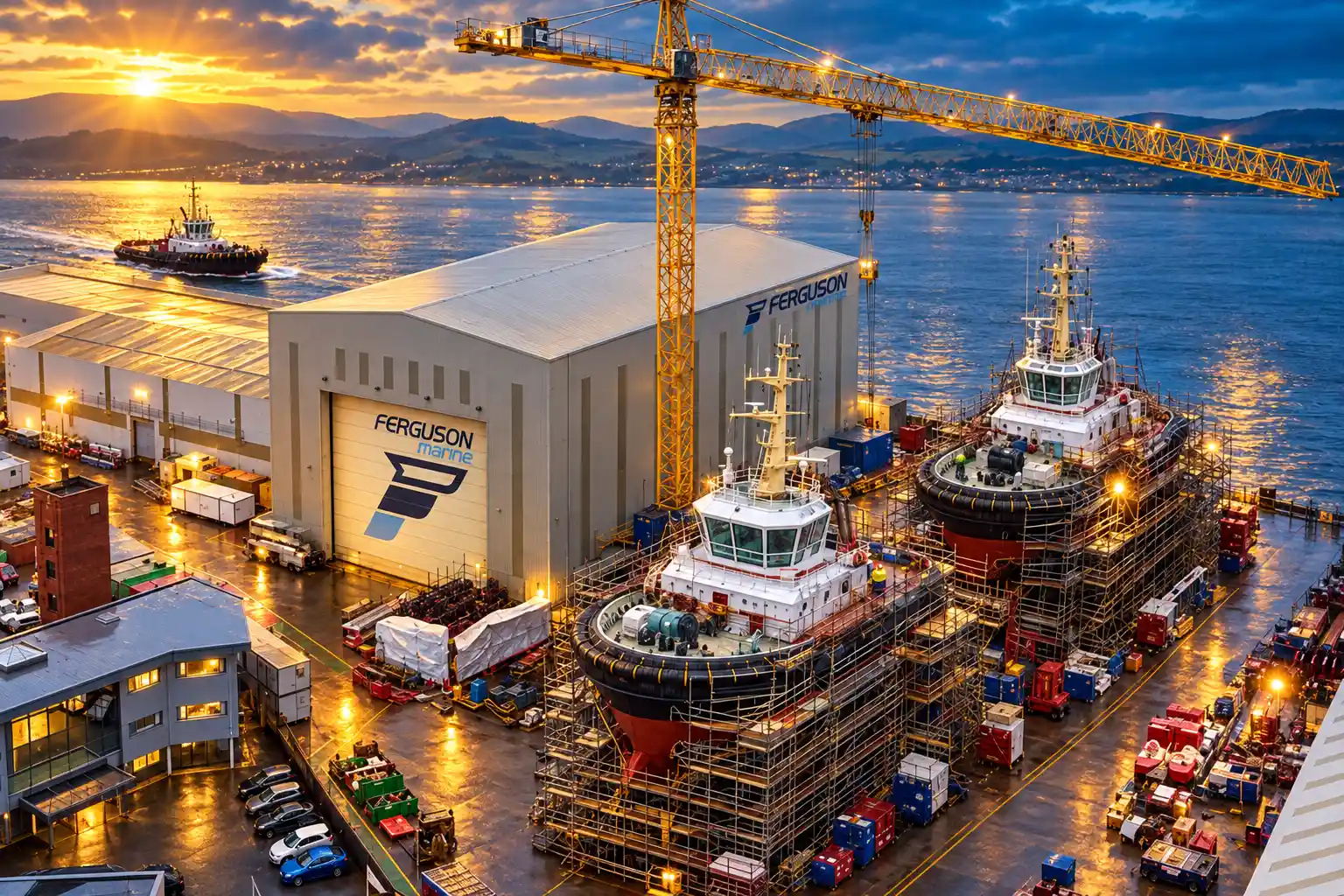
Scotland’s government will fund Ferguson Marine to build tugboats with no buyers, after the Port Glasgow yard’s last ferry work runs out. Economy and Transport Secretary Stephen Flynn told Holyrood on 17 September 2026 that he had agreed the yard’s request for working capital so it can build a small number of tugs and then try to sell them.
The cash amount is unpublished. So is the tug count. The bet sits in the empty months after MV Glen Rosa, due in the fourth quarter of 2026, and before four larger public ships that ministers proposed on 3 March 2026 but have still not placed.
Flynn Backs Tugs With No Buyers Yet
Flynn said the board at the state-owned yard had asked for working capital “to enable it to build a small number of tugboats for subsequent sale into commercial markets.” He told MSPs he had said yes because he agreed with that board.
I have agreed that this proposal should be taken forward because I agree with the board that it represents a sensible, commercial approach to maintaining productive activity within the yard.
Stephen Flynn, Economy and Transport Secretary, Scottish Parliament
He said the money could hold “critical shipbuilding capability and workforce skills” in the gap between Glen Rosa and the still-unawarded public ships, “by making sure we have a commercial alternative in place with tugboats.” Officials have been told to sort the commercial, financial and governance paperwork “as quickly as possible.”
The hulls would use a pre-packaged design from an established builder so cutting can start soon. Dutch group Damen is the name in circulation. No contract with Damen has been confirmed, and no buyer has been named.
After Glen Rosa, Flynn said, “the yard has no contracted shipbuilding work scheduled for 2027.”
Four Promised Ships, Zero Contracts Signed
On 3 March 2026, Deputy First Minister Kate Forbes stood in the same chamber and proposed a five-year run of work. Ministers would directly award Ferguson the four new vessels proposed to be built at Port Glasgow: two small CalMac ferries from phase two of the Small Vessel Replacement Programme, for the Sound of Harris and the Sound of Barra, plus replacements for the marine research ship Scotia and the marine protection ship Minna.
Forbes said the four ships matched the yard’s size and skills, and that several of them replace hulls Ferguson had built before. She was already clear that a contract was not a signature. A due diligence process was “underway,” and “engagement with the Competition and Markets Authority” had to come before any formal award.
On 17 September, Flynn said that work was still not done. A principles assessment would go to the CMA “in the coming weeks,” with a final submission after that. Direct awards of this kind sit under the Subsidy Control Act 2022, which limits public money that distorts competition. Public bodies must follow the UK subsidy control statutory guidance before they place a no-bid order on a yard they own.
THE ORDER BOOK AGAINST THE CALENDAR
| Work | Status on 17 September 2026 | When steel can move |
|---|---|---|
| MV Glen Rosa | Completing at Port Glasgow | Handover due Q4 2026 |
| Spec tugboats | Working capital agreed; no buyers | Once a design partner is signed |
| Two CalMac small ferries | Proposed direct award; no contract | About a year of design after award |
| Scotia research-ship replacement | Proposed direct award; no contract | Same CMA path as the ferries |
| Minna protection-ship replacement | Proposed direct award; no contract | Same CMA path as the ferries |
| Type 26 units for HMS Birmingham | Three blocks delivered | Moved to Govan in July 2026 |
Even if those four public ships were signed at once, the yard would still face a dead stretch, because at least a year of design work sits between a contract and the first cut. The tugs exist to occupy that stretch. They do not replace the four ships, and they do not carry a named customer.
Why the Yard Has Nothing Booked for 2027
Ferguson is the last commercial yard on the Clyde, and the only builder left on the lower river. The slip is too small for many of the CalMac replacements now going out to tender, and that limit has already shown up in lost work.
In March 2025 the first batch of small electric ferries, seven hulls under phase one of the same replacement programme, went to Remontowa in Gdansk. Other CalMac ships have been placed at Cemre in Turkey. Port Glasgow’s paid order book, once Glen Rosa leaves, is empty.
Forbes had also tied a promised £14.2 million modernisation pot, over two years, to a new business plan and to the four-ship proposal. That money remains subject to due diligence. In March she said interim spend had gone on repairs, safety kit and targeted tools to help finish Glen Rosa, and that those steps “were not transformational.”
WHAT WE KNOW
- The cash decision: Flynn has agreed working capital for spec tugs, with no published sum.
- The last ferry: Glen Rosa is still scheduled for handover in Q4 2026, with no shipbuilding booked for 2027.
- The four ships: They remain a proposal. The CMA file has not gone in.
WHAT IS UNCONFIRMED
- Tug numbers: Ministers will only say a “small number.”
- The design partner: Damen is the name in play, not a signed yard.
- A sale: No harbour operator has ordered the boats.
Opposition MSPs treated the tug plan as a substitute for the March promise, not a bridge to it. Scottish Conservative MSP Stephen Kerr called the statement “painfully thin on detail” and said the four ships had been “nothing more than a con made to the people of Inverclyde mere weeks before the election.” Reform UK’s Malcolm Offord said tugs were “a thousand leagues from the expectations of Clyde shipbuilding” and that Flynn “knows perfectly well that tugboats are no substitute for ferries and larger vessels.” Labour’s Neil Bibby said months had passed and the yard was “still waiting.”
Lib Dem transport spokesperson Willie Rennie said the government “failed to carry out appropriate legal checks” before it told parliament it would make a direct award. “The consequences are being felt by the third of the workforce who have lost their jobs as a result of the government’s negligence,” he said. West Scotland Labour MSP Katy Clark put the same charge in public the morning of Flynn’s statement, before the tug cash was announced.
In March Kate Forbes promised 4 ferry contracts to Ferguson Marine.
Stephen Flynn now won’t commit to providing the work & 70 jobs are being cut at the yard. The Scottish Government must deliver on its promise now. pic.twitter.com/dcSh2hfFtR— Katy Clark MSP (@KatySClark) September 17, 2026
The replies under that post reran an old fight over who kept the yard alive in 2019, not over whether unsold tugs will find a harbour. The commercial question is still the one Flynn did not answer: who pays for the boats once the working capital is spent.
Glen Sannox Still Runs on Diesel
The empty 2027 diary is the bill for the dual-fuel pair that was supposed to secure the yard. CMAL ordered Glen Sannox and Glen Rosa in 2015 on a £97 million contract, with both ships due in 2018. Combined costs have since risen to around £400 million. Ferguson went into administration in August 2019 and into public ownership later that year so the hulls could be finished.
Glen Sannox entered CalMac service in January 2025. On 3 June 2025, while running on liquefied natural gas with 82 passengers on an Arran crossing, a vent valve failed open. CalMac’s investigation found that 700kg of methane left the ship in 12 minutes. Some of it was drawn into a ventilation intake and set off gas alarms in the generator room. The operator called it a “critical failure” in the gas fuel system. The LNG tank was emptied in November 2025, and the ship has since been running on diesel.
Glen Rosa, the sister, is still in the final stages at Port Glasgow, with delivery due in Q4 2026, eight years after the original date. Corrosion in stern tubes and hull coating, found after a long wait at the quay, pushed the handover back from the second quarter of 2026.
HOW THE ORDER BOOK DRAINED
- 2015: CMAL awards both dual-fuel ferries for £97 million, with 2018 delivery.
- August 2019: The yard enters administration; ministers take it into public ownership later that year.
- January 2025: Glen Sannox begins passenger sailings.
- 3 June 2025: A failed vent valve dumps 700kg of methane on an Arran crossing.
- 3 March 2026: Forbes proposes four direct-award ships, subject to subsidy checks.
- July 2026: Three Type 26 blocks leave Port Glasgow for Govan.
- 18 August 2026: The yard opens a voluntary exit scheme for up to 70 people.
- 17 September 2026: Flynn agrees working capital for tugs with no buyers.
Forbes told parliament in March that island communities’ frustration was “justified.” The tug plan does not put a new CalMac hull on a slip. It tries to keep the shop floor busy while that larger bet stays in legal review.
The Workforce Faces 70 Voluntary Exits
Ferguson employs 283 people, including 34 apprentices. On 18 August 2026 the company opened a voluntary scheme expected to take up to 70 of them, about a quarter of the payroll. Those who leave are due £1,000 per completed year of service, up to £10,000, on top of statutory pay. The company said Glen Rosa would still be finished on the Q4 2026 date.
Chief executive Graeme Thomson said the “immediate focus remains the safe, high-quality handover of Glen Rosa in Q4 2026.” He added that as the ship nears completion, “we face an inevitable gap in workload while we work with the Scottish Government to make the relevant preparations to enable us to proceed with contract negotiations.”
GMB Scotland called the cuts “a betrayal of a blameless workforce.” Flynn, in August, called the scheme “necessary” to put the yard on a more competitive footing, and said a smaller headcount would not delay Glen Rosa. On 17 September he said none of the exits would be compulsory.
THE PAYROLL THE TUGS ARE MEANT TO HOLD
- Headcount: 283 staff, including 34 apprentices, before the voluntary scheme.
- Exits: Up to 70 people, about a quarter of the yard.
- Pay on the way out: £1,000 per completed year, capped at £10,000, plus statutory redundancy.
- What the tugs must do: Keep enough trades on the floor to start the next hull, public or private.
Spec tugs only work as a jobs plan if they need the same trades the four public ships will later need, and if they sell before the working capital runs out. Flynn did not put a sale price, a build cost or a break-even date on the record.
Damen Already Builds Tugs Before It Sells Them
The commercial idea is not new. Damen, the Dutch builder named as a possible design partner, runs a stock programme in which hulls are started before a customer signs. In May 2026 it sold an ASD Tug 2111 and an ASD Tug 2813 to Türkiye’s Albayrak Group and said that, because of that already begun construction of the tugs, both boats would go in five to six months. The 2111 is 21.02m by 11.13m with 50 tonnes of bollard pull, built at Changde in China. The 2813 is 25.59m by 12.93m with up to 83 tonnes, built at Song Cam in Vietnam.
That is a sales machine with yards in more than one country and a catalogue harbour operators already know. Ferguson is being asked to copy the stock-build step without the confirmed licence, the overseas berths or the order book. A pre-packaged design would let Port Glasgow cut steel faster than a bespoke ferry. It would not give the yard Damen’s customers.
If the partner is not Damen, the same problem sits on whatever drawing is chosen. A tug built on speculation is inventory. Inventory at a yard whose last two ferries ran eight years late is a harder sell than inventory at a yard that ships the same model every month.
Frigate Blocks Have Already Left Port Glasgow
The one recent paid job that did leave the yard on time was not a ship. Ferguson signed with BAE Systems to fabricate three structural components for Ship 4, HMS Birmingham, on the Type 26 frigate programme. Each City-class hull is made of nearly 60 units, joined at Govan. In July 2026 the three Port Glasgow blocks went upriver, with Malin Abram and Coastworks on the heavy lift. Thomson called it a proud moment and said the work had given apprentices “high-level engineering experience.” BAE’s Simon Lister said Ferguson had already built two Type 26 units before this award.
Block work keeps welders busy. It does not fill a 2027 berth the way a tug, a ferry or a research ship would. Forbes said in March that ministers still intend to return Ferguson to the private sector “when the time is right.” Flynn said in August that once the yard can win private orders, “there would be market interest.” The tug cash is a wager that a few unsold workboats can carry the workforce across the legal wait, and that a buyer will appear before the working capital does not.
Flynn still says the yard “can have a strong future as a modern and competitive shipyard.” The four ships remain a proposal. The tugs remain a product without a customer. The sum on the cheque has not been put in front of MSPs.

Final Fantasy Resonance Turns a Dead Gacha Into HD-2D

PHP2Shell Forced Sites Offline While Exploits Stalled

Kindle+ Folds AI Audiobooks Into the Page-Read Fund

Chip Stocks Fall as the Bond Rally Cheapens AI Spend

Comcast’s Record Odyssey Quarter Doubles as the Exit

Microsoft 365 Auth Fault Took Down Exchange and Teams

Xbox Caps Game Pass Cloud Gaming at 15 Hours

OpenClaw 2.0 Ships a Team Workplace With Host-Trust Defaults

OpenAI Unveils GPT-6 Astra With a Critical Cyber Label

Diesel Breaks Its Record as the White House Claims Credit
-
 NEWS2 months ago
Microsoft 365 Auth Fault Took Down Exchange and Teams
-
 GAMING2 months ago
Xbox Caps Game Pass Cloud Gaming at 15 Hours
-
 NEWS2 months ago
OpenAI Unveils GPT-6 Astra With a Critical Cyber Label
-
 NEWS2 months ago
OpenClaw 2.0 Ships a Team Workplace With Host-Trust Defaults
-
 BUSINESS2 months ago
Diesel Breaks Its Record as the White House Claims Credit
-

 LIFESTYLE2 months ago
Squishy Dumpling Toys Recalled After Hiding Illegal Water Beads
-

 BUSINESS2 months ago
ChargePoint Stock Rally Prices Wilmer’s Three-Year Cash Plan
-

 AUTO2 months ago
Tesla Puts Its Wheel-Free Cybercab on Austin Streets