
BUSINESS
Nasdaq Recaptures the 50-Day Line as Buy Signals Flicker
Nasdaq jumped 1.69% and recaptured its 50-day line after the Fed hike, while AMD, Moderna and SpaceX printed early buys as overnight futures slipped.

Dow Jones futures slipped overnight after the Nasdaq Composite jumped 1.69% and recaptured its 50-day line. S&P 500 futures dipped 0.1% and Nasdaq-100 futures fell 0.3% after Thursday’s rebound.
The same session printed early buy setups in Advanced Micro Devices, Moderna and SpaceX, even as Starship’s first orbital flight slipped a week.
Nasdaq and the S&P Recapture Their 50-Day Lines
The Nasdaq Composite closed at 26,418.30 on Sept. 17, up 439.87 points. The S&P 500 rose 1.14% to 7,637.74. Both indexes moved back above their 50-day moving averages, and the Nasdaq also cleared its 10-day and 21-day lines in higher volume.
The Dow Jones Industrial Average added 0.62%, or 317.95 points, to 51,779.85, and still sat short of its own 50-day average. The Russell 2000 gained 0.55% and finished near the session’s lows, also well short of that line. Winners beat losers by more than 2-to-1. It was the biggest one-day gain for the Nasdaq and the S&P 500 since Aug. 4, and it put the Nasdaq in the green for September after seven declines in the prior eight sessions.
THURSDAY’S CLOSES
| Name | Thursday move | Close / note |
|---|---|---|
| Nasdaq Composite | +1.69% | 26,418.30, back above the 50-day |
| S&P 500 | +1.14% | 7,637.74, back above the 50-day |
| Dow Jones | +0.62% | 51,779.85, still below the 50-day |
| AMD | +6.36% | $545.09 |
| Moderna | +8.55% | $158.07 |
| VanEck Semiconductor ETF (SMH) | +2.8% | still below its 50-day |
U.S. crude settled at $101.91 a barrel, down 0.5%, after trading near $99 earlier in the day. Lower oil and a drop in Treasury yields did more for the tape than any change in the Fed’s words from Wednesday.
A Unanimous Quarter-Point Left the 10-Year at 4.95%
On Sept. 16 the Federal Open Market Committee voted 12-0 to raise the federal funds rate by a quarter point to a range of 3.75% to 4%. It was the first increase in more than three years. Sixteen of the 18 officials who submitted projections penciled in at least one more hike in 2026.
Chair Kevin Warsh told reporters the plain fact is that inflation is too high and has been for too long. He also said this summer’s inflation readings do not show that underlying trends have meaningfully improved. The Dow fell 631 points on that press conference, and the S&P 500 lost 0.45%.
Inflation remains elevated. Today’s policy action will support a timelier return to the Committee’s 2 percent goal. The Committee will deliver price stability.
Federal Open Market Committee statement, September 16, 2026
The same statement said economic activity is expanding at a solid pace, productivity growth is strong, and capital investment is robust. That last clause is what Thursday’s buyers chose to fund. The 10-year Treasury yield, which had pushed back above 5% on Wednesday, declined nearly six basis points to 4.95%. The gap between the 10-year and the two-year narrowed to 25.8 basis points, the tightest since March 2025.
A hawkish hike that knocks long rates lower is a bond-market vote that the Fed will stay on inflation. That vote, not a dovish surprise, is what let growth stocks bid again. Traders still priced a 55% chance of another quarter-point move at the late-October meeting.
AMD Rallies 6.36% on a Memory Squeeze
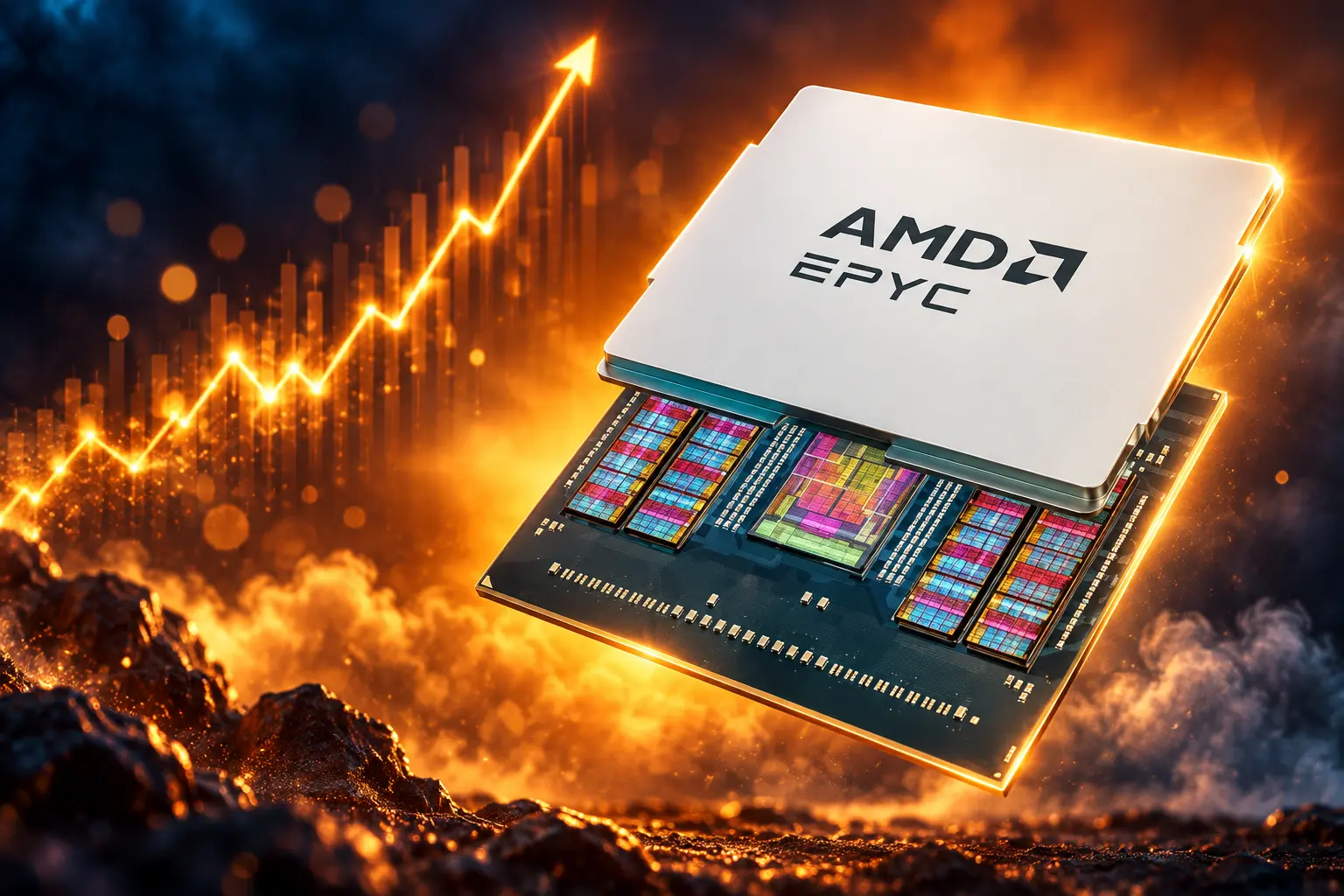
Advanced Micro Devices closed at $545.09, up $32.59, or 6.36%, from $512.50. The session ranged from $527.60 to $551.42. The stock remains below its 52-week high of $584.73. Intel rose 7.67%. Micron added 5.50%. Nvidia gained 2.54% and was still the largest single boost to both the S&P 500 and the Nasdaq. The VanEck Semiconductor ETF popped 2.8% and still sits below its 50-day line.
Intel chief executive Lip-Bu Tan said the company can meet only 50% of CPU demand because of limited factory capacity and a shortage of memory chips. Memory, he said, is the bottleneck, and next year looks worse. Talk that SK Hynix is exploring a partnership at Intel’s Ohio fab added a second bid under the group. The Magnificent Seven, Alphabet, Amazon, Apple, Meta Platforms, Microsoft, Nvidia and Tesla, each rose at least 1.3%.
That is a hardware bid. It treats the Fed’s hike as proof the economy can still pay for chips, racks and power, not as a reason to cut those budgets. Software participated, but it did not lead. The iShares Expanded Tech-Software Sector ETF rose 0.7%.
Which Stocks Flashed Buy Signals After the Fed?
Moderna, Marex, Incyte, NetApp, AMD and Elastic all moved into early-entry zones, combining pushes off key moving averages, short-term highs or trendlines. SpaceX shares rose to trade around an aggressive buy point. The question hanging on each name is whether Thursday’s strength lasts more than a session.
EARLY ENTRIES ON SEPT. 17
- Moderna (MRNA): Closed at $158.07, up $12.45, or 8.55%, from $145.62, with no new trial print that morning.
- AMD: Closed at $545.09, up 6.36%, and remains on the IBD 50 with Elastic and NetApp.
- SpaceX (SPCX): Traded around an aggressive early entry on the same day Starship Flight 14 slipped to Sept. 28.
- Marex, Incyte, NetApp, Elastic: Joined the early-entry list on moving-average and trendline pushes, without a shared news catalyst.
Moderna’s tape is still repricing the Aug. 19 Phase 3 readout from INTerpath-001, the 1,137-patient melanoma study of intismeran autogene plus Merck’s Keytruda. Shares jumped 177% on that session, the first Phase 3 success for a personalized neoantigen vaccine. Chief executive Stéphane Bancel called the result an extraordinary milestone. On Thursday the company presented at the Morgan Stanley Global Healthcare Conference, and the ARK Genomic Revolution ETF surged 7.8%.
Investors who did buy into the rebound were told, in so many words, to keep initial size small and to avoid piling into one theme. A lot of groups looked firm. Concentration in chips, biotech and SpaceX is still a single bet on long-duration growth surviving another hike.
SpaceX Tests a Buy Point as Starship Slips to Sept. 28
SpaceX said it is now targeting Starship Flight 14 as early as Monday, Sept. 28, pending regulatory approval. The prior window had been Sept. 22, a six-day slip, and the company gave no reason. The FAA license remains the gate. Hardware has been ready longer than the paperwork.
Now targeting to launch Starship Flight 14 as early as Monday, September 28, pending regulatory approval https://t.co/3nG9wffG6A
— SpaceX (@SpaceX) September 17, 2026
The mission is still meant to be Starship’s first trip to orbit. The first 13 flights, dating to April 2023, were suborbital. Ship 41 is supposed to complete six orbits at about 275 kilometers, fly for nearly 10 hours, then splash down in the Pacific west of Chile. Super Heavy is supposed to splash down in the Gulf of Mexico about seven minutes after liftoff. There will be no tower catch of either stage.
SpaceX’s own mission page calls this the first Starlink V3 satellite deployment, a load of 26 spacecraft, three of them fitted with cameras to inspect the heat shield. Starlink already counts more than 11,000 active satellites, none of them V3. Ryan Caton, a host at NASASpaceflight, put the contradiction in one line: Ship 41 is attempting orbit for the first time, but it is deploying real Starlinks, so it is a revenue flight. Replies called it both, and noted that Booster 21 still has to prove a Super Heavy splashdown after two failed returns.
That mix is why a six-day delay did not break the bid. The market is underwriting V3 capacity and an orbital vehicle, not a Tuesday launch window. The same shares now testing an early entry sit on a path that could force $50 billion in stock selling once a broader listing lands.
STARSHIP AND THE FED WEEK
- July 24, 2026: Starship Flight 13 flies a suborbital test; Super Heavy makes a hard splashdown after engines fail to relight.
- September 16, 2026: The Fed raises rates 25 basis points to 3.75% to 4% on a 12-0 vote.
- September 17, 2026: Nasdaq and S&P 500 reclaim their 50-day lines; SpaceX retargets Flight 14 to Sept. 28; AMD, Moderna and SpaceX print early entries.
- September 28, 2026: New no-earlier-than date for Starship’s first orbital attempt, still pending regulatory approval.
By going to orbit, SpaceX wrote, the next phase of developing Starship to be fully and rapidly reusable can begin. Until the license prints, that sentence stays a plan.
Equal-Weight and Small Caps Never Confirmed the Turn
The rebound was real and it was narrow. The Invesco S&P 500 Equal Weight ETF gained 0.5% and remains well below its 50-day line, lagging the cap-weighted S&P 500. Financials and consumer staples were the only two of the 11 S&P 500 sectors to close lower. The Financial Select Sector SPDR edged down 0.1%.
WHO FOLLOWED, WHO DID NOT
| Fund | Thursday | 50-day line |
|---|---|---|
| VanEck Semiconductor ETF (SMH) | +2.8% | Still below |
| Invesco S&P 500 Equal Weight (RSP) | +0.5% | Well below |
| ARK Innovation (ARKK) | +4.5% | n/a |
| ARK Genomic Revolution (ARKG) | +7.8% | n/a |
| SPDR S&P Metals and Mining (XME) | +2.3% | n/a |
| Financial Select Sector SPDR (XLF) | -0.1% | n/a |
Miners and biotech confirmed the risk bid. Banks did not. Small caps did not. The equal-weight S&P 500 did not. A 50-day reclaim on the Nasdaq that leaves SMH, RSP and the Russell 2000 under their own lines is a leadership test, not a finished repair.
After the close, Dow Jones futures lost a fraction, S&P 500 futures dipped 0.1%, and Nasdaq-100 futures fell 0.3%. The 10-year yield edged to 4.94%. Overnight futures are a weak vote, and they do not always survive the cash open. They were the first place Thursday’s reclaim came up for a bid.
The 50-day averages that the Nasdaq and S&P 500 recaptured on Sept. 17 are now support to defend, not trophies. AMD at $545.09, Moderna at $158.07, and SpaceX around an aggressive entry all need follow-through that Wednesday’s hike and Thursday’s delay have not yet guaranteed.
Disclaimer: This article is news reporting and market analysis for information only. It is not investment advice, a recommendation, or an offer to buy or sell AMD, Moderna, SpaceX, index futures, or any other security. Readers should consult a licensed financial adviser or broker who can review their own holdings, time horizon and risk limits before acting on any price, moving average or buy-point discussed here. Index closes, yields, oil prices, launch dates and Fed projections reflect the sources available on Sept. 17, 2026, and can change in the next session.

Final Fantasy Resonance Turns a Dead Gacha Into HD-2D

PHP2Shell Forced Sites Offline While Exploits Stalled

Kindle+ Folds AI Audiobooks Into the Page-Read Fund

Chip Stocks Fall as the Bond Rally Cheapens AI Spend

Comcast’s Record Odyssey Quarter Doubles as the Exit

Microsoft 365 Auth Fault Took Down Exchange and Teams

Xbox Caps Game Pass Cloud Gaming at 15 Hours

OpenClaw 2.0 Ships a Team Workplace With Host-Trust Defaults

OpenAI Unveils GPT-6 Astra With a Critical Cyber Label

Diesel Breaks Its Record as the White House Claims Credit
-
 NEWS2 months ago
Microsoft 365 Auth Fault Took Down Exchange and Teams
-
 GAMING2 months ago
Xbox Caps Game Pass Cloud Gaming at 15 Hours
-
 NEWS2 months ago
OpenAI Unveils GPT-6 Astra With a Critical Cyber Label
-
 NEWS2 months ago
OpenClaw 2.0 Ships a Team Workplace With Host-Trust Defaults
-
 BUSINESS2 months ago
Diesel Breaks Its Record as the White House Claims Credit
-

 LIFESTYLE2 months ago
Squishy Dumpling Toys Recalled After Hiding Illegal Water Beads
-

 BUSINESS2 months ago
ChargePoint Stock Rally Prices Wilmer’s Three-Year Cash Plan
-

 AUTO2 months ago
Tesla Puts Its Wheel-Free Cybercab on Austin Streets