
NEWS
A Moon City Would Drink the Polar Ice in a Century
A million-person Moon city would drain polar ice in about 100 years, leaving a village as the size that actually fits.

A million people living on the Moon would drain a generous billion tons of polar ice in about 100 years, even with space-station recycling, two astronomers calculate. Power on the crater rims is the easy part. The water in the dark floors is not.
Martin Elvis, a senior astrophysicist at the Smithsonian Astrophysical Observatory, and Jonathan McDowell, an astrophysicist at Durham University’s Space Research Centre, published the arithmetic on Sept. 14, 2026, in Frontiers in Space Technologies. Their brief report is titled a billion tons of water is not enough for sustainability. Elon Musk had said in February that SpaceX had shifted toward a “self-growing city” on the Moon in less than 10 years. He did not say how many people that city would hold. The paper tests one million, the scale of Stockholm, and 100,000, the usual floor for calling a place a city.
A Billion Tons Still Buys Only a Century
A billion tons of water is one cubic kilometer. Poured over Central Park it would stand 120 m deep, about 30 percent taller than the Statue of Liberty. Elvis told colleagues by email that he had assumed that pile would be plenty once recycling entered the picture. The surprise was a 100-year supply for a million residents.
That billion tons is a generous baseline, not a measurement. India’s Chandrayaan-1 radar work in 2013 pointed to several hundred million tons near the south pole. A 2022 survey of 65 large permanently shadowed regions put the eight richest stores at about 34 million tons of water, roughly 30 times below the figure the new paper uses as its ceiling. Every lifetime in the study scales with the starting pile. Cut the ice by that factor and a small city on ISS-style plumbing runs dry after about a decade.
WHAT IS COUNTED, AND WHAT IS NOT
- The generous pile: One billion tons of polar ice is the working ceiling, taken as an upper bound rather than a proven reserve.
- The eight-crater tally: About 34 million tons across the richest cold traps, from a 2022 meta-analysis of 65 large shadowed regions.
- The recovery analog: Oil fields typically give back 33 to 50 percent of what is in the ground; lunar ice mixed with dust may do no better.
- The open hole: Neutron tools see 1 to 2 m down and radar 10 to 20 m, while the loose surface rubble runs tens of meters deep.
Until a borehole is drilled, every city plan is a bet on ice in the top few meters, and on an estimate that can still move either way.
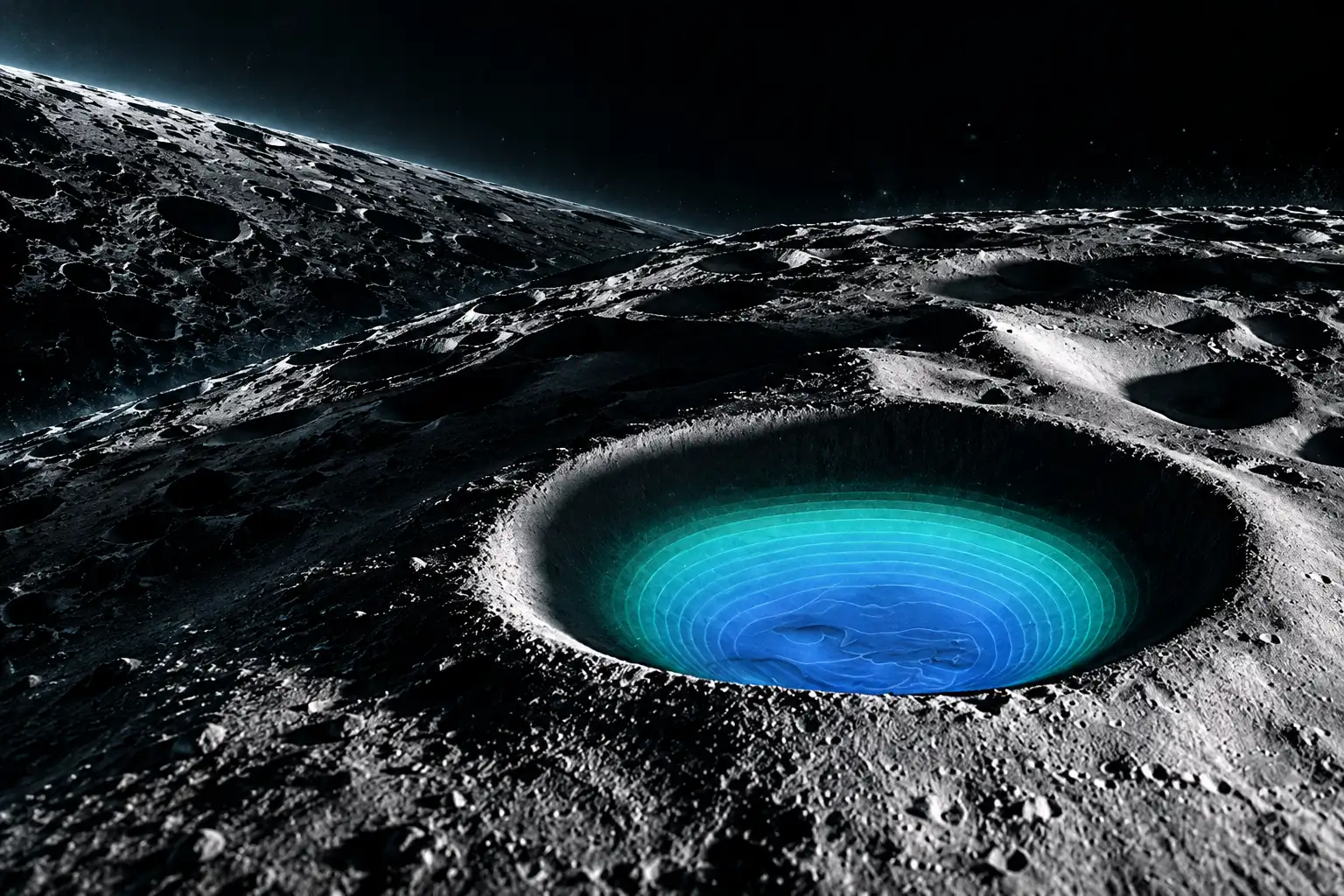
The Crater Rims Can Make the Power
The Moon tilts only 1.5 degrees, so near the poles the Sun skims the horizon and high ground stays lit. The same geometry leaves crater floors in shadow. Some of those floors have not seen direct sunlight in about four billion years. Below 110 K, ice sublimates by no more than 1 mm per billion years, which is why the shadowed floors at the lunar south pole still hold what the early solar system dumped there.
Kilometre-tall photovoltaic towers on those rims could deliver a mean of about 3 GW for 90 percent of the time, the authors note, citing a 2023 study of south-polar solar geometry. Silicon is already in the dirt. A million people at the high end of U.S. household use would need 800 MW. Fold in U.S.-scale industry and the load rises to about 2.1 GW, still inside the 3 GW envelope. Agriculture adds only about 64 W per person if the farms need no extra heat or light. Data centers, each hungry for a gigawatt, could blow that budget faster than homes would.
Fission would work away from the poles, at the cost of large radiators and about 24 tons of fuel per gigawatt-year. The authors’ conclusion is blunt for a space paper: if industry stays within about twice personal use, power is a weak limit on a million people. Water is the hard stop.
How Long Lunar Water Lasts at Each City Size
Without recycling, a million people exhaust the generous billion tons in 2.4 years. You could not finish building the city in that time. The International Space Station changed the math. A 2 percent loss each year, the ISS figure, stretches the same pile to about 100 years for a million residents, and to about 1,000 years for 100,000, a bit below the population of Sandy Springs, Georgia.
YEARS OF POLAR ICE AT ISS RECYCLING
| Population | Years on 1 billion tons at 98% recycling | Earth comparison |
|---|---|---|
| 1 million | about 100 | Stockholm |
| 100,000 | about 1,000 | Sandy Springs, Georgia |
| 10,000 | about 10,000 | a small town, on this baseline |
McDowell put the 10,000-person case in plain words: on that generous pile you have 10,000 years of water, long enough to hunt for another source. On the 34-million-ton tally the same town is a centuries-long project, not a millennial one. A village of about 1,000, the size of an Antarctic winter crew, can treat the ice with little worry either way. The paper calls 1,000 years at 100,000 people long enough to count as sustainable, and about 100 years at one million too short for the investment a true city would demand.
Farming Takes Most of the Ice
Direct human use is the small line on the ledger. U.S. drinking, washing, and flushing run about 125 tons per person per year. Breathing adds about 2 tons more, because a sealed habitat gets its oxygen by splitting water. Food is the well. A World Bank range of 2 to 5 tons of water to feed one person for one day works out to 730 to 1,825 tons a year, six to 15 times personal use. Elvis and McDowell assumed tighter lunar farming and booked 500 tons per person per year, and even that number dominates the budget.
Beef takes about six times the water of soybeans; chicken takes about double. A low-meat or vegan menu would help, and livestock in one-sixth gravity is a separate headache. Vertical farms that cut water by large fractions would help more. Rocket propellant is another bite, at about 1,200 tons per rocket on the authors’ table, before anyone starts fuelling a cislunar traffic system.
Showers, laundry, and toilets that work on the Moon would likely make recycling worse, not better. Elvis said a century of supply “depends on people being very nice” about water, including “always using rather dubious toilets and not doing laundry,” and he called that habit “unlikely to be sustainable.” The lost 2 percent is the whole problem. Raise recovery by a factor of about 10, and the million-person case starts to look like a long stay. The station needed years to climb from the mid-90s to 98 percent.
Eight Dark Craters Hold the Prize
The ice is not a polar ocean. It is a handful of holes. H. M. Brown and colleagues, compiling ten remote-sensing sets on 65 large traps, named eight permanently shadowed polar craters as the richest stores: Faustini, Cabeus, de Gerlache, Shoemaker, Haworth, Sverdrup, Slater, and Amundsen. Faustini shows the strongest combined signs of ice. Cabeus holds the largest estimated subsurface mass, about 11 million tons. Shoemaker is next at about 5 million, Faustini about 4 million, de Gerlache and Haworth about 3 million each. The remaining three make up the rest of the 34 million ton total.
Shackleton, the crater that dominates popular maps, is not on that richest-eight list. One study gave it 1.6 to 4.5 million tons depending on the assumptions, a factor-of-three swing in a single hole. A 2026 ShadowCam analysis cited in the new paper found water in only 3.5 percent of cold traps, though those patches may run as high as 30 percent ice by weight. Micro cold traps could add on the order of 10 percent more area, not a new ocean.
THE RICHEST HOLES, BY NAME
- Cabeus: About 11 million tons of subsurface ice, and the site of the 2009 LCROSS impact that proved water was there.
- Shoemaker: About 5 million tons, second among the named masses.
- Faustini: About 4 million tons, with the strongest overall ice indicators in the 2022 ranking, and a rim that overlaps an Artemis landing zone.
- de Gerlache and Haworth: About 3 million tons each; Haworth leads in estimated surface frost.
- Sverdrup, Slater, Amundsen: The rest of the eight-crater, 34-million-ton total.
Elvis has warned for years that the useful spots are few and small. With so few big craters, parties may try to grab the best of them and work the ice. Ian Crawford, a professor of planetary science and astrobiology at Birkbeck, University of London, who was not on the paper, said careful management will be required, and that this points to an agreed international framework so a “gold rush” does not drain the reserve early.
HOW THE ICE INVENTORY SHRANK
- 2009: LCROSS slams into Cabeus and throws water and other volatiles into sunlight, the first ground truth that polar ice is real.
- 2013: Chandrayaan-1 Mini-SAR work infers several hundred million tons in south-polar shadowed regions, the first solid mass claim.
- 2022: Brown and colleagues rank 65 large traps and put about 34 million tons in the eight richest craters.
- 2023: A brine processor on the ISS lifts total water recovery to 98 percent, the efficiency the new paper uses as its best case.
- February 8, 2026: Musk writes that SpaceX has shifted toward a self-growing Moon city that could be done in less than 10 years.
- September 14, 2026: Elvis and McDowell publish the city-scale water lifetimes.
Musk’s own post is the claim the arithmetic is answering.
For those unaware, SpaceX has already shifted focus to building a self-growing city on the Moon, as we can potentially achieve that in less than 10 years, whereas Mars would take 20+ years.
The mission of SpaceX remains the same: extend consciousness and life as we know it to…
— Elon Musk (@elonmusk) February 8, 2026
The Ice Is Also a Four-Billion-Year Archive
The same cold that keeps the ice drinkable keeps a record. Simeon Barber, a senior research fellow at the Open University who searches for lunar water and was not on the study, notes that polar ice has built up over billions of years and preserves a chemical and physical record of the environment in which Earth, and life on Earth, took shape. He argues that those secrets should be read before the ice is pulled for industry.
Barber also described the practical mess. The extreme cold and long darkness make the craters a hard place for robots or people. The water is not clean cubes waiting to be melted. It is likely mixed with a cocktail of poisonous chemicals that must be stripped out first. Extraction is not a tap. It is mining in a freezer that never sees the Sun.
I had assumed that a billion tons of water would be plenty, with recycling. To find only a 100 year supply was a big surprise.
Martin Elvis, senior astrophysicist, Smithsonian Astrophysical Observatory
Crawford called the paper a dose of realism for long-term settlement talk. If large bases are to exist, he said, water, or at least hydrogen to make water from oxygen in lunar rock, will have to be brought in. That import path is the escape hatch the study leaves open, and it is a cargo problem. At station efficiency, a million-person city would need on the order of 10 million tons of water landed each year, about 27 landers a day. Asteroid ice is real. Daily tanker traffic from the belt is a different industry from a city that lives on local wells.
A Winter Crew in Antarctica Is the Working Model
Jeff Bezos has talked about moving heavy industry to the Moon. Musk has talked about a city that grows itself. The paper reads those plans as implying, if they are to matter to Earth’s economy, something like 80 million people, about 1 percent of Earth’s population, on a body 50 percent larger than North America. On the ice we can currently count, that is not a water budget. It is a wish.
The station reached 98 percent water recovery after a brine processor began wringing extra liters from urine brine. Christopher Brown, on the Johnson Space Center life-support team, put the loop in household units: collect 100 pounds, lose two, and the other 98 percent just keeps going around. Jill Williamson, who manages the station’s water subsystems, said the system sat between 93 and 94 percent before that machine. A lunar city would have to beat the best closed loop yet flown, then keep it running through laundry, farms, and rocket fuel.
Chang’e-5 soil samples later showed a second reservoir, solar-wind water in impact glass beads mixed through metres of global dust, with an upper estimate of 2.7 × 10¹⁴ kg. That is a huge number on a page and a thin soup in the ground. It is not the polar ice the city math is about, and it is not a lake you can pump.
FOUR WAYS OFF THE WATER CLIFF
- Recycle harder: The authors say efficiency would need to improve by a factor of about 10 to make a million-person city look long-term.
- Use less: Vertical farming and lab-grown meat are the cuts Elvis called the most promising, if they can be made to work in one-sixth gravity.
- Import ice: Accessible asteroids hold water, at the price of a tanker cadence the paper treats as a last resort.
- Find more: Buried ice below today’s 1-to-20 m sensing depth is the hope Elvis called the most likely, and the one a borehole would settle.
McDowell translated Musk’s 10-year city into a 30-year town. A thousand people can be relatively carefree with the ice. A hundred thousand have to start being careful. A million, on the generous billion tons and the best recycling yet demonstrated, get about 100 years. Elvis wrote that if the ambitious plans are to be realized, finding more water is the first step.
Frequently Asked Questions
How Much Water Ice Did the 2026 Study Treat as Available?
The working ceiling is 1 billion tons in permanently shadowed polar regions, described as generous. The eight richest craters in a 2022 compilation hold about 34 million tons combined, and Shackleton alone has been estimated at 1.6 to 4.5 million tons depending on the model. Spudis and colleagues in 2013 inferred several hundred million tons from Chandrayaan-1 radar, still below the billion-ton ceiling and well above the eight-crater sum.
What Recycling Rate Has the ISS Reached?
NASA reported in 2023 that a brine processor assembly pushed total station recovery to 98 percent, up from 93 to 94 percent. The unit takes leftover brine from the urine processor, runs it through a membrane, and uses warm dry air to evaporate water back into the cabin humidity loop. Christopher Brown described the result as keeping 98 of every 100 pounds in circulation.
Which Polar Craters Hold Most of the Ice?
Faustini, Cabeus, de Gerlache, Shoemaker, Haworth, Sverdrup, Slater, and Amundsen rank as the most resource-rich large traps. Cabeus leads estimated subsurface tonnage at about 11 million tons; Faustini ranks first on combined ice indicators and has a rim inside an Artemis candidate zone; Haworth leads estimated surface frost. Those eight together are listed at about 34 million tons.
Why Does Growing Food Dominate a Lunar Water Budget?
Personal washing and drinking are booked at about 125 tons per person per year, and splitting water for oxygen adds about 2 tons. The authors still assigned 500 tons a year to food after assuming better-than-Earth farming, because the World Bank range for feeding one person is 2 to 5 tons of water per day. On that full range, agriculture is 6 to 15 times direct personal use before anyone fuels a rocket at about 1,200 tons per vehicle.
Could Glass Beads Replace Polar Ice for a Settlement?
Chang’e-5 beads analyzed in 2023 hold solar-wind hydrogen that has diffused inward, and the global soil reservoir is estimated between 3.0 × 10¹¹ kg and 2.7 × 10¹⁴ kg. That water is spread through 3 to 12 m of regolith at glass fractions of a few percent by volume, so it is a processing problem, not a polar mine. Elvis and McDowell built the city lifetimes on cold-trap ice, not on that dispersed bead inventory.

Final Fantasy Resonance Turns a Dead Gacha Into HD-2D

PHP2Shell Forced Sites Offline While Exploits Stalled

Kindle+ Folds AI Audiobooks Into the Page-Read Fund

Chip Stocks Fall as the Bond Rally Cheapens AI Spend

Comcast’s Record Odyssey Quarter Doubles as the Exit

Microsoft 365 Auth Fault Took Down Exchange and Teams

Xbox Caps Game Pass Cloud Gaming at 15 Hours

OpenClaw 2.0 Ships a Team Workplace With Host-Trust Defaults

OpenAI Unveils GPT-6 Astra With a Critical Cyber Label

Diesel Breaks Its Record as the White House Claims Credit
-
 NEWS2 months ago
Microsoft 365 Auth Fault Took Down Exchange and Teams
-
 GAMING2 months ago
Xbox Caps Game Pass Cloud Gaming at 15 Hours
-
 NEWS2 months ago
OpenAI Unveils GPT-6 Astra With a Critical Cyber Label
-
 NEWS2 months ago
OpenClaw 2.0 Ships a Team Workplace With Host-Trust Defaults
-
 BUSINESS2 months ago
Diesel Breaks Its Record as the White House Claims Credit
-

 LIFESTYLE2 months ago
Squishy Dumpling Toys Recalled After Hiding Illegal Water Beads
-

 BUSINESS2 months ago
ChargePoint Stock Rally Prices Wilmer’s Three-Year Cash Plan
-

 AUTO2 months ago
Tesla Puts Its Wheel-Free Cybercab on Austin Streets