
NEWS
The iPhone 18 Pro Cooler Is Fighting Its Own Screen
iFixit’s iPhone 18 Pro teardown cracked three of four display frames, and the new 3x vapor chamber may be stealing the heat shops need to open the glue.

iFixit’s teardown of the iPhone 18 Pro found the display’s plastic frame cracked on three of the four phones it opened. The group still scored both the Pro and the Pro Max a provisional 7 out of 10, matching last year’s 17 Pro.
The written teardown landed on September 20, 2026, two days after the phones went on sale. The camera iris is the showpiece. The fight over heat is the part shops will feel.
Three of Four Display Frames Split on the Way In
iFixit went in through the front, the same path the 17 Pro forced on anyone swapping a battery or a camera. The OLED panels survived and still worked. The white plastic frame around them cracked or pulled away in three openings.
That frame is part of the display assembly, not a clip you order on its own. Fresh perimeter glue will not mend broken plastic. iFixit said a damaged frame will not sit flush, and it will not seal the way a whole one does, which puts the phone’s IP68 rating (6 meters for 30 minutes) at risk after a screen job.
The fourth phone came apart clean. Other public teardowns, including Zach Nelson’s JerryRigEverything bench, got the glass off without that split. Four units cannot set a failure rate, and iFixit said adhesive, heat, technique, or a difference in the plastic could all matter. Apple has used this same plastic frame since the iPhone 15 Pro, and it did not fail like this on those older phones.
WHAT WE KNOW
- The count: The frame cracked or peeled on three of four iPhone 18 Pro phones iFixit opened on September 20, 2026.
- The intact unit: The screen that came off clean sat on a pad for 15 minutes at 70 degrees Celsius, then another 10 minutes at 72.
- The spare: Apple does not sell the plastic frame alone, so a broken one means a whole new display module.
WHAT IS UNCONFIRMED
- The cause: iFixit asked whether the new cooling stack is pulling heat off the seam before the glue lets go.
- The spread: Other benches opened 18 Pro units without this damage, so a bad batch or a heat-pad recipe remain on the table.
- The score hit: The failures have not yet cut the 7 out of 10, because the group still does not know how repeatable they are.
In the teardown video, a heat mat and a few minutes of patience still left a corner of that white frame torn. The OLED can go back in. The phone may never be watertight again.
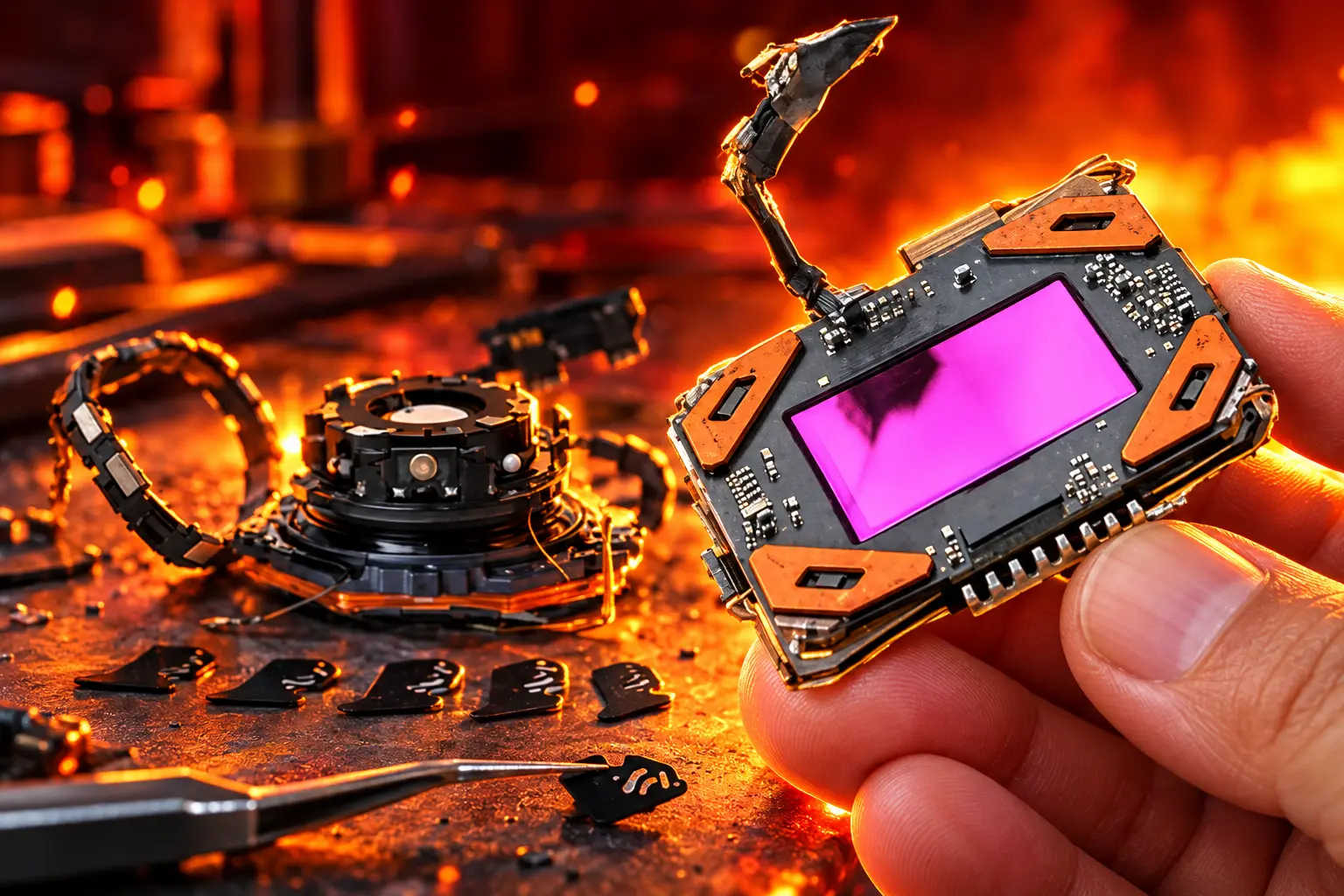
Apple Built a Cooler That May Fight Its Own Glue
On September 9, 2026, Apple said the A20 Pro uses packaging inspired by its M-series chips, with the silicon die placed beside the memory instead of under it. That move takes the RAM out of the chip’s heat path and lets the die sit on a next-generation vapor chamber. Apple said the chamber has three times the surface area of the one in the iPhone 17 Pro, and that the package, new thermal materials, and the larger chamber together deliver up to a 40 percent gain in sustained performance over last year’s Pro.
That 40 percent is a system figure for how long the phone holds speed under load. It is separate from Apple’s other 40 percent claim, which is for the 7-core GPU against the A19 Pro. The A20 Pro is a 2-nanometer chip with 50 percent more memory bandwidth than A19 Pro and a dual 16-core Neural Engine.
THE COOLING STACK IN THE 18 PRO
- Chamber size: Three times the surface area of the iPhone 17 Pro vapor chamber, spreading heat across much of the body.
- Chip contact: The A20 Pro die presses through thermal material straight onto that chamber, with RAM no longer stacked on top.
- Shop heat: The one iFixit screen that survived removal took 25 minutes at 70 then 72 degrees Celsius.
- Sustained speed: Apple’s figure is up to 40 percent better sustained performance than iPhone 17 Pro.
iFixit’s own guess is blunt. A cooler that is this good at moving heat away from silicon may also drag heat away from the display glue while a pad is trying to soften it. The team had to cook the intact phone longer than a typical screen job, and even then called it a lot of heat.
Could the improved thermals be pulling too much heat away from the seam, preventing the adhesive from softening? The screen that came apart cleanly, we heated for 15 minutes at 70 degrees Celsius and then another 10 minutes at 72. That’s a lot of heat!
iFixit, iPhone 18 Pro and Pro Max teardown
If that guess holds, the upgrade that lets the A20 Pro hold frame rate is the same upgrade that makes a $1,199 phone harder to open without wrecking the part you have to remove first. Independent shops already heat, slice, and reseal these displays for a living. They now need a recipe that beats a chamber designed to dump heat as fast as the pad can put it in.
The Variable Aperture Is a Whole-Camera Job
Apple’s 48MP Fusion main camera is the first iPhone lens with a true variable aperture. Six laser-cut blades sit on a new rotor and move between four Camera app presets: ƒ/1.48, ƒ/1.8, ƒ/2.8, and ƒ/4.0. Apple said ƒ/1.48 is about 50 percent better in low light, and that the blades can also be handed to third-party apps across the full range.
iFixit pulled the module, heated the lens stack, and watched a blade fly across the room. Each polymer-composite leaf is about as thin as a human hair. A magnet held near the iris still opens and closes it after supporting hardware is gone, which is elegant and also a warning: this is watchmaking, not a user part. “We’re reluctant to call a repair impossible, but this is about as close as it gets,” iFixit wrote.
THE FOUR STOPS ON THE MAIN CAMERA
- ƒ/1.48: Widest iPhone opening yet, a 4.6 mm hole on a 6.8 mm lens, about 7.3 times more light than ƒ/4.0.
- ƒ/1.8: Close to last year’s default, still a small-sensor blur rather than a DSLR bokeh disc.
- ƒ/2.8: A middle stop for group shots when you want more of the room sharp.
- ƒ/4.0: Narrowest preset, the sharpest of the four in iFixit’s wall-and-toolkit test shots.
On a 50 mm SLR lens, ƒ/1.48 would mean a 33.8 mm opening. The iPhone’s 4.6 mm hole is 29.2 mm smaller, which is why iFixit is cool on the portrait hype. Backgrounds at ƒ/1.48 still look fairly sharp. The light-gathering win is real. The creamy-bokeh win is not.
Variable aperture is also old. An overlapping-blade diaphragm was patented in 1858. Nokia put one in the N86 in 2009. Samsung shipped a variable aperture in the Galaxy S9 in 2018, then dropped the feature after deciding a phone-sized sensor did not get enough out of it. Stuck blades and oil on the leaves are known failure modes on those older systems.
The good news is modularity. Once the screen is off, swapping the whole main camera on the 18 Pro and Pro Max is straightforward. The bad news is cost. Apple has not posted 18 Pro parts yet. Last year’s camera assembly for the 17 Pro is $249, and iFixit expects the moving iris to push that number up. A bent blade or a speck of grit becomes a full-module bill.
Why the Battery Tray Still Hides Behind Glass
Shops will change far more batteries than irises. The 18 Pro keeps the screw-in tray Apple added on the 17 Pro. The tray comes off with a driver. The cell still uses electrically released adhesive, and iFixit’s photos show that glue peeling off the tray in a clean sheet. For a physical-SIM 18 Pro, the pack is listed at 4,056 mAh.
Getting there still means opening a glued display. The back glass lifts, but the only serviceable bit behind it is the wireless charging coil in the panel itself. That front-only path is the 17 Pro’s hangover after Apple dropped the 16 Pro’s dual-entry design, and it is why a cracked display frame is not a side note. It sits on the only door into the battery.
Small parts are worse. iFixit said it misses the more open USB-C layout from the 16 Pro, and that replacing the port still means pulling a large share of the internals. The power button is a full gut for a single switch: logic board out, battery shifted, cameras shifted, three sideways screws, and a bracket iFixit called super fragile.
iPhone 18 Pro power button replacement: logic board out, battery moved, cameras moved, other cameras moved, three sideways screws, one super fragile bracket. For a button. pic.twitter.com/yTHeJlFH50
— iFixit (@iFixit) September 18, 2026
A parts-house teardown from REWA Technology also found NAND and power ICs stacked between board layers, which turns storage and power-rail work into a board-level job rather than a socket swap. Repair Assistant still has to finish calibration for supported replacement parts, and 18 Pro spares are not on the shelf. The tray is the bright spot. The entrance is the tax.
Face ID Now Looks Through Thinned Pixels
Apple moved the infrared Face ID camera under the OLED on this year’s Pro phones, which is how the Dynamic Island got smaller. The selfie camera and the IR dot projector stay in that island. Under a microscope, iFixit found Apple hid the relocated sensor by removing every other row of pixels above it. The thinning fades toward the edges, and an IR-pass filter under the OLED blocks visible light.
The filter does not run all the way to the edge of the opening, which produced what iFixit called an eclipse effect under some microscope settings. REWA’s earlier strip-down made the same point in shop language: aftermarket display makers now have to copy that pixel map and that hidden camera window, or Face ID on a third-party screen will not see straight. A cracked plastic frame on top of that stack is a second way a “simple” screen swap can fail.
The 6.3-inch Super Retina XDR panel is otherwise the same size as last year, with Ceramic Shield 2 on the front. The phone is 211 grams and 8.75 mm thick. That does not change the new rule: the display is both the lid and a sensor cover.
A Provisional 7 Out of 10 Leaves the Frame Out
iFixit gave the iPhone 18 Pro and the iPhone 18 Pro Max a provisional 7 out of 10 for repairability. That is the same number the 17 Pro received, and it is still a hold while parts, pairing tests, and the frame question play out. Credit goes to the battery tray and the removable camera modules, plus Apple’s repair support. The score takes a hit because almost every serious job still goes through the screen.
The cracked frames have not cut that 7 yet. iFixit said it does not know what caused them, how common they are, or whether they repeat, so it refused to tank the rating on four phones. If the split becomes the normal result of a heat-pad opening, a 7 will be hard to defend, because a screen that cannot be resealed is a screen that cannot be repaired in the usual sense.
HOW THE LAST TWO PRO PHONES OPEN
| Item | iPhone 17 Pro | iPhone 18 Pro |
|---|---|---|
| Repairability | 7 out of 10 | 7 out of 10, provisional |
| Main entry | Display first | Display first |
| Battery | Screw-in tray, electrically released cell glue | Screw-in tray, electrically released cell glue |
| Main camera | Modular assembly, $249 on Apple’s parts store | Modular assembly with variable aperture, 18 Pro parts not posted |
| Cooling | First Pro vapor chamber | Chamber with 3x the surface area, die on the chamber |
| Display frame | Plastic frame used since iPhone 15 Pro | Cracked or peeled on three of four iFixit units |
Carsten Frauenheim, who wrote iFixit’s iPhone 18 Pro repair page, logs the phone as an iteration on the 17 Pro’s aluminum unibody, not a new architecture. The score matches that reading. The chamber and the iris are new. The way you get in is not.
Other Benches Opened the Same Phone Cleanly
FROM ANNOUNCEMENT TO THE CRACKED FRAME
- September 9, 2026: Apple announces iPhone 18 Pro, the six-blade main camera, and a vapor chamber with 3x the surface area of the 17 Pro’s.
- September 18, 2026: The phones go on sale. REWA Technology publishes a first internals video, including the under-display IR camera and the larger chamber, without a report of a torn display frame.
- September 19, 2026: Zach Nelson of JerryRigEverything pries the 18 Pro from the front with a heat gun, says an experienced tech can swap the screen in about five minutes, and does not crack the white frame.
- September 20, 2026: iFixit publishes the full teardown, with three of four frames split and a provisional 7 out of 10 for both Pro models.
Those other benches are why the cooling guess is still a guess. A heat gun that makes the chassis almost too hot to hold is a different tool from a pad at 70 degrees Celsius. Nelson’s five-minute screen swap and iFixit’s 25-minute intact open can both be true. They may simply describe two ways of beating a chamber that is now very good at stealing heat.
The practical split for a shop is ugly either way. Run less heat and the frame can tear, which means the customer’s water seal is gone and the shop owns a display Apple will not sell as a bare frame. Run more heat, for longer, and the OLED, the under-display IR camera, and the island sensors sit on a pad that is fighting a cooler built to dump that energy into the rest of the phone. The iris blade that flew across iFixit’s lab is a camera problem. The cracked frame is the door problem, and every battery, port, and button job still has to walk through it.
Until Apple ships 18 Pro parts and iFixit repeats the opening on a wider sample, the 7 out of 10 stays a placeholder. The one phone that came apart whole had been heated for 25 minutes. The other three had not.

Final Fantasy Resonance Turns a Dead Gacha Into HD-2D

PHP2Shell Forced Sites Offline While Exploits Stalled

Kindle+ Folds AI Audiobooks Into the Page-Read Fund

Chip Stocks Fall as the Bond Rally Cheapens AI Spend

Comcast’s Record Odyssey Quarter Doubles as the Exit

Microsoft 365 Auth Fault Took Down Exchange and Teams

Xbox Caps Game Pass Cloud Gaming at 15 Hours

OpenClaw 2.0 Ships a Team Workplace With Host-Trust Defaults

OpenAI Unveils GPT-6 Astra With a Critical Cyber Label

Diesel Breaks Its Record as the White House Claims Credit
-
 NEWS2 months ago
Microsoft 365 Auth Fault Took Down Exchange and Teams
-
 GAMING2 months ago
Xbox Caps Game Pass Cloud Gaming at 15 Hours
-
 NEWS2 months ago
OpenAI Unveils GPT-6 Astra With a Critical Cyber Label
-
 NEWS2 months ago
OpenClaw 2.0 Ships a Team Workplace With Host-Trust Defaults
-
 BUSINESS2 months ago
Diesel Breaks Its Record as the White House Claims Credit
-

 LIFESTYLE2 months ago
Squishy Dumpling Toys Recalled After Hiding Illegal Water Beads
-

 BUSINESS2 months ago
ChargePoint Stock Rally Prices Wilmer’s Three-Year Cash Plan
-

 AUTO2 months ago
Tesla Puts Its Wheel-Free Cybercab on Austin Streets