
NEWS
Iceland’s Ice Caves Open on Last Summer’s Melt
Iceland ice caves are due to open 1 October 2026 as melt-water rooms inside Vatnajökull, after a 15 billion-tonne loss year and the 2024 collapse.

Iceland’s natural ice caves are due to reopen on 1 October 2026, if the autumn cold has firmed the ice. The blue rooms sold for winter sit inside Vatnajökull, and they are melt-water tunnels, not monuments. Summer 2026 cut them. Spring 2027 will take them apart.
Operators at Jökulsárlón have first tours planned for 1 October, conditions permitting, with the season running through late April 2027. Booking pages still tell visitors the season starts in November. The jeeps are meant to leave a month earlier, into ice that is still draining.
The Caves Open Because Last Summer Cut Them
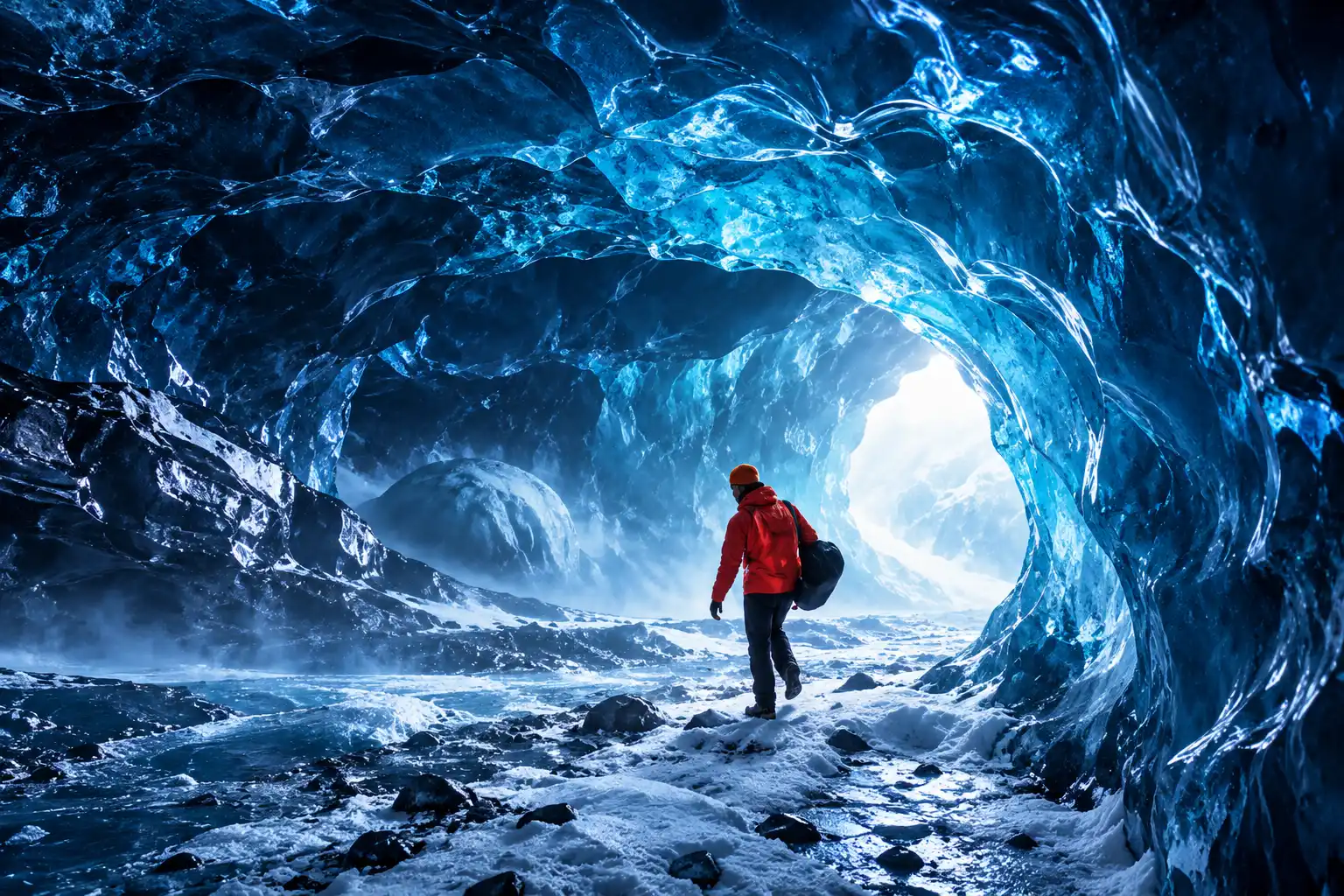
An ice cave in Vatnajökull is a hole the glacier’s own water made. Melt cuts a channel in the warm months. When the water drains or freezes, a hollow is left that a group can walk into with helmets and spikes. Sindri, who has guided these caves every winter since 2015 with Glacier Trips in Höfn, puts the basic fact on the booking page: every cave re-forms every winter, and last season’s cave may not exist this one.
That is why the winter photographs are not a promise. Past seasons on Breiðamerkurjökull have used names such as Atlantis, ABC and West Wing. Those write-ups are history. Which chamber opens this winter is decided on the ice, then again the night before, then again at dawn with the park.
The meeting point is the main car park at Jökulsárlón, about a 5-hour drive from Reykjavík. A same-day round trip is more than 10 hours of winter driving around a short tour. Guides tell guests to sleep in Höfn, Hali, Hof or Skaftafell and to treat the outing as a half-day, because weather can move a departure by the hour.
A Collapse in August 2024 Rewrote the Season
On 25 August 2024 an ice wall came down on Breiðamerkurjökull, an outlet of Vatnajökull, during a commercial tour. An American man died at the scene. His partner, who was pregnant, was flown to Reykjavík with serious injuries. Twenty-three people were on the trip. Rescuers first thought two others were missing; police later accounted for everyone and called off the search.
Vatnajökull National Park halted ice-cave tours, then shut the in-park caves for the warm months. Natural blue-ice tours inside the park now run October to April and stay closed from May through September. Glacier hikes still go in summer. The caves do not.
Magnús Tumi Guðmundsson, a professor of geophysics at the University of Iceland, had already said the quiet part in a park study. He and colleagues Finnur Pálsson and Jón Gauti Jónsson wrote the park’s 2017 ice-cave risk assessment, which grades a cave green, yellow or red. Red means warm weather and water, a thinning roof, and a rising chance of collapse. On red, nobody goes in. After the 2024 death he said a summer cave can lose 10 centimetres of ice in a day.
In summer, however, a cave can easily experience 10 centimetres of melting per day. That means the walls and the roof of the cave is getting thinner by 10 centimetres every single day.
Magnús Tumi Guðmundsson, professor of geophysics, University of Iceland
The park itself stopped being a stand-alone body on 1 January 2025, when Náttúruverndarstofnun, the Nature Conservation Agency of Iceland, took it over. Access is now by contract, not a rolling permit. An advertisement on 4 July 2025 invited firms to apply for ice-cave tours and glacier walks on Breiðamerkurjökull, Falljökull/Virkisjökull and Skeiðarárjökull, with contracts running through 30 September 2027 from 1 October 2025.
THE SAFETY REWRITE
- 2017: University of Iceland glaciologists grade summer ice caves red for the park and say tours should not run while meltwater is moving.
- 25 August 2024: An ice wall collapses on a Breiðamerkurjökull tour, killing one visitor and injuring another.
- Late August 2024: The park suspends ice-cave trips, then bars them in the park from May through September.
- 1 January 2025: The Nature Conservation Agency takes over the park.
- 4 July 2025: The agency advertises a new two-year round, capped at 30 contracts.
- 1 October 2026: Operators plan the first 2026-27 cave departures, if the ice holds.
Sigurjón Andrésson, chair of the park board, said in September 2025 that 34 companies applied and 30 received contracts, and that each guide may take 8 to 16 guests depending on the trip. Lead guides have to show Hard Ice 3 or a comparable course from the Association of Icelandic Mountain Guides. The agency can cap total numbers if queues build. Those rules stop at the park boundary.
Dagbjartur Brynjarsson, a safety specialist at the Icelandic Tourist Board, Ferðamálastofa, said in April 2025 that in reality there are no established national rules on how ice-cave tours should be run. What does apply across the country is thinner: Act No. 96/2018 requires a written safety plan in Icelandic and English, with daily fines of 50,000 to 500,000 kronur if it is missing or ignored.
Vatnajökull Lost Nearly 11 Billion Tonnes
The water that carves the rooms is not a side show. The Icelandic Meteorological Office, working with Landsvirkjun, the University of Iceland’s Institute of Earth Sciences and the Icelandic Institute of Natural History, found that Iceland’s glaciers lost more than 15 billion tonnes in the 2024 to 2025 glacier year. Vatnajökull, the ice cap that holds the famous caves, shed nearly 11 billion tonnes. Hofsjökull and Langjökull together lost nearly 3 billion.
THE 2024 TO 2025 GLACIER YEAR
- Total loss: More than 15 billion tonnes across Iceland’s glaciers.
- Vatnajökull: Nearly 11 billion tonnes, with an annual balance of about -1.43 metres water equivalent, the fourth worst since measurements began.
- Rain, not snow: About 27 percent of winter precipitation on Vatnajökull fell as rain, the highest share since the 2016 to 2017 winter.
- The pause is over: The slower-loss years of 2012 to 2020 have ended, and the ice is shedding as fast as it did from 1995 to 2011.
A long warm spell in May 2025 pushed temperatures widely over 20C and stripped winter snow in bright sun. Summer melt on Vatnajökull was the third highest on the record. Hofsjökull’s balance was -2.09 metres, worse in only one year, 2010. Langjökull lost 1.49 metres, about 20 percent above its usual yearly loss. An Icelandic Meteorological Office glacier round-up also found Heinabergsjökull’s snout 3 kilometres shorter than two years earlier.
From 1995 to 2011, Vatnajökull thinned by 0.74 metres a year on average. From 2012 to 2020 that fell to 0.34 metres as nearby sea water cooled. The office now says the sea has warmed again and the fast-loss years are back. The blue walls in the winter photos are a stage in that process, not a freeze-frame of it.
What an Ice Cave Tour Buys This Winter
The product most visitors want is a natural crystal or blue chamber on Breiðamerkurjökull, reached by modified 4×4 from Jökulsárlón. Glacier Trips, one local operator, is selling two versions of that day for 2026-27. Other contract holders run similar routes under park rules. Groups should expect to share a popular cave, or wait, around Christmas and Easter.
THREE THINGS SOLD AS ICE CAVES
| Product | Where | Window | What you walk into |
|---|---|---|---|
| Natural blue cave | Vatnajökull outlets from Jökulsárlón | October to April | A meltwater chamber that changes every winter |
| Katla, or Secret, ice cave | Kötlujökull near Vík, outside the park | Year-round, if conditions allow | Ash-banded ice on Mýrdalsjökull, a different look and a different rulebook |
| Langjökull ice tunnel | Man-made tunnel in Langjökull | Year-round | An excavated passage, not a natural cave |
On the Glacier Trips short run, Ice Cave Inside Vatnajökull, the day is 2.5 to 3 hours, leaving at 11:00 and 14:30, with a maximum of 14 guests, a minimum age of 8, and prices from 23,900 kronur (about $195). The longer Adventures Dream run is 5 to 6 hours at 9:30, maximum 8 guests, age 14 and up, from 36,900 kronur, and adds a glacier hike. Helmets, micro spikes when needed, and a headlamp come with the ticket. Sturdy boots with ankle support do not. Trainers will not take spikes.
Peak dates from December through February can fill 4 to 8 weeks ahead. Of the guests who travelled with that firm last winter, the median booked 11 days ahead. Free cancellation on those trips runs to 48 hours before departure. The park’s own cap, 8 to 16 guests per guide by tour type, still applies on top of each company’s limit.
Sigurjón said ice-cave tours and glacier hikes in the park brought in 4 billion to 5 billion kronur a year, with about 200,000 people on those trips in the previous season. Ferðamálastofa counted 2.27 million foreign passengers leaving through Keflavík in 2025. IUCN’s World Heritage outlook put 970,000 visitors at Jökulsárlón in 2023. The lagoon is the funnel. The cave is the extra ticket.
October Ice Is Still Draining
Park rules let tours restart in October. The ice is not at its winter state then. Guide to Iceland, a booking platform, scored the season with 31 years of daily weather from Skaftafell, Kvísker and Höfn, plus flow on three glacial rivers draining Vatnajökull, the Skaftá, Hverfisfljót and Djúpá. February comes out safest on frozen-through days. October, the reopening month, comes out weakest.
HOW THE ICE BEHAVES BY MONTH
| Month | Days frozen through | Meltwater vs yearly average | Tours at Jökulsárlón |
|---|---|---|---|
| October | 1.0% | 101% | Opening, limited |
| November | 9.9% | 57% | Full season |
| December | 18.5% | 44% | Full, peak demand |
| January | 18.8% | 37% | Full, coldest ice |
| February | 18.9% | 36% | Full, most stable |
| March | 10.7% | 32% | Full, more daylight |
| April | 1.9% | 40% | Closing |
February holds the ice below freezing on 18.9 percent of days, the highest share, and thaws and refreezes less often than January. January is close, at 18.8 percent, and quieter if the aim is an empty chamber. March has the lowest river flow of the year, 32 percent of average, but it is frozen through on only 10.7 percent of days. August flow hits 264 percent of average, more than seven times February’s 36 percent. October is still at 101 percent, which means the glacier is actively draining when the first groups walk in. It also has the season’s highest share of heavy-rain days, 12.1 percent.
On days with 20 millimetres of rain or more, cancellations on the crystal-cave trips from Jökulsárlón rose from 13.2 percent to 20.4 percent in that booking set. Across 17,779 ice-cave bookings covering 46,684 travellers, monthly cancellation counts tracked how many trips were sold, not how stable the ice was. The rate is the fair measure, and rain on the day moves it more than the name of the month.
The blue in the photographs needs daylight on the ice. A 9:30 departure in early winter can leave in the dark. Guide to Iceland’s two-season tally of crystal-cave trips from Jökulsárlón, 1,702 departures, 8,059 bookings, 21,268 travellers and 423 operating days, is why some desks now push late-morning slots. On 29 September 2026 the same agency still told followers that ice-cave season starts in November. That is the brochure calendar. It is not the park’s.
Katla and the Tunnel Are a Different Product
Year-round offers are real, and they are not the winter blue room. The Katla cave near Vík sits on Kötlujökull, an outlet of Mýrdalsjökull, outside Vatnajökull National Park. Ash from the volcano bands the ice. Tours there run through the summer when conditions allow, under the Tourist Board’s paper rules rather than the park’s contract system. Magnús has said summer groups in natural caves in that active melt zone are unacceptable, in part because sudden glacial floods are hard to see coming.
The Langjökull tunnel is a third thing: a passage cut by people, open through the year, with walls that do not depend on last summer’s river. It photographs as ice. It is not a glacier cave that will collapse in May because the meltwater returned.
If the point of the trip is the deep-blue natural chamber from the posters, the window is still winter on Vatnajökull, with a guide holding a park contract, on a morning the joint assessment has cleared. If the point is any ice overhead on a June itinerary, Katla or the tunnel is the honest listing.
WHAT GUIDES CHECK BEFORE ANYONE GOES IN
- The forecast: Temperature and wind for the two days before the visit and for the morning itself.
- The lip: Whether the ice at the opening is wet or dry.
- The roof: Water, loose material, broken ice, or cracks in the ceiling mean the cave is not used that day.
- The pass mark: Snow on the ground or air near freezing, with no visible melt and no water flowing, is the relatively safe case.
Sindri’s version of that routine is a daily call with other local operators and the park. If a cave is unsafe they move, change the activity, or cancel. He has lost tour days to that habit and says he has not regretted one of them.
The Chamber You Enter Will Be Gone by May
By late April the caves thin as melt speeds up. From May through September they are gone as a commercial product inside the park, which is the point of the 2024 rewrite. Next autumn the same firms will scout new channels where the 2026 melt ran, and they will not know the names until the ice says so.
Bring layers, waterproof boots, and a spare day, because a warm, wet morning in October is a cancellation even when the calendar says the season is open. A tripod helps in the low light, and a wide lens takes in a chamber that will not look like the last visitor’s photograph. White balance needs a push, because the ice is blue for a physical reason: it has squeezed the air out, and the remaining ice swallows other wavelengths.
The 1 October jeeps, if they roll, will drive onto a glacier that just recorded one of its worst mass-balance years and into a room that water made. That room is worth seeing. It is also on a clock that runs to May, and then it is a different hole, or no hole at all.

Final Fantasy Resonance Turns a Dead Gacha Into HD-2D

PHP2Shell Forced Sites Offline While Exploits Stalled

Kindle+ Folds AI Audiobooks Into the Page-Read Fund

Chip Stocks Fall as the Bond Rally Cheapens AI Spend

Comcast’s Record Odyssey Quarter Doubles as the Exit

Microsoft 365 Auth Fault Took Down Exchange and Teams

Xbox Caps Game Pass Cloud Gaming at 15 Hours

OpenClaw 2.0 Ships a Team Workplace With Host-Trust Defaults

OpenAI Unveils GPT-6 Astra With a Critical Cyber Label

Diesel Breaks Its Record as the White House Claims Credit
-
 NEWS2 months ago
Microsoft 365 Auth Fault Took Down Exchange and Teams
-
 GAMING2 months ago
Xbox Caps Game Pass Cloud Gaming at 15 Hours
-
 NEWS2 months ago
OpenClaw 2.0 Ships a Team Workplace With Host-Trust Defaults
-
 NEWS2 months ago
OpenAI Unveils GPT-6 Astra With a Critical Cyber Label
-
 BUSINESS2 months ago
Diesel Breaks Its Record as the White House Claims Credit
-

 LIFESTYLE2 months ago
Squishy Dumpling Toys Recalled After Hiding Illegal Water Beads
-

 BUSINESS2 months ago
ChargePoint Stock Rally Prices Wilmer’s Three-Year Cash Plan
-

 AUTO2 months ago
Tesla Puts Its Wheel-Free Cybercab on Austin Streets