
NEWS
The A20 Pro Drops Stacked Memory to Cool Two Phones
Apple’s A20 Pro ditches stacked RAM so heat can hit a bigger vapor chamber, which is why the iPhone Duo now cools through its hinge.

Apple’s A20 Pro is the first iPhone chip to sit beside its memory instead of under it, a laptop-style layout that lets heat leave the die. That package now powers the iPhone 18 Pro, the 18 Pro Max, and the iPhone Duo, Apple’s first foldable, which goes on sale October 23.
The speed claims are downstream of that one change. Apple stopped stacking DRAM on the processor, then rebuilt two very different phones around the path that move opened.
Side-by-Side Memory Is the Real Chip Upgrade
Every iPhone system-on-a-chip before this one used package-on-package, or POP. The DRAM sat on top of the processor to save board space. Dan Murray, Apple’s vice president of silicon engineering, said that stack blocked heat. “Since the DRAM is physically on top of the SoC, it limits the ability to extract heat from the SoC into the system,” Murray said. “So for A20 Pro, we brought a new packaging technology to the iPhone.”
The new layout puts the silicon and the memory next to each other, the way Mac chips already do. Apple calls it custom packaging inspired by M-series silicon. The September 9 newsroom note says the design silicon die side by side with the memory, which takes RAM out of the thermal path and lets the die attach to a next-generation vapor chamber.
Industry labs describe the same package as a wafer-level multi-chip module. The X-Y footprint grows a little. Murray said Apple’s system team had to clear room on the logic board so the larger module would still fit. In return, heat can leave the die through the top instead of cooking the RAM that used to sit there.
That is the fork in the design. A faster 2-nanometer chip still throttles if the heat has nowhere to go. Unstacking the memory is what made the rest of the thermal work possible.
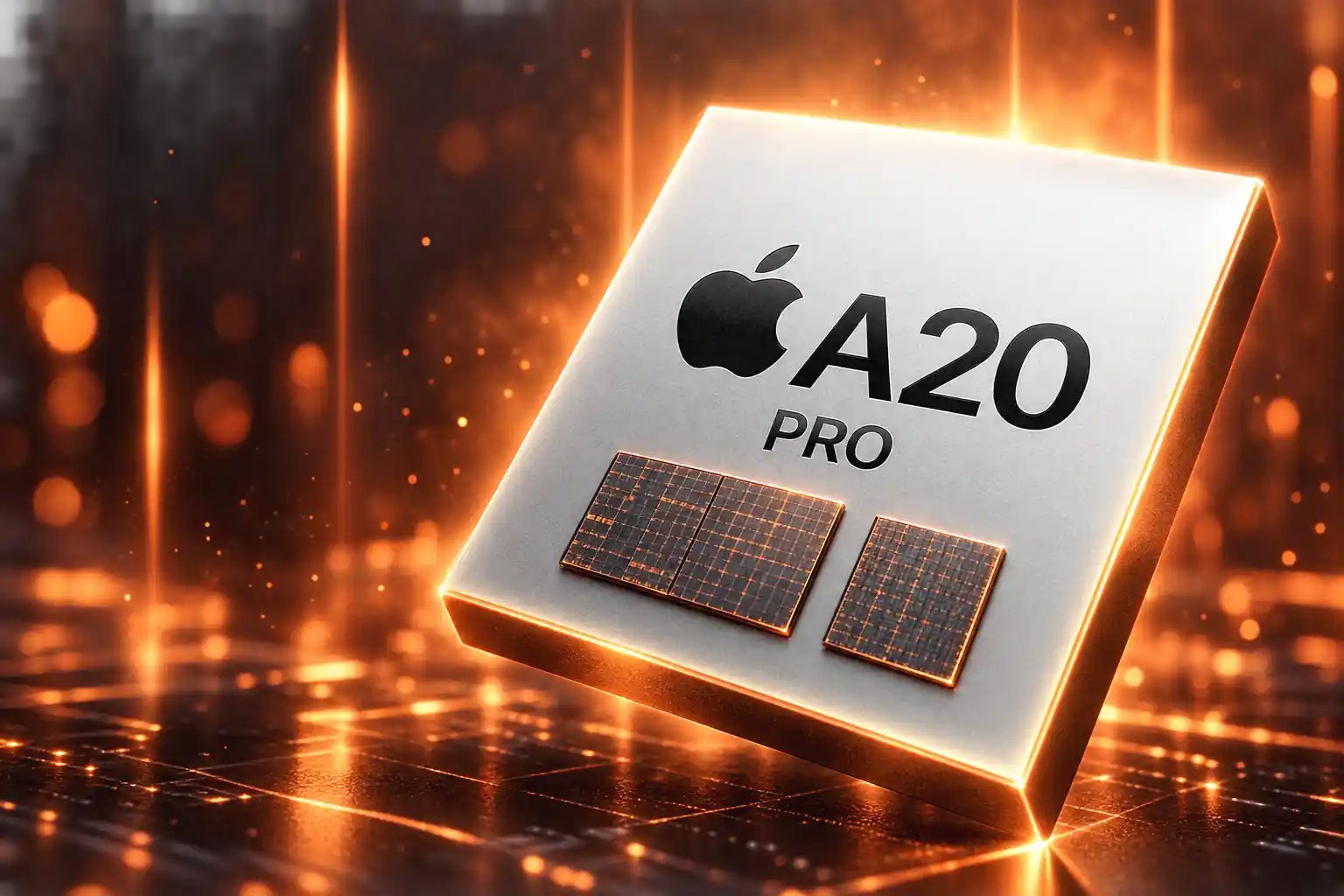
What the A20 Pro Puts on That Package
The A20 Pro is Apple’s first phone chip built on a 2-nanometer process at TSMC, the foundry’s N2 node. TSMC’s N2 platform uses gate-all-around nanosheet transistors in place of FinFETs, and the company has quoted a 15 percent speed gain or a 30 percent power cut versus N3, with more than 1.15 times the chip density.
Apple put those transistors into a 6-core CPU with 2 super cores and 4 efficiency cores. It says the super cores are 20 percent faster than the A19 Pro’s performance cores. The GPU grows from 6 cores to 7 and is rated up to 40 percent faster than the A19 Pro. A second-generation neural accelerator on the GPU raises throughput by 50 percent, per Murray’s briefing.
The Neural Engine is the other jump. The A19 Pro had one 16-core engine. The A20 Pro has two banks of 16, for 32 cores that can run apart or bonded. Apple says that doubles on-device AI compute and feeds Siri AI and computational photography. Memory bandwidth rises 50 percent, which Apple calls the widest memory interface it has shipped in an iPhone.
A19 PRO VS. A20 PRO
| Spec | A19 Pro | A20 Pro |
|---|---|---|
| Process | 3nm (TSMC) | 2nm (TSMC N2) |
| CPU | 2 performance + 4 efficiency | 2 super + 4 efficiency |
| GPU | 6 cores | 7 cores |
| Neural Engine | 16 cores | Dual 16-core (32) |
| Memory package | Stacked on the die (POP) | Beside the die (WMCM) |
| Memory bandwidth | Prior generation | 50 percent higher (Apple) |
TechInsights pulled an A20 Pro from an iPhone 18 Pro and put the compute die at about 8.0 mm by 12.3 mm, an estimated die area of 98.2 mm², nearly the same as the A19 Pro. Extra GPU and neural area fit because N2 is denser, not because the chip got bigger. The lab’s early read also points to a 96-bit LPDDR5X interface. Apple has not published the bus width.
The Duo version is almost the same silicon with two extras. Murray said Apple added a second display engine so the inner and outer screens can run at once, and support for a FaceTime camera behind the inner display. Those are extra loads on the same thermal budget.
Four Paths Out of a Hot 2nm Phone
iPhone 17 Pro models were the first to use a vapor chamber. Apple kept the idea and rebuilt it around the exposed A20 Pro die. Banafsheh Barabadi, senior manager of thermal product design, called the pairing a state change. “For the first time, we were able to couple silicon directly to our thermal solution, and we designed the entire system around that opportunity,” she said.
She described four pillars. Direct silicon access is first: with DRAM gone from the stack, heat has a straight path into the chamber. The second is a pad Apple calls metal over foam, a springy thermal bridge that had to be stiff enough for the chassis and soft enough not to crack the die. “It took us months of development to get the material properties exactly right,” Barabadi said.
The Chamber That Holds the Phone Together
The third pillar is the chamber itself. Apple says it has 3 times the surface area of the iPhone 17 Pro unit and more deionized water inside. In the 18 Pro and 18 Pro Max it is also the mechanical spine. The battery and logic board mount to it. Apple used 80 percent recycled steel in the chamber chassis for that stiffness.
Apple’s newsroom figure for the whole thermal stack is up to a 40 percent gain in sustained performance versus the iPhone 17 Pro, and twice the sustained performance of the iPhone 16 Pro. That 40 percent sustained number is a system claim. It sits beside the separate 40 percent GPU peak claim versus the A19 Pro.
Copper Behind the Screen
The fourth pillar is a nanotwin copper plate on the back of the display, plus a high-conductivity graphite layer. Apple says that pairing had not been available in a smartphone before, because the plate has to be strong enough for the screen and still move heat sideways. Hotspots flatten across the glass instead of pooling over the chip.
THE FOUR THERMAL PILLARS
- Direct silicon path: DRAM no longer sits on the die, so heat can reach the vapor chamber without a RAM lid in the way.
- Metal over foam: A compliant pad couples the A20 Pro to the chamber without breaking mechanical limits.
- Larger vapor chamber: Triple the prior surface area, more deionized water, and a steel plane that also holds the battery and board.
- Nanotwin copper plate: A new display-back metal plus graphite spreads heat across the screen and cuts local hot spots.
Barabadi said the four together help both long jobs, such as games and video, and short bursts such as on-device AI. She also tied the same stack to faster charging. Apple rates a 50 percent wired charge in around 15 minutes with a 60W-class adapter. eSIM-only video playback is rated at up to 36 hours on iPhone 18 Pro and up to 45 hours on iPhone 18 Pro Max, with typical use at up to 24 and 30 hours.
A Graphite Pipe Runs Through the Duo Hinge
Most of that stack is shared. The Duo cannot copy it. Open, it is the thinnest iPhone Apple has shipped, with a 7.6-inch inner display. Closed, thickness doubles, which traps heat in a tighter box. The inner panel is 50 percent larger than the 18 Pro Max screen; the 5.4-inch outer panel still has 90 percent of the 18 Pro’s screen area.
Apple gave the Duo a thinner vapor chamber that floats instead of acting as the chassis spine, plus a dual-battery layout and a custom-designed vapor chamber in the foldable body. The hard part, Barabadi said, was moving heat from one half to the other. Apple ran a flexible graphite pipe through the hinge, co-designed with the mechanical team so it can take repeated folds without losing thermal contact.
This was one of the most technically challenging aspects of our design.
Banafsheh Barabadi, senior manager of thermal product design, Apple
The hinge already has more than 100 parts, grade 5 titanium, and a magnet array that snaps the book shut. Adding a heat path through that joint means the part most likely to fatigue is now also a cooling duct. Barabadi said the graphite has to keep both thermal connectivity and structural integrity for the life of the product.
On the slab phones, Apple’s own sustained claim is the 40 percent system gain. On GPU hold specifically, Barabadi quoted a different figure: 35 percent higher sustained GPU performance than iPhone 17 Pro. Independent cool-down clips of the 18 Pro Max already show a much larger chamber than last year’s phone. The Duo still has no public lab run against those slabs, because it is not in stores yet.
Qualcomm Shifted Memory and Stopped Short
Apple is not the only one pulling RAM off the hottest silicon. Qualcomm’s Snapdragon 8 Elite Extreme Gen 6, shown in late September, uses offset package-on-package. Memory moves to the side of the logic die rather than sitting square on top of the CPU and GPU. A thermal transporter fills the gap. Qualcomm says that helps the chip hold peak speed twice as long. Those phones are still due later this year, so the claim is untested in shipping devices.
The two moves are cousins, not copies. Apple’s module places die and DRAM fully beside each other and bonds the silicon to a chamber that is also the phone’s spine. Qualcomm’s offset PoP still stacks, just not dead-center over the hot cores. Both are answers to the same 2nm problem: more transistors in the same pocket, and DRAM that used to act as a lid.
If the Extreme phones ship with that offset stack and hold clocks as advertised, Apple’s packaging lead gets narrower. If they throttle, the full side-by-side layout plus the 3-times chamber is the cleaner thermal bet. The Duo is the stress test either way, because it has to do the same job in a hinge.
Pre-Orders Open Before Independent Tests Begin
iPhone 18 Pro and 18 Pro Max have been on sale since September 18. The Duo is the delayed half of the same silicon plan. Pre-orders begin October 16. Availability begins October 23 in the first wave, then October 30 in 28 other countries. It starts at $1,999 for 256GB in Star White and Night Sky.
THE PATH TO OCTOBER 23
- September 9, 2026: Apple announces the A20 Pro, iPhone 18 Pro, iPhone 18 Pro Max, and iPhone Duo.
- September 18, 2026: iPhone 18 Pro models go on sale with the new package and the larger vapor chamber.
- September 22, 2026: TechInsights publishes first die measurements of production A20 Pro silicon.
- October 16, 2026: iPhone Duo pre-orders open.
- October 23, 2026: iPhone Duo goes on sale in the first countries.
Some buyers appear to be sitting out the slab refresh until the foldable arrives, and others are simply balking at price. That pause does not test the hinge. It just means the first week of Duo reviews will carry the thermal question the 18 Pro already answered in a brick-shaped shell.
WHAT WE KNOW
- Shared silicon: The same A20 Pro family runs in the 18 Pro, 18 Pro Max, and Duo, with a second display engine on the foldable.
- Packaging change: DRAM sits beside the die, which is the condition for direct chamber contact.
- Slab results: Apple’s sustained and battery ratings, plus early teardowns, apply to phones already in stores.
WHAT IS UNCONFIRMED
- Duo thermals: No independent lab has published sustained GPU or charging tests on the foldable.
- Hinge life: Graphite conductivity after many fold cycles is an Apple claim, not a measured field result.
- Closed-book heat: Performance with both displays on, or with the device shut, has not been scored in public tests.
Barabadi’s favorite detail is that none of the work is visible. Buyers will feel it as frame rate, camera processing, and battery hours, or they will feel it as a warm hinge. The A20 Pro already made that bet on the 18 Pro. The Duo has to make it through a strip of graphite Apple will not let anyone flex until October 23.

Final Fantasy Resonance Turns a Dead Gacha Into HD-2D

PHP2Shell Forced Sites Offline While Exploits Stalled

Kindle+ Folds AI Audiobooks Into the Page-Read Fund

Chip Stocks Fall as the Bond Rally Cheapens AI Spend

Comcast’s Record Odyssey Quarter Doubles as the Exit

Microsoft 365 Auth Fault Took Down Exchange and Teams

Xbox Caps Game Pass Cloud Gaming at 15 Hours

OpenClaw 2.0 Ships a Team Workplace With Host-Trust Defaults

OpenAI Unveils GPT-6 Astra With a Critical Cyber Label

Diesel Breaks Its Record as the White House Claims Credit
-
 NEWS2 months ago
Microsoft 365 Auth Fault Took Down Exchange and Teams
-
 GAMING2 months ago
Xbox Caps Game Pass Cloud Gaming at 15 Hours
-
 NEWS2 months ago
OpenAI Unveils GPT-6 Astra With a Critical Cyber Label
-
 NEWS2 months ago
OpenClaw 2.0 Ships a Team Workplace With Host-Trust Defaults
-
 BUSINESS2 months ago
Diesel Breaks Its Record as the White House Claims Credit
-

 LIFESTYLE2 months ago
Squishy Dumpling Toys Recalled After Hiding Illegal Water Beads
-

 BUSINESS2 months ago
ChargePoint Stock Rally Prices Wilmer’s Three-Year Cash Plan
-

 AUTO2 months ago
Tesla Puts Its Wheel-Free Cybercab on Austin Streets