
NEWS
ASML Customers Queue for Tools as 2028 Supply Falls Short
ASML’s record quarter came with a warning that 2027 and 2028 lithography supply will not cover AI demand, even as some buyers ask about 2030 tools.

ASML Holding said some chipmakers want lithography tools for 2029 and even 2030, while planned supply for 2027 and 2028 will not fully meet demand. The Veldhoven equipment maker posted a record quarter on October 14, 2026, and lifted the floor of its 2026 sales range as AI factory plans kept growing.
That combination is less a simple demand beat than a queue. ASML is still the only company that builds extreme ultraviolet scanners for the most advanced chips, and its customers are now trying to reserve slots years before the tools can ship.
€11.7 Billion in Sales and a 57.5% Margin
Third-quarter net sales were €11.7 billion, toward the high end of guidance, with a gross margin of 57.5% and net income of €5.0 billion. Basic earnings were €12.95 a share. A year earlier, sales were €7.5 billion, the margin was 51.6%, and net income was €2.1 billion.
President and Chief Executive Officer Christophe Fouquet called it a record for total net sales. Installed Base Management, the service and field-option line, came in at €3.3 billion, which Executive Vice President and Chief Financial Officer Roger Dassen said was €400 million above guidance because customers wanted productivity upgrades on tools they already own. That mix, not only new-system volume, pushed the margin above the company’s own range.
Net income included €500 million from the revaluation of a first-tranche purchase, Dassen said, so the profit figure is not a clean read on scanner shipments alone. New lithography systems sold were 113, plus 8 used units, for 121 tools in the quarter, up from 91 in the second quarter. System sales were €8.4 billion. Cash and short-term investments ended at €12.7 billion. ASML bought around 2.8 million shares for around €4.1 billion in the quarter and set a second interim dividend of €1.88 a share, payable on November 4, 2026.
ASML QUARTERLY SNAPSHOT
| Measure | Q3 2025 | Q2 2026 | Q3 2026 |
|---|---|---|---|
| Total net sales | €7.5 billion | €9.3 billion | €11.7 billion |
| Gross margin | 51.6% | 54.0% | 57.5% |
| Net income | €2.1 billion | €2.9 billion | €5.0 billion |
| Basic EPS | €5.49 | €7.59 | €12.95 |
| Lithography systems sold | 72 | 91 | 121 |
The company now expects full-year sales of €44 billion to €45 billion ($49.3 billion to $50.4 billion) and a gross margin around 56%. The previous floor was €43 billion. Fourth-quarter sales are guided at €14.2 billion to €15.2 billion, with a margin around 57% and Installed Base Management around €3.7 billion. The upper end of that quarter sits above the LSEG consensus of €14.2 billion. LSEG had put third-quarter profit at €4.1 billion. Dassen said the 2026 sales outlook is growth of roughly 36% from 2025, with EUV up more than 45%, non-EUV up about 20%, and the installed-base line up about 50%.
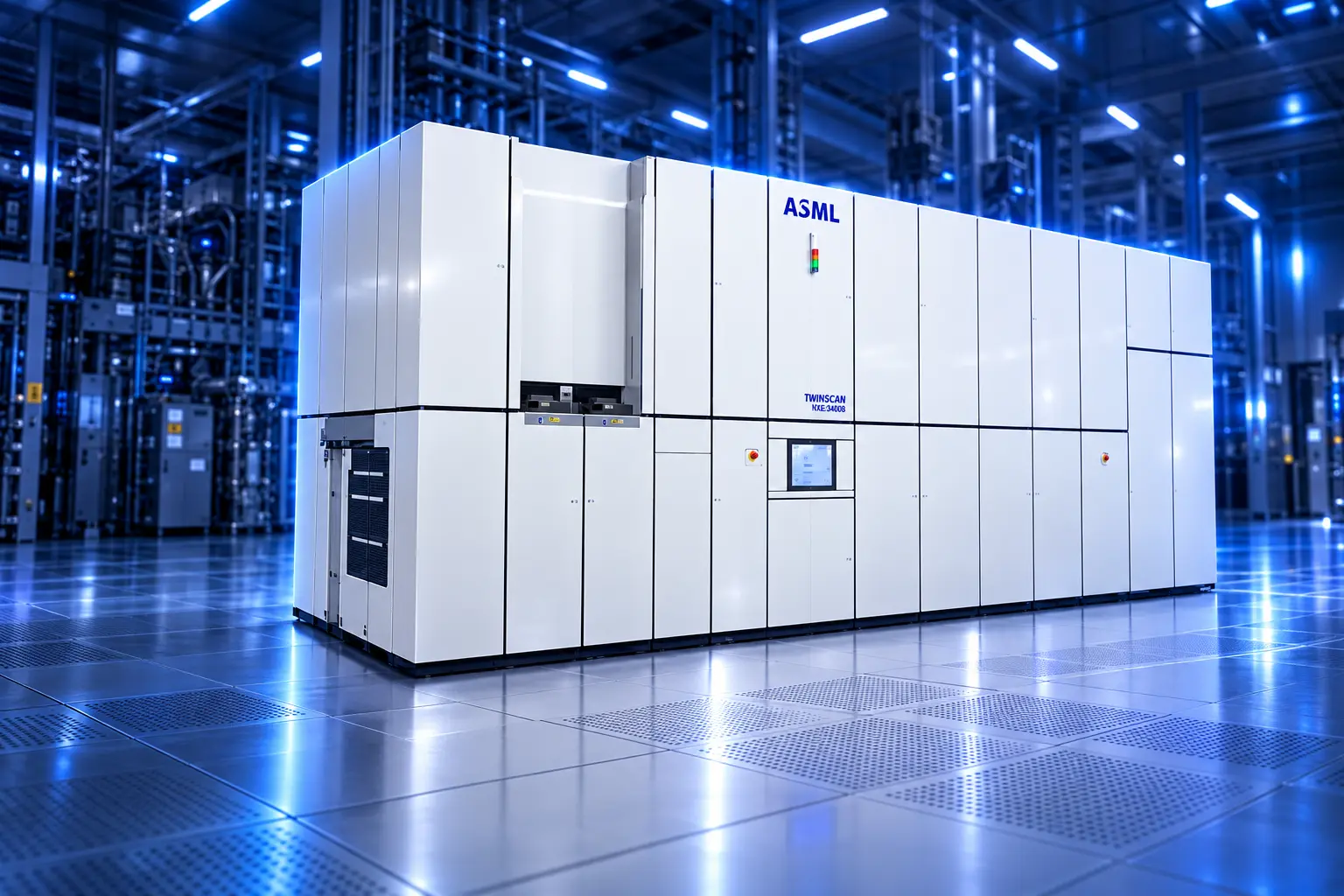
Planned Supply for 2027 and 2028 Still Falls Short
The number that will travel farther than the margin is the capacity warning. Fouquet said the order book has kept rising quarter after quarter in 2026, and that supply as now planned for both 2027 and 2028 will not fully meet customer demand. In July, ASML had already mapped a 30% capacity increase for 2027 and a further 30% for 2028. On the results video he said those two steps, taken together, will not be enough.
Last quarter, we talked about 30% more capacity next year and also the aspiration to have another 30% increase in 2028. But, to be honest, it’s becoming very clear that 30% in 2027 and 30% in 2028 will not allow us to meet our customer demand.
Christophe Fouquet, President and Chief Executive Officer, ASML Q3 2026 results video
ASML expects to ship about 65 EUV systems in 2026, more than 50% above last year. Deep-ultraviolet immersion shipments are now expected to hold roughly flat year on year, after an earlier plan for fewer tools. In July the company had put 2026 low-NA EUV capacity at around 65 systems and DUV immersion at around 130. A 30% lift on that EUV base is a large step. It is still smaller than the factory plans its customers are bringing in.
Chip shares had already been under pressure after Broadcom Inc. CEO Hock Tan likened investor sentiment in the industry to a casino. The ASML print does not settle that valuation fight. It does show that the foundries placing the actual tool orders have not pulled back their medium-term build plans.
Why Chipmakers Are Already Asking About 2030
Fouquet said customers keep raising their short- and medium-term equipment forecasts, “driven primarily by their views on the size and duration of AI-related investments.” In that light, some are “expressing an interest in placing orders with us for 2029 and even 2030.” He also said a lot of customer talks have shifted beyond 2027, with heavy order intake for 2028 and strong interest, in some cases, in 2029 and 2030.
Interest is not a purchase order, and a 2030 slot is not 2026 revenue. The useful reading is the other way around. If 2027 is already tight after a 30% capacity add, and 2028 is already short after another 30%, then asking about 2029 is how a buyer stays in line. The bottleneck has moved from graphics chips and power to the plant that builds the printers those fabs cannot replace.
BREAKING: $ASML reports €11.7 billion total net sales, gross margin of 57.5%, and €5.0 billion net income in Q3 2026. https://t.co/7fnlze068z
— ASML (@ASMLcompany) October 14, 2026
ASML’s own account posted the quarter as €11.7 billion in sales, a 57.5% margin, and €5.0 billion in net income. The same release is the one that told customers the 2027 and 2028 plans will not cover them. Shares have risen 56% in 2026. That gain prices a long cycle. It does not create extra scanners.
Faster Scanners and a Surge in Upgrade Work
Because new-tool output cannot be doubled on a short clock, ASML is trying to pull more wafers from each machine. Dassen said the NXE:3800F, due in small quantities in 2027, lifts throughput from 230 wafers per hour to 260, with a broader effect in 2028 and after. Key immersion tools shipping in 2027 are specified at 330 wafers per hour. In July, CFO commentary had also pointed to cutting EUV build-and-test cycle time from about 22 weeks toward 15 to 16 weeks.
HOW ASML IS STRETCHING OUTPUT
- Installed-base upgrades: Service and field options hit €3.3 billion in the third quarter, €400 million above guidance, as fabs buy productivity kits instead of waiting for a new serial number.
- NXE:3800F scanners: Throughput rises from 230 wafers per hour to 260, with small 2027 shipments and a wider capacity effect from 2028.
- Immersion tools in 2027: Key DUV systems are specified at 330 wafers per hour, stretching the non-EUV fleet that still runs many layers beside EUV.
Fouquet said the company also shipped the YieldStar 550 overlay metrology system, aimed at 14-angstrom logic and 1d DRAM, with a 60% productivity increase. More measurement is the unglamorous twin of more exposure: as layer counts rise, fabs need the overlay kit as badly as they need the scanner. None of that removes the 2027-2028 gap. It is how ASML sells wafer starts while the cleanroom line is still catching up.
TSMC, Samsung and Intel Stake Out High NA Dates
The next-generation tool is already being allocated on a calendar, which is the other half of the queue. High NA, or 0.55 numerical aperture EUV, is the EXE platform. ASML’s 0.55 NA High NA TWINSCAN EXE:5200B is specified at 8 nm resolution, with 40% more imaging contrast than NXE tools, features 1.7 times smaller, and transistor density 2.9 times higher. Fouquet said Intel continues to run High NA in high-volume manufacturing and is raising the number of layers and wafers it puts through those tools. Samsung has said it plans High NA high-volume manufacturing in 2028, for DRAM. TSMC has confirmed High NA high-volume manufacturing around 2030 for advanced nodes.
On September 8, 2026, ASML and TSMC also launched an industry push to move High NA photomasks from the current 6-inch format to 12-inch reticles. The IR deck puts the gain at more than 40% productivity for a dual-mask exposure. The joint plan targets a 12-inch mask pilot line by 2031 and lithography-system readiness for advanced-node production by 2033. Early High NA volume at TSMC still starts on 6-inch masks. TSMC asked ASML to lead the consortium on that mask shift, Fouquet said.
HIGH NA DATES ON THE RECORD
- July 15, 2026: ASML raises 2026 sales guidance to €43 billion to €45 billion and maps 30% more capacity for 2027, with another 30% under study for 2028.
- September 8, 2026: TSMC commits to High NA high-volume manufacturing from 2030; Samsung targets DRAM High NA in 2028; the 12-inch mask initiative is announced, with a 2031 pilot and 2033 production readiness.
- October 14, 2026: Fouquet says planned 2027 and 2028 supply will not fully meet demand, some customers ask about 2029 and 2030, and ASML studies 2028 output beyond the earlier 30%.
Three customers and three dates is not a broad market. It is the leading edge talking to the only vendor. Smaller foundries and later memory nodes sit behind that list, which is why 2028 extra capacity, if it ever lands, will be fought over as soon as it is announced.
China Holds 20% of Sales Without EUV Access
Dassen said China is still expected to account for about 20% of total business, matching the prior forecast. That slice is DUV and services, not the EUV monopoly. ASML is restricted from selling EUV tools and some DUV systems into China, so the 20% figure is a ceiling set by license policy as much as by orders.
A Chinese DUV effort has been circulating in industry talk since July, and it sits in a different league from High NA. DUV immersion is the workhorse for many layers; EUV is the gate on the most advanced logic and on the HBM-linked memory roadmaps that AI clusters actually buy. China at 20% keeps the installed-base and mid-critical tool lines busy. It does not give Beijing a ticket into the 2029-2030 EUV conversation Fouquet described.
Extra 2028 Output Is Still Only Under Review
Value-based pricing talks with key customers are done, Dassen said, with little effect in 2026, a partial effect in 2027, and the full effect more visible from 2028. That timing lines up with the shortage years. When supply is short, the vendor does not need a slogan to raise the price of the next tool and the next spare kit.
What ASML has not done is commit a new 2028 unit number. Fouquet said the company is looking at ways to extend capacity “especially in 2028 and beyond.” In September it began work on a new Eindhoven campus, with the first phase aimed at 2029, which is useful for the decade and late for a 2028 hole. The next formal reset of the long-term model is Capital Markets Day on June 10, 2027. Until then, the working picture is the one from October 14, 2026: about 65 EUV systems this year, 30% more capacity in 2027, another 30% in 2028 that still does not cover the book, and buyers already asking what 2029 and 2030 look like.
A 2030 expression of interest will not ship a wafer in 2027. The 2027 and 2028 shortfall will. That is the part of the quarter that outlasts the profit print.
Disclaimer: This article is news reporting and analysis of ASML’s public results, guidance and product roadmaps, and it is for information only. It is not investment advice, a recommendation to buy or sell ASML or any other security, or a forecast of future returns. Readers who may act on company figures, capacity plans or share-price history should consult a qualified financial adviser or licensed broker who can consider their own objectives and risk. Sales ranges, margins, shipment plans and customer timelines are taken from company materials as published on October 14, 2026, and those figures can change in later updates.

Final Fantasy Resonance Turns a Dead Gacha Into HD-2D

PHP2Shell Forced Sites Offline While Exploits Stalled

Kindle+ Folds AI Audiobooks Into the Page-Read Fund

Chip Stocks Fall as the Bond Rally Cheapens AI Spend

Comcast’s Record Odyssey Quarter Doubles as the Exit

Microsoft 365 Auth Fault Took Down Exchange and Teams

Xbox Caps Game Pass Cloud Gaming at 15 Hours

OpenClaw 2.0 Ships a Team Workplace With Host-Trust Defaults

OpenAI Unveils GPT-6 Astra With a Critical Cyber Label

Diesel Breaks Its Record as the White House Claims Credit
-
 NEWS2 months ago
Microsoft 365 Auth Fault Took Down Exchange and Teams
-
 GAMING2 months ago
Xbox Caps Game Pass Cloud Gaming at 15 Hours
-
 NEWS2 months ago
OpenAI Unveils GPT-6 Astra With a Critical Cyber Label
-
 NEWS2 months ago
OpenClaw 2.0 Ships a Team Workplace With Host-Trust Defaults
-
 BUSINESS2 months ago
Diesel Breaks Its Record as the White House Claims Credit
-

 LIFESTYLE2 months ago
Squishy Dumpling Toys Recalled After Hiding Illegal Water Beads
-

 BUSINESS2 months ago
ChargePoint Stock Rally Prices Wilmer’s Three-Year Cash Plan
-

 AUTO2 months ago
Tesla Puts Its Wheel-Free Cybercab on Austin Streets