
NEWS
Ken Griffin’s AI Bubble Warning Is a GPU Price Call
Ken Griffin tied his AI bubble call to GPU rents that can collapse like leftover airline seats once supply catches demand.

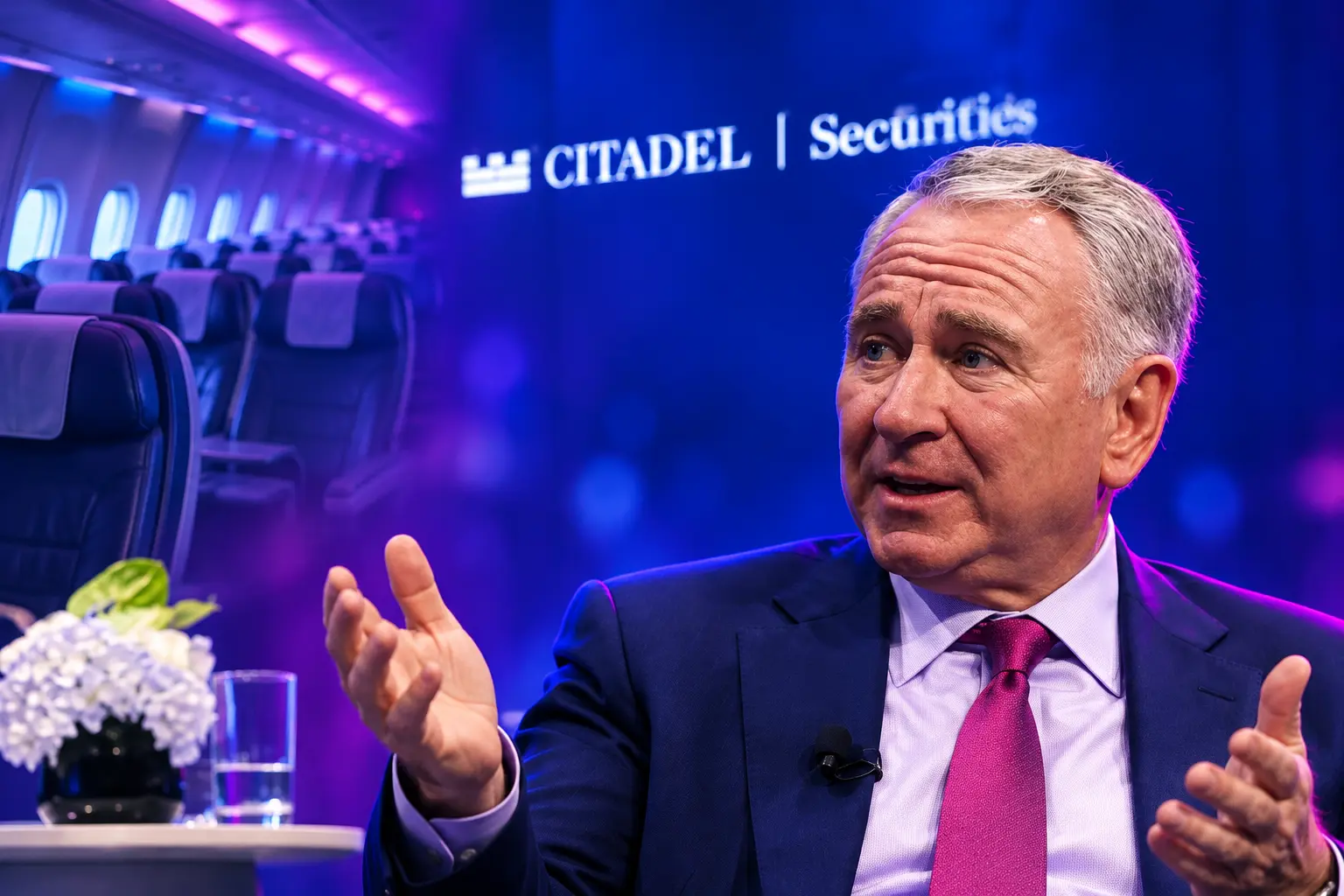
Ken Griffin said on Oct. 20, 2026 that investors are almost certainly in an AI bubble, then compared GPUs to leftover airline seats. He was not telling anyone to sell the stocks.
Speaking with Dani Burger at Citadel’s Future of Global Markets Conference in New York, the Citadel founder treated the bubble as the usual companion of a real shift, and treated the chips as the part that can reprice overnight.
GPUs Behave Like Unsold Airline Seats
Griffin’s load-bearing claim was not that the models are fake. It was that a graphics chip, once it is installed and powered, has a very low extra cost to run, so the price of an hour can fall hard if supply runs ahead of jobs.
GPUs like airlines have a very low marginal cost to run.
Ken Griffin, founder and CEO, Citadel, Future of Global Markets Conference
He walked the room through an empty cabin. An unsold seat that goes out for as little as $20 still helps, which is why fares drop when planes fly with space. If GPU supply exceeds demand, he said, that same math sends chip pricing into free fall.
He reached for the telecom boom around 2000, when firms laid more fiber than traffic needed and communication prices fell. He also doubted that chips five or six years old, which still earn rents he called extraordinary, will do so for another five or six years.
On the recent slide in chip stocks, he waved off the habit of blaming hedge-fund deleveraging. “The reason that people love that answer is it actually washes your hands of accountability,” he said.
Older A100 Cards Still Command Rent
The rental board on Oct. 20 still prints money on last-generation silicon, which is the “extraordinary” part Griffin flagged. Compute Credit Index Research, a GPU-rate tracker, posted guaranteed on-demand hours in the United States and Europe that morning.
THE RENTAL BOARD ON OCT. 20
| Chip | Hyperscaler ($/GPU-hr) | GPU cloud ($/GPU-hr) | Marketplace ($/GPU-hr) |
|---|---|---|---|
| B200 | 14.24 | 8.15 | 7.50 |
| H200 | 10.30 | 4.63 | 5.14 |
| H100 | 11.25 | 3.34 | 3.07 |
| A100 | 4.45 | 1.86 | 1.58 |
Hyperscalers in that ladder are AWS, Azure, Google Cloud and Oracle. GPU clouds include CoreWeave, Lambda and Nebius. Marketplaces include Vast and RunPod.
The same H100 that lists at $11.25 on a big cloud already prints an H100 marketplace rate of $3.07, about 3.7 times cheaper for the same chip. Spare, interruptible H100 hours sit at $2.19 on GPU clouds. The older A100, the card that matches Griffin’s five-to-six-year window, still fetches $4.45 on a hyperscaler list and $1.58 on the open marketplace. Interruptible A100 hours on GPU clouds print $1.14.
That spread is the empty-seat fare in plain view. List prices on the big clouds have not collapsed. The spare hour already has.
Buyers of the boxes have been stretching how long they book the life of a server. Amazon told shareholders that from Jan. 1, 2025 it moved a subset of servers and networking gear from six years to five, citing a faster pace of AI and machine-learning hardware. Griffin’s warning sits on the other side of that choice: if the extra years of rent do not show up, the books are long and the cash is short.
Fiber Prices Collapsed After the 2000 Overbuild
Griffin’s fiber parallel is the part of 2000 that the Pets.com jokes skip. The glass got built. The traffic did not fill it. The hour of bandwidth then went on sale.
THE FIBER SUPERCYCLE
- 1996 to 2001: Telecom firms pour more than $500 billion into fiber, switches and wireless, much of it with debt.
- 2001: An estimated 100 million miles of fiber sit in the ground; only about 3% to 5% of it carries live traffic.
- 2002: Long-haul bandwidth prices are down more than 90% on many routes from the peak, and several carriers have failed.
Later buyers picked up routes for cents on the dollar. Cheap transit is what made later video and voice products affordable. The companies that laid the dark fiber often were not the ones that collected on it.
The 2026 fiber market is not a glut. TrendForce, in an Oct. 19 note, projected a global shortfall of 180 million fiber-kilometers this year as AI data centers, interconnects and backbone jobs pull glass, with mill use at 92% and inventories down to about a month from four months in 2024. Spot prices for some finished fiber are running 2.8 to 5 times 2025 levels. Griffin is not saying glass is cheap again. He is saying GPU hours can follow the 2000 price path even if the ducts around the chips stay tight.
What a Chip Glut Would Hit First
If spare GPU hours start pricing like leftover seats, the pain is not evenly spread. The software firms that still own distribution after a bust can look like Amazon after the internet boom. The landlords of the hours cannot.
WHO EATS A COMPUTE GLUT
- Chip vendors: A glut shows up first as weaker rents and then as slower orders for the next board.
- Cloud hosts: They bought the boxes on multi-year lives; a cheaper spare hour undercuts the list they still print.
- Model labs: Premium OpenAI and Anthropic bills lose share if jobs move to cheaper open-source models that firms run themselves.
- Index holders: Retirement accounts that own the buildout through broad funds take the mark-to-market hit even if they never bought a chip stock on purpose.
Griffin sorted those last two in the same breath. Corporate buyers, he said, are already picking which jobs justify the frontier labs and which can run on models anyone can download. “Corporate America has been very uneven in its ability to extract value from its AI models,” he said. “I think all of Corporate America is looking at their bills from Anthropic and OpenAI and going, ‘Okay, we need to think about how to make sure we’re getting productivity out of this.’”
Nvidia chief Jensen Huang, at Davos in January, said the industry is only “a few hundred billion dollars” into what he called the largest infrastructure buildout in human history, with trillions still to go. Griffin did not dispute the long project. He disputed the idea that every hour stays scarce for the life of the loan.
Citadel Bought the Panic, Then Named the Bubble
The same firm that hosted the bubble talk had already traded the last forced sale in these names. That order of events is the tell, not a sideshow.
THE JULY BOOK SALE
WHAT WE KNOW
- The seller: Situational Awareness, the AI-focused fund founded by former OpenAI researcher Leopold Aschenbrenner, sold most of its public stock book to Citadel on July 30, 2026.
- The hole: The public book, about $16 billion, had dropped 67% in July; the fund had borrowed as much as four times its capital.
- The terms: Citadel took the positions at about a 10% discount after Griffin and senior staff spent a night on the names and their liquidity.
- The exit: In an August letter to clients, Griffin wrote that Citadel had already shed more than 80% of that risk through nearly 100 block trades totaling more than $4 billion.
WHAT IS UNCONFIRMED
- What is still on: How much, if any, of that book Citadel still holds has not been disclosed since the August letter.
- Private book: Situational Awareness also held private stakes, including a large Anthropic position; those did not move with the public sale.
Calling a bubble in October, after warehousing a distressed AI book in July and cutting most of the risk by August, is the act of a shop that gets paid to take the other side of a fire sale. It is not the act of a tourist discovering chips. Griffin still used the word bubble. He also said he wished he had kept his Amazon stock after the last one.
Inside the firm, he said, AI agents have already cut some high-level research from weeks to a couple of hours. He did not present that as a reason the rented chips stay dear. He presented it as proof the tools work for the people who figure out the workflow.
“Any radical transformation of our economy is generally intertwined with a bubble,” he said. “What’s left in the wake of these bubbles, if we want to use that word, is often game changing for the world. And the companies that are on the other side of that bubble are the market leaders for decades to come.” He called the internet a great bubble. He did not call this one a reason to go to cash.
Why Corporate Buyers Are Shopping Down the Stack
The spend is still rising even as the invoices get read more slowly. Gartner, in a Sept. 16, 2026 forecast, put worldwide AI spending of $2.67 trillion for 2026, up 49.5% from $1.79 trillion in 2025, and $3.64 trillion in 2027.
WORLDWIDE AI SPEND
| Slice | 2025 | 2026 | 2027 |
|---|---|---|---|
| AI infrastructure | $982 billion | $1.48 trillion | $1.98 trillion |
| AI software | $288 billion | $462 billion | $656 billion |
| AI services | $434 billion | $576 billion | $746 billion |
| Total AI spending | $1.79 trillion | $2.67 trillion | $3.64 trillion |
Infrastructure is the largest slice at $1.48 trillion this year. John-David Lovelock, a distinguished VP analyst at Gartner, called the data-center buildout the largest infrastructure project humanity has even undertaken, and said demand for that kit remains strong even with higher memory prices. He also placed generative AI in the firm’s Trough of Disillusionment for 2026, with buyers leaning on simpler features already sitting inside software they own. Gartner sees a $1.2 trillion AI-services opening by 2030 as firms chase those smaller jobs.
The debt around the buildout is already large. Data from LSEG show Amazon, CoreWeave, Google, Meta, Microsoft and Oracle had issued $193 billion of bonds as of early August 2026, up from $16.7 billion in 2024, more than eleven times the prior year’s take.
Griffin’s version of that table is a finance team with the Anthropic and OpenAI PDFs open, asking which tasks still need the frontier model. If that shopping continues, the labs’ spend plans and the chipmakers’ next-board forecasts take the first cut. The open-source stack, which anyone can run on rented or owned cards, is the $20 seat.
Fink Is Still Building Through the Warning
The glut is a mechanism Griffin described, not a print he said is already on the tape. The next day, two other chiefs argued the scarce-compute case.
If we don’t build out these data centres, it is actually more inflationary because the cost of compute is so high right now.
Larry Fink, CEO, BlackRock, Oct. 21, 2026
Deutsche Bank chief Christian Sewing, speaking the same day, said he does not think the market is in a bubble that is bursting, while allowing that single companies can still take a hit. Fink has been on this side before, treating delays as a tax on growth rather than as prudence.
Those two views can sit on the same tape. Hyperscaler lists on Oct. 20 still charge $11.25 for a guaranteed H100 hour. The marketplace already sells that hour for $3.07, and an older A100 for $1.58. Griffin’s bet is that the lower number is the one that spreads if the cabin does not fill. Fink’s bet is that the cabin is still short of seats.
Griffin closed the AI portion of his talk the way a trader who lived through 2000 would. He wants the United States to “grow the damn economy,” keep data centers onshore, and push nuclear, batteries and robotics as well as AI. He is not exiting the technology. He is pricing the leftover hour.
Disclaimer: This article is news reporting and analysis of public remarks, market prints and research forecasts. It is for information only and is not investment advice, a recommendation to buy or sell any security, fund, token or commodity, or a prediction of future prices. Readers should consult a licensed financial adviser or other qualified investment professional who can review their own holdings, time horizon and risk before acting on any AI, semiconductor or cloud-related idea. Figures, rental rates, forecasts and portfolio statuses reflect the cited sources as of the dates named in the piece and can change with the next print, filing or speech.

Final Fantasy Resonance Turns a Dead Gacha Into HD-2D

PHP2Shell Forced Sites Offline While Exploits Stalled

Kindle+ Folds AI Audiobooks Into the Page-Read Fund

Chip Stocks Fall as the Bond Rally Cheapens AI Spend

Comcast’s Record Odyssey Quarter Doubles as the Exit

Microsoft 365 Auth Fault Took Down Exchange and Teams

Xbox Caps Game Pass Cloud Gaming at 15 Hours

OpenClaw 2.0 Ships a Team Workplace With Host-Trust Defaults

OpenAI Unveils GPT-6 Astra With a Critical Cyber Label

Diesel Breaks Its Record as the White House Claims Credit
-
 NEWS2 months ago
Microsoft 365 Auth Fault Took Down Exchange and Teams
-
 GAMING2 months ago
Xbox Caps Game Pass Cloud Gaming at 15 Hours
-
 NEWS2 months ago
OpenAI Unveils GPT-6 Astra With a Critical Cyber Label
-
 NEWS2 months ago
OpenClaw 2.0 Ships a Team Workplace With Host-Trust Defaults
-
 BUSINESS2 months ago
Diesel Breaks Its Record as the White House Claims Credit
-

 LIFESTYLE2 months ago
Squishy Dumpling Toys Recalled After Hiding Illegal Water Beads
-

 BUSINESS2 months ago
ChargePoint Stock Rally Prices Wilmer’s Three-Year Cash Plan
-

 AUTO2 months ago
Tesla Puts Its Wheel-Free Cybercab on Austin Streets