
NEWS
The iPhone Duo Pause That Makes Touch ID Feel Slow
Apple added a hold to every iPhone Duo Touch ID unlock so alerts can appear, and that designed pause is why reviewers are putting on an Apple Watch.

Apple put an intentional pause on every iPhone Duo Touch ID unlock, and reviewers who spent a week with the foldable keep calling the fingerprint reader slow. After a registered finger hits the side button, the phone lingers on the Lock Screen and only continues to the Home Screen if you keep holding.
Apple said the hold gives Lock Screen alerts time to appear and keeps the gesture in step with Macs and iPads. Several testers still ended up wearing an Apple Watch, which skips the hold altogether.
Apple Built a Pause Into Every Unlock
Marques Brownlee, who tested the phone for more than a week, said Apple added the delay to “every single” Touch ID unlock. Touch the side button and the Duo stays on the Lock Screen. Keep the finger there, and it proceeds. He looked for a setting that would cut the wait and did not find one.
It’s technically smart. Like, it’s giving people a chance to check to see their notifications real quick before it goes and unlocks it. And if they want to deliberately hold it longer, it’ll unlock. But as someone who is used to the instant unlocks from Face ID, I was like, I need to find a way to turn this off. And I did not find that. Like it just makes the fingerprint reader feel slow when it’s not slow.
Marques Brownlee, on his iPhone Duo review
Apple’s explanation matches that read. The company said the pause creates a more consistent experience next to other Touch ID hardware, including Macs and iPads, and gives the phone time to wake and show Lock Screen alerts. The sensor itself is not the lag. The extra beat is a software choice sitting on top of it.
Brownlee’s workaround is to wake the Duo, swipe up, then hit the sensor, which he said produces an instant unlock. That extra choreography is the point reviewers keep circling. Face ID on other iPhones lets you glance and go. This phone asks you to wait on purpose, then rewards a longer press.
YouTuber Mrwhosetheboss put a number on the annoyance, saying the hold instead of a tap “feels like a tiny bit of extra friction 50 times a day.” He also found the button more comfortable in landscape, which is a strange daily tax on a phone people will carry closed as often as open.
Two Screens and One Fingerprint
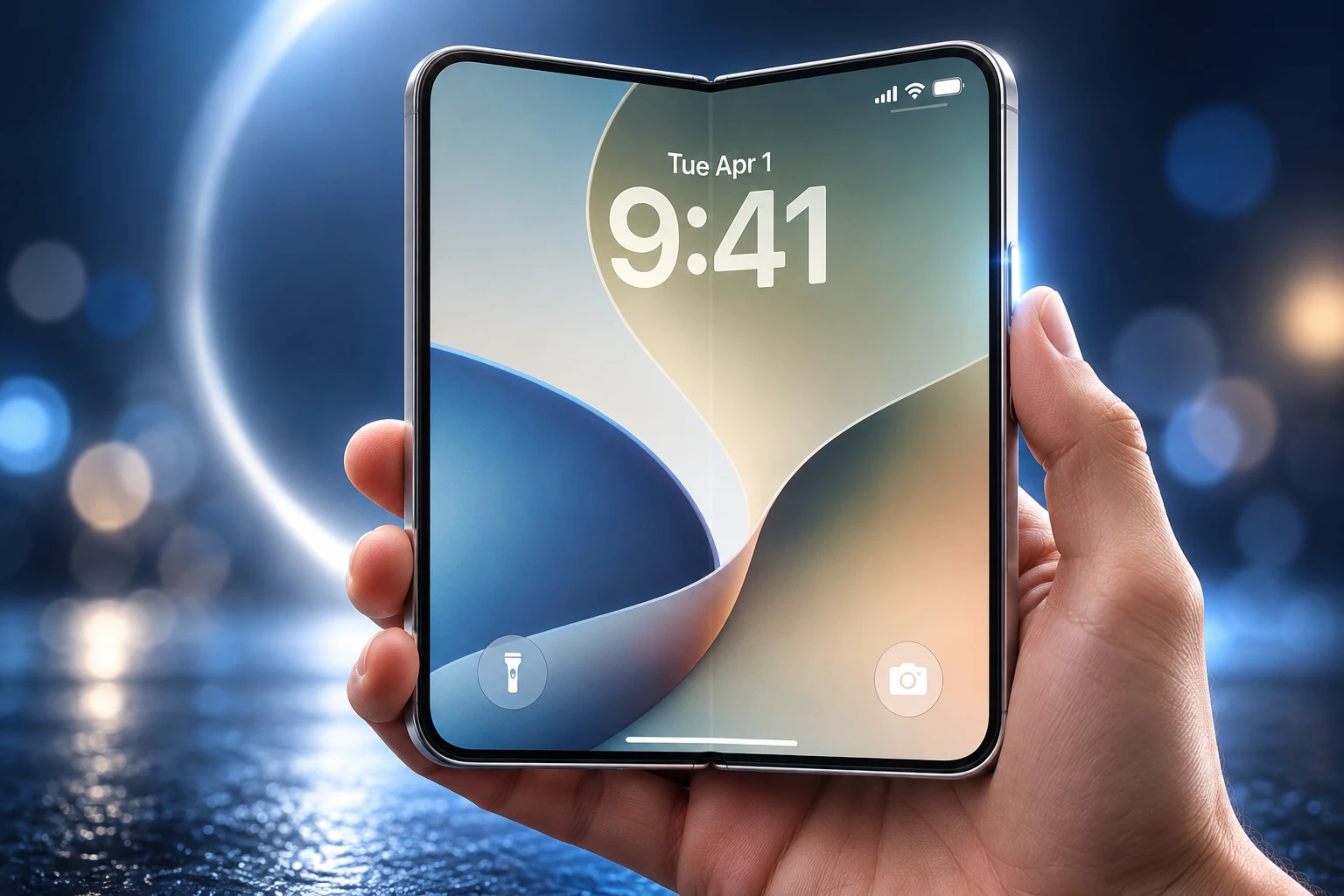
iPhone Duo is Apple’s first foldable, announced on September 9, 2026, with a 5.4-inch outer display and a 7.6-inch inner display. Closed, Apple says it is similar in size to a passport and offers 90 percent of the screen area of iPhone 18 Pro. Open, the inner panel is 50 percent larger than iPhone 18 Pro Max, and Apple calls it the thinnest iPhone it has shipped. It starts at $1,999 and runs iOS 27 on an A20 Pro chip. Colors are star white and night sky.
A normal iPhone has one front, so Face ID has one obvious home. Duo has two fronts. The outer camera is a 12MP Center Stage sensor built for photos and video calls, not a face scan. Under the inner display sits a FaceTime camera that stays hidden until you need it. Apple’s own spec sheet does not describe either camera as TrueDepth, and it does not list Face ID at all.
That inner canvas can already show two iPhone apps side by side. The camera under it is for FaceTime, not a face scan. One TrueDepth module on a single display would leave the other state without a look-to-unlock. Two modules would fight for space inside a body that already carries two batteries, a hinge, and a vapor chamber. Apple has not published a full Face ID rationale. What it did publish is the workaround: Touch ID integrated into the side button, working whether the phone is closed or open.
Carl Pei, CEO of Nothing, said a phone that costs $1,999 should have Face ID. Apple’s product page answers the FAQ in one line, calling the side button an easy, secure, and consistent way to authenticate in both states. Consistency is the word Apple wants. Reviewers keep hearing delay.
Wet Fingers Still Fail the Side Button
The daily misses cluster around the same old fingerprint problems Face ID had erased, plus a few new ones that come from putting the sensor in a power button.
WHERE THE SIDE BUTTON BREAKS DOWN
- Wet or greasy fingers: Mrwhosetheboss said the reader struggled right after he washed his hands or when his fingers were slightly greasy.
- Winter gloves: Consumer tech editor Raymond Wong noted that gloves still have to come off, the same tax older Touch ID phones imposed.
- Five enrolled prints: Joanna Stern said she was still fumbling unlocks after a week, with five fingers registered.
- Accidental presses: Picking the phone up or shifting it can hit the button, and early reviews described a haptic error buzz that one tester said went off constantly.
- Apple Pay: Wong missed looking at the phone to confirm a payment, because Duo’s specs route store, app, and web Apple Pay through Touch ID.
Stern’s verdict was blunt. “Face ID, I cannot tell you how deeply I miss you,” she said. Wong said he missed it every time he grabbed the Duo off a desk or out of a pocket and remembered he had to put a registered finger on the button. The muscle memory of raising a phone to a face does not map onto a hold on the edge.
A slice of hands-on testers actually liked having a fingerprint back, and some buyers talking through the reviews said the sensor was a reason to want the phone. That group is real. It is also smaller, in the first week of reviews, than the group that keeps reaching for a watch.
Why the Apple Watch Feels Faster
Apple already shipped a second unlock path. The September launch note said users can unlock iPhone Duo using their Apple Watch. Reviewer Brian Tong did not bury the advice. “I’m going to tell you right now, you will want to wear an Apple Watch,” he said.
Testers who tried Watch unlock said it was faster than the fingerprint hold and removed a lot of the friction. Chance Miller used the Duo for the first few days with Watch unlock off, on purpose, to feel a fingerprint iPhone for the first time in nearly a decade. He then turned the Watch path on. Swipe up on the Lock Screen, he said, and the phone unlocks if the watch is on your wrist, unlocked, and protected by a passcode. He said that change made the experience better.
Apple Watch Series 12 starts at $399. Apple Watch SE 3 starts at $249. Either one is an extra device on top of a $1,999 phone, and iPhone 18 Pro, which keeps Face ID, starts at $1,199. Apple’s shop lists those Watch prices as the floor, not a bundle with Duo.
THREE WAYS ONTO THE HOME SCREEN
| Method | What you do | What testers found |
|---|---|---|
| Face ID on other iPhones | Look at the phone | Instant unlock; the habit Duo owners miss |
| Touch ID side button | Hold a registered finger on the button | Pause on the Lock Screen; feels slow even when the sensor is not |
| Apple Watch | Wake the phone and swipe up with the watch nearby | Faster than the hold; less daily friction |
Miller also found one case where the fingerprint beat a face scan: the phone lying flat on a table. Rest a finger on the side button, glance at locked alerts, and you never have to pick it up. That is the courtesy Apple designed. It is also the courtesy that makes a quick unlock from a pocket feel late.
Nine Years of Looking at the Phone
Flagship iPhones have used Face ID since 2017, when iPhone X dropped the Home button. Dan Riccio, who led Apple hardware then, said the company spent no time putting a fingerprint reader on the back, through the glass, or on the side, because Face ID was the bridge it was willing to burn. A side sensor, he said, would have been a distraction from doing Face ID well.
Nine years later the side sensor is the plan. The phone that would not entertain a side fingerprint now asks you to hold one, then waits so you can read your alerts, then waits until you mean it. The irony is sitting in Apple’s own 2017 words.
THE UNLOCK SWAP
- 2017: iPhone X ships Face ID and no Touch ID, after Riccio says Apple will not chase a side fingerprint.
- September 9, 2026: Apple unveils iPhone Duo with Touch ID in the side button and Watch unlock, and no Face ID.
- October 16, 2026: Pre-orders open.
- October 21, 2026: First-week reviews land on the pause, the haptic buzz, and the Watch workaround.
- October 23, 2026: iPhone Duo goes on sale.
Apple’s security guide still treats the two biometrics as unequal. A random person matching Face ID is less than 1 in 1 million with Face ID. A random match on Touch ID is less than 1 in 50,000 for a single print, and the odds worsen to as high as 1 in 10,000 with five fingerprints. Stern enrolled five because a foldable has more than one grip. The extra fingers that make open and closed usable also weaken the math Apple used to sell Face ID as the safer successor.
There Is No Switch for the Pause
Brownlee never found a toggle. Apple has not advertised one. The hold is the product. If you want the old instant path, you either learn his wake-then-swipe-then-touch trick, or you wear a watch, or you live with the beat Apple added so the Lock Screen can speak first.
WHERE TESTERS DISAGREE
- Brownlee and Stern: The pause and the misses make Face ID the thing people will want back, even after a week of practice.
- Miller: The sensor works quickly and reliably once you remember to use it, and a table-top press is actually easier than lifting a phone to your face, but Watch unlock is still what he turned on.
- Tong and Watch testers: Treat the fingerprint as a step back and the watch as the daily driver, not a backup.
One review said a week was long enough to get used to Touch ID, and that it is mostly painless once you remember you are supposed to be using it. That is the gentlest version of the same story. Even that version still asks you to remember. Face ID did not.
iPhone Duo goes on sale Friday, October 23, 2026. Buyers who pick it up that day get a side-button fingerprint that Apple slowed on purpose, no Face ID, and a Watch unlock sitting in Settings if the hold wears them down.

Final Fantasy Resonance Turns a Dead Gacha Into HD-2D

PHP2Shell Forced Sites Offline While Exploits Stalled

Kindle+ Folds AI Audiobooks Into the Page-Read Fund

Chip Stocks Fall as the Bond Rally Cheapens AI Spend

Comcast’s Record Odyssey Quarter Doubles as the Exit

Microsoft 365 Auth Fault Took Down Exchange and Teams

Xbox Caps Game Pass Cloud Gaming at 15 Hours

OpenClaw 2.0 Ships a Team Workplace With Host-Trust Defaults

OpenAI Unveils GPT-6 Astra With a Critical Cyber Label

Diesel Breaks Its Record as the White House Claims Credit
-
 NEWS2 months ago
Microsoft 365 Auth Fault Took Down Exchange and Teams
-
 GAMING2 months ago
Xbox Caps Game Pass Cloud Gaming at 15 Hours
-
 NEWS2 months ago
OpenAI Unveils GPT-6 Astra With a Critical Cyber Label
-
 NEWS2 months ago
OpenClaw 2.0 Ships a Team Workplace With Host-Trust Defaults
-
 BUSINESS2 months ago
Diesel Breaks Its Record as the White House Claims Credit
-

 LIFESTYLE2 months ago
Squishy Dumpling Toys Recalled After Hiding Illegal Water Beads
-

 BUSINESS2 months ago
ChargePoint Stock Rally Prices Wilmer’s Three-Year Cash Plan
-

 AUTO2 months ago
Tesla Puts Its Wheel-Free Cybercab on Austin Streets