
NEWS
One Cancer Drug Blunts Penicillin Against MRSA
A Galway mBio study finds four chemo drugs help penicillin-class drugs kill MRSA, while 6-thioguanine weakens them for patients already on treatment.

Four chemotherapy drugs restored penicillin-class killing of MRSA in lab tests published on 8 September 2026, while a fifth, 6-thioguanine, made those antibiotics weaker. The University of Galway team reported the split in mBio, the American Society for Microbiology’s flagship journal, after screening drugs that starve nucleotide production.
That split lands first on people already taking these medicines for cancer, not on a new MRSA protocol. The paper’s own importance note flags drug interactions in cancer patients as a reason to map the combinations before anyone talks about reuse.
Five Cancer Drugs, Four Outcomes
Aaron Nolan, a postdoctoral researcher and lecturer in microbiology, ran the screen with Sarah Byrne, Assistant Professor Merve Zeden, and Professor James O’Gara in the School of Biological and Chemical Sciences. They tested five cancer drugs that disrupt nucleotide metabolism, plus an antifungal and two antivirals, against four MRSA strains: JE2, MW2, BH1CC, and COL.
All five cancer drugs slowed MRSA on their own at some dose. The antifungal 5-fluorocytosine and the antivirals acyclovir and azidothymidine did not, even at 1,024 µg/mL. The useful line was not “cancer drugs” as a class. It was pyrimidine versus purine.
THE FIVE CANCER DRUGS IN STRAIN JE2
| Drug | Chemical class | JE2 MIC (µg/mL) | With oxacillin or cloxacillin |
|---|---|---|---|
| 5-fluorouracil (5-FU) | Pyrimidine analog | 16-32 | Synergy |
| 5-fluorouridine (5-FUrd) | Pyrimidine analog | 1-2 | Synergy |
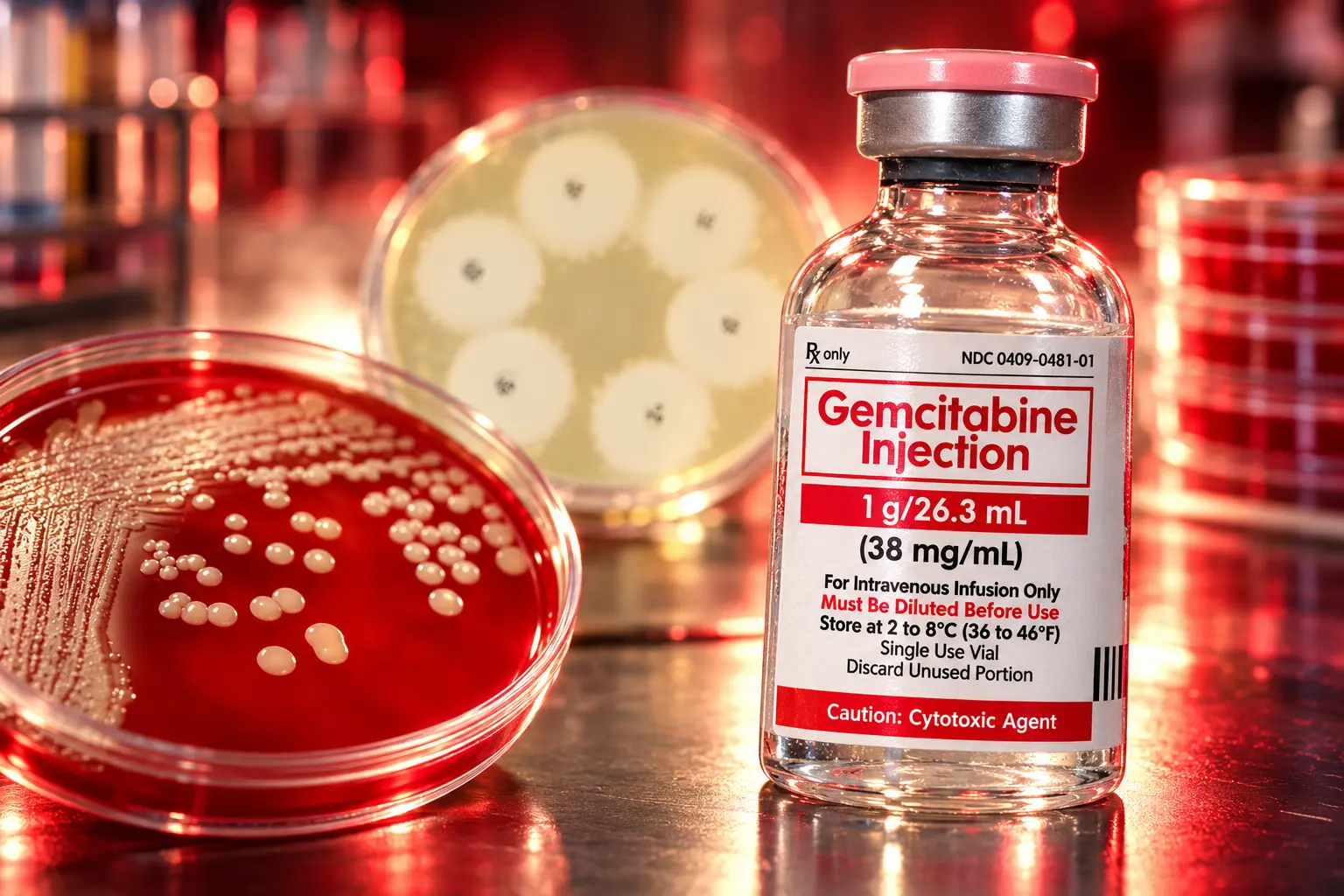
| Gemcitabine | Pyrimidine analog | 0.5 | Synergy |
| Mitomycin C | DNA-crosslinking agent | 0.25 | Synergy |
| 6-thioguanine (6-TG) | Purine analog | 128-256 | Antagonism |
MIC is the lowest dose that stopped visible growth. Gemcitabine stopped JE2 at 0.5 µg/mL, while 6-thioguanine needed 128 to 256 µg/mL, a gap of more than two hundredfold on the same strain. MW2, BH1CC, and COL followed the same pattern, with mitomycin C MICs as low as 0.008 to 0.015 µg/mL on COL.
Penicillin Worked Again in the Dish
MRSA carries PBP2a, a cell-wall enzyme that keeps building peptidoglycan when older penicillins try to shut that job down. Hospitals then reach for vancomycin, daptomycin, or linezolid. The Galway group asked whether starving the wall’s building blocks could bring oxacillin and cloxacillin back.
Checkerboard assays showed that four pyrimidine drugs synergized with oxacillin and with cloxacillin. 5-FU, 5-fluorouridine, gemcitabine, and mitomycin C each pulled growth down together with those penicillin-class drugs. 6-thioguanine pushed the other way and reduced the antibiotics’ effect. The same four also paired with fosfomycin, which blocks an earlier wall step at MurA.
Fluorescence microscopy matched the growth curves. Pyrimidine drugs plus oxacillin cut incorporation of a fluorescently labelled amino acid into the wall and scrambled how daughter cells split. 6-thioguanine did not. Glutathione, which mops up reactive oxygen, blunted killing by cloxacillin combinations, a sign that DNA stress and oxidative damage sit in the same killing path.
We discovered several anti-cancer drugs that helped antibiotics to kill MRSA. But we also identified one anti-cancer drug that interfered with antibiotic effectiveness highlighting the importance of carefully prescribing the most appropriate antibiotic in patients undergoing chemotherapy.
Aaron Nolan, postdoctoral researcher and lecturer in microbiology, University of Galway
Zeden said certain cancer drugs may be reusable beside antibiotics to re-sensitise bacteria that have already beaten older treatments. O’Gara framed the work as a faster route because the medicines already exist. The dish data support the first claim more cleanly than the second, because host toxicity is why these molecules were never infection drugs.
Why 6-Thioguanine Made Antibiotics Worse
RNA sequencing after a one-hour pulse at half the MIC showed opposite gene programs. 5-FU, 5-fluorouridine, and gemcitabine produced similar cell-wall profiles. Mitomycin C was close but not identical. 6-thioguanine ran the tape in reverse. Differentially expressed genes numbered 294 for 5-FU, 142 for 5-fluorouridine, 388 for 6-thioguanine, 133 for gemcitabine, and 293 for mitomycin C.
The pyrimidine set turned down lysine, glutamate, and arginine biosynthesis, the amino acids that feed the staphylococcal wall peptide. They also suppressed GlmS, the enzyme that starts UDP-GlcNAc production for peptidoglycan. 6-thioguanine induced those same pathways. Cells pretreated with the pyrimidine drugs became easier for lysostaphin to lyse. 6-thioguanine made them harder to lyse and strongly repressed autolysis.
That opposition fits the lab’s earlier nucleoside work. In 2023 the same group showed that guanosine and xanthosine restored penicillin-type activity, while adenosine raised oxacillin resistance. 6-thioguanine, a purine analog, now sits on the adenosine side of that ledger. Hitting “DNA building blocks” is too coarse a lever. The branch that is hit decides whether the wall thins or thickens.
The Oncology Ward Is the First Test
Cancer patients are already immunocompromised and pick up MRSA in hospitals at high rates. The new map is therefore a prescribing chart before it is a drug-development plan. Nolan said as much in the university release on Tuesday, 8 September 2026. The four helpers and the one blocker are already on chemo orders.
WHO MEETS THIS FINDING FIRST
- 5-FU or gemcitabine patients: A new MRSA infection during those regimens now has lab evidence that oxacillin-class drugs may gain, not lose, activity if the bug sees the analog.
- 6-thioguanine patients: The same penicillin-class choice may lose ground, so the default MRSA drugs stay the safer bet until someone tests the interaction in people.
- Device and wound cases: Biofilms, which blunt most antibiotics, were thinned by the pyrimidine set alone and further by pairings with daptomycin or rifampicin in the dish.
Reuse as a planned MRSA booster still collides with the reason these molecules were boxed as chemo. Gemcitabine’s antibacterial MIC in JE2 is 0.5 µg/mL, and the paper’s cited human peak blood level is 40 µg/mL, eighty times higher. That looks like a wide window until the same dose is scored against marrow, lung, and gut. 5-FU’s JE2 MIC is 16 to 32 µg/mL against a cited peak of 68 µg/mL, only about two to four times the lab stop-growth dose. 6-thioguanine’s cited peak of 78 µg/mL sits below its 128 to 256 µg/mL MIC, so the antagonism seen in broth may not even require a full antibacterial dose in a patient.
130,000 MRSA Deaths and a Slow Hospital Decline
The Global Burden of Disease collaborators estimated 130,000 deaths attributable to MRSA in 2021, up from 57,200 in 1990, more than a doubling. Deaths associated with MRSA rose from 261,000 to 550,000 over the same years. Across all bacteria they counted 1.14 million deaths attributable to resistance and 4.71 million associated with it in 2021. MRSA was the pathogen-drug pair that increased the most.
The US picture is smaller and slowly improving in hospitals, which is a different tally, not a rival one. CDC estimates more than 70,000 severe infections a year and 9,000 deaths. Hospital-onset MRSA bacteremia fell 16% in 2022 and another 7% in acute-care hospitals from 2023 to 2024. WHO GLASS still found methicillin resistance in 27.1% of S. aureus bloodstream isolates worldwide, using 2023 data, highest in the Eastern Mediterranean.
MRSA IN THREE COUNTS
- Global deaths, 2021: 130,000 attributable and 550,000 associated, per the GBD 2021 AMR analysis.
- US burden, CDC: More than 70,000 severe infections and 9,000 deaths a year, with hospital-onset bacteremia still falling.
- Carriage: About one in three people carry S. aureus in the nose, and about two in every 100 people carry MRSA.
A lab trick that returns oxacillin to that list would matter because beta-lactams remain cheaper and better tolerated than the drugs MRSA forced onto the ward. It would matter more if the trick did not require a chemo dose.
Biofilm Work at Doses People Already Receive
Biofilms are a second reason MRSA treatments fail, even when the MIC looks acceptable. The pyrimidine drugs cut biofilm on their own. Pairing them with daptomycin or rifampicin deepened that effect. The team set those biofilm doses at or below published human peak concentrations, including 68 µg/mL for 5-FU, 40 µg/mL for gemcitabine, 5 µg/mL for mitomycin C, 100 µg/mL for daptomycin, and 10 µg/mL for rifampicin.
Resistance still arrived in the flask. After 12 to 20 hours at half-MIC, JE2 threw up mutants. Two 6-thioguanine-resistant isolates carried changes in hpt, a purine salvage gene. Gemcitabine resistance mapped to pyrimidine genes including cmk, nupC, and dck. Mitomycin C resistance touched rpoC and several envelope and regulatory genes. A 5-FU isolate changed a predicted sodium-dependent transporter. The paper records those escapes as a limit, not a footnote.
THE GALWAY NUCLEOTIDE SERIES
- 17 January 2023: The group reports that purine nucleosides interfere with c-di-AMP and re-sensitise MRSA to beta-lactams in mBio.
- 26 May 2026: Zeden posts the preprint of the cancer-drug screen, the study now in mBio.
- 10 June 2026: An Antimicrobial Agents and Chemotherapy paper shows guanosine depletes thymidine and boosts 5-FU, 5-fluorouridine, and trimethoprim-sulfamethoxazole, including in biofilms.
- 8 September 2026: mBio publishes the five-drug split, with 6-thioguanine as the antagonist.
Zeden flagged the preprint on 26 May, months before the journal version.
New @biorxiv_micrbio pre-print from the lab: "Purine and pyrimidine analogues differentially regulate cell wall precursor biosynthesis to control β-lactam susceptibility in S. aureus" https://t.co/aEfPwqAvdm@biorxivpreprint @uniofgalway @Researchirel @hrbireland @JPIAMR
— Merve Suzan Zeden (Zeden Lab Galway) (@msz11x) May 26, 2026
Nothing in that sequence is a clinical trial. No infected mouse, no patient cohort, no dosing schedule for an MRSA indication. What the sequence does give hospitals is a signed warning: pyrimidine analogs and 6-thioguanine do not pull MRSA in the same direction, and the people already receiving them are the first natural experiment.
Frequently Asked Questions
Which MRSA strains did the Galway cancer-drug tests use?
The panel was JE2, MW2, BH1CC, and COL. All four were stopped by the five cancer drugs at strain-specific MICs, and all four ignored acyclovir, azidothymidine, and 5-fluorocytosine at greater than 1,024 µg/mL, so the nonstarter result was not an artefact of one lab isolate.
Did any wall-targeting drug besides oxacillin gain from the cancer drugs?
Fosfomycin, which blocks MurA, was synergistic with 5-FU (FIC 0.375), 5-fluorouridine (FIC 0.375), and mitomycin C (FIC 0.365). 6-thioguanine was antagonistic with fosfomycin at an FIC of 2. The authors treated FIC values at or below 0.5 as synergy and values above 2 as antagonism.
How close were the biofilm doses to peak levels already seen in people?
Biofilm assays used concentrations at or below published human peaks: 68 µg/mL 5-FU, 200 µg/mL 5-fluorouridine, 40 µg/mL gemcitabine, 5 µg/mL mitomycin C, 78 µg/mL 6-thioguanine, 89 µg/mL cloxacillin, 100 µg/mL daptomycin, and 10 µg/mL rifampicin. That is a pharmacokinetic match in broth, not proof the same pairing is safe in a patient.
Can MRSA evolve around these cancer drugs in a day?
Yes in the flask. After 12 to 20 hours at half-MIC, independent JE2 mutants appeared. 6-thioguanine resistance hit hpt twice. Gemcitabine resistance hit cmk, nupC, dck, and a site upstream of nrdI. 5-fluorouridine resistance included a 16-gene deletion matching SaPI5 excision. Any adjuvant plan would inherit that escape rate.
Why did the antifungal and antiviral nucleotide drugs fail here?
5-fluorocytosine, acyclovir, and azidothymidine produced MICs greater than 1,024 µg/mL on every strain and barely dented JE2 growth at that ceiling. Sharing a nucleotide-like shape was not enough. The anti-MRSA effect tracked the pyrimidine-set gene program, not the broad label of antimetabolite.
Disclaimer: This article is news reporting on a laboratory study and is for information only. It is not medical advice, a treatment plan, or a recommendation to combine chemotherapy with antibiotics for an infection. Anyone on cancer treatment or being treated for MRSA should consult a licensed physician or an infectious-disease specialist before any change in drugs or doses. Names, concentrations, and public-health figures come from the published paper and the agencies cited and may change as new data appear.

Liberty Parks MotoGP on Formula 1’s Austin Stage

The Salary Cap Fight That Can Freeze Baseball’s TV Payday

The 2027 Mercedes GLE and GLS Keep Alabama Busy

Margaret Hamilton Dies at 90 With a Harder Fight Unfinished

Unity Parks Its Engine Inside Google’s Prompt Games

Microsoft 365 Auth Fault Took Down Exchange and Teams

Diesel Breaks Its Record as the White House Claims Credit

Xbox Caps Game Pass Cloud Gaming at 15 Hours

Squishy Dumpling Toys Recalled After Hiding Illegal Water Beads

IFA 2026’s Weird Gadgets Are Building a Sensor Home
-
 NEWS2 months ago
Microsoft 365 Auth Fault Took Down Exchange and Teams
-
 GAMING2 months ago
Xbox Caps Game Pass Cloud Gaming at 15 Hours
-
 BUSINESS2 months ago
Diesel Breaks Its Record as the White House Claims Credit
-

 AUTO2 months ago
Tesla Puts Its Wheel-Free Cybercab on Austin Streets
-

 NEWS2 months ago
OpenClaw 2.0 Ships a Team Workplace With Host-Trust Defaults
-

 NEWS2 months ago
Sony and Warner Sue Anthropic Over Torrented Song Lyrics
-
 LIFESTYLE2 months ago
Squishy Dumpling Toys Recalled After Hiding Illegal Water Beads
-
 NEWS2 months ago
IFA 2026’s Weird Gadgets Are Building a Sensor Home