
NEWS
The Universe’s 33.3-Billion-Year Crunch Is One Model’s Bet
A Cornell axion model times a Big Crunch at 33.3 billion years, but the fit is degenerate, later DESI maps drifted, and the Sun dies first.

A Cornell-led model gives the universe a total life of 33.3 billion years, with a Big Crunch about 20 billion years from now. That figure is a best-fit in one axion theory, not a measured expiry date, and it lands long after the Sun is gone.
Hoang Nhan Luu, Yu-Cheng Qiu, and S.-H. Henry Tye published the calculation in the Journal of Cosmology and Astroparticle Physics on September 18, 2025. Later maps from the Dark Energy Spectroscopic Instrument have already shifted part of the same evidence back toward a constant dark energy and an expansion that never turns around.
The 33.3-Billion-Year Lifespan Is a Benchmark Fit
Tye, the Horace White Professor of Physics Emeritus at Cornell University, is the corresponding author. Luu is based at the Donostia International Physics Center in Spain, and Qiu at the Tsung-Dao Lee Institute of Shanghai Jiao Tong University. Both are former doctoral students of Tye’s at the Hong Kong University of Science and Technology.
Their paper, “The Lifespan of our Universe,” does not time a collapse from a tape measure on the sky. It takes recent Dark Energy Survey and DESI results, fits an axion-dark-energy model, and then runs that fit forward until the scale factor crashes toward zero.
THE BENCHMARK RUN
- Total life: Numerical evolution of the best-fit parameters gives a lifespan of 33.3 billion years.
- Time left: With the universe 13.8 billion years old, the authors say it “will end in about 20 billion years.”
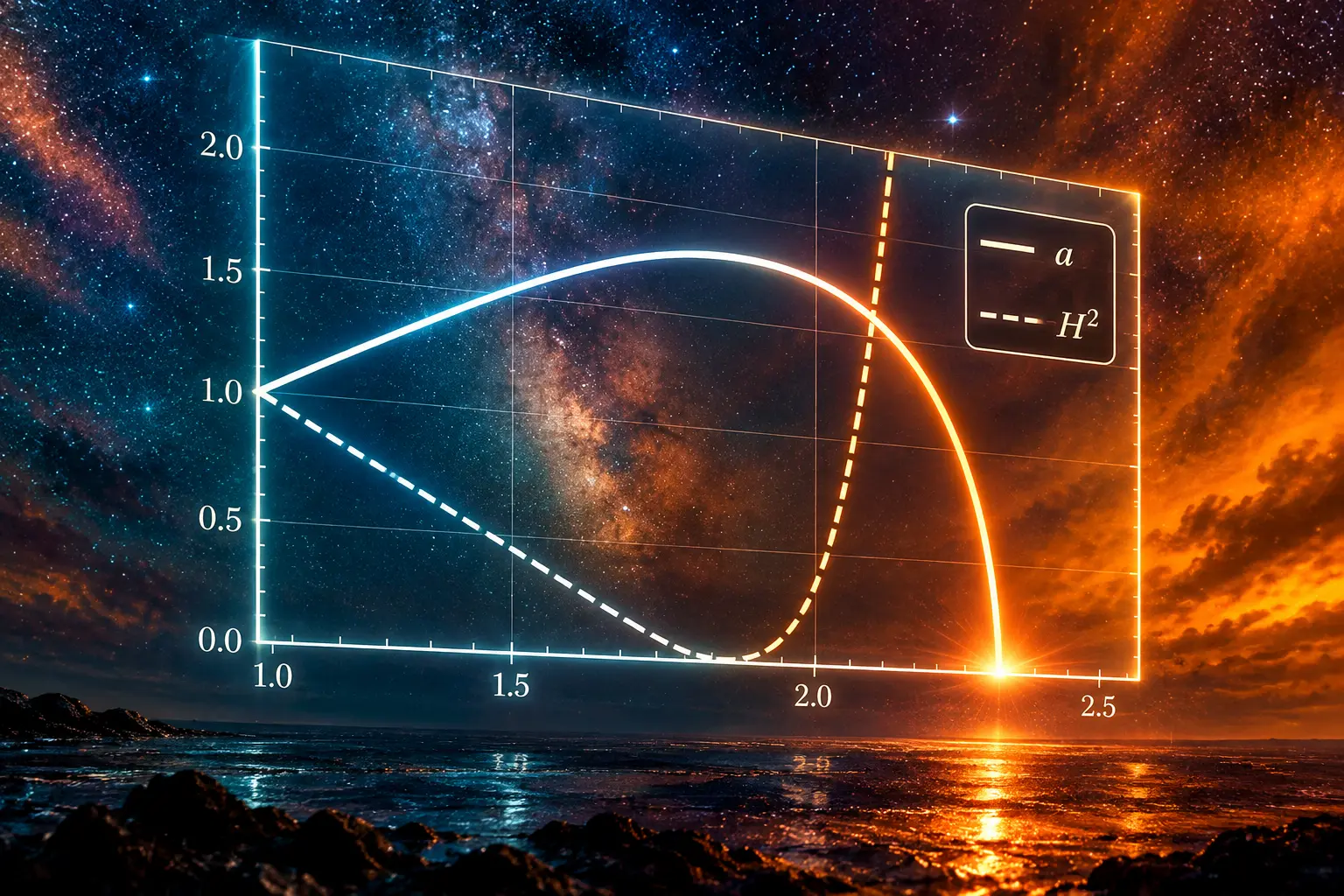
- Turnaround: The scale factor peaks at about 1.69 times today’s size, 11 billion years from now, when the Hubble rate hits zero.
- Crunch share: The collapsing phase takes only about 25 percent of the whole life in this run.
The same paper warns that the parameter space is “rather large” in its degeneracy. The best-fit cosmological-constant density is -1.61, well outside the 1-sigma band of the mean, which sits at -0.69. Using those mean values stretches the life to 40.3 billion years. Setting the constant to zero, a pure-axion case, is still consistent with the DESI data they used. The 33.3 billion year number is one star on their plot, not the whole plot.
An Ultralight Axion Plus a Negative Lambda
Standard cosmology treats dark energy as Einstein’s cosmological constant, a fixed energy in empty space with equation of state w = -1. In that picture the constant is positive, expansion accelerates forever, and distant galaxies eventually slip beyond any future observer’s reach.
Luu, Qiu, and Tye split today’s dark energy into two pieces. An ultralight axion-like field, with a mass of 2.93 × 10^-33 electronvolts, behaves like a cosmological constant while it is frozen, then starts to roll and dump energy. Underneath it they place a true cosmological constant that comes out negative. In the best-fit, the axion term is +2.33 in density units and the constant is -1.61, so they sum to 0.72, the model’s present dark-energy share, with matter at 0.28.
While the axion still dominates, expansion can keep accelerating, which is why the sky has not started shrinking. Once the field has rolled far enough, the negative constant takes over, the Hubble parameter crosses through zero, and the scale factor falls. Today’s dark-energy equation of state in the fit is about -0.738, not -1. The authors read DES and DESI as claiming dynamical dark energy at 4.2 sigma, and they treat that claim as the reason to keep the negative-constant branch.
WHAT THE MODEL NEEDS
- The particle: An ultralight axion whose vacuum energy first mimics a constant and later dilutes.
- The trap: A negative cosmological constant that only wins after the axion has rolled.
- The data bet: DES and DESI really have measured w different from -1, not a systematic in the combined fit.
If that bet fails, the crunch date fails with it. The authors say so: the DES and DESI observation “remains to be checked,” and more data will test the model.
DESI’s July Map Shifted Back Toward Lambda CDM
DESI, a spectrograph on the Mayall Telescope at Kitt Peak in Arizona, maps millions of galaxies and the hydrogen between them to reconstruct expansion history. In March 2025 it released baryon-acoustic-oscillation measurements from its first three years and reported that a time-evolving dark-energy equation of state fit better than a pure constant when those distances were combined with the cosmic microwave background and supernovae. That combined hint is what Tye’s group fed into the axion model.
On July 30, 2026, DESI published a fuller reading of the same Data Release 2 Lyman-alpha forest, using the entire correlation pattern rather than the acoustic peak alone. The new central value moved toward the Planck Lambda CDM prediction. The collaboration wrote that the result agrees with the standard model, which could mean the hints of evolving dark energy may fade, or that a more complicated model is needed to hold every probe at once.
THE DARK-ENERGY CALENDAR
- March 19, 2025: DESI releases three-year BAO results and says the case for a changing dark-energy equation of state has grown since Year 1, still short of a 5-sigma discovery.
- June 30, 2025: Luu, Qiu, and Tye post the axion-plus-negative-lambda calculation, timing a crunch from that combined hint.
- September 18, 2025: The Journal of Cosmology and Astroparticle Physics publishes the paper.
- April 15, 2026: DESI says it has mapped more than 47 million galaxies and quasars plus 20 million Milky Way stars, with full five-year dark-energy results expected in 2027.
- July 30, 2026: The DR2 Lyman-alpha full-shape measurement tightens and slides toward Lambda CDM.
A single crunch date cannot outrun that sequence. The 33.3 billion year run assumes the spring 2025 combined preference holds. One of DESI’s own later probes has already leaned the other way.
WHERE EXPERTS DISAGREE
- Tye’s group: Combined DES and DESI data make a negative cosmological constant likely in their axion model, so the universe has a finite life that can be timed.
- DESI’s July analysis: The new Lyman-alpha full-shape point is compatible with a never-changing constant, and the evolving-dark-energy story may not survive the full survey.
- Skeptical cosmologists: Preference for changing dark energy still depends on which supernova set and which parametrization are stacked with the galaxy map, and it has not crossed the field’s usual discovery line.
End-of-universe dates have a habit of traveling farther than the error bars behind them. This one is already being passed around as a countdown, stripped of the mean-versus-best-fit split and of the July 2026 shift.
Every Clock That Matters for Earth Runs Out First
Even if the benchmark crunch were right, it would not be a date on which “the world” is destroyed. In the model, expansion is still speeding up. Contraction does not start for 11 billion years. Several endings that actually involve Earth, the Sun, and the Milky Way fall earlier on every standard timeline, including the one the paper itself cites.
CLOCKS THAT EXPIRE FIRST
| Event | Timescale from now | What the source says |
|---|---|---|
| Sun leaves the main sequence | About 5 billion years | NASA: the Sun lasts another 5 billion years or so before it becomes a white dwarf, swelling into a red giant that swallows Mercury and Venus and possibly Earth |
| Milky Way-Andromeda encounter | 4 to 10 billion years | Luu, Qiu, and Tye cite this range and note it should be recomputed before any crunch |
| Expansion peaks in the aDE run | 11 billion years | Scale factor 1.69; Hubble rate crosses zero |
| Big Crunch in the same run | About 20 billion years | Best-fit numerical life of 33.3 billion years minus the present age of 13.8 billion years |
NASA’s Sun facts page says the star is 4.5 billion years old and a little less than halfway through its life, with another 5 billion years or so before the white-dwarf stage. A crunch 20 billion years out is an event in a future solar system that no longer has a living Sun, and likely no Earth as we know it. Selling that number as the day the world ends skips the clocks that actually close the biosphere.
How Cosmology Dropped the Crunch After 1998
A recollapsing universe was not an exotic idea. Before the late 1990s, a closed cosmos that expanded, stalled, and fell back was one of the two textbook endings, the other being a coast toward a thin, cold heat death. The switch came when two supernova teams showed that expansion was speeding up, work that later drew the 2011 Nobel Prize in Physics.
That acceleration is the observational fact. The name for whatever causes it is dark energy. NASA’s explainer still puts the share at approximately 68.3 to 70 percent of the universe, with dark matter around 27 percent and ordinary matter under 5 percent. For two decades the simplest match has been a positive cosmological constant: energy in empty space that never thins as the universe grows.
Tye’s group is trying to reopen the older ending without throwing out the acceleration we already measure. The axion supplies the push we see now. The negative constant supplies a later pull. In that sense the crunch is a revival, timed only because new galaxy maps opened a crack in w = -1. If that crack closes, cosmology’s default ending is again a universe that expands until star formation dies and black holes evaporate, on timescales that dwarf 33.3 billion years.
Tye Says the Model Finally Gives an End Date
Cornell posted the claim on October 1, 2025, with Tye arguing that a signed cosmological constant decides the fate, and that the new surveys finally pick a sign.
The universe is approaching the midpoint of its 33-billion-year lifespan, a Cornell physicist calculates with new data from dark-energy observatories. After expanding to its peak size about 11 billion years from now, it will begin to contract – snapping back like a rubber band to… pic.twitter.com/Qsb8nwhHCL
— Cornell University (@Cornell) October 1, 2025
For the last 20 years, people believed that the cosmological constant is positive, and the universe will expand forever. The new data seem to indicate that the cosmological constant is negative, and that the universe will end in a big crunch.
S.-H. Henry Tye, Horace White Professor of Physics Emeritus, Cornell University
He was careful to separate the qualitative point from the timing. People have long said a negative constant means collapse, he noted; what the model adds is a when and a how. On the Cornell page he puts it plainly: the cosmological constant is negative in this reading of the data, and that is what ends the universe in a crunch.
He also tied the exercise to cosmology’s oldest pair of questions. In the 1960s the field learned the universe had a beginning. For years after the supernova result, many researchers treated the future as endless. “It’s good to know that, if the data holds up, the universe will have an end,” Tye said. The clause that matters is the one he put in the middle: if the data holds up.
Euclid, SPHEREx and Rubin Still Have to Confirm It
The paper’s own next sentence is that more and better data are coming. DESI will keep observing. Cornell’s write-up lists other programs already on sky or newly there: the Zwicky Transient Facility, Europe’s Euclid space telescope, NASA’s SPHEREx mission, and the Vera C. Rubin Observatory. DESI has said its full five-year dark-energy results are expected in 2027, after a survey that already beat its original galaxy target.
WHAT STILL HAS TO HAPPEN
- DESI’s complete map: The collaboration finished its planned footprint ahead of schedule and is extending coverage; the 2027 analysis is the first that can be called the full survey.
- Independent distances: Euclid’s three-dimensional galaxy map and Rubin’s supernova and weak-lensing samples can confirm or kill the combined preference that the axion model used.
- The sign of lambda: Tye’s crunch exists only on the negative-constant branch. If future fits push that term back through zero, the life of the universe goes back to infinity inside this setup.
A 33.3 billion year crunch is a number a model can print when you pin it to one best-fit point. The mean of the same model is already 40.3 billion years, a zero constant is still allowed, and a DESI probe reported in July 2026 moved toward the standard, unchanging dark energy that never lets expansion reverse. The Sun, on NASA’s clock, does not wait for any of those fits to settle.

Liberty Parks MotoGP on Formula 1’s Austin Stage

The Salary Cap Fight That Can Freeze Baseball’s TV Payday

The 2027 Mercedes GLE and GLS Keep Alabama Busy

Margaret Hamilton Dies at 90 With a Harder Fight Unfinished

Unity Parks Its Engine Inside Google’s Prompt Games

Microsoft 365 Auth Fault Took Down Exchange and Teams

Xbox Caps Game Pass Cloud Gaming at 15 Hours

IFA 2026’s Weird Gadgets Are Building a Sensor Home

Tesla Puts Its Wheel-Free Cybercab on Austin Streets

Diesel Breaks Its Record as the White House Claims Credit
-
 NEWS2 months ago
Microsoft 365 Auth Fault Took Down Exchange and Teams
-
 GAMING2 months ago
Xbox Caps Game Pass Cloud Gaming at 15 Hours
-
 AUTO2 months ago
Tesla Puts Its Wheel-Free Cybercab on Austin Streets
-
 NEWS2 months ago
IFA 2026’s Weird Gadgets Are Building a Sensor Home
-
 BUSINESS2 months ago
Diesel Breaks Its Record as the White House Claims Credit
-

 NEWS2 months ago
OpenAI Unveils GPT-6 Astra With a Critical Cyber Label
-

 NEWS2 months ago
OpenClaw 2.0 Ships a Team Workplace With Host-Trust Defaults
-

 LIFESTYLE2 months ago
Squishy Dumpling Toys Recalled After Hiding Illegal Water Beads