
NEWS
Tanzania’s New Tusked Species Pulls the Oldest Dinosaurs Younger
Dinodontosaurus isiyavamanda, a 240-million-year-old Tanzanian dicynodont, links the Manda Beds to South America and pulls alleged oldest dinosaurs younger.

A University of Bristol team has named Dinodontosaurus isiyavamanda, a 240-million-year-old tusked plant-eater from Tanzania whose presence pulls the Manda Beds younger. The paper went online on 15 September 2026 in the Journal of Vertebrate Paleontology.
The animal is not a dinosaur. It is a dicynodont, a beaked synapsid on the mammal line, and the first confirmed Dinodontosaurus found outside South America. That geographic jump is what moves the clock on rocks long sold as home to the oldest possible dinosaurs.
A Tusked Plant-Eater From Tanzania Gets Its Name
Lead author Hady George, the Bristol doctoral researcher who led the anatomy work, worked with Juan A. Escobar of CONICET and the Museo Argentino de Ciencias Naturales in Buenos Aires, Edmund R. R. Moody at the University of Barcelona, Charles B. Saanane at the University of Dar es Salaam, Michael O. Day at the Natural History Museum in London, and Nigel R. Larkin at the University of Reading.
The holotype is NHMUK PV R 12710(1)a, a skull and partial skeleton collected in 1963 from the mid-to-upper Lifua Member of the Manda Beds in Tanzania’s Ruhuhu Basin. A second skull, NMT RB462, came later from locality Z143 and now sits in Tanzanian collections. The team used CT scans and 3D surface imaging, then ran Bayesian and parsimony trees that placed the Tanzanian animal inside Dinodontosaurus.
Our discovery marks the first confirmed record of the genus Dinodontosaurus outside South America. The finding links the Tanzanian and South American fossil-bearing rocks, showing they are of equivalent age.
Hady George, PhD student, University of Bristol
The species name refers to the land of the Wamanda people, who live in the region where the bones were found. Diagnostic traits separate it from South American Dinodontosaurus tener and D. brevirostris and from other Manda dicynodonts such as Tetragonias, Sangusaurus and Angonisaurus.
TRAITS THAT TIED THE SKULL TO DINODONTOSAURUS
- Frontal tabs: The frontals carry tab-like anterior processes that the paper treats as diagnostic of the genus.
- Bulbous palate: A swollen posterior, or median, palatal ridge on the premaxilla is absent in the South American material.
- Temporal groove: A midline groove runs along the temporal bar, another trait not seen in the Brazilian and Argentine skulls.
- Heavy tusks: Large upper tusks point anteroventrally and show wear facets, with deep pulp cavities still visible in the holotype.
George’s group published the full cranial description of the Tanzanian skulls after the journal received the manuscript on 5 December 2024 and accepted it on 14 May 2026. The postcranial skeleton is still largely undescribed.
The Skeleton Sat in London While Techniques Caught Up
More than 60 years ago a British field party bagged a large haul of synapsid bones in what was then Tanganyika and sent them to London. The Natural History Museum held the associated skeleton, but only parts of that collection were ever written up, and the identity of this animal stayed open.
Larkin, now a visiting research fellow at Reading, took the skeleton as an MSc project at University College London in 1994. He judged it new and used the unpublished name Ruhuhuungualasaurus croucheri, a nomen nudum that never entered a journal. Other workers later parked bits of the same catalogue number with Shansiodon, a placement the new paper rejects.
I studied this dicynodont skeleton for my MSc thesis at University College London back in 1994 and judged it to be a species new to science, but it took me nearly 30 years to start the process of writing it up for publication. I’m glad I waited, as the international team we put together, headed by Hady George, has done an amazing job of fleshing-out this story in much more detail and depth than I could have achieved on my own. And what’s 30 years? It’s the blink of an eye compared to the age of this prehistoric specimen.
Nigel Larkin, Visiting Research Fellow, University of Reading
Mike Day, curator of non-mammalian tetrapods at the museum, said the Tanzanian fossil had been in the museum’s care for more than 60 years and that putting a name on it shows how old drawers can move the timeline as much as a new trench.
FROM THE 1963 TRENCH TO THE 2026 NAME
- 1963: Alan Charig and Barry Cox collect the holotype skeleton on the British Museum (Natural History) and University of London joint expedition to Northern Rhodesia and Tanganyika.
- 1964: The team publishes the 1963 joint palaeontological expedition’s first account in Nature.
- 1994: Larkin describes the skull and skeleton in an unpublished MSc thesis and flags it as new.
- 2013: Sterling Nesbitt and colleagues name Nyasasaurus parringtoni from the same Lifua Member and float it as the earliest dinosaur or its closest relative.
- 5 December 2024: The George team’s manuscript reaches the journal.
- 15 September 2026: Dinodontosaurus isiyavamanda is published online.
Micro-CT, the tool Larkin said he could not have imagined in the 1990s, is what let George’s group see the swollen palatal ridge inside a cracked, weathered snout. International authorship did the rest: Escobar brought the South American comparative sample, Saanane the Tanzanian institutional link, and Day the London specimen.
Why a South American Genus Moves Tanzania’s Clock
The mid-to-upper Lifua Member had been treated as Middle Triassic Anisian rock, about 247 to 242 million years old, because it seemed to share genera with South Africa’s Cynognathus Assemblage Zone. The paper says that correlation no longer holds once Dinodontosaurus is in Tanzania.
In Brazil the genus defines the Dinodontosaurus Assemblage Zone of the Santa Maria Supersequence. In Argentina it occurs in the Chañares Formation. New radiometric dates on those South American dinosaur-bearing sequences come out up to 10 million years younger than the South African units they were once matched against. Put the Tanzanian animal in that South American club, and the Lifua Member has to sit in the same window.
The paper’s wording is blunt on the replacement age. It says the mid-to-upper Lifua Member is likely late Ladinian (242 to 237 million years ago) to Carnian (237 to 227 million years ago), against the Anisian age it has historically been given.
HOW THE ROCK CLOCKS NOW LINE UP
| Rock unit | Old assignment | Age argued in the 2026 paper | Why it matters |
|---|---|---|---|
| Mid-to-upper Lifua Member, Manda Beds, Tanzania | Anisian, 247 to 242 million years ago | Late Ladinian to Carnian, 242 to 227 million years ago | Holds D. isiyavamanda and the alleged oldest dinosaurs |
| Cynognathus Assemblage Zone, South Africa | The old match for the Lifua Member | No longer treated as equivalent | Shared Cricodon and, until recently, Angonisaurus |
| Dinodontosaurus Assemblage Zone, Brazil | South American Middle to Late Triassic | Same window as the mid-to-upper Lifua Member | Home of D. tener |
| Chañares Formation, Argentina | Tied to dates up to 10 million years younger than South Africa | Same window as the mid-to-upper Lifua Member | Home of D. brevirostris |
George said that match “helps confirm that the oldest dinosaur candidates from Tanzania are probably no older than those from South America, refining the timeline of dinosaur origins.” The University of Bristol’s release went further, saying Tanzanian Triassic rocks can no longer be regarded as preserving the oldest potential dinosaur fossils.
Nyasasaurus Loses Its Claim on a 243-Million-Year Start
The fossil that made the Manda Beds famous outside specialist circles is not the new dicynodont. It is Nyasasaurus parringtoni, named from a humerus and vertebrae collected decades earlier in the Lifua Member.
The 2013 study that floated Nyasasaurus as the oldest dinosaur, led by Sterling Nesbitt, put the animal at about 243 million years and 10 to 15 million years older than the Carnian dinosaurs of Argentina and Brazil. The authors already hedged: either the earliest dinosaur or the sister taxon to Dinosauria. Asilisaurus kongwe, a silesaurid from the same member, sat in that same early window.
If the mid-to-upper Lifua Member is late Ladinian to Carnian, that 10-to-15-million-year head start collapses. Nyasasaurus would then be about the same age as the southern South American dinosaurs, not a Middle Triassic pioneer. The new paper’s own title calls them “the alleged oldest dinosaurs.”
WHERE EXPERTS DISAGREE
- The old Karoo match: Many charts still lined the mid-to-upper Lifua Member up with the Cricodon–Ufudocyclops Subzone of South Africa’s Cynognathus Assemblage Zone and treated both as Anisian.
- The 2026 paper: George, Escobar, Moody, Saanane, Day and Larkin say Dinodontosaurus ties those Tanzanian beds to Brazil and Argentina instead, at late Ladinian to Carnian age.
- Earlier dissent: The paper notes that Kammerer and colleagues in 2019, and Peecook and colleagues in 2017, had already argued against treating the Tanzanian and South African units as the same age.
None of this deletes Nyasasaurus from the early dinosaur story. It changes the question from “did dinosaurs start 10 to 15 million years earlier in Tanzania?” to “were Tanzania, Brazil and Argentina on the same clock?” The 2013 team’s morphological case for dinosaur-grade growth in that humerus still stands; the rock that holds it does not.
The Palate Looks Built for a Different Bite
Dicynodonts were the big plant-eaters of Triassic Gondwana, with a keratin beak, two upper tusks, and no cheek teeth. Several of them already share the mid-to-upper Lifua Member, so another large kannemeyeriiform needs an ecological excuse to exist beside them.
The paper’s answer sits in the mouth. The bulbous palatal ridge is read as a food-processing trick, a way of dividing plants with neighbours such as Tetragonias njalilus and Sangusaurus parringtonii rather than competing for the same bite. Wear on the tusks fits an animal that used those teeth, not just displayed them.
Snout width in the holotype falls closer to D. brevirostris than to the narrower-faced D. tener. The tusks themselves are hypertrophied, closer to other Dinodontosaurus and to Kannemeyeria than to the slender or vestigial tusks of some related forms. George said later work will look at how several large herbivores could live in the same place, using the leftover postcranial bones still in London.
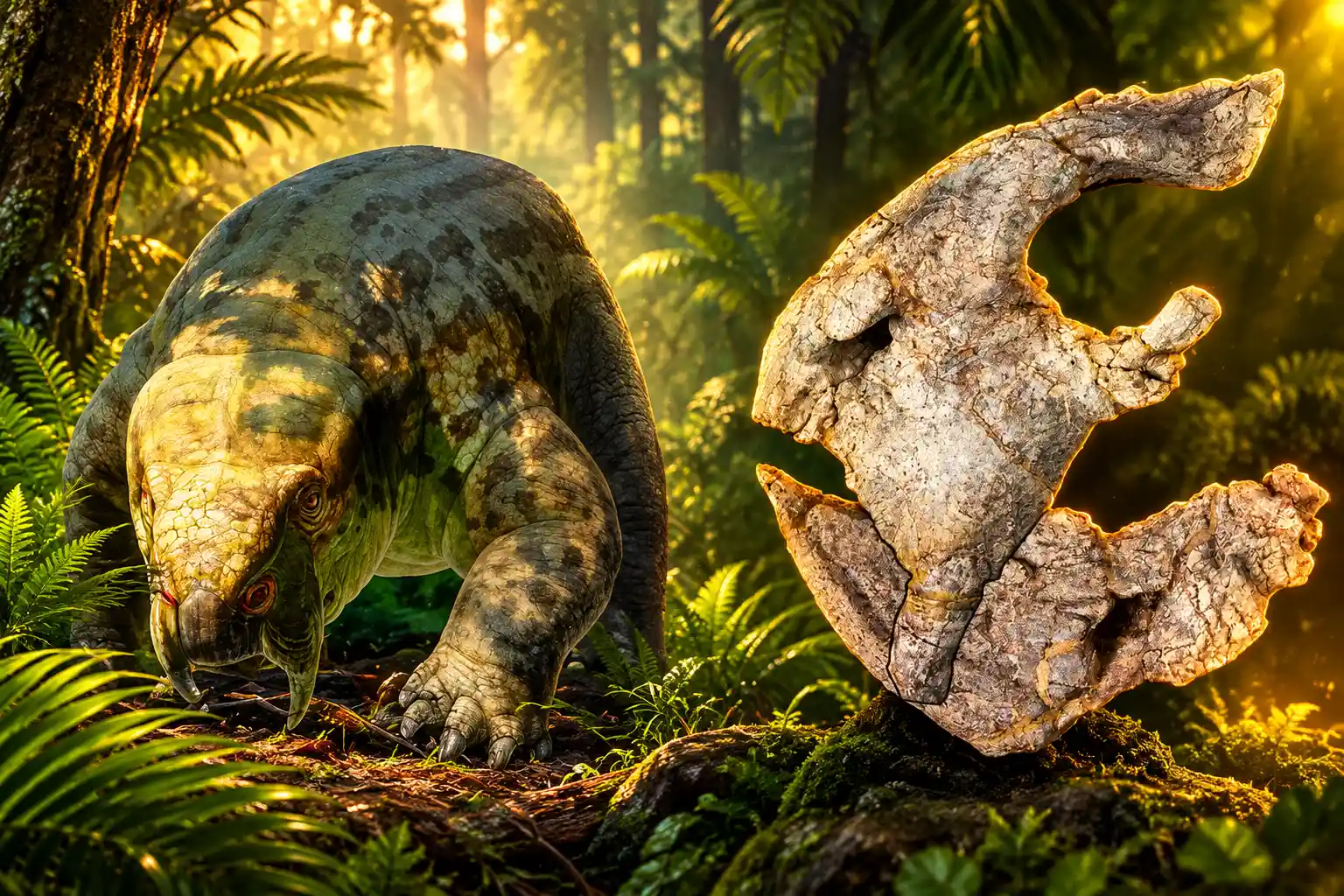
Gabriel Ugueto’s life reconstruction, released with the Bristol notice, shows a barrel-bodied animal with a short beak and two long curved tusks. That is the public face of a skull that, in the lab photos by Jonathan Jackson and George, is still a cracked snout, a lower jaw, and a pair of tusks on a bench.
A Second Skull Stayed in Dar es Salaam
Most of the story still runs through London, because that is where the 1963 jackets went. The referred skull did not. NMT RB462 preserves parts the holotype lacks, including a usable anterior pterygoid ramus that lets the team score tusk position against the orbit, and it remains in Tanzania with Saanane on the author list.
That split matters for a fauna whose type specimens have long lived in European cupboards. Day’s point about museum drawers is true for NHMUK PV R 12710. It is incomplete without the Tanzanian skull that confirmed the same species from a second locality.
WHAT THE TEAM SAYS STILL SITS IN THE DRAWERS
- Postcranial bones: A large share of the Tanzanian Dinodontosaurus skeleton has not been described, including femora that will be compared with NMT RB462.
- South American matches: Direct anatomical comparison with Brazilian and Argentine specimens is planned once those leftover bones are on the table.
- Bite mechanics: The group wants to test how several large dicynodonts partitioned plants in the same Lifua habitats.
The name is now fixed, the genus is no longer a South American endemic, and the mid-to-upper Lifua Member has a published late Ladinian to Carnian age argument attached to it. The dinosaur that made those beds famous will have to live with that younger clock, or wait for a radiometric date of its own.

Liberty Parks MotoGP on Formula 1’s Austin Stage

The Salary Cap Fight That Can Freeze Baseball’s TV Payday

The 2027 Mercedes GLE and GLS Keep Alabama Busy

Margaret Hamilton Dies at 90 With a Harder Fight Unfinished

Unity Parks Its Engine Inside Google’s Prompt Games

Microsoft 365 Auth Fault Took Down Exchange and Teams

Diesel Breaks Its Record as the White House Claims Credit

Xbox Caps Game Pass Cloud Gaming at 15 Hours

Squishy Dumpling Toys Recalled After Hiding Illegal Water Beads

IFA 2026’s Weird Gadgets Are Building a Sensor Home
-
 NEWS2 months ago
Microsoft 365 Auth Fault Took Down Exchange and Teams
-
 GAMING2 months ago
Xbox Caps Game Pass Cloud Gaming at 15 Hours
-
 BUSINESS2 months ago
Diesel Breaks Its Record as the White House Claims Credit
-

 NEWS2 months ago
OpenAI Unveils GPT-6 Astra With a Critical Cyber Label
-

 AUTO2 months ago
Tesla Puts Its Wheel-Free Cybercab on Austin Streets
-

 NEWS2 months ago
OpenClaw 2.0 Ships a Team Workplace With Host-Trust Defaults
-

 NEWS2 months ago
Sony and Warner Sue Anthropic Over Torrented Song Lyrics
-
 LIFESTYLE2 months ago
Squishy Dumpling Toys Recalled After Hiding Illegal Water Beads