
AUTO
Tesla Puts Steering Wheels Back on New York Cybercabs
New York Cybercabs have steering wheels and drivers because Tesla has not filed the state autonomous testing permit the wheel-free cabin would need.

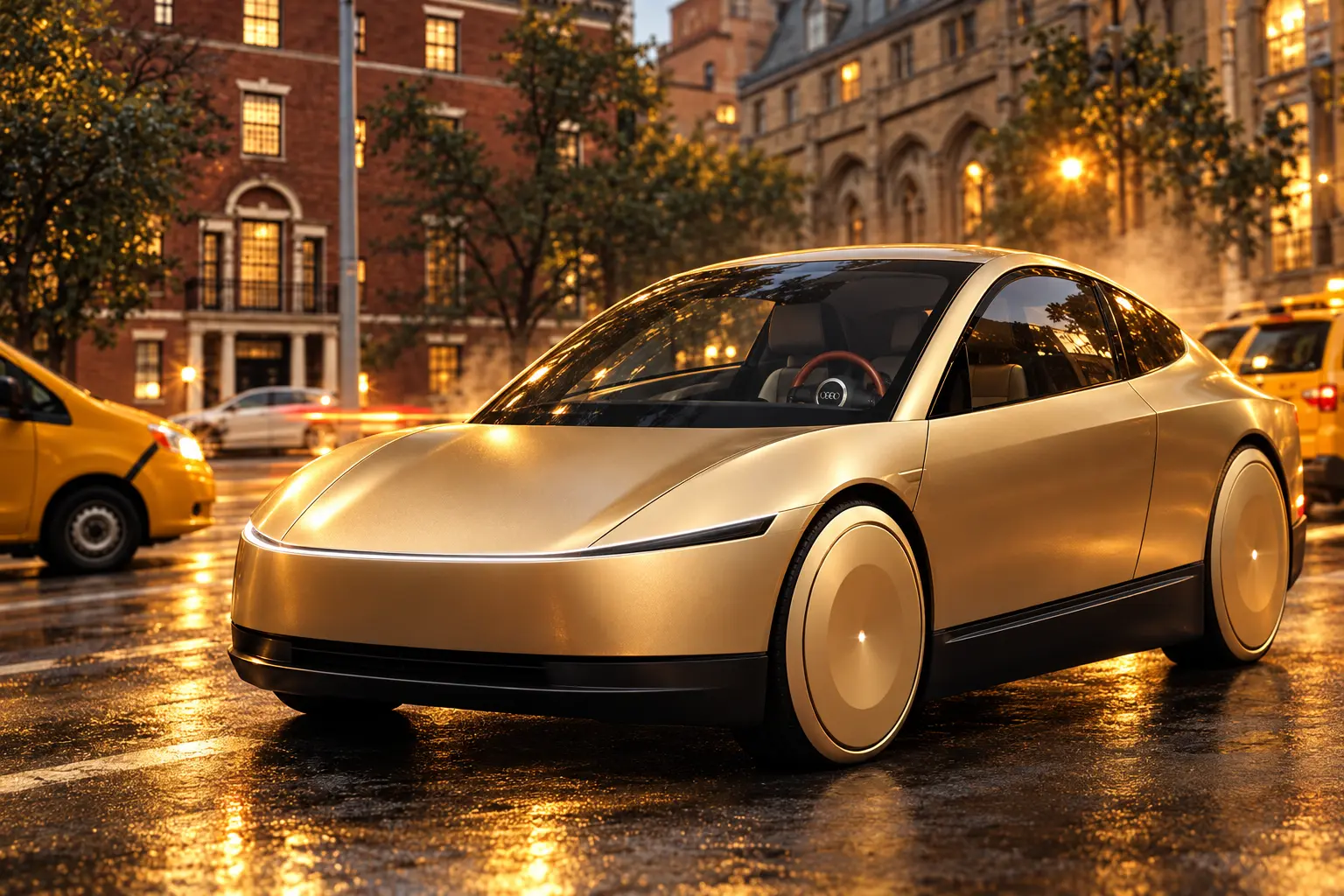
Tesla’s sand-colored Cybercabs in New York City have a steering wheel and a person in the driver’s seat, the hardware Elon Musk presented in 2024 as something this two-seater would not need. City officials said the cars are running a supervised self-driving system. The New York State Department of Motor Vehicles said Tesla has not applied for an autonomous vehicle testing permit.
That is the bind inside the product. The cabin Tesla built to prove the car does not need a human is the cabin New York will not let onto a public street.
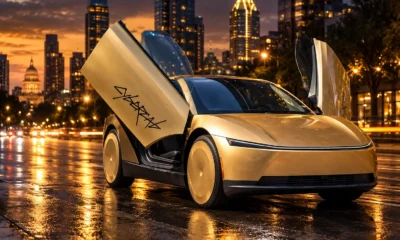
Gold Cybercabs in New York Still Have Drivers
A city transportation official confirmed the tests on September 10, 2026, after the two-seaters were seen around the boroughs. The cars lack side mirrors. They wear Texas plates and a Cybercab mark on the front. Unlike the units Tesla put into paid service in Texas and Florida, these had a person sitting behind a wheel.
One was flagged down on Fulton Street in Lower Manhattan. The driver did not answer questions. Another was seen late in August at the entrance of the Brooklyn-Battery Tunnel. Tesla has not said how many of the cars are in the city or how long they will stay, and it has not described the New York tests in public.
The company’s own Robotaxi site still sells a fully autonomous fleet Tesla is marketing, callable on an app, with no mention of New York. Empty-cabin clips from Austin keep circulating as if that is the car now on every street. In New York the same body shell is being used as a mapping mule with a human in the seat, which is a different machine wearing the same paint.
New York Law Still Requires Hands on the Wheel
State law still treats a self-driving test car as a car with a driver. A licensed person must sit in the driver’s seat on public roads and be ready to take control. The Taxi and Limousine Commission said its rules do not allow autonomous vehicles for for-hire trips, so even a permitted test cannot pick up a fare.
WHAT NEW YORK REQUIRES TO TEST
- A licensed driver: A person with a valid license must be in the driver’s seat and ready to operate the car safely and lawfully.
- Trained operators: Every test driver has to be trained on that specific vehicle, not just any passenger car.
- $5 million in cover: Each listed test car must carry at least $5 million in insurance, a bond, a deposit, or self-insurer status.
- Forms AV-1 and AV-2: The state will not accept a file without both forms, proof of insurance, and a law-enforcement interaction plan.
- A city fee on top: After the state permit, testers in the five boroughs still need the city permit that follows the state filing, at $5,000 a year, plus data reports to the city.
The state also wants a report on any permitted tests by March 1, 2027. The statute that allows the demonstrations expires on April 1, 2028. The application packet tells companies that tests run under the direct supervision of the New York State Police. That is not optional window dressing. It is why a wheel-free cabin cannot legally collect the street data Tesla wants in this market.
Austin Runs the Cabin Manhattan Cannot Have
Tesla began commercial Cybercab trips in Austin on September 3, 2026, then opened public hails the next day at 5 p.m. Central Time. Texas Department of Motor Vehicles records showed 45 Cybercabs on Tesla’s authorized roster ahead of that launch, inside a statewide Tesla robotaxi fleet of 420 vehicles, most of them Model Y cars. Those Austin Cybercabs are the version with no permanently attached wheel or pedals, the same wheel-free Cybercab rides in Austin the company used for the hometown rollout.
Waymo still runs the paid-ride business Tesla is trying to enter, at about 500,000 paid trips a week. Amazon’s Zoox already charges in Las Vegas in a purpose-built cabin that also has no wheel. New York is the market where Tesla is visible and legally stuck in 2018-style supervised testing.
CABIN CONTROLS AND PAID SERVICE
| Operator | Cabin controls | Paid rides now | New York status |
|---|---|---|---|
| Tesla Cybercab | No wheel in Austin; wheel and driver in NYC | Paid in Austin from a 45-car Texas roster | Supervised mapping; no state AV permit on file |
| Waymo | Steering wheel and pedals remain | About 500,000 paid rides a week | Safety-driver test permit for up to 8 cars expired in March 2026 |
| Zoox | No wheel, pedals, or driver’s seat | Paid in Las Vegas from August 2026 | Not operating a NYC service |
The table is the product split in one view. Tesla can sell the empty cabin where Texas law already allows it. In New York it can only run the body shell as a supervised car, which is the opposite of the 2024 pitch.
Why Tesla Has Not Applied for New York’s AV Permit
The state Department of Motor Vehicles said Tesla had not applied for any New York autonomous vehicle testing permit. That filing is the front door. Without it, Tesla is not in the AV testing program even if a human is holding the wheel. The city’s transportation department had already said in 2025, when Tesla was hiring vehicle operators in Queens for data collection, that the company had not sought city AV approvals either.
Waymo did walk that path. The city issued it a six-month permit to test up to eight vehicles in parts of Manhattan and Downtown Brooklyn with a trained specialist in the seat; that permit expired in March 2026. Waymo has kept collecting data in the city with the self-driving feature off. Gov. Kathy Hochul earlier this year also reversed a plan to let Waymo run a limited deployment outside New York City after labor groups pushed back.
WHAT WE KNOW
- NYC hardware: The Cybercabs seen in the boroughs have a steering wheel, a driver, no side mirrors, Texas plates, and a Cybercab mark on the front.
- Official label: The city calls the work a supervised self-driving test in which the driver can take over at any point.
- No Tesla AV file: The state DMV said Tesla has not applied for the testing permit that AV work on public highways requires.
WHAT IS UNCONFIRMED
- Fleet size: Tesla has not said how many Cybercabs are in New York.
- End date: There is no public timetable for how long the cars will stay.
- A future filing: Nothing in the state record shows Tesla has started the AV-1 and AV-2 process.
Hiring people in Queens to log camera and audio data, then sending gold two-seaters through Manhattan with Texas plates, is a mapping program. It is not the permit path Waymo already used, and it is not a taxi service the TLC will license.
Zoox Already Holds the Federal Waiver
The New York wheel is only half of the hardware problem. On September 3, 2026, the same day Tesla began commercial Cybercab trips in Austin, the National Highway Traffic Safety Administration opened a federal audit of Cybercab certification, tagged AQ26002. The resume covers an estimated 1,000 Cybercabs. It is an audit of paperwork, not a finding that the cars are defective.
Tesla told the agency it had certified those Cybercabs as meeting all applicable Federal Motor Vehicle Safety Standards and that it plans to add vehicles and cities. The cars, NHTSA wrote, “lack permanently attached, conventional manual controls, such as a brake pedal, gas pedal, steering wheel, and mirrors.” The agency said it will look at how far that certification rested on a claim that some of those standards do not apply to this vehicle. Tesla’s own compliance paperwork has described some Cybercabs as able to run with brake pedals and manual operation, without mentioning a steering wheel.
Zoox already asked for the other door. On July 30, 2026, NHTSA granted a temporary exemption for 2,500 Zoox vehicles a year for two years, the first commercial deployment exemption of its kind for a purpose-built robotaxi with no manual controls. NHTSA Administrator Jonathan Morrison said the agency was granting it because Zoox showed an equivalent level of safety and would face extra oversight.
NHTSA fully supports the safe development and deployment of automated vehicles. But as the federal regulator, we need to ensure that all of our laws are followed.
Jonathan Morrison, Administrator, National Highway Traffic Safety Administration
Tesla has not received a comparable commercial exemption for the wheel-free Cybercab. It self-certified and started charging in Austin anyway. New York, which still writes its test rules around a person holding a wheel, is the place that makes that bet visible on the street.
A Cybertruck Wheel Bolted Into the Cabin
The New York cars are not a surprise if you follow the hardware. Tesla unveiled the Cybercab on October 10, 2024, at the We, Robot event on the Warner Bros. lot in Burbank, with 20 concept cars and no wheel and no pedals in the cabin. Musk’s line that night was the whole pitch.
There are no steering wheels or pedals in the car. So I hope this goes well; we’ll find out.
Elon Musk, We, Robot event, Burbank
He said the car would cost less than $30,000 and go into production before 2027. In October 2025, Tesla chair Robyn Denholm already left the door open, saying that if the company has to have a steering wheel, it can have a steering wheel and pedals. Photos from Berkeley, California, dated September 11, 2026, show how that looks in metal: a squared Cybertruck wheel on an exposed column bolted into a two-seat cabin that was never tooled for a driver, with a Texas manufacturer plate on the car.
HOW THE WHEEL LEFT AND CAME BACK
- October 10, 2024: Tesla unveils the Cybercab with no steering wheel and no pedals and says production starts before 2027 at under $30,000.
- October 2025: Chair Robyn Denholm says the car can take a wheel and pedals if regulators require them.
- July 30, 2026: NHTSA grants Zoox the first commercial exemption for a purpose-built, wheel-free robotaxi, up to 2,500 vehicles a year for two years.
- September 3, 2026: Tesla starts paid Cybercab trips in Austin and NHTSA opens audit AQ26002 on how Tesla certified a car with no permanently attached wheel, pedals, or mirrors.
- September 4, 2026: Public Cybercab hails open in Austin at 5 p.m. Central Time from a 45-car Texas roster.
- September 10, 2026: New York officials confirm supervised Cybercabs with steering wheels; the state DMV says Tesla has not applied for an AV testing permit.
The bolted column is the physical joke. Tesla designed a car whose defining absence is a wheel, then had to fabricate a mount so a person could drive it through cities that still require one.
Mapping Miles Are Not a Taxi Service
TLC Commissioner Midori Valdivia put the local stakes in labor terms, not cabin design. The commission is watching safety, congestion, emergency response, and driver pay, and it named the workforce the cars would meet if they ever took fares.
We take the arrival of autonomous vehicle technology very seriously, and we are closely monitoring AV developments in other cities, including the operational challenges and impacts on safety, congestion, emergency management, and driver pay. Not least among our concerns is the potential impact on the livelihoods of the 180,000 hardworking drivers who keep our city moving.
Midori Valdivia, Commissioner, New York City Taxi and Limousine Commission
Bhairavi Desai, executive director of the New York Taxi Workers Alliance, called the New York cars another tech firm trying to look inevitable by showing up in many cities at once, with safety questions still open. That read matches the hardware. Tesla is collecting New York miles in a Cybercab body because the unsupervised cabin cannot legally do that work here. Public posts have shown the same split in other places, including a Cybercab in North Hollywood on September 13 with a driver and a wheel, while Austin clips still show the empty cabin.
The New York DMV still has no Tesla autonomous testing permit on file.

Liberty Parks MotoGP on Formula 1’s Austin Stage

The Salary Cap Fight That Can Freeze Baseball’s TV Payday

The 2027 Mercedes GLE and GLS Keep Alabama Busy

Margaret Hamilton Dies at 90 With a Harder Fight Unfinished

Unity Parks Its Engine Inside Google’s Prompt Games

Diesel Breaks Its Record as the White House Claims Credit

Microsoft 365 Auth Fault Took Down Exchange and Teams

Xbox Caps Game Pass Cloud Gaming at 15 Hours

IFA 2026’s Weird Gadgets Are Building a Sensor Home

Tesla Puts Its Wheel-Free Cybercab on Austin Streets
-
 BUSINESS2 months ago
Diesel Breaks Its Record as the White House Claims Credit
-
 NEWS2 months ago
Microsoft 365 Auth Fault Took Down Exchange and Teams
-
 GAMING2 months ago
Xbox Caps Game Pass Cloud Gaming at 15 Hours
-
 NEWS2 months ago
IFA 2026’s Weird Gadgets Are Building a Sensor Home
-
 AUTO2 months ago
Tesla Puts Its Wheel-Free Cybercab on Austin Streets
-

 LIFESTYLE2 months ago
Squishy Dumpling Toys Recalled After Hiding Illegal Water Beads
-

 NEWS2 months ago
OpenClaw 2.0 Ships a Team Workplace With Host-Trust Defaults
-
 NEWS2 months ago
OpenAI Unveils GPT-6 Astra With a Critical Cyber Label