
BUSINESS
Truckers and Farmers Pay Diesel’s Record $6.20 First
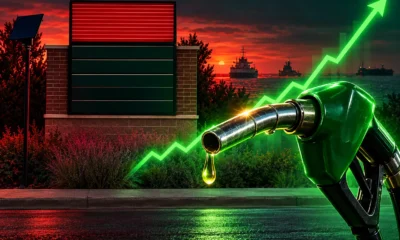
Record $6.20 diesel is already a cash cost for independent truckers and harvest farmers, weeks before shoppers see it in food prices.

AAA put the U.S. diesel average at $6.20 a gallon on Sept. 13, a new national record. Independent truckers and harvest crews are paying that bill now, before it shows up on a grocery receipt.
Regular gasoline was $4.29 on Sept. 11. Diesel is the fuel in the tractor, the grain truck, and the 18-wheeler, and those machines do not wait for November.
The First Check at the Truck Stop
An independent driver with Majestic Manor Trucking in Atmore, Alabama, who hauls stone, dirt, and crops across Florida, Mississippi, and Georgia, said he now spends more than $3,000 a week to fuel one truck. “I mean, we’re barely breaking even right now,” he said. “So it’s really tough.” He is paying close to $6 a gallon wherever he stops, after years of filling nearer $2 to $3.
Large fleets often recover diesel through fuel surcharges that move with the government’s weekly pump average. Owner-operators on spot loads collect that extra only when a broker actually pays it, which is why the same national number lands as a wage cut in one cab and a line item in another.
The American Transportation Research Institute’s 2026 cost study, covering 2025 operations, already put the industry at the highest per-mile cost on record at $2.336, even though fuel that year was only $0.482 a mile. Strip fuel out and the rest of the bill rose 4.2% to $1.854 a mile, faster than the 2.7% inflation rate. Truckload operating margins averaged 0.4%. Flatbed fleets ran at a 0.5% loss. That was the baseline before diesel left the $3 range.
At ATRI’s average of 85,991 miles per truck, the 7.6-cent rise in 2025 costs was about $6,535 more per truck for the year, with fuel still the stable line. Fuel is no longer the stable line. Patrick De Haan, head of petroleum analysis at GasBuddy, said the national average had reached $6.20, with some California pumps hitting their $9.99 display limit. “I don’t know when the story is going to end, but certainly gives me chills after six months,” he said.

Harvest Will Not Wait for Cheaper Fuel
Corn and soybean harvest is underway, and diesel use rises when the combine starts, not when the price eases. Near Forest City, Missouri, Jason Kurtz, 49, burns 200 gallons a day in the combine across a harvest he puts at about 30 days, on top of the trucks and tractor. At $6.20, that combine alone is about $1,240 a day. His diesel bill has doubled from last year, and chemical and fertilizer costs were already up.
We have to harvest. We have to run the machines. We have to use the diesel, so it cuts into our bottom line.
Jason Kurtz, corn and soybean farmer, Forest City, Missouri
Paul Mitchell, a professor of agricultural and applied economics at the University of Wisconsin-Madison, said the damage is not confined to the field. “Those prices hurt,” he said. “And it’s not just the harvesting. It’s the hauling of everything, moving the grain or the silage from the field to the farm and then from the farm to wherever they’re selling it.”
HARVEST DIESEL BILLS ON NAMED FARMS
- Jason Kurtz, Missouri: Combine at 200 gallons a day for a harvest of about 30 days, with trucks and a tractor still to fuel, after diesel expense doubled from last year.
- Fred Uhl, Indiana: Filling the on-farm tank now costs $10,000, up from $5,000 in January; his combine uses 175 gallons a day on 2,200 acres of corn and soybeans, and he expects at least three more 2,000-gallon fills.
- Greg Miller, Illinois: About 300 gallons on a busy day, or about $1,800 in fuel, on 2,000 acres of corn, soybeans, and hay; he puts the season’s extra diesel near $25,000 to $30,000.
- Planting already spent: A congressional analysis put 2026 planting diesel $1.4 billion above 2025, including more than $151 million in Iowa, a little more than $100 million in Minnesota, $80 million in Indiana, and more than $20 million in Kentucky.
Uhl said buyers add a fuel surcharge when they deliver to him, and he cannot add one when he takes grain to town. “When we take the crop to town, and I ask for a fuel surcharge, they’re gonna run me off,” he said. Off-road farm diesel still runs below the highway average in some counties, which does not cancel a doubled fill. Tyler Rath in Belgrade, Minnesota, put farm-tank diesel at $4.99 a gallon after paying about $2.38 a year earlier. A Colorado cattle and crop operation north of Denver posted $6.30 at the start of harvest. The calendar, not the midterm map, sets when those tanks get filled.
Why Diesel Hit $6.20 a Gallon
AAA first printed a daily national average above $6 on Sept. 11, at $6.0556 a gallon, about 63% above the year-ago $3.7053. The Sept. 13 reading of $6.20 extended that record. On Sept. 4 the average was $5.85, which took out diesel’s prior record of $5.82 from June 2022. A month before the $6 print, AAA had diesel at $5.3213. In late February, when the United States and Israel opened the Iran campaign, the average was about $3.76. In January 2025 it was $3.69. The Energy Information Administration’s weekly on-highway series, the figure many fuel surcharges still track, was $5.967 for the week of Sept. 7.
AAA NATIONAL DIESEL AVERAGE
| Reading | Dollars per gallon |
|---|---|
| Sept. 13, 2026 | $6.20 |
| Sept. 11, 2026 (first daily print above $6) | $6.0556 |
| Sept. 4, 2026 | $5.85 |
| One month before Sept. 11 | $5.3213 |
| Year earlier | $3.7053 |
California diesel has been near $8, with some stations at $9.99. Arkansas on Sept. 12 was about $5.73. The spread is real, and the national number is still the one that sets freight math.
Two wars are cutting the world’s diesel at the same time. Fighting around the Strait of Hormuz oil chokepoint has limited crude and product movements from the Gulf since late February. Ukrainian strikes on Russian plants then pulled still more diesel off the water. Russia banned diesel exports on July 8 and extended the ban through September after domestic shortages. Columbia University’s Center on Global Energy Policy has treated refined products as a security blind spot, noting Middle East refinery runs in the second quarter were about 27% lower at around 6.5 million barrels a day, after regional product exports had exceeded 5 million barrels a day before the war.
HOW THE DIESEL MARKET TIGHTENED
- Late February 2026: The Iran war begins; U.S. diesel averages about $3.76 a gallon.
- July 8, 2026: Russia bans diesel exports to cover domestic fuel after Ukrainian strikes on refineries.
- August 2026: Moscow extends the diesel export ban through September; the International Energy Agency later puts August net diesel and gasoil exports from Gulf countries at just over a quarter of their pre-war level.
- Sept. 4, 2026: AAA’s national average reaches $5.85 and tops the June 2022 high of $5.82.
- Sept. 11-13, 2026: The daily average clears $6, then prints $6.20.
The IEA also noted that in February, combined net diesel and gasoil exports from the Gulf and Russia accounted for almost 45% of global seaborne trade. When both streams shrink, buyers look to the United States.
A Five-Year High in Distillate Exports
U.S. tanks are being asked to cover a world shortfall. Distillate stocks, diesel plus heating oil, were 106.3 million barrels on Sept. 4, in the thin end of a four-decade range, with 28.6 days of supply. East Coast stocks had already printed a record low of 19.3 million barrels in August. The EIA’s September Short-Term Energy Outlook says those inventories will fall below 100 million barrels in September and stay below the 2021-2025 low through the end of 2026 and most of 2027.
DISTILLATE SNAPSHOT
- U.S. stocks: 106.3 million barrels on Sept. 4, with the EIA forecasting a drop under 100 million barrels this month.
- Exports: 1.735 million barrels a day in the week of Aug. 28, against 1.341 million a year earlier; 1.556 million in the week of Sept. 4.
- Net trade: Distillate net exports have been above or near the five-year high in every month of 2026 since February.
- Crack spread: The EIA estimates the U.S. average diesel crack will stay above $2 a gallon from August through November.
The agency says tightness abroad raises global distillate prices and “incentivizes U.S. exports of distillate,” after supply losses from the Middle East, Russia, and China. Fall refinery maintenance then cuts production just as harvest and, later, heating demand rise. That is the mechanism that puts a Missouri combine and a European cargo in the same line for the same molecules. Diane Swonk, KPMG’s chief economist, put the reach in one line: “The cost of diesel gets into just about everything.”
$2 a Gallon Stays With Refiners
The same tightness that empties tanks fattens the diesel crack, the margin between crude and the finished fuel. The EIA estimates U.S. average diesel cracks will exceed $2 a gallon from August through November, then ease into 2027 only if tanker traffic through Hormuz returns to normal and Saudi and Kuwaiti plants can raise distillate exports. If Middle East flows stay constrained past the end of 2026, the agency says global cracks would run higher than that forecast. It also expects Russian plant outages to keep pressing the market through the first half of 2027.
For 2026 as a whole, the EIA raised its retail diesel forecast to an average of $5.07 a gallon, from $3.66 in 2025, and lifted 2027 to $4.40. Those annual averages sit well below a $6.20 September print, which is the point. A harvest-month spike can wreck a cash year even when the yearly mean later looks calmer. Major refiners have been running near full capacity, which leaves little spare unit to answer a further outage.
Bernard Yaros, lead U.S. economist at Oxford Economics, has argued that gasoline gets the attention because drivers see it, while diesel does the work. “Take the food industry, for instance. Diesel powers the irrigation pumps, the tractors in the field and the trucks that bring food from the farm to your local grocery store,” he said. “It’s part of every layer of food production in the U.S.”
The Shelf Price Comes Last
Shoppers still meet diesel as a later, smaller line inside bread, meat, lumber, and parcel rates. Farmers and owner-operators meet it as cash this week. Kurtz said his budget was “already tight.” Miller, who has farmed more than 50 years, put the bind without a speech. “Unfortunately, with our game we don’t have the choice of saying, well, we’re not going to do something. We got to take the crop out,” he said.
Kevin Shedd, a third-generation Illinois farmer, said his combine can burn 100 to 150 gallons a day and his operation typically uses 3,500 to 4,500 gallons through harvest. Chris Weaver, farming from Finksburg, Maryland, said his crew was meeting to cut extra trips between fields. None of those choices change the fact that grain still has to move. Food still rides diesel from the field to the elevator and from the warehouse to the store, so the grocery effect is delayed rather than cancelled. Heating oil in the Northeast draws from the same distillate pool as the harvest, which is why a thin September stock number still matters in January.
Trump Asks Kyiv to Stop Hitting Diesel
President Donald Trump, speaking Sept. 13 at his golf club in Doonbeg, Ireland, after the $6 print, told reporters he had asked Ukrainian President Volodymyr Zelenskyy to stop striking Russian diesel plants. He has pledged cheaper energy and has also said elevated oil prices could last past the November midterms. Treasury Secretary Scott Bessent has described an energy shock from Ukrainian strikes on Russian energy assets and from the Iran conflict.
Mr. Zelenskyy has to do one thing. He has to stop knocking out diesel fuel in Russia. There are plenty of other targets. Don’t hit diesel fuel, because that’s hurting the world.
President Donald Trump, Sept. 13, Doonbeg, Ireland
Trump added that the diesel shortage “isn’t done by the Middle East, this is done by what’s happening with Russia and Ukraine.” Ukraine calls the refineries legitimate military targets. The EIA’s own outlook still lists lost distillate from the Middle East, Russia, and China, together with high U.S. net exports, as the reasons American stocks are this low.
WHERE EXPERTS DISAGREE
- White House view: Trump said the diesel shortage is a Russia-Ukraine problem, not a Middle East one, and asked Kyiv to spare diesel plants.
- EIA view: U.S. stocks fell below the five-year range after high net exports filled gaps left by lost supply from the Middle East, Russia, and China.
- IEA view: Gulf diesel and gasoil net exports in August were just over a quarter of their pre-war level, on top of a near-halt in Russian product exports.
Kurtz, who voted for Trump, said he will delay some field work in hope that fuel cheapens. He still has corn and soybeans to take out at 200 gallons a day. “That’s one good thing about farming,” he said. “Tomorrow will be different.”

Liberty Parks MotoGP on Formula 1’s Austin Stage

The Salary Cap Fight That Can Freeze Baseball’s TV Payday

The 2027 Mercedes GLE and GLS Keep Alabama Busy

Margaret Hamilton Dies at 90 With a Harder Fight Unfinished

Unity Parks Its Engine Inside Google’s Prompt Games

Microsoft 365 Auth Fault Took Down Exchange and Teams

Diesel Breaks Its Record as the White House Claims Credit

Xbox Caps Game Pass Cloud Gaming at 15 Hours

Squishy Dumpling Toys Recalled After Hiding Illegal Water Beads

IFA 2026’s Weird Gadgets Are Building a Sensor Home
-
 NEWS2 months ago
Microsoft 365 Auth Fault Took Down Exchange and Teams
-
 GAMING2 months ago
Xbox Caps Game Pass Cloud Gaming at 15 Hours
-
 BUSINESS2 months ago
Diesel Breaks Its Record as the White House Claims Credit
-

 AUTO2 months ago
Tesla Puts Its Wheel-Free Cybercab on Austin Streets
-

 NEWS2 months ago
OpenClaw 2.0 Ships a Team Workplace With Host-Trust Defaults
-

 NEWS2 months ago
Sony and Warner Sue Anthropic Over Torrented Song Lyrics
-
 LIFESTYLE2 months ago
Squishy Dumpling Toys Recalled After Hiding Illegal Water Beads
-
 NEWS2 months ago
IFA 2026’s Weird Gadgets Are Building a Sensor Home