
GAMING
Apple’s Beats Controllers Target iPhone Pads It Already Sells
Two Beats iPhone controllers, in the works more than a year, would compete with Backbone, 8BitDo, and the pads Apple already stocks.

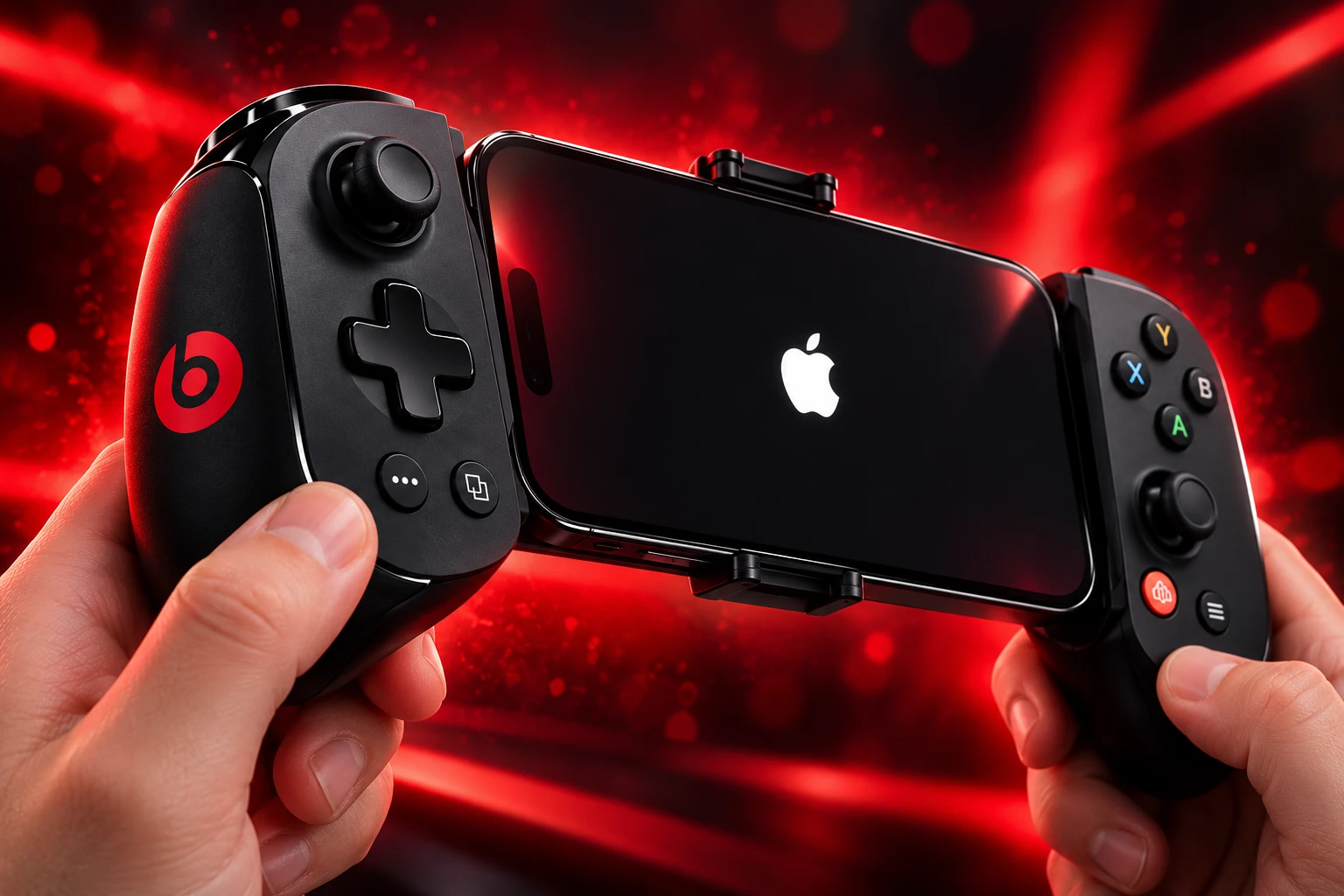
Mark Gurman says Apple has spent more than a year on two iPhone game controllers, most likely sold under Beats. The pads would compete with the clamps and Bluetooth sticks Apple already puts in its own store.
Code in macOS 26.7 named the hardware as T6502 and T1057. Gurman, who covers Apple, says Beats executives are running the project and that the company wants a cut of a market it has so far licensed to other brands.
T6502 and T1057, Then the Code Disappeared
In mid-August, the first macOS 26.7 release candidate carried GameController profiles for two devices tagged as Apple hardware. Public ipsw diffs on GitHub, under blacktop/ipsw-diffs, listed dedicated plug-ins for each one, which is the kind of hook firmware uses for real gear rather than a dummy layout.
Both profiles describe a full pad: a D-pad, dual thumbsticks, shoulder buttons, analog triggers, plus Home and Menu. The haptic setups differ. Only T1057 includes an accelerometer and gyroscope. T6502 does not.
THE TWO CONTROLLERS IN THE CODE
| Model | Motion sensors | What both share |
|---|---|---|
| T6502 | None listed | D-pad, dual thumbsticks, shoulders, analog triggers, Home, Menu, haptics |
| T1057 | Accelerometer and gyroscope | D-pad, dual thumbsticks, shoulders, analog triggers, Home, Menu, haptics |
Apple pulled those strings from the second 26.7 release candidate. That is how unreleased hardware often vanishes from a build once someone notices it. Nine days after the code was described in public, on September 13, Gurman said the work is real, aimed at iPhone, and more than a year old, even though the traces sat in macOS rather than iOS.
Design is still unknown. No shipping date or price has been attached to either model.
Who Loses If Beats Ships an iPhone Pad?
Backbone, SteelSeries, 8BitDo, and Razer built businesses on a hole Apple left open. A Beats pad with first-party pairing would sit on the same shelf those firms already occupy, including inside Apple’s own store, and Gurman’s brief is explicit that the goal is to compete with those options.
The iPhone already accepts plenty of plastic. Settings will pair an Xbox or PlayStation pad over Bluetooth, and Apple’s Game Controller framework for physical pads maps DualSense, DualShock, and Xbox layouts beside older Made for iPhone sticks. A first-party Beats unit does not create that pipeline. It tries to own the default object at the end of it.
THE IPHONE PADS ALREADY ON THE SHELF
- Backbone One: A USB-C clamp for iPhone 15, 16, and 17 that passes through charging and lists at $79.99 on Backbone’s site.
- SteelSeries Nimbus+: A traditional pad Apple already sells in its store alongside Backbone.
- 8BitDo Pro 3 and Ultimate 2: Bluetooth pads that pair with iPhone, iPad, Apple TV, Mac, and Vision Pro, with rumble and motion still off on Apple.
- Xbox and DualSense: Console pads that pair in Bluetooth settings; Apple’s store has also carried Sony’s DualSense.
People who already own those pads will not rush out for a Beats logo. The squeeze lands on the brands whose whole pitch is “this is the iPhone controller,” especially the clamps that turn a phone into a handheld. A Beats SKU that shows up in the Apple Store search box, pre-paired, with motion on one model, is a different offer than another Bluetooth stick in a drawer.
The Store Already Stocks Backbone and SteelSeries
Apple has not been ignoring this category. It has been taking a cut of it. The same store that would ring up a Beats controller currently pushes the Backbone One USB-C clamp and SteelSeries Nimbus+, and it has sold DualSense hardware too.
That is an odd split if you have spent more than a year building replacements. It is a familiar one if you have watched Apple let a partner prove demand, then put its own name, or a sister name, on the next version. Tile to AirTag followed that path. Third-party styluses did too. Backbone and SteelSeries are standing in the same spot now, still listed as accessories while Beats staff work on the in-house pair.
A clamp is also a different product from a slab you rest on a table. The code dump does not say whether T6502 or T1057 grips an iPhone in the middle or sits apart from it. Until that is public, Backbone’s form factor is the one a first-party pad has to beat for pocket play, and a Bluetooth pad is the one it has to beat for the couch.
Why the Gyro on One Model Matters
T1057 is the model that should worry licensed accessory makers more than the Beats logo does. Motion is the feature several popular iPhone pads still cannot legally or technically match on Apple’s stack, even when the same hardware tilts fine on other platforms.
8BitDo’s Apple page is blunt about the gap. On current firmware, rumble and motion remain blocked for its controllers on Apple devices, while rumble and tilt are ordinary on other systems. USB wired play is limited to iPhones with USB-C. Up to four pads can join a game that allows it, on iOS 16.3 and later. That is a mature accessory line running into a software ceiling Apple can lift for its own hardware on day one.
Two haptic designs point the same way. Apple does not need two rumble maps for a lab dummy. It needs them if one pad is the cheap stick and the other is the motion model with a distinct feel. Gurman has not described the shells. The profiles already describe an uneven pair, not a single SKU with a color choice.
The louder limit is still the software catalog. A Beats pad will not make a touch-first App Store title grow analog sticks. Games that already badge controller support, including Apple Arcade titles that speak MFi, are the ones this hardware can actually move. Plastic is the easy half of that problem.
Beats Cases and Cables Wrote This Playbook
Apple bought Beats in 2014 as a headphone company. The brand now sells iPhone cases and USB-C cables that skip the milled-aluminum ritual of the Apple logo. Gurman put the controller in that bin: cheaper materials, a wider audience, and a culture that already treats a gamepad as lifestyle gear rather than a precision instrument.
For example, Beats now sells a range of iPhone cases and USB-C cables that don’t necessarily fit Apple’s usual approach to design. A controller makes sense in that context. To reach a broad audience, it has to be relatively affordable, which means avoiding some of the more expensive materials and finishes typically associated with Apple products. The culture and lifestyle around gaming controllers also could fit naturally under the Beats umbrella.
Mark Gurman, Power On newsletter
Apple is working on an iPhone video game controller— and it’ll most likely come from the Beats brand rather than its own. https://t.co/D6GPFX1S1y
— Mark Gurman (@markgurman) September 13, 2026
The accessory prices already on sale show how that split works in practice. Beats iPhone cases from $45 cover the slim MagSafe shell, with a kickstand model at $59 and a rugged shell at $79. Woven USB-C cables list at $18.99 for 1.5 m and $29.99 for the 3 m 240W cord. Oliver Schusser, Apple’s vice president of Music, Sports, and Beats, said the case line proved buyers want style and utility in the same object. A gamepad is that brief with analog sticks on it.
A Beats pad that ships at Apple-premium money would miss the reason the logo moved. The whole point of parking this under Beats is to sell a lot of units without putting a $200 slab of glass-blasted aluminum in a gamer’s backpack.
Apple Has Scrapped Controller Hardware Before
This is not the first time Apple has stood next to a gamepad and then walked off. It spent years building software support instead of a first-party stick, and it has killed or outsourced the hardware when the alternative was easier.
APPLE’S ON-AND-OFF CONTROLLER HABIT
- 2015: Apple TV games must support the Siri Remote, and titles may not require a separate controller.
- 2016: That remote-only rule is dropped within months, and third-party MFi pads stay the path for analog play.
- November 2025: Vision Pro adds PlayStation VR2 Sense controllers through a Sony tie-up rather than an Apple-designed pair.
- Mid-August 2026: macOS 26.7’s first release candidate carries T6502 and T1057 as first-party GameController devices, then the second candidate strips the code.
- September 13, 2026: Gurman says the iPhone pads have been in the works more than a year and will likely carry Beats branding.
The Siri Remote episode is the caution. Apple tried to make the object in the box into a game controller, then admitted console-style games need a real pad, then declined to sell that pad itself. Vision Pro repeated the dodge with Sony’s hardware. A year of Beats-led work is the first sign the company is willing to put its own (or its sister brand’s) name on the grip.
It can still kill the project. Stripped firmware strings are how dead accessories look, too. Gurman’s reporting is what turns those strings into a product plan rather than a lab jig.
Backbone’s $79.99 Clamp Sets a Hard Ceiling
If Beats is the cheap channel, the number that matters is already on Backbone’s site. The USB-C One is $79.99, snaps around current iPhones, and is sold as a way to play Apple Arcade, Xbox cloud, PlayStation streaming, and PC streaming with pass-through charging. A Beats controller that costs more, without a clamp, has to explain why someone should leave that grip in a drawer.
Cloud play is the quiet use case. A lot of iPhone “console” time is streamed Xbox, PlayStation, or GeForce Now, not a native App Store build, and Xbox’s own 15-hour Game Pass cloud cap already rationed that habit. A first-party pad does not add hours. It makes the hours someone already pays for feel like a handheld, which is the slot Nintendo and the streaming bricks also want.
Xbox and DualSense owners will keep pairing what they have. The fight is for the person who does not own a console pad, who wants one object that talks to iPhone without a third-party app tax, and who might buy it because it is hanging next to a Beats case in an Apple Store. Gurman still has no price and no window. Until those show up, T6502 and T1057 are two model numbers, a gyro on one of them, and a warning to every clamp already in the store.

Liberty Parks MotoGP on Formula 1’s Austin Stage

The Salary Cap Fight That Can Freeze Baseball’s TV Payday

The 2027 Mercedes GLE and GLS Keep Alabama Busy

Margaret Hamilton Dies at 90 With a Harder Fight Unfinished

Unity Parks Its Engine Inside Google’s Prompt Games

Diesel Breaks Its Record as the White House Claims Credit

Microsoft 365 Auth Fault Took Down Exchange and Teams

Xbox Caps Game Pass Cloud Gaming at 15 Hours

IFA 2026’s Weird Gadgets Are Building a Sensor Home

Tesla Puts Its Wheel-Free Cybercab on Austin Streets
-
 BUSINESS2 months ago
Diesel Breaks Its Record as the White House Claims Credit
-
 NEWS2 months ago
Microsoft 365 Auth Fault Took Down Exchange and Teams
-
 GAMING2 months ago
Xbox Caps Game Pass Cloud Gaming at 15 Hours
-
 NEWS2 months ago
IFA 2026’s Weird Gadgets Are Building a Sensor Home
-
 AUTO2 months ago
Tesla Puts Its Wheel-Free Cybercab on Austin Streets
-
 LIFESTYLE2 months ago
Squishy Dumpling Toys Recalled After Hiding Illegal Water Beads
-
 NEWS2 months ago
OpenClaw 2.0 Ships a Team Workplace With Host-Trust Defaults
-
 NEWS2 months ago
OpenAI Unveils GPT-6 Astra With a Critical Cyber Label