
AUTO
Young Buyers Turn Mazda’s Cheap Miata Into a Collector Car
Gen Z accounts for 38 percent of first-gen Mazda Miata shopping, and clean pop-up cars are getting scarce as rust and race use thin the supply.

Hagerty says Gen Z accounts for 38 percent of first-generation Mazda Miata inquiries, against a 10 percent share of all enthusiast shopping. The cars are 29 to 37 years old. A lot of the people hunting them were not alive when Mazda built them.
Bob Hall, the former Mazda product planner who pushed the car into existence, still tells owners to drive them. The market around those owners has other ideas. Unmodified pop-up cars with records now change hands as collector objects, while rust, race conversions, and V8 swaps keep thinning the analog originals those younger buyers say they want.
Gen Z Accounts for 38 Percent of NA Inquiries
Brian Rabold, vice president of Automotive Intelligence at Hagerty, said younger fans have entered the market and that the NA Miata is the model they want most. Gen Z is 10 percent of enthusiast vehicle shopping on Hagerty’s books and 38 percent of NA Miata inquiries. The first-generation cars, sold in the United States as 1990 through 1997 models, now sit in the same conversation as other 1990s cars that aged into weekend toys with a following.
THE GEN Z MIATA TAPE
- Inquiry share: Gen Z accounts for 38 percent of first-generation Miata shopping on Hagerty, against 10 percent of all enthusiast vehicle shopping.
- Factory count: Mazda built 431,506 first-generation MX-5s worldwide between 1989 and 1997.
- U.S. color count: Mazda’s Irvine marketing office tallied 215,364 U.S. cars by paint from 1990 through 1997.
- New-car volume: Mazda sold 8,727 MX-5s in the United States in 2025, soft tops and RF retractable fastbacks included.
Jason Bell, a co-organizer of Miatas at the Gap, said first-gen cars made up 30 percent of this year’s field of more than 1,800. He still takes his 1994 Laguna Blue out at least once a month. It is a manual with a rebuilt engine, frame rails, a roll bar, and a radio his uncle upgraded, and he said the next one would not be a resto-mod because an original NA is so hard to find.
Howard Swig, president of Bring a Trailer, has watched that hunt on his own site, where more than 700 NAs have sold. Buyers want unmodified cars, service records, and original paint. Original wheels, radios, and center caps add money. Most of the cars that come through, he said, have been crashed or turned into race cars.
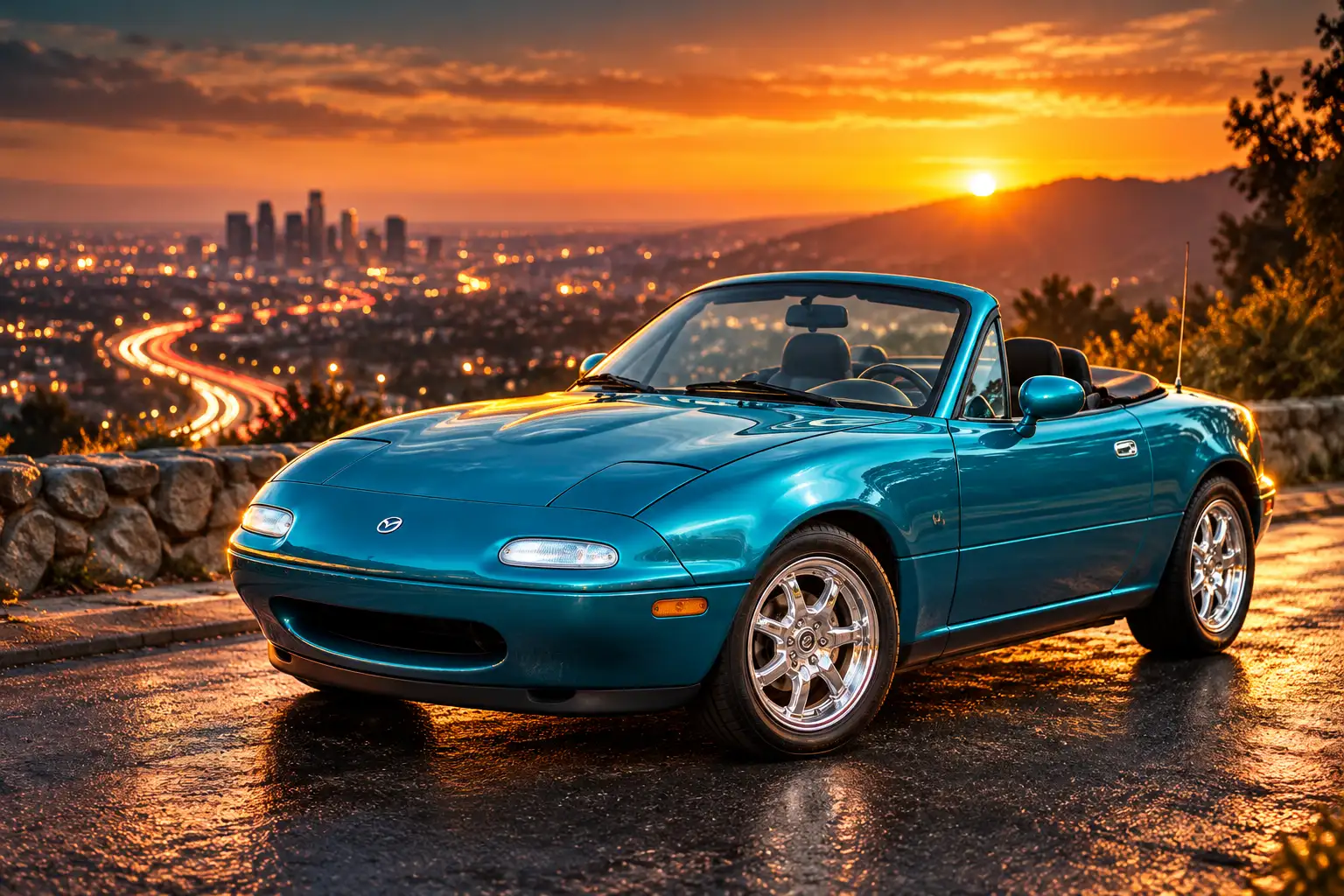
Mazda Built a Cheap British Roadster in Hiroshima
Hall put the idea to Mazda chief engineer Kenichi Yamamoto as a low-cost, rear-drive two-seater that would sit under the RX-7 and revive the British roadsters then leaving the market. Mazda hired him in 1981. Hall’s early paper on a cheap roadster argued for a four-cylinder, a manual, a rear axle, and as many existing parts as the accountants would allow.
The feel cars were a Lotus Elan and a Triumph Spitfire. Designers shifted the clay toward the Elan after an early Ferrari-like pass. Toshihiko Hirai ran the production program in Hiroshima. Hall still says Hirai is the person who should get credit for creating the car. Mazda showed the MX-5 at the Chicago Auto Show in February 1989 and started building it at Ujina Plant No. 1 in April 1989.
FROM SKETCH TO SHOWROOM
- 1979: Hall sketches a cheap open two-seater for Yamamoto as MG and Lotus roadsters fade from U.S. lots.
- 1982: He files a planning paper that keeps cost down by recycling parts Mazda already makes.
- February 1989: The MX-5 debuts in Chicago; U.S. cars arrive as 1990 models.
- April 1989: Production begins in Hiroshima. Hall later said dealers were getting $5,000 over an $18,000 sticker because volume was low and buyers wanted the higher A package.
- 1997: The pop-up NA ends after 431,506 cars. The last 1,500 U.S. cars are STO specials.
Hagerty’s 1990 base MSRP for the cheapest car is $13,800, a different figure from Hall’s $18,000 memory of a loaded sticker. Either way, the brief was a sports car a regular person could use. Hall still owns one in a metallic Tiffany-like color coded H4143, with a lip spoiler and 15-inch wheels, and he said it is not for sale.
What Does a Clean First-Gen Miata Cost?
A typical first-generation Miata still sells in the low five figures. Classic.com’s recent tape shows an average first-gen sale of $12,226 across 153 results and $1.9 million in volume, with a $3,850 low and a $46,000 high. Swig puts most Miatas in a $10,000 to $20,000 band. Rabold said a great NA can still be found under $10,000.
WHAT THE TAPE PAID
| Car | Price | What it is |
|---|---|---|
| Classic.com NA average, 153 sales | $12,226 | Recent first-gen market mean |
| Hagerty “great NA” | Under $10,000 | Clean, usable original |
| Swig’s typical band | $10,000 to $20,000 | Most Miatas, per Bring a Trailer |
| 1990 Mariner Blue, 8,000 miles | $34,000 | Bring a Trailer, June 5, 2026 |
| 2001 SE with LS3 V8 | $70,000 | Hagerty sale, second-gen swap |
| 2026 MX-5 Sport 6MT MSRP | $30,430 | Mazda, before $1,235 destination |
The outliers are the story now. Bring a Trailer’s 8,000-mile Mariner Blue 1990 sold for $34,000 on June 5, 2026, after 37 bids. It had stayed with one family until 2026, kept the 1.6-liter engine rated at 116 hp and 100 lb-ft, the five-speed, pop-up lamps, and 14-inch daisy wheels. The inner top had a tear near the driver’s seat. That is new-Miata money for a 116-hp car Mazda once priced as a weekend toy.
Limited-run paint still helps. The 1993 Limited Edition, a 1,505-car U.S. run, carries a Classic.com benchmark around $12,611. M-Editions from 1994 through 1997 sit higher, around $15,218 on that same board. Color, miles, and whether the radio and wheel caps are still the ones that left Hiroshima do more than model year.
Pop-Up Headlights and 2,182 Pounds
Swig said people want the lightest cars with the most pure expression, and that the current Miatas are bigger and heavier. A 1990 NA is listed at 2,182 pounds with 116 hp. Mazda’s 2026 Sport is 2,366 pounds with 181 hp, a 184-pound gap and 65 extra horsepower. The new car is quicker. The old car is the one with pop-up lamps, a five-speed that clicks like a light switch, and no screen.
Mazda starts the 2026 Sport at $30,430 before a $1,235 destination charge. Every 2026 MX-5 uses a Skyactiv-G 2.0-liter four making 181 hp at 7,000 rpm and 151 lb-ft at 4,000 rpm, with a 7,500-rpm redline and a standard six-speed manual. Sport and Club are manual only. Grand Touring can take a six-speed automatic. The dash holds an 8.8-inch infotainment display with Apple CarPlay and Android Auto.
1990 NA VS 2026 SPORT
| Spec | 1990 NA | 2026 Sport |
|---|---|---|
| Engine | 1.6-liter I4, 116 hp | 2.0-liter I4, 181 hp |
| Curb weight | 2,182 lb | 2,366 lb |
| Gearbox | 5-speed manual | 6-speed manual |
| Headlights | Pop-up lamps | Fixed LEDs |
| Screen | None | 8.8-inch display |
| Base MSRP | $13,800 | $30,430 |
From 1994 the NA moved to a 1.8-liter four rated at 128 hp. That still leaves it a long way from 181 hp. Hagerty’s inflation series found that, in 2025 dollars, NA and NB base prices peaked at over $39,000, and that since 2022 a new ND has been the cheapest a new Miata has ever been. Last year’s MX-5 sat a little over $30,000 on that chart. Young buyers are not picking the NA because Mazda stopped selling a bargain. They are picking pop-ups, a 2,182-pound curb weight, and a cabin with no screen.
Dave Coleman, Mazda’s manager of vehicle engineering, still describes the whole line, old and new, as a club that wants driving without the pose.
The small size forces you to declutter when you drive it, the light weight makes it respond to your every thought, its relatively low power lets you enjoy driving aggressively without actually going very fast, and if anyone on the road isn’t smiling at you, that’s obviously a them problem.
Dave Coleman, manager of vehicle engineering, Mazda
Pop-up headlights do work the crowd does not put in press quotes. They are the first thing a stranger notices, and they are the one styling cue the ND cannot copy. That is the car a first-time enthusiast still learns to work on, because the engine bay is simple, the aftermarket is huge, and a seized drain tube is a Saturday job until it is not.
Look Under the Sills Before You Fall in Love
The same open-air design that made the NA a cheap toy also made it easy to wreck from the inside. Soft-top rain rails feed drain tubes behind the seat-belt towers. Those tubes empty into the rocker panels, which are supposed to drip out through slits in the pinch welds. Leaves and dirt clog the path. Water sits in the sills and lower rear quarters and rusts the steel from the inside out. Paint bubbles are the last thing you see, not the first.
WHERE THE METAL GOES FIRST
- Rocker panels: The sills rot from the inside after clogged drains trap water, and blistered paint at the rear of the sill usually means the inner structure is already gone.
- Rear quarters: The lower seam where the quarter meets the rocker is the classic failure, and a patch panel is a weld-and-paint job, not a bolt-on.
- Wheel arches: Inner rear arches go after the sills, and the liner has to come out before you can see the damage.
- Windscreen frame: The lower frame traps water on cars that sat outside, and it is easy to miss on a walk-around.
That is why Swig’s “special one” is hard to find. Mazda built 431,506 of these cars, then owners did what Hall asked: they drove them, tracked them, and left them outside. Salt states and cars parked under trees pay first. A clean, dry, unmodified NA with original paint is the leftover, not the norm. In some markets the NA and NB are already the generations young drivers actually buy, and the complaint attached to those cars is that the clean ones have gotten expensive.
A $70,000 Swap and a $10,000 Original
Rabold said record money goes to well-executed engine-swap cars. Hagerty sold a 2001 SE with an LS3 for $70,000, a second-generation car, not an NA, and still a warning about where the bids run when someone does the V8 conversion cleanly. Swig sees the same appetite on Bring a Trailer. The original inline-four is the analog brief. The V8 is the other brief, and it pays more.
Bell’s own 1994 is the middle path, a driven car with a rebuilt engine and a roll bar, and he said he would not buy that kind of car next time. Original NAs are the ones that got away. Mazda sold 8,727 new MX-5s in the United States in 2025 and 6,909 through August 2026, so the factory roadster is not gone. The used NA is the one that cannot be built again with pop-up lamps and a 2,182-pound body in 116-hp form.
Some owners even step out of later Miatas into NA and NB cars, accepting more upkeep for the older steering and the folding lamps. The new car is faster, safer, and, in inflation-adjusted dollars, the bargain. The old car is the one that still feels like Hall’s cheap British sketch.
Hall Still Tells Owners to Drive Them
Hall asked why anyone would want a $150,000 Porsche that you cannot drive the way it was meant to be driven and that costs a fortune to fix. He said it is more fun to drive a slow car fast than a fast car slow, and that you can enjoy a Miata every day without breaking the law. He does not buy a car to put in a garage. Cars, he said, are made to be driven.
That advice is how so many NAs ended up crashed, tracked, or full of water in the sills. It is also why a 33-year-old Limited Edition with dead batteries and cracked leather can still be worth saving, and why an 8,000-mile Mariner Blue car can bring $34,000. Younger buyers showed up for the analog car Mazda designed in the 1980s. The ones that were actually used, which was the point, are the ones they cannot find.

Liberty Parks MotoGP on Formula 1’s Austin Stage

The Salary Cap Fight That Can Freeze Baseball’s TV Payday

The 2027 Mercedes GLE and GLS Keep Alabama Busy

Margaret Hamilton Dies at 90 With a Harder Fight Unfinished

Unity Parks Its Engine Inside Google’s Prompt Games

Diesel Breaks Its Record as the White House Claims Credit

Xbox Caps Game Pass Cloud Gaming at 15 Hours

IFA 2026’s Weird Gadgets Are Building a Sensor Home

Microsoft 365 Auth Fault Took Down Exchange and Teams

Tesla Puts Its Wheel-Free Cybercab on Austin Streets
-
 GAMING2 months ago
Xbox Caps Game Pass Cloud Gaming at 15 Hours
-
 BUSINESS2 months ago
Diesel Breaks Its Record as the White House Claims Credit
-
 NEWS2 months ago
Microsoft 365 Auth Fault Took Down Exchange and Teams
-
 NEWS2 months ago
IFA 2026’s Weird Gadgets Are Building a Sensor Home
-
 AUTO2 months ago
Tesla Puts Its Wheel-Free Cybercab on Austin Streets
-

 NEWS2 months ago
OpenClaw 2.0 Ships a Team Workplace With Host-Trust Defaults
-

 NEWS2 months ago
Sony and Warner Sue Anthropic Over Torrented Song Lyrics
-

 BUSINESS2 months ago
ChargePoint Stock Rally Prices Wilmer’s Three-Year Cash Plan