
BUSINESS
Amazon Pauses 21 Air After Miami and Shifts the Flying
Amazon paused 21 Air after the Miami 767 crash killed five ground workers, then moved the freight onto other contractors it already uses.

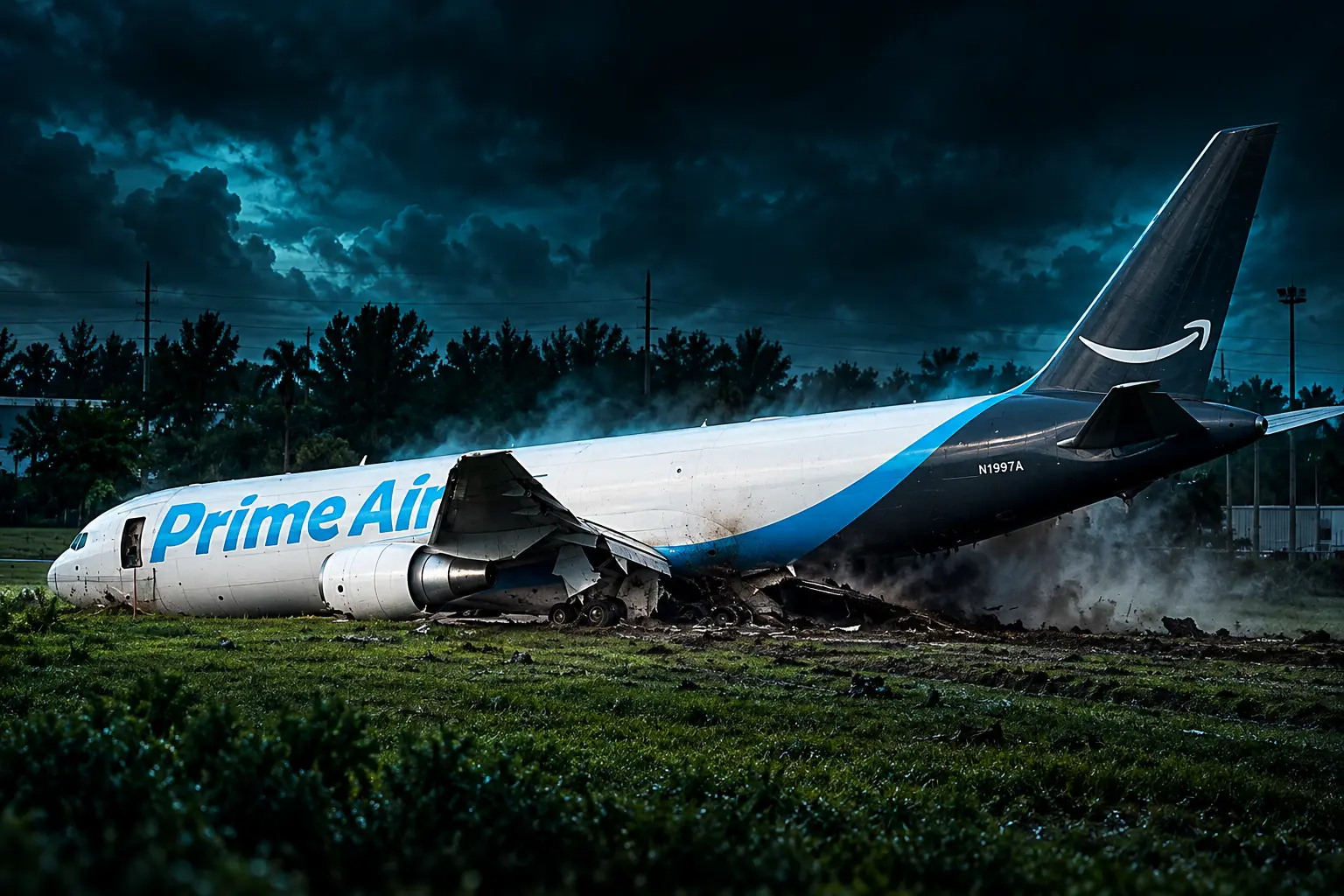
Amazon paused its contract with 21 Air on Sept. 13, seven days after a 21 Air Boeing 767 ran off a Miami runway and killed five people on the ground. The retailer will move those shipments onto other cargo airlines it already uses, because Amazon does not operate the planes that wear its name.
Amazon Paused 21 Air Seven Days After Miami
Kelly Nantel, an Amazon spokesperson, said the company had reviewed some of the circumstances around Flight 7598 and would keep supporting the National Transportation Safety Board. She did not list those circumstances. She did say Amazon would pause our operations with 21 Air, the operator of the Sept. 6 landing at Miami International Airport.
Safety has always been our top priority, whether in our own operations or when we’re working with partners. After the tragic incident last weekend, we’ve spent time supporting the investigation and reviewing some of the surrounding circumstances, and we’ve decided to pause our operations with 21 Air, the operator of Flight 7598. We’ll continue working to support the investigation and everyone affected.
Kelly Nantel, Amazon spokesperson, company update, Sept. 13
The crash was on Sunday, Sept. 6. The NTSB put recorder data out on Sept. 9. Amazon’s pause landed on Sunday, Sept. 13, after those numbers were already public. 21 Air, based in Greensboro, N.C., said it was working with the NTSB and with partners, including Amazon, and that it was confident in its safety policies, procedures, and training.
Keith Winters, the airline’s CEO, posted that his deepest condolences are with the families of the dead, and that 21 Air was cooperating with the NTSB, the Federal Aviation Administration, and local authorities. Amazon named no FAA grounding. What it described is a commercial stop: the flying that would have gone to 21 Air will go to other carriers on Amazon’s list.
A Go-Around Called After Touchdown
The NTSB’s preliminary cockpit and flight-data readout is not a probable cause. It is a second-by-second account of a landing that came in fast, sat down unevenly, and never used the two systems that dump speed on a 767 once the wheels are on the ground. Chihoon Shin, the investigator in charge, said there was no indication in the recorded data that speed brakes or thrust reversers were deployed. He also said it was not clear why.
On the cockpit voice recorder, one pilot cautioned they were too fast at 01:42 before the tape ended, when flaps were called to 20 degrees, and kept talking about speed. The NTSB said there was not a consistent verbal response to those comments. Electronic sink-rate and too-low-terrain callouts followed. Minimums sounded at 00:50. A pilot called for flaps 30 at 00:41, after that minimums call and near a “forty” radio-altimeter callout. Sounds similar to touchdown came at 00:31. A go-around was called at 00:15. Sounds similar to leaving the pavement came at 00:10.
FLIGHT DATA IN THE LAST 30 SECONDS
| Time to end of recording | What the FDR recorded | Groundspeed |
|---|---|---|
| 00:30 | Nose and right main gear touched down | 158 knots |
| 00:23 | Brakes applied | 146 knots |
| 00:19 | Left main gear touched down | 134 knots |
| 00:15 | Brakes released; throttles raised to go-around thrust | 120 knots |
| 00:11 | Throttles cut to idle; brakes reapplied | 117 knots |
| 00:07 | Lateral, longitudinal, and vertical acceleration changed markedly | 96 knots |
| 00:00 | Recording ended; no speed brakes or thrust reversers | 65 knots |
The NTSB warned that the cockpit tape and the flight-data tape have not been precisely synchronized. Read as separate clocks, they still describe the same shape: a fast, lopsided touchdown, a four-second burst of go-around thrust with the brakes off, then idle power and brakes again, with the jet still moving when the data stops. Ross Aimer, a retired airline captain who runs Aero Consulting Experts, was blunt about that sequence.
In my 60 years of flying, I’ve never seen such a terrible performance from a crew. These fellows should have gone around long before even getting close to that airport.
Ross Aimer, CEO, Aero Consulting Experts
Jennifer Homendy, the NTSB chair, said the 767-33A was on its third sector of the day, having flown Cincinnati to Miami, Miami to San Juan, and San Juan back to Miami. The two pilots survived. Miami-Dade Sheriff Rosie Cordero-Stutz identified them as Joseph Carroll, 55, and Jaime Felipe Silva Molina, 37.
Who Flies an Amazon Air Jet?
Amazon Air looks like an airline. The jets are painted with the Prime smile. The network, on Amazon’s own cargo pages, runs 100+ aircraft and 250+ daily flights. The legal line underneath that paint is different. Amazon’s air-cargo terms state that Amazon is not an air carrier, and that it sells capacity by contracting with airlines that operate the aircraft. The carrier’s pilot in command, not Amazon, has authority over cargo acceptance and flight safety.
21 Air is one of those certificate holders. It started Amazon flying in late 2024 on a crew-and-maintenance contract, with Amazon supplying Boeing 767s that had been moved off Atlas Air. Cirium, the aviation data firm, counted eight 21 Air jets in the Amazon network. The rest of the branded fleet is spread across other operators. Amazon’s internal FAST group handles aircraft, carrier sourcing, technical operations, and ground services. The crews, training, and FAA operating specs sit with the airlines.
That split is why a fatal crash can become a vendor pause in a week. Amazon does not have to park a fleet it does not certificate. It can stop assigning loads to 21 Air and keep the same airframe type moving with someone else. The NTSB still investigates 21 Air as the operator of Flight 7598. Amazon still gets to say it reviewed surrounding circumstances and stepped back.
Five Airport Cleaners Died on the Ground
All five people killed were on the ground, in a van that was not part of Amazon’s air operation or 21 Air’s cockpit. They worked for Professional Ocean Service Corp., an airline cleaning contractor that has been on the Miami airport for years. Cordero-Stutz said the van was carrying seven people when the 767 struck it after leaving Runway 30, then hit a second vehicle. Two other cleaners in the van lived. A driver in an SUV was hurt. The two pilots were hurt and released.
THE FIVE WHO WERE KILLED
- Yoel Rodriguez Naranjo, 53: His widow, Yaraisi Santiso Morejon, later sued Amazon, 21 Air, and the pilots in Miami-Dade court.
- Rolando Aleman Leon, 55: Named by the sheriff with the rest of the van crew.
- Julio C. Pineda, 75: The oldest of the five, also a Professional Ocean Service employee.
- Carlos Acosta Fajardo, 53: Identified with the van occupants on Sept. 8.
- Javierkys Reyes Quevedo, 47: The youngest of the five killed.
Professional Ocean Service called the dead and injured family, and said it would not talk about the crash itself while the probe ran. The injured workers in the van were identified as Ridoel Averhoff Diaz, 32, and Roosevelt Sebastian Perdomo Torres, 36. The SUV driver was identified as Eugenio Corredor, 79. The people Amazon’s pause is named after, in public, are a contractor airline and a branded jet. The people who died were finishing a cleaning shift.
Ex-Pilots Had Flagged 21 Air Years Earlier
Nantel’s “surrounding circumstances” arrived after former 21 Air pilots had already put safety complaints on a federal docket. Karl Seuring, a veteran captain and former president of 21 Air’s pilot union, alleged in a Department of Labor whistleblower case that he was fired in 2022 after raising concerns and being told the problems were not going to change. His lawyer, Mike Anello, has said that case went through an OSHA hearing Seuring lost and a 2023 trial, with a judge’s ruling still pending. Seuring has said 21 Air has a long-established history of safety problems, and that he was not surprised by Miami.
Don Helmig, a retired airline and military pilot who had been reviewing safety work at the company, resigned in 2021. In a June 12, 2021, email to majority owner Jim Crane, Helmig wrote, “After three months, everywhere I looked, there are issues,” and accused leaders of paying lip service to safety. Bruce Joseph, a former 21 Air chief pilot, testified in a Labor Department tribunal that he had personal knowledge of people being discouraged from logging concerns in the company safety system.
Those filings are allegations, not NTSB findings, and they are years old. 21 Air’s public line after Miami is that it is confident in its policies, procedures, and training. Amazon, which brought 21 Air onto Amazon Air in 2024 as it reshuffled 767s away from Atlas, did not say whether those older complaints were part of the review that produced the Sept. 13 pause. The recorder data from Sept. 9 already gave the retailer a current, official record of a fast approach, a late go-around, and unused deceleration devices.
Six Other Carriers Can Absorb the Freight
Amazon said other carriers will transport the shipments that would have been assigned to 21 Air. It named the airlines already inside the network. That is the second move the contractor model buys: the pause does not have to shrink Prime Air’s map if someone else can crew the same kind of jet.
CARRIERS AMAZON NAMED TO TAKE THE FLYING
- Air Transport International: An ATSG airline and one of the largest Amazon 767 operators.
- ABX Air: Also under ATSG, another 767 partner on Amazon metal.
- Sun Country Airlines: A passenger carrier that also flies Amazon-owned 737 freighters.
- Hawaiian Airlines: Flies Airbus A330 freighters for Amazon.
- Cargojet: A Canadian widebody operator that also holds a 25% stake in 21 Air.
- ASL Airlines: Amazon’s European partner in the same contracted network.
Cargojet’s stake in 21 Air is a reminder that these companies overlap on paper even when Amazon treats them as interchangeable lift. 21 Air still flies for DHL and other customers on 757s and 767s that were never Amazon’s to reassign. Amazon’s pause covers Amazon-assigned flying. It does not, on the words released so far, pull 21 Air’s certificate or shut the Greensboro airline down.
The Flying Certificate Stays in Greensboro
21 Air remains the FAA certificate holder that put Flight 7598 on Runway 30. Amazon remains the company that paints the jets, books the network, and can stop sending those jets to one operator when a crash and a week of recorder briefings make that operator expensive to keep. The NTSB has not said why speed brakes and thrust reversers never appeared in the data, why the left main gear came down 11 seconds after the right, or why a go-around called after touchdown lasted about four seconds. That work continues.
What Amazon settled on Sept. 13 is the commercial piece. The five dead were not Amazon employees and not 21 Air crew. The airline that lost the Amazon flying still says its training is sound. Other carriers on the same roster are expected to take the freight. The Prime smile stays on the fleet. The operating certificate stays in Greensboro.

Liberty Parks MotoGP on Formula 1’s Austin Stage

The Salary Cap Fight That Can Freeze Baseball’s TV Payday

The 2027 Mercedes GLE and GLS Keep Alabama Busy

Margaret Hamilton Dies at 90 With a Harder Fight Unfinished

Unity Parks Its Engine Inside Google’s Prompt Games

Microsoft 365 Auth Fault Took Down Exchange and Teams

Diesel Breaks Its Record as the White House Claims Credit

Xbox Caps Game Pass Cloud Gaming at 15 Hours

Squishy Dumpling Toys Recalled After Hiding Illegal Water Beads

IFA 2026’s Weird Gadgets Are Building a Sensor Home
-
 NEWS2 months ago
Microsoft 365 Auth Fault Took Down Exchange and Teams
-
 GAMING2 months ago
Xbox Caps Game Pass Cloud Gaming at 15 Hours
-
 BUSINESS2 months ago
Diesel Breaks Its Record as the White House Claims Credit
-

 AUTO2 months ago
Tesla Puts Its Wheel-Free Cybercab on Austin Streets
-

 NEWS2 months ago
OpenClaw 2.0 Ships a Team Workplace With Host-Trust Defaults
-

 NEWS2 months ago
Sony and Warner Sue Anthropic Over Torrented Song Lyrics
-
 LIFESTYLE2 months ago
Squishy Dumpling Toys Recalled After Hiding Illegal Water Beads
-
 NEWS2 months ago
IFA 2026’s Weird Gadgets Are Building a Sensor Home