
NEWS
CHIME Finally Maps Cosmic Hydrogen Without Galaxy Surveys
CHIME detected 21 cm hydrogen at redshift 1.16 without galaxy catalogs. The 12.4 sigma spectrum still sits on nonlinear clustering scales.

CHIME measured the 21 cm glow of hydrogen at mean redshift 1.16 using only its own radio maps, at 12.4 sigma, from 94 nights in 2019. The Canadian Hydrogen Intensity Mapping Experiment, a transit array at the Dominion Radio Astrophysical Observatory near Penticton, British Columbia, no longer needs an optical galaxy catalog to see that signal. The paper, published September 28, 2026 in The Astrophysical Journal, is the first 21 cm auto-power detection at redshift about 1.
That is the bet the cylinders were built to cash. It is not yet a dark energy measurement. The wavenumbers in this spectrum already sit where hydrogen clustering is nonlinear, so the first solo map tests how gas sits in galaxies more than it tracks cosmic expansion.
Ninety-Four Nights Produced a 12.4 Sigma Spectrum
The team used nighttime data from January 1 through November 5, 2019, then kept 94 sidereal days that passed quality cuts. They measured the 21 cm auto-power spectrum from 608.2 MHz to 707.8 MHz, a 21 cm redshift range from 1.34 to 1.01, at 0.4 to 1.5 h Mpc^-1. Full-band significance is 12.4 sigma, well above the five sigma line physicists treat as a detection.
Two independent halves of the same band show the same signal. The lower-frequency half, mean redshift about 1.24, reaches 9.1 sigma. The upper half, mean redshift about 1.08, reaches 8.6 sigma. Arnab Chakraborty, a University of Toronto postdoctoral fellow who first proposed the finding, said the group spent more than a year proving the spike was not a false alarm from terrestrial radio, the Galaxy, or the instrument itself.
“We worked very hard to convince ourselves that this wasn’t a false alarm. After all the tests, the signal remained. That gave us confidence we were seeing real hydrogen from the distant universe.”
University of British Columbia News posted the standalone hydrogen detection from 2019 nights on September 28, 2026, the same day the journal paper appeared.
CHIME has made its first standalone detection of hydrogen's ancient radio glow, using only its own observations. The result opens a new way to study dark energy and the evolution of the universe. 🔭
Read more ⤵️ https://t.co/Rfo2cGE9XM
— UBC News and University Affairs (@UBCNews) September 28, 2026
CHIME 21 CM DETECTIONS
| Measurement | Data | Method | Significance |
|---|---|---|---|
| Auto-power, mean z 1.16 | 94 nights, 2019 | CHIME only | 12.4 sigma |
| Lower sub-band, z ~ 1.24 | same 94 nights | CHIME only | 9.1 sigma |
| Upper sub-band, z ~ 1.08 | same 94 nights | CHIME only | 8.6 sigma |
| Stack on eBOSS quasars | 102 nights, 2019 | cross with catalog | 11.1 sigma |
| Stack on eBOSS LRGs | 102 nights, 2019 | cross with catalog | 7.1 sigma |
| Stack on eBOSS ELGs | 102 nights, 2019 | cross with catalog | 5.7 sigma |
| Cross with eBOSS Ly-alpha forest | 88 days, 400-500 MHz | cross at mean z 2.3 | 9 sigma |
MeerKAT teams have reported 21 cm auto-power at redshift 0.32 and 0.44. CHIME’s claim is narrower and still hard: first auto-correlation at redshift about 1, where the band was designed to watch the era when dark energy started to dominate the expansion.
Optical Catalogs Were the Safety Net
For most of the past decade, 21 cm intensity mapping has leaned on someone else’s galaxy list. Cross-correlation works because radio foregrounds and optical catalogs do not share the same junk. A real large-scale structure pattern should appear in both. CHIME’s 2023 analysis stacked 102 nights of maps on luminous red galaxies, emission-line galaxies, and quasars from the extended Baryon Oscillation Spectroscopic Survey and got 7.1, 5.7, and 11.1 sigma. A 2024 follow-up crossed CHIME’s 400 to 500 MHz band with eBOSS Lyman-alpha forest spectra at mean redshift 2.3 and reached 9 sigma.
Those detections proved the hydrogen was in the maps. They also left CHIME tied to surveys that cost millions more dollars and that only target sky dense enough to form stars. Auto-correlation drops that crutch. The radio map has to carry its own clustering, which means the pipeline has to beat Galactic synchrotron, extragalactic continuum, and radio-frequency interference that sit several orders of magnitude above the cosmic 21 cm line.
HOW CHIME REACHED A SOLO MAP
- January 24, 2013: Ground is broken at the Dominion Radio Astrophysical Observatory, a federally protected radio-quiet site near Penticton.
- September 7, 2017: The telescope is inaugurated and enters commissioning, with no moving parts and a correlator built around gaming GPUs.
- January 1 to November 5, 2019: The 94 nights used for the auto-power paper are recorded.
- 2023: Spectral stacks on eBOSS galaxies and quasars yield the first CHIME 21 cm detections, still using an optical catalog.
- 2024: A Lyman-alpha forest cross at mean redshift 2.3 reaches 9 sigma in the 400 to 500 MHz band.
- September 28, 2026: The Astrophysical Journal publishes the auto-power detection at mean redshift 1.16.
The new pipeline, not a new telescope, is what changed. Novel RFI masks, achromatic beamforming, and a delay filter applied before time averaging cut spectral leakage that had swamped earlier auto-spectra. A DAYENU filter removes delay structure slower than 200 ns, the smooth foregrounds that would otherwise bury the line. Even-odd day splits and a later stack on quasars in the same patch were used as checks that the pipeline was not inventing power.
Does This Spectrum Constrain Dark Energy?
No. The 94-night auto-power runs from 0.4 to 1.5 h Mpc^-1, a range the companion analysis calls the nonlinear regime, so this spectrum does not yet reach the baryon acoustic oscillation scale that clocks cosmic expansion. Mark Halpern, a University of British Columbia physics professor and CHIME’s principal investigator, still frames the instrument as a Canadian route into that larger program. The path is open. This paper does not walk it.
This is a completely new technique for probing the cosmos, delivered by an instrument that was conceived, built and funded by Canadians. It’s a bold new step in the global cosmology program and a Canadian success story.
Mark Halpern, professor of physics and astronomy and CHIME principal investigator, University of British Columbia
Intensity mapping was sold as a shortcut to huge volumes because it never has to resolve a single galaxy. Hydrogen’s rest line sits at 21.106 cm, or 1420.406 MHz, and redshift slides that line down into CHIME’s 400 to 800 MHz band, covering 21 cm redshifts from 0.8 to 2.5. Baryon acoustic oscillations, the frozen sound-wave ruler used to track dark energy, live on larger scales than this first auto-spectrum. The companion fit holds Planck 2018 expansion parameters fixed and varies hydrogen density, bias, and two phenomenological shape terms. That is a galaxy-gas analysis with cosmology parked.
Chakraborty put the scientific use in tracer language. Hydrogen is the most common element and the raw material for stars, and its faint radio emission maps how matter is laid out. Mapping that glow over time is how an expansion history, and then a dark energy test, would be built. The 94 nights show the tracer is in the data. They do not yet return a dark energy equation of state.
Two Percent of the Hydrogen Stayed Neutral
Shabbir Shaikh, a postdoctoral fellow at Arizona State University, gave the headline astrophysics. At this epoch, when the universe was about five billion years old, roughly two percent of the hydrogen was still in neutral atomic form, a share he said matches other measurements. The rest is ionized, locked in stars and molecules, or otherwise missing from the 21 cm line. The auto-spectrum’s job is to say how that remaining atomic gas is clustered.
The companion interpretation paper, which reports the hydrogen clustering amplitude at redshift 1.16, cannot split hydrogen density from bias without an extra prior. With a Gaussian prior on linear bias centered at 1.56 (20 percent wide, from simulations), the team finds Omega_HI times 10^3 equal to 0.79, with statistical errors +0.20 and -0.16 and a systematic floor of 0.07. That density parameter is not the same quantity as Shaikh’s two percent of all hydrogen; one is a cosmic density relative to critical, the other is a mass share of the element.
WHAT THE SPECTRUM IMPLIES
- Neutral share: Shaikh said roughly two percent of the hydrogen was still atomic at this epoch, in line with other probes.
- HI density: With a bias prior of 1.56, Omega_HI at redshift 1.16 is 0.79 x 10^-3, statistical errors +0.20 and -0.16, systematic 0.07.
- TNG100: The measured clustering amplitude sits 3.1 sigma above the TNG100 hydro run after the same pipeline is applied to the simulation.
- TNG300: The offset versus TNG300 is 4.0 sigma, again after forward-modeling CHIME’s filter and mask.
The team argues the mismatch is probably not a wrong total hydrogen budget. It is more likely a wrong amount of redshift-space clustering on the nonlinear scales CHIME actually measured, including how fast hydrogen moves inside halos. If each IllustrisTNG curve is rescaled to the data, the shape fits; the amplitude does not. That is a galaxy-formation problem the optical surveys were never going to pose in this form, because they do not weigh the gas directly.
Four Cylinders and a Gaming-Card Supercomputer
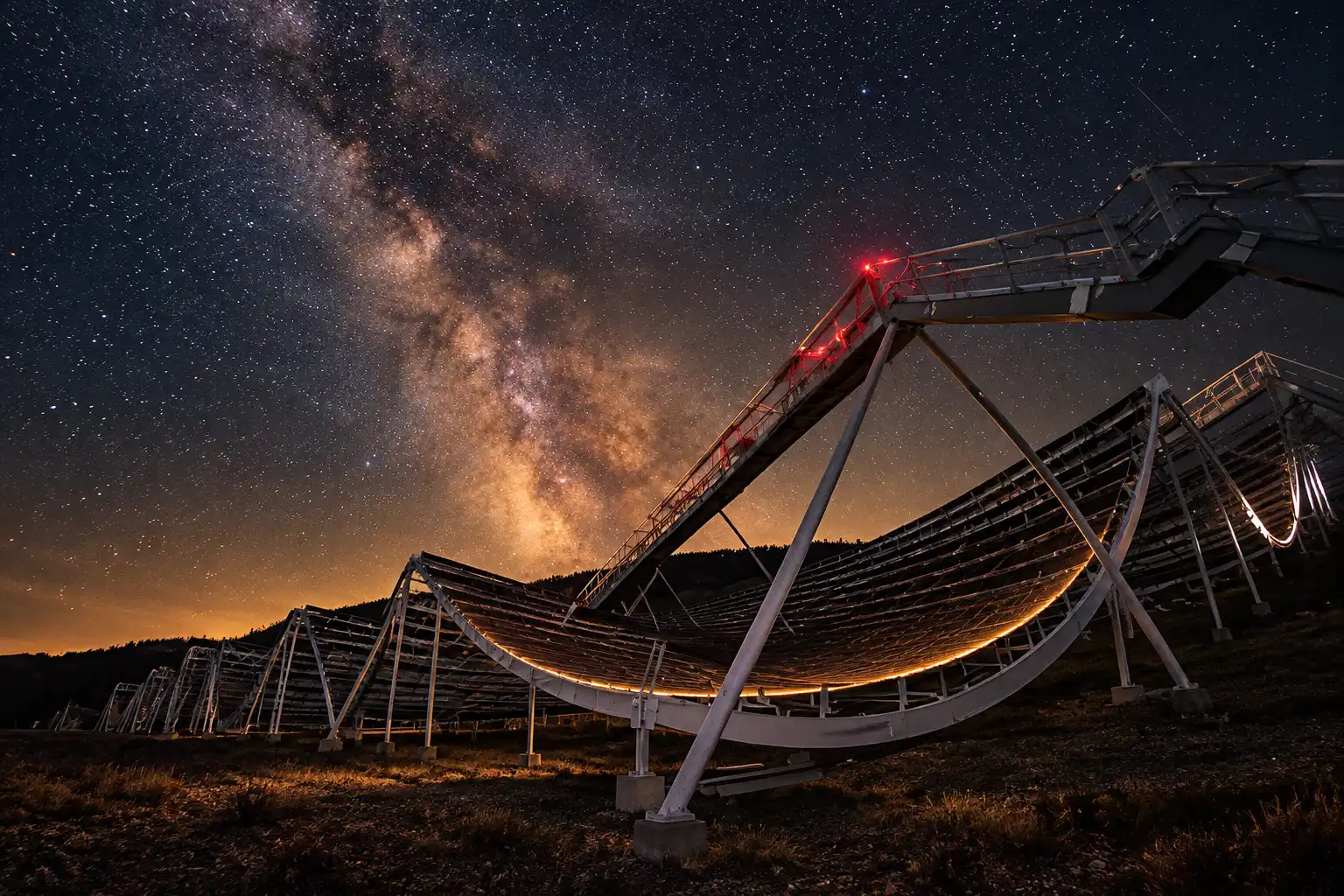
CHIME is four north-south cylinders, each 20 m wide and 100 m long, with 256 dual-polarization feeds along every focal line. The four 100-metre cylindrical reflectors stare at the meridian and let Earth rotation sweep about three quarters of the sky each day. Collecting area is 8,000 square metres. The cosmology band is 400 to 800 MHz. Forecasts in the instrument paper use 31,000 square degrees of sky. There are no moving parts and no cryogenics. Analog filters and amplifiers were taken from the cell-phone industry.
McGill University said in 2017 that the array was built with $16 million in Canadian funding from federal and provincial sources, a fraction of the cost of other world-class radio telescopes. The Canada Foundation for Innovation put $4.6 million behind principal investigator Halpern’s digital-telescope grant. Matt Dobbs at McGill led the correlator. Radio data arrive at 13 terabits per second, comparable to the world’s mobile traffic at the time, too fast to store, so the sky is imaged in real time. Keith Vanderlinde at the University of Toronto built that imaging engine from commercial graphics cards. He joked that his university wondered why grant money was buying so many gaming boards.
WHAT THE ARRAY ACTUALLY DOES
- Daily scan: A two-degree-wide meridian strip covers the northern sky as Earth turns, with no steering motors.
- Line redshift: Neutral hydrogen’s 1420.406 MHz line falls through 400 to 800 MHz between redshift 0.8 and 2.5.
- Commensal beams: The same visibilities feed fast-radio-burst searches, pulsar timing, Galactic magnetism, and 21 cm absorbers.
- Resolution trade: Angular resolution is about 40 arcminutes, coarse for galaxies, enough to sample the large-scale hydrogen field.
UBC’s 2013 construction note already named the science target: map a quarter of the observable universe and write an expansion history. Fast radio bursts made CHIME famous first. The hydrogen program is the reason the cylinders exist.
Nearly Seven Years of Observations Remain
The auto-power paper uses only a small slice of what CHIME has recorded since science operations began. UBC said researchers now have nearly seven years of observations and are pushing the same analysis toward earlier cosmic time, when the universe was only three billion years old, deeper in the 400 MHz end of the band. More nights shrink the statistical error that still dominates the hydrogen-density constraint. They also raise the stakes on residual RFI and foreground leakage, which get louder as thermal noise falls.
CHORD, a dish array now going up on the same site, is being billed as an order of magnitude more powerful than CHIME, with first dishes installed in 2025 and a full build planned for 2027. Until that camera is live, the existing cylinders are the cheap, wide-field 21 cm mapper that finally stood alone. The 94 nights from 2019 show the method works without a borrowed catalog. The dark energy test still needs the rest of the tape, and larger scales than this first spectrum reached.
Frequently Asked Questions
What Is 21 cm Intensity Mapping?
It is a radio method that records the combined 21 cm glow of many unresolved hydrogen clouds instead of taking a spectrum of each galaxy. The rest frequency is 1420.406 MHz. As the universe expands, that line slides down into CHIME’s 400 to 800 MHz band, so frequency becomes distance. The original design goal was to measure baryon acoustic oscillations across redshift 0.8 to 2.5, the stretch of time when dark energy began to dominate the expansion, without waiting on optical redshift surveys.
Where Is the CHIME Telescope?
It sits at the Dominion Radio Astrophysical Observatory in the south Okanagan, near Penticton, British Columbia, a site chosen because the surrounding area is federally protected from radio transmitters. Host is the National Research Council of Canada. The collaboration runs through the University of British Columbia, McGill University, the University of Toronto, and DRAO, with partners that include Arizona State University, MIT, Yale, and the Raman Research Institute.
How Does Auto-Correlation Differ From Cross-Correlation Here?
Cross-correlation looks for matching structure between CHIME’s radio map and an external catalog, so shared cosmic web survives while uncorrelated noise dies. Auto-correlation measures clustering inside CHIME’s map alone, which is what a true 21 cm survey must do to cover sky that no optical survey has listed. As a sanity check on the same 94 nights, the team still stacked the cleaned map on 33,119 eBOSS quasars between redshift 1.01 and 1.34 and recovered the 21 cm signal at 9.1 sigma.
How Far Back Can CHIME’s Frequency Band Reach?
The 400 to 800 MHz receivers correspond to 21 cm redshifts from 0.8 to 2.5, a span the instrument paper describes as the universe between about 2.5 and 7 billion years old. This auto-power paper used only 608.2 to 707.8 MHz (redshift 1.34 to 1.01), a slice chosen to dodge persistent RFI gaps. The next reduction aims at the lower band, when the universe was about three billion years old.
Did This Paper Measure Dark Energy?
It did not fit a dark energy model. The companion analysis freezes Planck 2018 cosmological parameters and constrains an amplitude A_HI^2 = 3.55 with statistical errors +0.96 and -1.32 plus 0.61 systematic, a degenerate mix of hydrogen density and bias. Those bandpowers live at 0.4 to 1.5 h Mpc^-1. A dark energy test that uses the baryon acoustic peak still needs larger scales and the much larger set of nights already sitting on disk.

Final Fantasy Resonance Turns a Dead Gacha Into HD-2D

PHP2Shell Forced Sites Offline While Exploits Stalled

Kindle+ Folds AI Audiobooks Into the Page-Read Fund

Chip Stocks Fall as the Bond Rally Cheapens AI Spend

Comcast’s Record Odyssey Quarter Doubles as the Exit

Microsoft 365 Auth Fault Took Down Exchange and Teams

Xbox Caps Game Pass Cloud Gaming at 15 Hours

OpenClaw 2.0 Ships a Team Workplace With Host-Trust Defaults

OpenAI Unveils GPT-6 Astra With a Critical Cyber Label

Diesel Breaks Its Record as the White House Claims Credit
-
 NEWS2 months ago
Microsoft 365 Auth Fault Took Down Exchange and Teams
-
 GAMING2 months ago
Xbox Caps Game Pass Cloud Gaming at 15 Hours
-
 NEWS2 months ago
OpenAI Unveils GPT-6 Astra With a Critical Cyber Label
-
 NEWS2 months ago
OpenClaw 2.0 Ships a Team Workplace With Host-Trust Defaults
-
 BUSINESS2 months ago
Diesel Breaks Its Record as the White House Claims Credit
-

 LIFESTYLE2 months ago
Squishy Dumpling Toys Recalled After Hiding Illegal Water Beads
-

 BUSINESS2 months ago
ChargePoint Stock Rally Prices Wilmer’s Three-Year Cash Plan
-

 AUTO2 months ago
Tesla Puts Its Wheel-Free Cybercab on Austin Streets