
BUSINESS
Lenders Behind the AI Buildout Took Friday’s Real Hit
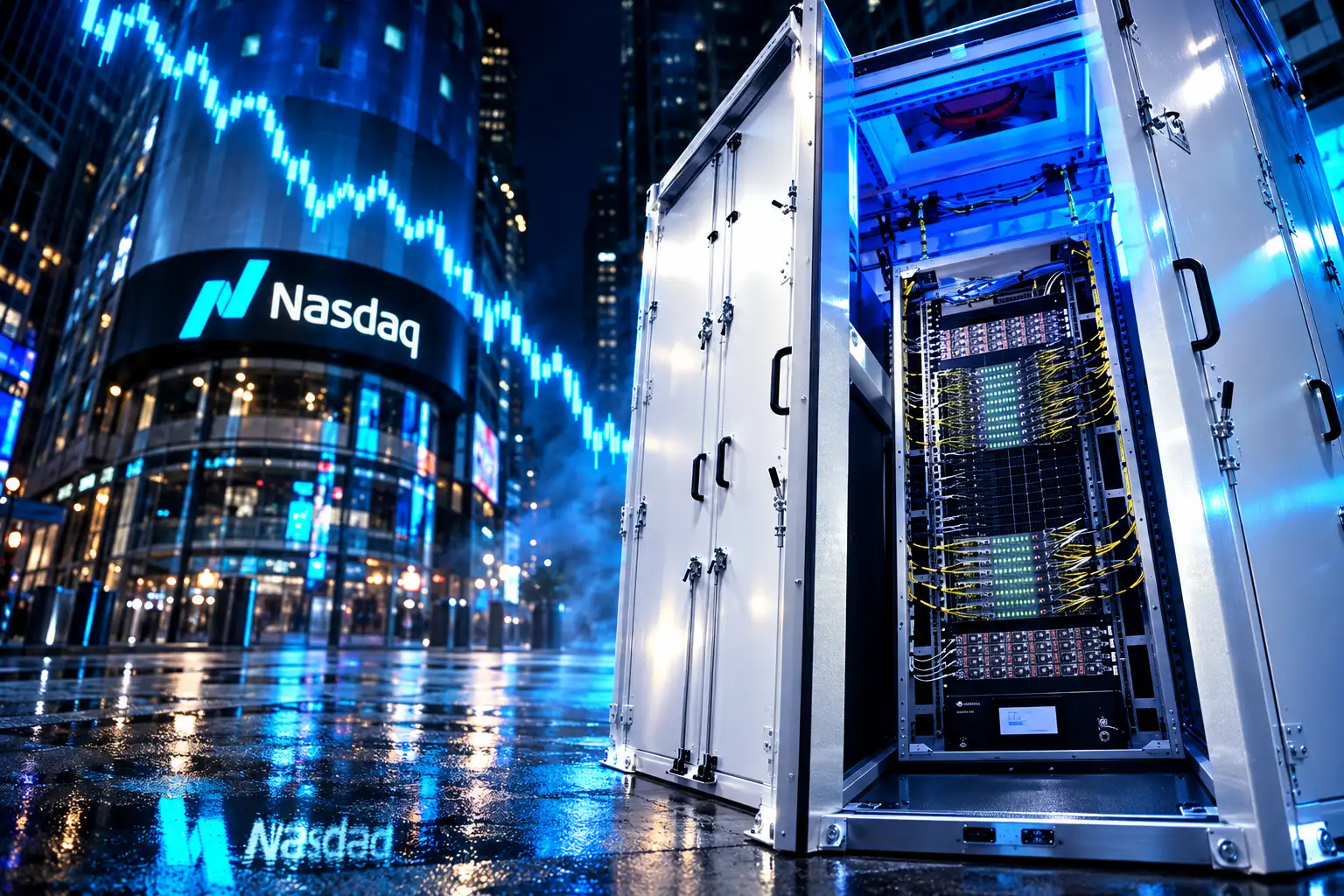
Nasdaq fell 2.1% on October 16 as CoreWeave bonds yielded 15% to 16%, putting Blackstone, Magnetar and other AI lenders in the spotlight.

The Nasdaq Composite dropped 573 points, or 2.1%, to 26,140 on October 16. Chipmakers and AI cloud names led the slide as credit desks repriced the debt that paid for the data-center boom.
The index closed out its worst week since June. The overlooked book is not the tape in the chips. It is the private-credit funds and project lenders who financed CoreWeave and the campuses that company rents.
Nasdaq Closes Out Its Worst Week Since June
The S&P 500 fell 1.1% and the Dow Jones Industrial Average slipped 0.3%. CoreWeave shares slid nearly 12% on October 16 and dropped roughly 24% for the week, after a midweek bounce failed to hold.
Adam Crisafulli, head of Vital Knowledge, said so-called neocloud firms that rent the raw compute AI models need have been funding a large share of capital spending with debt and new equity rather than cash from operations. That is the model the market spent the week testing.
Unsecured CoreWeave notes due 2031 and 2032 changed hands around 76.5 to 81 cents on the dollar, with yields near 15% to 16%. The cost of insuring the company’s debt rose to about 1,200 basis points, per LSEG data cited in market notes this week. Elon Musk wrote “yikes” after the 15% yield made the rounds.
FRIDAY’S TECH TAPE
| Name | October 16 move |
|---|---|
| Micron Technology | -5.6% |
| Advanced Micro Devices | -6% |
| Intel | -5.8% |
| Broadcom | -4.5% |
| CoreWeave | nearly -12% |
Nvidia-backed CoreWeave listed on Nasdaq in March 2025. A chart of its bonds yielding about 15% spread on October 14, the stock’s worst one-day drop since February, and the credit market did not ease even after Nvidia’s chief, Jensen Huang, said he did not expect to have to rescue the company.
Who Lent the Money Against the GPUs?
LSEG puts CoreWeave’s debt near $50 billion, a later-inclusive total that is larger than the last quarterly filing. The money did not arrive from a single bank window. It came in stacked GPU-backed loans and then in junk-rated notes, with Blackstone, Magnetar, Carlyle and BlackRock among the names on the earlier facilities.
THE GPU-BACKED LOAN STACK
- 2023, $2.3 billion: A graphics-chip-backed facility led by Magnetar Capital and Blackstone Tactical Opportunities.
- 2024, $7.5 billion: A larger loan that brought in Blackstone, Magnetar, Carlyle, BlackRock and other investors.
- March 2026, $8.5 billion: A delayed-draw term loan anchored by Blackstone Credit & Insurance, with MUFG and Morgan Stanley as co-structuring agents.
James Martin, senior U.S. credit strategist at SMBC, said buyers have not walked away from data-center paper. “There is still a price. Investors are still comfortable financing it, but they’re demanding more compensation for it,” he said, talking about projects that are further from completion.
Carlyle, which sat in the 2024 syndicate, told its own clients in an October 1 paper that the AI compute buildout could need roughly $1 trillion of private credit, more than half of the industry’s current assets under management. Jason Thomas, the firm’s head of global research and investment strategy, and Mark Jenkins, co-president and head of global credit and insurance, warned lenders to set concentration limits before that book gets any larger.
Nvidia has agreed to buy unsold CoreWeave capacity through April 13, 2032. That backstop is why some equity desks still treat the name as a demand story. It did not stop unsecured yields from moving into distressed territory.
$35.1 Billion on the June Balance Sheet
The last public filing is cleaner than the $50 billion headline, and it is still a fast-growing pile. CoreWeave’s June 30 condensed balance sheet shows $35.1 billion of debt, up 64% from $21.4 billion at the end of 2025.
COREWEAVE AT JUNE 30, 2026
- Total debt: $35.1 billion, including $7.5 billion due within 12 months of the filing date.
- Cash: $5.524 billion, against $77.070 billion of assets, up from $49.302 billion six months earlier.
- Contracted work: $103.7 billion of remaining performance obligations, with 41%, or about $42.5 billion, due to be recognized through June 30, 2028.
- Second-quarter sales: $2.575 billion of revenue in the three months ended June 30.
Management points to those contracts as take-or-pay paper that should service the associated loans. The company has also raised its 2026 capital spending plan to $35 billion to $39 billion, which means it still has to fund a large share of this year’s build at today’s higher rates.
Co-founder Brannin McBee said CoreWeave was seeking an investment-grade rating that would open the door to “unlimited” capital from insurers. S&P Global rates the company B+, still junk. Gil Luria, head of technology research at D.A. Davidson, put the equity case in harsher terms: if the AI investment cycle turns, he said, “the equity value is going to be zero.”
The company told staff it added more than $25 billion of new customer commitments early in the third quarter. That figure will be tested when third-quarter results arrive, expected around November 10.
Project Bonds That Rest on One Tenant
CoreWeave’s own notes are only the first stack. A second stack sits in high-yield project bonds issued by special-purpose vehicles that own data halls and collect rent. Several of those vehicles list CoreWeave as the sole tenant, so a hit to the lessee is a hit to the landlord’s debt service.
Fitch assigned DDC 01 Propco LLC a BB- rating with a positive outlook on a 15-year triple-net lease to CoreWeave. The agency’s base case still produced thin coverage, about 1.08 times debt service through 2031, and Fitch said the rating is constrained by CoreWeave’s own credit profile. In plain language, the building’s bonds cannot score much better than the tenant who pays the rent.
That is the circular piece the equity market was slow to price. The same name is the distressed borrower and the rent check behind other distressed data-center paper. A GPU is both collateral and the machine that is supposed to earn the coupon. When those two roles share one credit, a 16% yield on the parent is not a local problem.
Thursday’s rebound in the stock, after Huang pushed back on bailout talk, left the bonds where they were. Friday the credit view won again. For anyone holding the lease-backed notes, that sequence is the tell: equity can argue about backlog, while the people who lent against the building already marked the tenant weaker.
Anthropic IPO Talk Slips Toward $1.5 Trillion
The same week, investors who had been treating a giant model-lab listing as a $2 trillion event started talking about a lower number. At an October 14 investor day in San Francisco, some current and prospective buyers discussed valuing Anthropic around $1.5 trillion, $500 billion under the earlier target, after reviewing fresh figures.
Anthropic told those investors third-quarter revenue reached $16.8 billion, up 45% from $11.6 billion in the second quarter and $4.7 billion in the first. Growth is still rapid. It is no longer doubling every quarter, and that deceleration is what the $1.5 trillion talk is about. The company also said it was profitable on an adjusted basis in the third quarter.
The draft filing trail is older. Anthropic confidentially submitted a Form S-1 on June 1 and has pointed toward a November listing. The same disclosures show about $518 billion of computing commitments over a decade, much of it hard to cancel, and a 2025 net loss of about $42 billion. A weak reception would land on OpenAI’s expected listing next year, which is why a private-lab markdown now feeds the public AI tape.
Crisafulli flagged Anthropic’s ability to keep that revenue pace as one of the worries hanging over Friday’s session. The model layer and the power layer are being marked on the same day, for the same reason: the cash to pay for compute is arriving more slowly than the bills to build it.
The $8.5 Trillion Hole in the Revenue Math
Gartner put a research stamp on that gap on October 14. Will Sommer, a senior director analyst at the firm, said AI providers are on track to spend nearly $1 trillion on infrastructure in 2026 and another $6 trillion from 2027 through 2030. The revenue those sites can claim does not match the hurdle.
Through 2030, AI data center owners would need to generate a cumulative $8.5 trillion in revenue to cover announced capital spending, financing costs, and a 12% return on invested capital (ROIC), which we assume to be the hurdle rate of investment capital.
Will Sommer, Senior Director Analyst, Gartner
Gartner forecasts no more than $3.6 trillion of enterprise and consumer AI revenue that can be attributed to those data centers over the same stretch. Owners would need $8.5 trillion of revenue through 2030 to clear that 12% hurdle. The firm says more than $3.5 trillion of infrastructure spending could be exposed to impairment by the end of 2030 if the current pace holds.
GARTNER’S 2030 GAP
| Measure | Gartner figure |
|---|---|
| Revenue needed through 2030, with 12% ROIC | $8.5 trillion |
| Attributable AI revenue forecast | no more than $3.6 trillion |
| Infrastructure spend in 2026 | nearly $1 trillion |
| Neoclouds still independent by 2030 | over 80% expected to cease |
Sommer said cost pressure and a thin business model will force over 80% of neocloud providers to cease independent operations by 2030, by sale, partnership or failure. Hyperscalers can absorb more of that hit because they have other cash businesses. CoreWeave does not.
Warsh Already Lifted Rates Into This Buildout
The credit squeeze is arriving into a tighter policy setting, not an easy one. The Federal Open Market Committee raised the federal funds rate in September by a quarter point to a range of 3.75% to 4%, on a 12-0 vote, the first increase of Kevin Warsh’s chairmanship. The statement said inflation remains elevated and that the move would support a faster return to the 2% goal.
The next meeting is October 28-29. Most traders still expect no change at that sitting. CME FedWatch futures probabilities put the odds of a hike at the December meeting at 74.3%, up from 50.2% a month earlier. The 10-year Treasury yield held at 5.1% on October 16, after a burst earlier in the month to a two-decade high.
Warsh, in Bangkok for a gathering of financial officials on October 16, offered no hint on the next move. For a borrower that still has to fund a $35 billion to $39 billion 2026 build, a funds rate at 3.75% to 4% and a 10-year at 5.1% are the terms that turned a 9% coupon into a 16% market yield.
The people who already lent against those GPUs cannot mark the loans to a software multiple. They mark them to rent, to chip life, and to whether Anthropic, Microsoft and OpenAI keep paying for the halls. Friday was the first session where the rest of the market traded that way too.
Disclaimer: This article is news reporting and market analysis based on company filings, central-bank statements, research notes and trading levels. It is for information only and is not investment, trading or tax advice, and it is not a recommendation to buy, sell or hold any stock, bond, loan or fund. Readers should consult a licensed financial adviser or other registered investment professional before acting on any security or credit instrument named here. Market prices, yields, ratings and forward-looking figures reflect the sources as of the dates given in the piece and can change without notice.

Final Fantasy Resonance Turns a Dead Gacha Into HD-2D

PHP2Shell Forced Sites Offline While Exploits Stalled

Kindle+ Folds AI Audiobooks Into the Page-Read Fund

Chip Stocks Fall as the Bond Rally Cheapens AI Spend

Comcast’s Record Odyssey Quarter Doubles as the Exit

Microsoft 365 Auth Fault Took Down Exchange and Teams

Xbox Caps Game Pass Cloud Gaming at 15 Hours

OpenClaw 2.0 Ships a Team Workplace With Host-Trust Defaults

OpenAI Unveils GPT-6 Astra With a Critical Cyber Label

Diesel Breaks Its Record as the White House Claims Credit
-
 NEWS2 months ago
Microsoft 365 Auth Fault Took Down Exchange and Teams
-
 GAMING2 months ago
Xbox Caps Game Pass Cloud Gaming at 15 Hours
-
 NEWS2 months ago
OpenAI Unveils GPT-6 Astra With a Critical Cyber Label
-
 NEWS2 months ago
OpenClaw 2.0 Ships a Team Workplace With Host-Trust Defaults
-
 BUSINESS2 months ago
Diesel Breaks Its Record as the White House Claims Credit
-

 LIFESTYLE2 months ago
Squishy Dumpling Toys Recalled After Hiding Illegal Water Beads
-

 BUSINESS2 months ago
ChargePoint Stock Rally Prices Wilmer’s Three-Year Cash Plan
-

 AUTO2 months ago
Tesla Puts Its Wheel-Free Cybercab on Austin Streets