
NEWS
Royal Navy Fires Its First War-Shot NSM at USS Klakring
HMS Portland’s first war-shot Naval Strike Missile hit USS Klakring off Scotland, closing a Harpoon-era gap from only two fitted frigates.

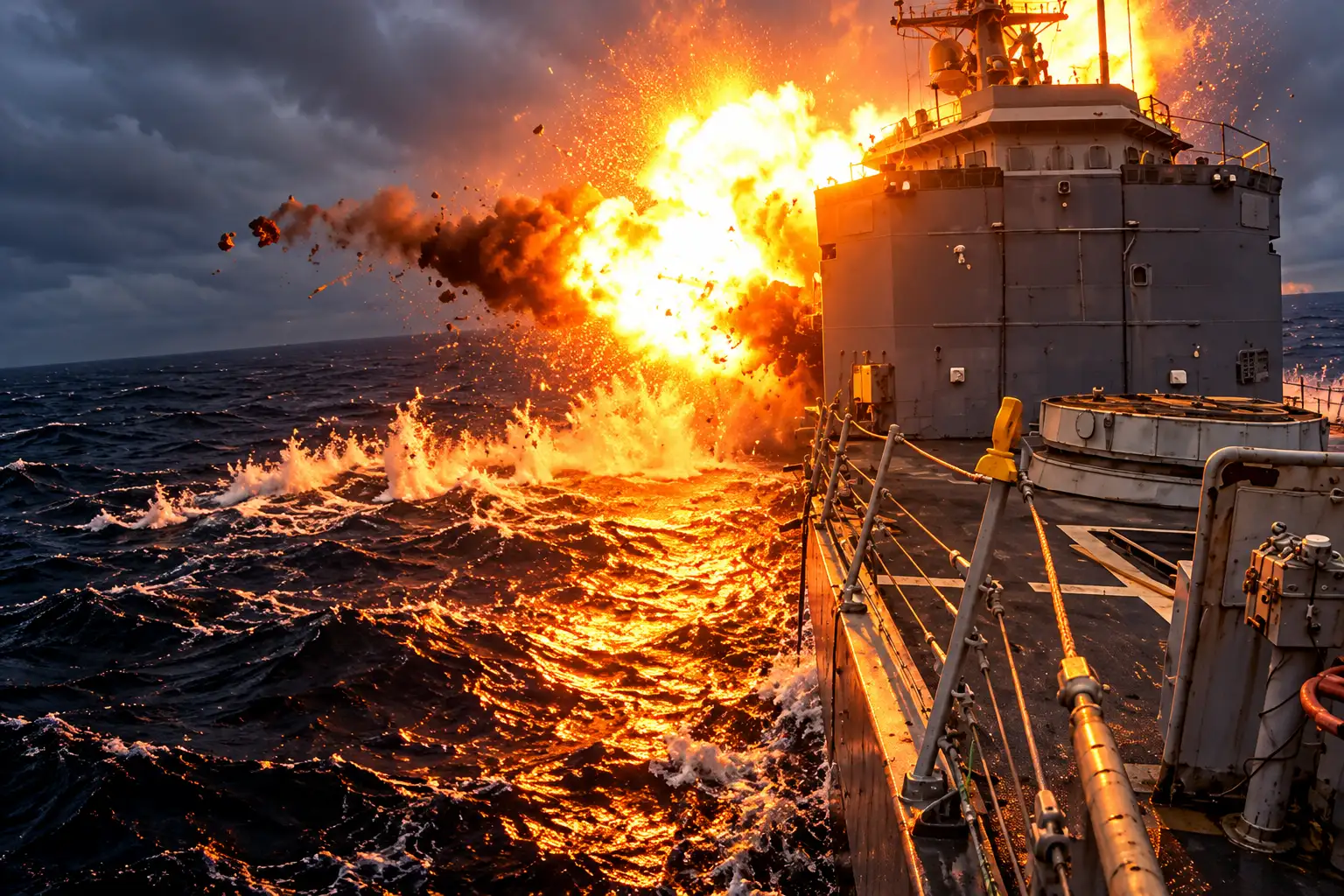
HMS Portland fired a live Naval Strike Missile at the retired American frigate USS Klakring on 21 September 2026. The round hit the hulk 150 nautical miles (about 170 miles) off the Outer Hebrides, the Royal Navy’s first war-shot of the weapon at a real ship.
A Wildcat from 815 Naval Air Squadron, flying from Portland’s deck, then put Sea Venom on the same hull. The kill shot came later from a Mk 48 Advanced Capability torpedo fired by the Virginia-class submarine USS Massachusetts, which sent the 4,100-ton Oliver Hazard Perry-class ship down in about 6,000 feet (1,800 metres) of water. The live serial sat inside Exercise Atlantic Thunder 2026, a U.S. 6th Fleet sinking exercise that ran from 14 to 25 September.
Harpoon Left a Hole the Fleet Has Just Fired Through
The British surface fleet has been waiting on this round since Harpoon left service in 2023. Britain signed a government-to-government buy of Kongsberg’s Naval Strike Missile in November 2022 as an interim anti-ship weapon, with an early fit planned for Type 23 frigates and Type 45 destroyers, and a heavier successor still years away.
HMS Somerset, the first Type 23 to embark NSM, test-fired one off Andøya, Norway, in September 2025 during Operation Aegir 25. That shot was against a floating range target. Portland’s round a year later carried a warhead and was aimed at a warship hull, which is why the navy is calling it the first operational firing.
Petty Officer James Kenyon, an above-water warfare specialist on Portland, pressed the trigger.
Being the first person to fire war-shot NSM and achieve a hit is a very proud moment, and one that will stay with me for the rest of my career. This was the culmination of over a year’s effort in planning and bringing the drills into service, and I am glad that I was able to contribute.
Petty Officer James Kenyon, above-water warfare specialist, HMS Portland
Kongsberg lists the missile at 407 kg and 3.96 metres, flying at high subsonic speed, with a range of more than 300 kilometres (162 nautical miles). The Royal Navy’s public line is more cautious, a sea-skimming shot of more than 100 miles. Both describe the same weapon; one is the maker’s sheet, the other is how the service talks about it.
FROM HARPOON OUT TO A LIVE ROUND
- November 2022: Britain agrees a government-to-government buy of NSM from Norway to replace Harpoon.
- 2023: Harpoon leaves Royal Navy service, leaving Type 23s without a long-range anti-ship missile.
- December 2024: HMS Portland completes NSM trials in Norway and loads eight missiles, becoming the second fitted frigate after Somerset.
- September 2025: HMS Somerset fires the first British NSM, at a floating target off Andøya.
- 21 September 2026: Portland fires a war-shot NSM at USS Klakring on the Hebrides range.
The last time the two navies ran this serial, in September 2022, HMS Westminster still had Harpoon. That Atlantic Thunder used the retired frigate ex-USS Boone and included the first live British Harpoon salvo since 2004. Four years later the British missile on the rail was Norwegian, and the hole Harpoon left was the point of the shoot.
What Hit the Hulk, in Order
The serial opened at long range and worked inward so each hit could be scored before the next weapon flew. USS Paul Ignatius, an Arleigh Burke-class destroyer, fired an anti-surface variant of the Standard Missile 6 to what 6th Fleet called its maximum damage and range; the navy did not publish the distance. NSM and Sea Venom followed from Portland and her helicopter. Massachusetts closed with the Mk 48, which 6th Fleet said was the final hit and the one that sank the hulk.
WEAPONS FIRED AT USS KLAKRING
| Weapon | Platform | Place in the serial |
|---|---|---|
| SM-6 (anti-surface) | USS Paul Ignatius (DDG 117) | Opened at maximum range |
| Naval Strike Missile | HMS Portland (F 79) | First British war-shot at a ship |
| Sea Venom | Wildcat, 815 Naval Air Squadron | First operational live round against a warship |
| Mk 48 ADCAP torpedo | USS Massachusetts (SSN 798) | Final hit; sank the hulk |
U.S. Navy and Royal Air Force P-8 maritime patrol aircraft, U.S. Air Force F-15E Strike Eagles, and sailors from Explosive Ordnance Disposal Mobile Unit 8 also took part, with forces assigned to U.S. Task Forces 65, 67, 68, 69 and 1060. Targeting ran through 6th Fleet and was shared with Portland, which also acted as a node in the strike net. Captain Kelechi Ndukwe, commander of Task Force 65, said the two navies talked to each other throughout the serial without a communications break.
Only Two Frigates Carry the Missile
The plan when NSM was bought was to fit 11 Royal Navy escorts, a mix of Type 23 frigates and Type 45 destroyers. The destroyers still have not received the system. HMS Richmond, which had been fitted, left the fleet in 2026. That leaves two Type 23s, Portland and Somerset, actually carrying NSM.
Portland is a Plymouth-based Duke-class frigate that entered service in 2001. She returned to sea in July 2026 after defect work, then went north for Atlantic Thunder. Lieutenant Commander Louise Kirkaldy, her principal warfare officer, called the NSM shot a test of modern maritime strike, and Commander Dafydd Bryden, Portland’s commanding officer, said firing live anti-ship missiles at a retired warship was a test of the people as much as the kit.
Expending a war-shot from a small stock drawn in part from Norwegian navy holdings is a choice. The Royal Navy still talks about NSM as a bridge to the Future Cruise Anti-Ship Weapon, now named Stratus, which is meant to be the heavy long-range round on Type 26 and Type 31 frigates fitted with Mk 41 vertical launch. Those ships are not yet in the fight. Until they are, two ageing Type 23s are the British surface fleet’s NSM battery.
Wildcat Runs the Full Kill Chain
Sea Venom is the smaller half of the same story. The missile is built to beat corvette-sized ships, or to knock a frigate or destroyer out of a fight rather than break it in half, and a Wildcat can carry four at once. MBDA, which makes it, gives a 30 kg-class warhead and a range of around 20 km. The first guided live firing from a Wildcat was at the Aberporth range in Wales in October 2024. Initial operating capability was declared during Operation Highmast in 2025. What had not been done, until this serial, was a live operational round against a warship.
The helicopter, working from Portland’s flight deck, ran the full chain: find, identify, shoot. That is the first Royal Navy firing of an operational NSM’s airborne partner, and the navy is treating the Sea Venom shot as the more useful aviation result, because a single 30 kg-class warhead was never going to sink a 4,100-ton frigate. The value sits in the sensor record of where it struck.
This was a landmark moment for the Wildcat Force. For the first time we demonstrated the live firing of an operational Sea Venom missile against a representative maritime target. More importantly, we proved our ability to execute the full maritime strike kill chain under realistic operational conditions.
Lieutenant Commander Rhydian Edwards, test and evaluation commander, Maritime Aviation Strike Operational Advantage Group
Edwards said the point was to give commanders confidence that Wildcat can find, fix and strike as part of a wider group, and that the lessons will feed tactics and training. The navy also says Sea Venom can be used over land and against harbour targets. Klakring, at the top of the missile’s design envelope, was a harsh first warship to try it on.
A Perry-Class Hulk, Towed From Philadelphia
Ex-USS Klakring (FFG 42) entered U.S. Navy service on 20 August 1983 and was decommissioned on 22 March 2013. She is 453 feet (138 metres) long, built at Bath Iron Works, and named for Rear Adm. Thomas B. Klakring, who earned three Navy Crosses as commander of the submarine USS Guardfish in the Second World War. After 13 years laid up in Philadelphia, she was towed across the Atlantic in August 2026 for this shoot.
Ndukwe said the United States paid for the tow and the United Kingdom paid for the range, a split that helps explain why a British Type 23 being scrapped was not the target. Naval Surface Warfare Center Carderock and Naval Information Warfare Center Pacific fitted sensors through the hull before she sailed, so battle-damage data could be pulled off after each weapon. 6th Fleet says that work will take months and will be shared with the UK.
HOW THE HULK WAS PREPARED
- The permit: Former U.S. Navy ships used as SINKEX hulks are prepared under an Environmental Protection Agency general permit issued under the Marine Protection, Research and Sanctuaries Act.
- The distance rule: Target vessels must be sunk at least 50 nautical miles from land and in at least 6,000 feet of water; Klakring went down 150 nautical miles out, at about that depth, in what Ndukwe called a deep valley off the Hebrides.
- The clean: Fuel tanks and lines are emptied and flushed, and detachable material that can pollute or float is stripped, including PCB-bearing kit on older hulls, before the tow.
- The watch: Trained crews monitored above and below the surface for whales and dolphins before live fire, in line with UK Ministry of Defence marine policy.
Ndukwe said the wreck will become a natural reef, and that the environmental approvals were in hand before the exercise. An underwater survey of the hull is planned once she is on the bottom.
Why the Ship Still Needed a Torpedo
A 43-year-old frigate that has been cleaned, instrumented and left undefended is not a peer combatant. The serial was built to spend several weapons on one hull, longest range first, which is why SM-6, NSM and Sea Venom all flew before the Mk 48. That the ship stayed up until the torpedo is a fact about how the day was designed, and about warhead size, not a simple scorecard of failure.
SM-6 is still an air-defence missile in origin, with a blast-fragmentation warhead meant for aircraft and incoming rounds. Sea Venom was sized for fast attack craft and corvettes. NSM, with a titanium-cased blast-fragmentation warhead in the 120 kg class, is the round in this mix that is actually meant to stop a ship of Klakring’s size, and even then navies fire it in salvos rather than as a single proof shot. Disable is the working aim; sink is a bonus, and a SINKEX keeps going until the hulk is gone because the sensors on board are the product.
Slow-motion film of the hits still showed fittings on the superstructure, which is what you get when a hulk is stripped for the environment rather than gutted to a bare shell. No uncrewed systems took part in the sinking, Ndukwe confirmed, even though a Ministry of Defence request for information in 2025 had talked up uncrewed underwater work around this exercise. Crewed ships, a submarine, a helicopter and patrol aircraft did the shooting.
Ndukwe put the official line in one sentence: the serial “delivers a clear message to adversaries that the U.S. Navy and Royal Navy remain a ready allied force.” The sharper reading is narrower. Britain can now put a live NSM and a live Sea Venom on a steel hull in the approaches to the North Atlantic. It can do that from two frigates, on a borrowed American target, with a U.S. submarine standing by to finish the job.
The 2028 Repeat Is Already in Planning
Planning for the next Atlantic Thunder has already started, with 2028 as the aim, half the gap between 2022 and 2026. Lieutenant Commander Paul Atkins, the UK lead project officer, said the 2026 serial showed the two navies can share targeting and fight as one group in poor North Atlantic weather. Primary aims were met, Ndukwe said, even though the weather got in the way.
By 2028 the Royal Navy wants NSM on more hulls and a first Type 26 in the water. Until those ships arrive, the war-shot that hit Klakring is both a closed chapter on the Harpoon gap and a reminder of how few British decks can repeat it.

Final Fantasy Resonance Turns a Dead Gacha Into HD-2D

PHP2Shell Forced Sites Offline While Exploits Stalled

Kindle+ Folds AI Audiobooks Into the Page-Read Fund

Chip Stocks Fall as the Bond Rally Cheapens AI Spend

Comcast’s Record Odyssey Quarter Doubles as the Exit

Microsoft 365 Auth Fault Took Down Exchange and Teams

Xbox Caps Game Pass Cloud Gaming at 15 Hours

OpenClaw 2.0 Ships a Team Workplace With Host-Trust Defaults

OpenAI Unveils GPT-6 Astra With a Critical Cyber Label

Diesel Breaks Its Record as the White House Claims Credit
-
 NEWS2 months ago
Microsoft 365 Auth Fault Took Down Exchange and Teams
-
 GAMING2 months ago
Xbox Caps Game Pass Cloud Gaming at 15 Hours
-
 NEWS2 months ago
OpenAI Unveils GPT-6 Astra With a Critical Cyber Label
-
 NEWS2 months ago
OpenClaw 2.0 Ships a Team Workplace With Host-Trust Defaults
-
 BUSINESS2 months ago
Diesel Breaks Its Record as the White House Claims Credit
-

 LIFESTYLE2 months ago
Squishy Dumpling Toys Recalled After Hiding Illegal Water Beads
-

 BUSINESS2 months ago
ChargePoint Stock Rally Prices Wilmer’s Three-Year Cash Plan
-

 AUTO2 months ago
Tesla Puts Its Wheel-Free Cybercab on Austin Streets