
NEWS
HP Built the Googlebook That Makes the OS Look Late
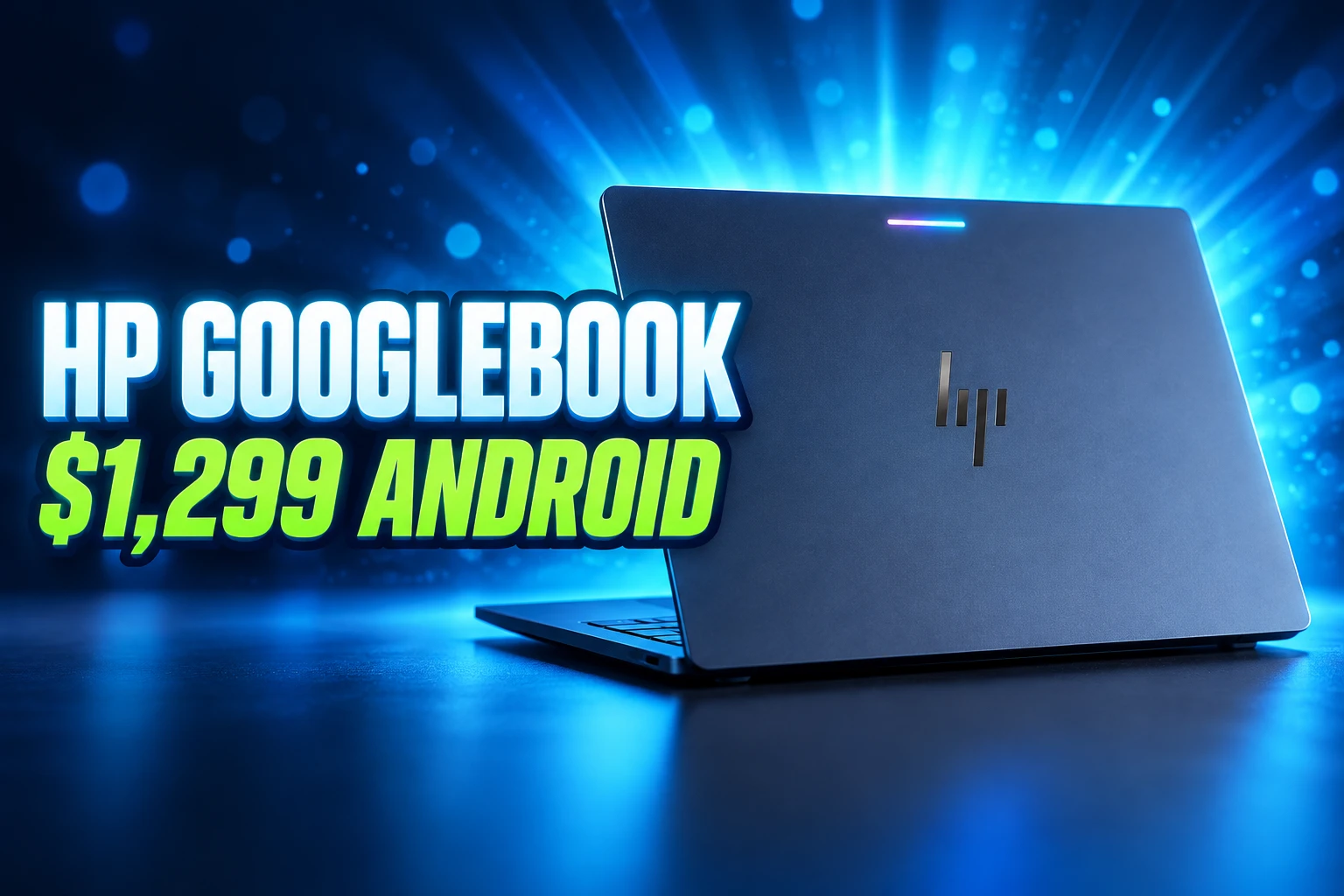
HP’s Googlebook 14 is a $1,299 OLED Snapdragon clamshell whose chassis is ready, while Googlebook OS still sells a phone laptop at MacBook Air money.

HP’s Googlebook 14 is a 2.74-pound OLED laptop that starts at $1,299 and still runs a phone-first OS. The 14-inch aluminum clamshell is 10.9 mm thick and uses a 12-core Snapdragon X Elite. Google is selling that build with 16 GB of memory and a 512 GB drive.
Hands-on use treats the keyboard, haptic trackpad, and screen as ready for a MacBook Air fight. What you actually buy is Googlebook OS, and that is the part that still behaves like a phone with a nicer lid.
HP Nailed the Thin OLED Clamshell
HP’s first Googlebook is a quiet, dense object, not a plastic Chromebook with extra RAM. The deck is aluminum with little flex, and the rear gap for air almost reads as a handle when the lid is shut. It is not a flat, edgeless slab, and after a stretch of daily use that silhouette starts to feel considered rather than leftover.
Google’s shop listing puts the machine from $1,299 with 16 GB of RAM and 512 GB of storage, at 2.74 pounds, with a 14-inch 2.8K OLED touchscreen. HP’s own spec sheet lists a starting weight of 1.24 kg and a rear height of 1.09 cm, which is the same 10.9 mm figure. Memory is soldered LPDDR5x-8448 in 16 GB or 32 GB. Storage steps are 256 GB, 512 GB, and 1 TB.
The chip is a 12-core Snapdragon X Elite X1E-80-100 with a 4.0 GHz boost, an Adreno GPU, and a Hexagon NPU rated at 45 TOPS. Boot is near instant because Googlebook sits on Android. Everyday speed is hard to pick at. The hiccups that show up are software stalls, not a machine that feels underfed.
The Keyboard and the Trackpad
The keyboard is the surprise in a chassis this thin. Key travel is deep, the clack is present without filling a café, and the backlight is even. Googlebook’s shortcuts take a sitting to learn. The top-row icons for fullscreen (F4) and screenshot (F5) are still vague, which is a software drawing problem on otherwise good switches.
Google required haptic trackpads on this first wave, and HP’s pad is wide enough to live with, sitting up against the spacebar. The click feels a touch hollow next to the best glass pads, and that is the only hardware nit that keeps coming back.
The 14-Inch Panel and the 70 Wh Pack
The 2880 x 1800 OLED is the showpiece: 120 Hz, 0.2 ms, 100% DCI-P3, Gorilla Glass 3, touch, and 500 nits. Color and contrast are the reason you notice the lid. Direct sun still washes it. That is a fair trade for a 14-inch OLED at this thickness, and a poor one if you work on a patio.
The pack is a 4-cell 70 Wh design. HP quotes a 65 W USB-C GaN brick and a 50% charge in 45 minutes with the machine off. Google’s shop claims up to 19 hours on a controlled web-browse test for this model, while the wider Googlebook line was announced at up to 14 hours. Standby is fine, and Android-style battery graphs are clearer than what Windows still ships. It is good endurance. It is not the reason you pick this over an Air.
Security hardware is not a sticker. Google Titan C sits in the machine, with a fingerprint reader and face unlock, plus a 5 MP camera, Wi-Fi 7, and Bluetooth 5.4. Ports are two USB-C connectors that can drive DisplayPort 1.4 at 4K 60 Hz, and a 3.5 mm combo jack. There is no HDMI and no card reader. HP announced the machine in Atmospheric Blue, and Google requires the Glowbar on every Googlebook, the lid light that sweeps for charge and wakes for Gemini.
From your first task to your last, the new HP Googlebook 14 is designed to keep your momentum going.
Designed for Gemini Intelligence and powered by Snapdragon® X Elite, it combines fast, responsive performance, an ultra-thin design, and up to 19 hours of battery life so it's… pic.twitter.com/cenvzDgiTy
— HP (@HP) September 21, 2026
Qualcomm president Cristiano Amon congratulated HP on pairing that chassis with Gemini and Snapdragon X Elite. The hardware pitch writes itself. The operating system is the part the ad does not have to live with all day.
$1,299 Sits Next to a MacBook Air
Google opened the Googlebook category at $899 on September 21, 2026, with machines from Acer, ASUS, Dell, HP, and Lenovo, and US shelf dates of October 4 (October 5 in Canada, the UK, Ireland, France, Germany, and Australia). HP’s 16 GB / 512 GB Googlebook 14 is not that $899 machine. Best Buy rings it at $1,299, the same list Apple posts for a 13-inch M5 MacBook Air with 16 GB and 512 GB.
THE $1,299 NEIGHBORHOOD
| Machine | Listed price | OS | Screen | Chip in this build |
|---|---|---|---|---|
| HP Googlebook 14 (16 GB, 512 GB) | $1,299 | Googlebook OS | 14-inch 2880 x 1800 OLED, 120 Hz | Snapdragon X Elite |
| 13-inch MacBook Air M5 (16 GB, 512 GB) | $1,299 | macOS | 13.6-inch Liquid Retina | Apple M5 |
| Acer Googlebook 14 (16 GB, 512 GB) | $899 | Googlebook OS | 14-inch 3K OLED, 120 Hz | Intel Core Ultra 5 |
| Dell XPS Googlebook (16 GB, 512 GB) | $999 | Googlebook OS | 13.4-inch 2.5K touch | Snapdragon X Elite |
Lenovo’s 15.3-inch Googlebook is $1,099 at the same shops. The HP is the expensive Googlebook in that set, $400 above Acer’s 14-inch, for Snapdragon X Elite, HP’s keyboard, and a 14-inch 120 Hz OLED. Every row in that table that runs Googlebook OS is the same software bet. Only one of them asks for Air money.
Google sweetens the HP with 12 months of Google AI Pro, a $249.99 value, including 5 TB of cloud storage and Gemini Pro, plus a limited bundle it values at up to $290+ covering BandLab, Adobe Photoshop, Luminar, CapCut, YouTube Premium, and GeForce NOW. Those are subscriptions and streaming seats. They are not the missing decades of desktop tools that still live on Windows, macOS, and Linux.
Pixelbook Already Tried This Premium Bet
Alex Kuscher, Google’s senior director of laptops and tablets, opened the May 12, 2026 Googlebook pitch by going back to Chromebooks. “Over 15 years ago, we introduced the Chromebook, a laptop built for a cloud-first world,” he wrote. That line is the tell. Chromebooks became normal because they were cheap enough for school carts, not because they beat a MacBook.
Google already tested the other direction. In October 2017 the Pixelbook arrived as a $999 convertible, climbing to $1,649 for the Core i7, 16 GB, and 512 GB build. The metal was admired. The question, then as now, was why pay Mac money for Chrome OS when a Windows laptop or a MacBook at the same price could open the apps people already paid for.
FROM CHEAP CHROMEBOOK TO $1,299 GOOGLEBOOK
- 2011: Google introduces the Chromebook as a low-cost, cloud-first laptop, the history Kuscher cited in May 2026.
- 2017: Pixelbook ships from $999 to $1,649, Google’s last serious attempt to sell Chrome OS as premium hardware.
- 2018: Chrome OS adds a Linux environment, the workaround that later let Chromebooks run real desktop tools.
- May 12, 2026: Google teases Googlebook as Android plus Chrome OS desktop foundations, built around Gemini.
- September 21, 2026: Pre-orders open from $899, with 10 years of OS updates promised.
- October 4, 2026: The first Googlebooks, including HP’s 14, reach US shelves.
Pixelbook did not fail because the hinge was wrong. It failed because the software ceiling sat under the price. Googlebook is the same ceiling with a new kernel story and a Glowbar.
A Terminal Built for Gemini, Not Apps
Googlebook OS is Android underneath, with desktop pieces taken from Chrome OS, Play Store apps, and desktop Chrome. John Solomon, vice president and general manager of laptops, tablets, and Android Enterprise, calls it the laptop your Android phone has been waiting for. That sentence is the strategy. It is also the limit. You buy a laptop to do the work a phone cannot. This one still leans on the phone’s app drawer, a curated set of “compliant” web apps, and a Linux box that is no longer the Chromebook escape hatch.
Chrome OS spent years letting people install Debian apps and launch them from the shelf. Googlebook ships a terminal instead. On October 13, 2026, Group Product Manager Cyrus Stoller described a VM-backed Linux terminal preview for AI workflows, not a general desktop. Commands run inside an isolated Debian VM. apt, git, ssh, Node.js, Python, Ruby, Go, and Rust are in the preview. Google says its own engineers have used Googlebooks to build a Linux kernel. GUI Linux apps can be made to run, and Google has said they are not the focus of this first release. A later roadmap puts those apps in the launcher, with GPU and NPU acceleration still to come.
Today, getting the most out of AI workflows requires access to a terminal with a command line, even if someone doesn’t identify as a programmer or software developer.
Cyrus Stoller, Group Product Manager, Laptops and Tablets, Android Developers Blog
That is a honest product statement, and a brutal one on a $1,299 HP. The Linux environment is a sandbox for agents such as Antigravity, with sudo inside the VM and a Level 5 pKVM hypervisor Google calls a first for laptops. It is not how a photographer opens a full desktop catalog, or how a researcher opens the one niche tool that never landed on Play. There is no translation layer here for Windows or macOS software. Google has those research lines elsewhere. They are not in this OS.
This Chassis Already Hosts Another Desktop
The HP’s Snapdragon board is not a toy, which is why people immediately tried to put other systems on it. Google software engineer Merck Hung, posting his own views, wrote that he had “Mac OS X Golden Gate 27.0 running on HP Googlebook 14 (Snapdragon X Elite)” through the Android Virtualization Framework, an ARM64-to-ARM64 translator, and a Metal-to-Vulkan translator, without KVM, which he noted needs root.
The experiment looked like a Hackintosh reunion, and the frame rate in that setup looked rough. Nobody should buy this HP to run macOS. The useful fact is simpler. The metal, the NPU, and Android’s own virtualization stack already have enough headroom that a desktop from another vendor can be coaxed onto the same board, while Googlebook itself still will not put a Linux window in the launcher.
Google has also confirmed Googlebook bootloaders can be unlocked, which is the kind of Android leftover Chromebooks never offered this freely. That openness is exciting for people who like to tinker. It is a warning light for anyone paying $1,299 for a finished PC.
What Google Means by a Phone Laptop
Google’s answer is continuity with Android, not a bigger app catalog. Sign-in is supposed to carry phone settings, passwords, Wi-Fi networks, and messages, with end-to-end encryption. Magic Pointer, built with DeepMind, wakes Gemini when you wiggle the cursor over something on screen. Rambler sits beside the Quick Insert key and turns speech into formatted notes. Create My Widget builds desktop widgets from a prompt. The Glowbar is the exterior tell that this is a Googlebook, not a quiet Windows clone.
THE PHONE FEATURES GOOGLE IS SELLING
- Continue On: A task started in a phone app such as BandLab is supposed to resume from the Googlebook taskbar.
- Files: The laptop Files app can search and open photos and documents that still live on the phone, without a manual copy.
- Cast My Apps: A phone app can stream into a desktop window, which is how Google wants you to grab a one-time code or place a food order without unlocking the handset.
Those three tricks are real, and they are the best case for the machine if your life already runs on a Pixel or another Android phone. They do not make Photoshop a full desktop suite, they do not restore the Linux apps Chromebooks already had, and they do not explain the $400 jump from Acer’s Googlebook 14 to HP’s. You are paying HP for the keyboard, the 14-inch 120 Hz OLED, and the Snapdragon board. You are paying Google for a thesis that a laptop is the phone’s companion.
Solomon’s launch post leans on that companion line, then lists Netflix, HBO Max, Play games, and a year of GeForce NOW for “AAA PC titles you own.” Streaming and a cloud-gaming seat are fine. They are what a $899 Googlebook can also do. HP’s 14 is the first Googlebook that makes you feel the missing desktop, because nothing in the chassis gives the OS an excuse.
Cheaper Googlebooks Make This One a Showpiece
Googlebook OS will get better. Chrome 155 already widened web-app installs. Better Together sync is still landing, including Samsung phones. Stoller’s terminal post is explicit that the Linux VM is a preview. Updates are promised for 10 years. That does not change the receipt on the HP. The 16 GB / 512 GB Googlebook 14 is $1,299 next to an M5 Air at the same list, and $400 above an Acer that runs the same OS on a 14-inch 3K OLED.
If Googlebook is going to repeat Chromebook’s actual trick, it needs the cheap machines, not a 10.9 mm HP that already types like a flagship. The HP Googlebook 14 is the proof the partners can build the metal. Until the OS can open the apps a $1,299 laptop is supposed to open, this one is the expensive demo unit for a platform that is still arguing with a phone.

Final Fantasy Resonance Turns a Dead Gacha Into HD-2D

PHP2Shell Forced Sites Offline While Exploits Stalled

Kindle+ Folds AI Audiobooks Into the Page-Read Fund

Chip Stocks Fall as the Bond Rally Cheapens AI Spend

Comcast’s Record Odyssey Quarter Doubles as the Exit

Microsoft 365 Auth Fault Took Down Exchange and Teams

Xbox Caps Game Pass Cloud Gaming at 15 Hours

OpenClaw 2.0 Ships a Team Workplace With Host-Trust Defaults

OpenAI Unveils GPT-6 Astra With a Critical Cyber Label

Diesel Breaks Its Record as the White House Claims Credit
-
 NEWS2 months ago
Microsoft 365 Auth Fault Took Down Exchange and Teams
-
 GAMING2 months ago
Xbox Caps Game Pass Cloud Gaming at 15 Hours
-
 NEWS2 months ago
OpenAI Unveils GPT-6 Astra With a Critical Cyber Label
-
 NEWS2 months ago
OpenClaw 2.0 Ships a Team Workplace With Host-Trust Defaults
-
 BUSINESS2 months ago
Diesel Breaks Its Record as the White House Claims Credit
-

 LIFESTYLE2 months ago
Squishy Dumpling Toys Recalled After Hiding Illegal Water Beads
-

 BUSINESS2 months ago
ChargePoint Stock Rally Prices Wilmer’s Three-Year Cash Plan
-

 AUTO2 months ago
Tesla Puts Its Wheel-Free Cybercab on Austin Streets