
NEWS
The iPhone Ultra Trades Face ID for a 4.5mm Fold
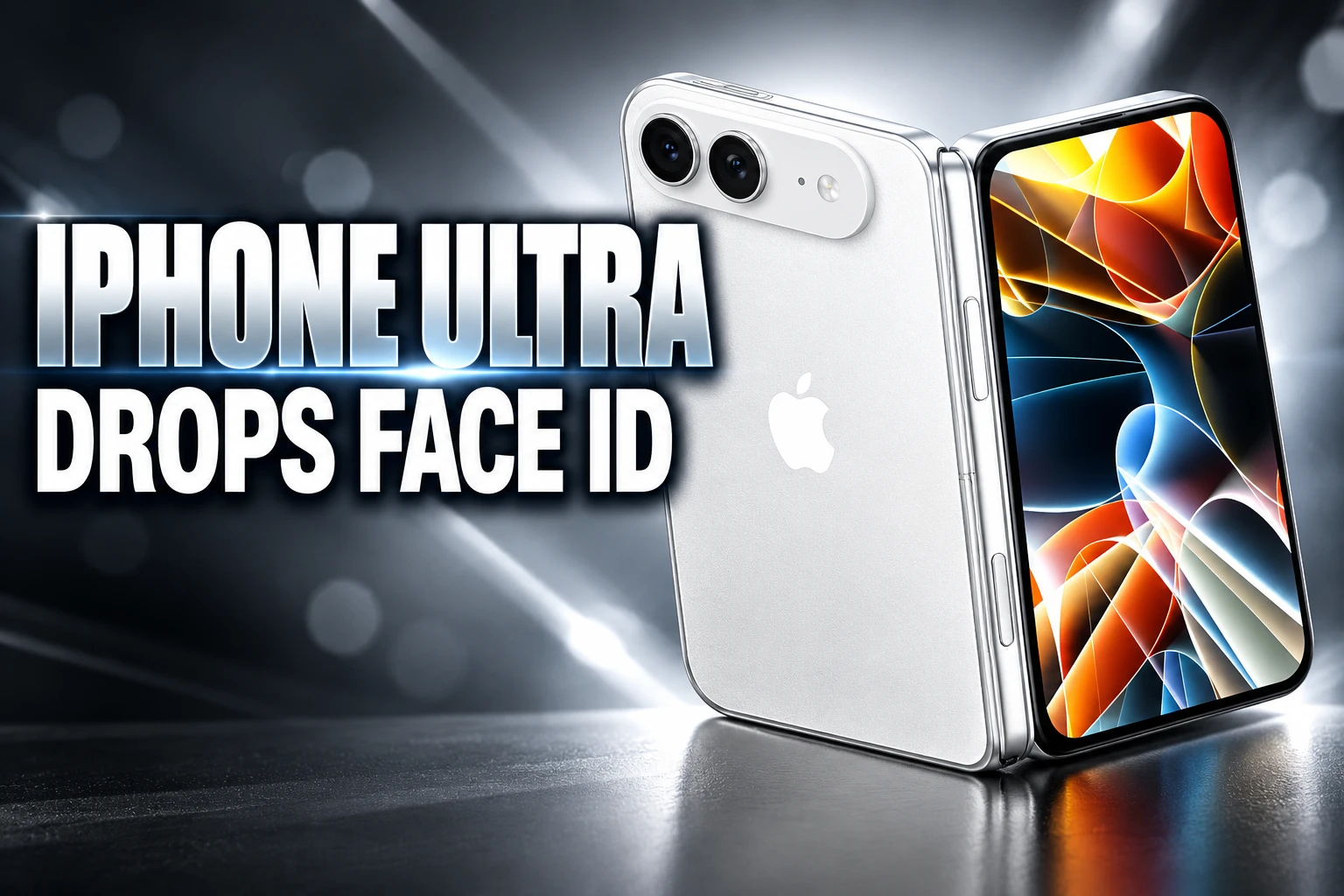
Rumors put Apple’s first foldable iPhone Ultra on stage September 9 as a 4.5mm phone that drops Face ID, keeps a crease, and starts near $2,099.

The iPhone Ultra is expected on September 9 as a 4.5mm foldable that drops Face ID to stay that thin. Apple has not confirmed the name, the price, or the crease. The latest rumors describe a first foldable that spent a decade in the lab and still ships as a set of trades.
Mark Gurman, who covers Apple, says the device will be the most significant overhaul in iPhone history. The overhaul is also a list of things the Ultra will not have.
The 4.5mm Body That Forced Touch ID
Unfolded, the book-style phone is rumored at 4.5mm, thinner than the 5.6mm iPhone Air and the 5.1mm 13-inch iPad Pro. Closed, the stack is expected at 9mm to 9.5mm. That open measurement is the whole product thesis, and it is also why Face ID is out.
THE THINNESS TRADE
- Unfolded: About 4.5mm, which would be Apple’s thinnest iPhone.
- Folded: About 9mm to 9.5mm, still a pocket device rather than a mini tablet brick.
- Cover and inner glass: About 5.5 inches closed and 7.8 inches open, just under the 8.3-inch iPad mini.
- Unlock: A Touch ID sensor in the side button, with volume keys at the top.
TrueDepth needs space Apple does not have if both halves stay that skinny, and a book fold would need two Face ID systems anyway. Ming-Chi Kuo, the TF International Securities analyst, has said thickness and internal space forced the fingerprint button. Gurman has told interviewers that likely buyers already use Touch ID on Macs and iPads, so the change may sting less than it looks on a spec sheet.
People who have handled internal units, in Gurman’s account, liked how the closed phone sits in a pocket and how the hinge feels. The same group flagged the missing Face ID. For a model wearing the Ultra badge, the unlock method is the first place the name and the hardware part company.
A Crease Apple Spent a Decade Trying to Kill
Apple has been working on a folding iPhone for more than a decade, and the crease is the reason the wait ran this long. Early briefings talked about a crease that would vanish. Later briefings are plainer. The fold line is expected to be shallow. It is not expected to be gone.
THE LONG WAIT FOR A FLAT FOLD
- 2019: Samsung ships the first Galaxy Fold, and reviewers spend months on cracked screens and a deep center line.
- June 2024: TrendForce tells clients a 2026 Apple foldable is unlikely because crease and reliability bars are still too high, with 2027 the earlier window.
- November 2025: Supply-chain notes put the project in engineering validation and claim Apple has largely solved the crease with a Samsung-made inner panel and a liquid-metal hinge.
- April 2026: Dummy units leak without a MagSafe ring, and leakers put crease depth under 0.15mm with a crease angle under 2.5 degrees.
- June 2026: The Elec reports hinge noise after millions of fold cycles, then says most of those defects are worked out as mass production aims at late July.
- September 2, 2026: Gurman says the crease will not be fully invisible, and that Apple is betting a better hinge will still beat the current Samsung line.
The inner OLED is expected from Samsung Display, built with a custom process Apple has trademarked, including touch sensors in the panel that cut thickness by about 19 percent. Optically clear adhesive is part of the stack, meant to flow into micro-gaps that would otherwise scatter light down the fold. The chassis is described as titanium where it has to take stress and aluminum where heat and weight matter. That is not a magic eraser. It is a very expensive way to make a line you can still find if you look.
Why MagSafe Came Back After Dummy Units Dropped It
Dummy models that circulated in April showed no MagSafe ring and no Action Button, which made the thinness story look even harsher. Cases with magnet arrays were already in tooling, so it was not clear whether charging magnets lived in the phone or in the accessory. Gurman closed that gap in a September 2 interview.
All indications that I’ve heard is that MagSafe is in for this foldable phone.
Mark Gurman, Apple reporter, September 2, 2026 interview
He pointed at the iPhone Air, which already packs MagSafe into a 5.6mm slab, and said the foldable should not be different. If that holds, Apple found room for a magnet array after all, while still refusing room for Face ID. The magnets are the compromise that got reversed. The fingerprint button is the one that stuck.
Third-party camera protectors from leaker Sonny Dickson also point to two finishes, white or silver and dark blue, with a raised two-lens bump that does not run the full width of the back. Apple Pencil support was tested and is not expected at launch. The device is being treated as a phone that opens into a small tablet, not as a drawing slate.
Two Cameras and No Pencil at More Than $2,000
The rear module is still a two-lens pair, Wide and Ultra Wide, with no telephoto. That is the camera set on regular iPhones, not on Pro models, and it is the cut testers have already noticed. TrendForce, in a September 3 note, also flags a conventional fingerprint sensor and says crease work is the hardware story Apple will try to sell.
WHERE THE ULTRA SITS ON PRICE
| Phone | Inner screen | Rear cameras | Unlock | U.S. starting price |
|---|---|---|---|---|
| iPhone Ultra (rumored) | About 7.8-inch, 4:3 | Wide and Ultra Wide | Touch ID side button | $2,099 to $2,299 |
| Galaxy Z Fold 8 Ultra | Samsung’s current book flagship | Full Ultra camera stack | Existing Fold biometrics | $2,099.99 |
| Galaxy Z Fold 8 | 7.6-inch, 4:3 | Standard Fold 8 set | Fingerprint as shipped | $1,899 |
Samsung already sells a wider 4:3 Fold 8 from $1,899, and lists the Fold 8 Ultra from $2,099.99. TrendForce’s starting price of $2,099 to $2,299 for Apple’s first foldable therefore lands on the same floor as Samsung’s eighth-generation Ultra, with top Apple configs that could exceed $3,000. Memory is the blunt instrument behind that tag. For a 256GB Pro model, TrendForce says memory costs in the third quarter of 2026 are nearly 400 percent higher than a year earlier, and it expects iPhone 18 series retail prices to rise about 10 to 20 percent as Apple eats part of the bill.
The A20 Pro, Apple’s first TSMC 2nm phone chip, is expected in the Ultra and in the iPhone 18 Pro models. That is not a unique Ultra brag. It is shared silicon under a more expensive hinge. Modem rumors are messier. Leaked Tata Electronics supplier files have suggested U.S. iPhone 18 Pro units may keep Qualcomm hardware for mmWave 5G while international units use Apple’s C2, because C1 and C1X never did mmWave and C2 may not either. Whether the foldable follows that split is still unconfirmed.
iOS 27 Is Doing the Work the Hardware Cannot
The inner sheet is a 4:3 pane closer to an iPad mini than to any recent iPhone. Almost every App Store layout is still a tall, narrow phone. Without a system fix, those apps would sit in letterboxes on the unfolded glass. Apple has been building that fix in public all summer, while saying it is for iPhone Mirroring and iPad.
WHAT iOS 27 ALREADY CHANGES
- Resizable apps: Rebuild against the iOS 27 SDK and Apple says the app is opted into resizability, with SwiftUI scene apps most of the way there.
- Hidden strings: Frameworks include foldState and angleDegrees, plus a key that counts built-in displays, none of which existed in iOS 26.
- Side by side: Gurman has said two apps can run together when the device is open, with left-edge sidebars in Apple’s own apps.
- Not an iPad: The same reporting says native iPad apps will not run, and the interface will not be a full windowing desktop.
At the Platforms State of the Union in June, Apple told developers to stop designing for one size and one orientation and to target a dynamic range of sizes and aspect ratios. The practical tool for that on a wide inner display is already in SwiftUI: two- or three-column layouts that collapse into a single stack on a narrow cover screen. Developers who stretch an iOS 27 app inside iPhone Mirroring on macOS Golden Gate already see Mail and Notes grow a sidebar. Third-party apps that have not been rebuilt stay stuck in the old rectangle.
That is the durable part of this launch. A 4.5mm hinge can be revised in 2027. An App Store that has to reflow is a years-long tax on every iPhone developer, paid because one model opens like a book.
TSMC Has $1 Billion in Chips Waiting on Memory
The other limit is not glass. It is DRAM. On August 5, semiconductor analyst Tim Culpan wrote that Apple and its suppliers were struggling to get enough DRAM for the iPhone 18 line and the foldable, with Apple leaning on Micron and also buying from SK Hynix and Samsung. He has described about $1 billion in Apple processors sitting at TSMC because wafer-level packaging cannot finish without the memory that bonds to the chip.
The packaging shift, from InFO to WMCM, is the same thermal story TrendForce lists for the A20 Pro. It shortens signal paths and helps with heat. It also means a finished logic wafer is stuck if LPDDR does not show up. Culpan’s sources still thought opening-week supply could be covered, then stopped promising anything after that. Online wait times and empty store trays are the failure mode, not a cancelled event.
TrendForce is cooler still on the category. It estimates foldables will be only about 2% of the global smartphone market in 2026, and it says Apple’s first unit will ship late enough, and in small enough quantity, that it will not move that share on contact. Brand heat is not the same thing as a filled channel.
The Ultra Name Meets a Lesser-Than-Pro Spec Sheet
Apple’s other Ultra products are the watch you take up a mountain and the headset you cannot ignore. The foldable, as rumored, is a two-camera phone with a fingerprint button and a crease you are asked not to mind. Max Weinbach, an analyst at Creative Strategies, put the naming problem in one line in August: it does not seem Ultra, and a device that is lesser than the Pro but unique is not how Apple has used that word. Gurman replied the next day.
Everyone calls it the Ultra internally. We’ll see what happens.
— Mark Gurman (@markgurman) August 11, 2026
Everyone calls it the Ultra internally, he wrote, and we will see what happens. Internally is not a store page. If the slide says iPhone Fold, the badge problem goes away. If the slide says Ultra, Apple is asking $2,000-plus for a first-gen that is thinner than a Pro and less of a camera than a Pro.
WHAT WE KNOW
- The date: Apple’s own developer note sets the Surprise and Shine event for September 9 at 10 a.m. PT, in line with September dates locked to Labor Day for the iPhone 18 Pro class.
- The shape: A book fold, 4:3 inner glass, titanium-and-aluminum frame, liquid-metal hinge, two rear lenses, Touch ID on the side.
- The software: iOS 27 is already pushing resizable iPhone apps, split views, and fold-aware framework strings.
WHAT IS UNCONFIRMED
- The name: Ultra is the internal word; Fold is still in circulation; Apple has said neither.
- Same-day shipping: Gurman has said he would be very surprised if the foldable did not arrive with the iPhone 18 Pro models or very close to them, which still allows a slip of weeks and a Saturday midnight preorder window that runs dry.
- The U.S. modem: C2 versus Qualcomm mmWave is documented in leaked Pro bills of materials, not yet in a foldable teardown.
On September 9 Apple can keep the Ultra name, show a 4.5mm open phone, and ask more than $2,000 for it. The crease, the fingerprint button, and the two-lens camera will be on the table whether the slide says Ultra or not.

The Salary Cap Fight That Can Freeze Baseball’s TV Payday

The 2027 Mercedes GLE and GLS Keep Alabama Busy

Margaret Hamilton Dies at 90 With a Harder Fight Unfinished

Unity Parks Its Engine Inside Google’s Prompt Games

The Hidden Vendor Cut in 403(b) vs 401(k) Plans

Microsoft 365 Auth Fault Took Down Exchange and Teams

IFA 2026’s Weird Gadgets Are Building a Sensor Home

Xbox Caps Game Pass Cloud Gaming at 15 Hours

Squishy Dumpling Toys Recalled After Hiding Illegal Water Beads

Tesla Puts Its Wheel-Free Cybercab on Austin Streets
-
 NEWS2 months ago
Microsoft 365 Auth Fault Took Down Exchange and Teams
-
 GAMING1 month ago
Xbox Caps Game Pass Cloud Gaming at 15 Hours
-
 NEWS1 month ago
IFA 2026’s Weird Gadgets Are Building a Sensor Home
-

 NEWS1 month ago
OpenAI Unveils GPT-6 Astra With a Critical Cyber Label
-
 AUTO1 month ago
Tesla Puts Its Wheel-Free Cybercab on Austin Streets
-

 NEWS2 months ago
OpenClaw 2.0 Ships a Team Workplace With Host-Trust Defaults
-

 NEWS2 months ago
Sony and Warner Sue Anthropic Over Torrented Song Lyrics
-
 LIFESTYLE1 month ago
Squishy Dumpling Toys Recalled After Hiding Illegal Water Beads