
NEWS
Margaret Hamilton Dies at 90 With a Harder Fight Unfinished
Margaret Hamilton, who led Apollo flight software and spent decades trying to stop errors before they were written, has died at 90.

Margaret Hamilton, who led the onboard flight software for NASA’s Apollo missions and then spent half a century trying to keep errors out of code before they were written, died on September 30 in a Cambridge, Massachusetts, hospital. She was 90.
Her daughter, Lauren Hamilton, confirmed the death. MIT announced her death on October 7, a week after she died. The cause was not disclosed. The landing story is what most people still tell. The longer fight is the one she never got the industry to finish.
We’ve lost an icon. Margaret Hamilton, a computer science pioneer best known for her work at MIT leading development of the flight software for the Apollo missions to the moon, has died at 90. Read about her legacy via MIT News: https://t.co/ODkbdIsoHw pic.twitter.com/M2xauYYUkU
— Massachusetts Institute of Technology (MIT) (@MIT) October 7, 2026
What the 1202 Alarm Did
On July 20, 1969, about three minutes before Eagle was due to touch the Moon, the lunar module computer threw a 1202 alarm. A rendezvous-radar switch, left in a setting a crew checklist had allowed, was feeding the machine extra work it did not need for the landing. The computer was out of room for new jobs.
Mission Control had a go or no-go call to make. The software did not crash. It shed the low-priority radar work, kept steering the descent, and put a warning in front of the crew so Houston could see what had happened. NASA later said the software overrode a command to switch priority processing to that radar, and that this let the mission continue.
Hamilton described the design as error detection plus recovery. The machine restarted, then put the highest-priority tasks back on the clock. “The error detection and recovery mechanisms had come to the rescue,” she said.
WHAT THE SOFTWARE KEPT RUNNING
- Descent steering: Thrust commands to the landing engine stayed on the clock while the machine rebooted selected jobs.
- Crew display: The DSKY still told Armstrong and Aldrin what the computer was doing, instead of going dark.
- Priority alarms: Critical warnings could interrupt normal screens so the crew and Houston saw the overload in time to keep flying.
- Dropped work: Repeated rendezvous-radar jobs, which should not have been scheduled, were left off the restart list.
Paul Curto, then senior technologist for NASA’s Inventions and Contributions Board, later called her ideas of asynchronous software, priority scheduling, end-to-end testing, and human-in-the-loop “priority displays” the foundation for ultra-reliable software design. The 1202 moment made that architecture famous. It was not a lucky patch written on the way down.
She Named the Job So Hardware Would Listen
Hamilton was born in 1936 in Paoli, Indiana, studied at the University of Michigan, then earned a BA in mathematics with a minor in philosophy from Earlham College in 1958. She moved to Boston in 1959 while her husband went to law school and took a temporary post in MIT’s meteorology department under Edward N. Lorenz, writing weather-prediction software. That work later fed Lorenz’s papers on chaos theory.
In 1961 she programmed the SAGE air-defense prototype at MIT Lincoln Laboratory, on the AN/FSQ-7 computer known as XD-1. When a program crashed there, lights flashed and bells rang, and everyone came running to see whose code had hurt the system. She started caring about reliability in public, not as a private embarrassment.
In 1965 she was preparing for graduate school when her husband saw a newspaper ad. The Instrumentation Lab needed people to write software to send a man to the Moon. She applied and was hired as the first programmer on the Apollo project at MIT, and the first woman on that project. “I was attracted both by the sheer idea and the fact that it had never been done before,” she said in 2019.
By 1968 she was assistant director in charge of the Command and Service Module team, and more than 400 people were working on Apollo’s software. The lab held NASA’s contract for the two onboard computers, one in the command module and one in the lunar module. There were no textbooks and no degree in the work. Hardware people still treated code as a side task.
I fought to bring the software legitimacy so that it, and those building it, would be given its due respect, and thus I began to use the term software engineering to distinguish it from hardware and other kinds of engineering, yet treat each type of engineering as part of the overall systems engineering process. When I first started using this phrase, it was considered to be quite amusing. It was an ongoing joke for a long time.
Margaret Hamilton, computer scientist, quoted by MIT from a 2018 interview
The Computer History Museum, which named her a 2017 Fellow, records that she made up the term software engineering so the work, and the people doing it, would get the same respect as other engineering. A hardware lead later agreed in a meeting that building software should count as an engineering discipline. The joke ended. The title stuck. The harder argument, that most errors should be impossible to write, did not.
A Four-Year-Old Crashed the Command Module Simulator
The landing alarm was not the first time her instinct for “the never-going-to-happen” had been tested. One day her daughter Lauren, then four, was playing on the command-module simulator at the Instrumentation Lab and started a pre-launch program called P01 while the sim was already in flight. The session crashed.
Hamilton wrote a program note: do not select P01 during flight. She also wanted a software lock so the mistake could not wipe navigation data on a real mission. She was overruled. The astronauts, she was told, would never do that.
During Apollo 8 in 1968, Jim Lovell did exactly that. In-flight navigational data vanished. Hamilton’s team was called in to recover the mission, and her change went into the program after the fact. MIT now cites that episode as an early case of defensive programming, software built to anticipate a human or hardware mistake instead of assuming training would prevent it.
She later told MIT News, in 2009, that designing the software, watching it run, and learning from it was at least as exciting as the public events around each flight. “There was no second chance. We knew that. We took our work seriously, many of us beginning this journey while still in our 20s.” Upper management, she said, gave the group freedom because software was still a black box. “Looking back, we were the luckiest people in the world; there was no choice but to be pioneers.”
Error Prevention Became Her Second Career
Apollo wound down. The Instrumentation Lab spun out of MIT as Draper Laboratory. Hamilton did not go with it. In 1976 she started Higher Order Software, built on error prevention and fault tolerance. In 1986 she founded Hamilton Technologies in Cambridge, to sell a way of planning and building systems that would raise reliability, cut cost, and shorten time to market.
The flagship was the Universal Systems Language, tied to a method she called Development Before the Fact and to an automation suite known as 001. The point was blunt. Stop hunting for bugs late. Define the system so most errors, including interface errors, cannot get in.
DEVELOPMENT BEFORE THE FACT
- The aim: Prevent errors by how a system is defined, instead of finding them in late tests.
- The language: Universal Systems Language, drawn from empirical study of Apollo onboard flight software.
- The claim: Most errors, including all interface errors, are not allowed into a system just by the way it is specified.
- The contrast: Ordinary practice stays curative, testing for faults after they have already been written.
She published more than 130 papers, proceedings, and reports. Olivier de Weck, the Apollo Program Professor and interim head of MIT Aeronautics and Astronautics, said her career was dedicated to preventing errors and to “handling the unknown.” Draper president and CEO Jerry M. Wohletz said she left an indelible mark and that the lab would honor her legacy. Public tributes this week still start with Eagle. They rarely stay for the companies, the language, or the argument that testing after the fact is the wrong order.
NASA’s Largest Individual Award Arrived in 2003
NASA did not formally honor that technical record until September 3, 2003, when it gave her an Exceptional Space Act Award. Curto, who nominated her, said he was surprised she had never been formally recognized. Administrator Sean O’Keefe said the concepts her team created became building blocks for modern software engineering. The award came with a check for $37,200, then NASA’s largest to an individual. Congress had capped each such innovation at $100,000.
That was 34 years after the landing. In 2016, President Barack Obama presented her the Presidential Medal of Freedom, the nation’s highest civilian honor. The White House citation said she defined new forms of software engineering and helped launch an industry, and that her architecture “led to giant leaps for humankind.”
Three minutes before Armstrong and Aldrin touched down on the moon, Apollo 11’s lunar lander alarms triggered, red and yellow lights across the board. Our astronauts didn’t have much time. But thankfully, they had Margaret Hamilton. A young MIT scientist, and a working mom in the ’60s, Margaret led the team that created the onboard flight software that allowed the Eagle to land safely.
Barack Obama, President of the United States, White House Medal of Freedom ceremony, November 22, 2016
Obama added that software engineering was not even a field yet, that there were no textbooks, and that, as she put it, there was no choice but to be pioneers. “Luckily for us, Margaret never stopped pioneering,” he said, and “her software architecture echoes in countless technologies today.” The spoken line that traveled was simpler: thankfully, they had Margaret Hamilton.
HONORS AFTER THE LANDING
| Year | Honor | What it named |
|---|---|---|
| 2003 | NASA Exceptional Space Act Award | Asynchronous software, priority scheduling, end-to-end testing, priority displays; $37,200 |
| 2016 | Presidential Medal of Freedom | Apollo onboard flight software and a new form of software engineering |
| 2017 | Computer History Museum Fellow | Leadership on DOD and Apollo software, plus fundamental work in the field |
| 2019 | Intrepid Lifetime Achievement Award | Career in flight software and systems methods |
| 2022 | National Aviation Hall of Fame | Induction for the Apollo software record |
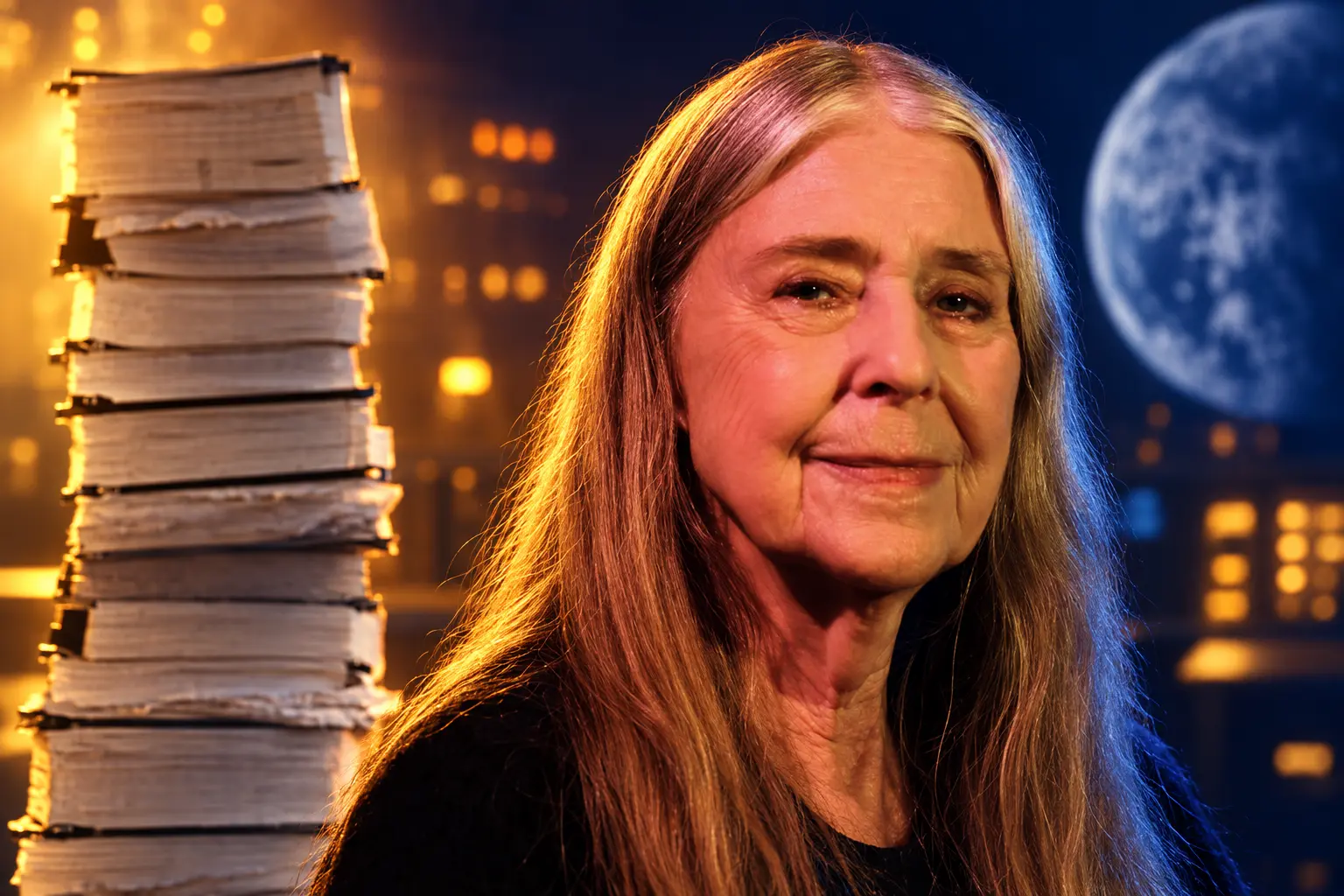
MIT also noted that a now-famous photograph of Hamilton standing beside a printout of her team’s Apollo code turned her into a public icon for women in science, years after the flights.
GitHub Now Holds the Apollo Flight Software
In 2015 the Apollo software she helped develop was Apollo software posted in full on GitHub. In 2017 she became a Lego minifigure in a set first designed by MIT science communicator Maia Weinstock, honoring women of NASA. The paper stack in the photograph, once a punchline about how much code a Moon landing took, is now a classroom object and a toy.
The job title she fought to have taken seriously is ordinary. Entire industries now hire software engineers by the tens of thousands. What did not become ordinary is the order of work she wanted after Apollo: define the system so the dangerous errors cannot be typed in, instead of shipping and then scanning for them. Universal Systems Language never displaced that habit. The 1202 story did, because it is easy to tell.
Hamilton is survived by her daughter, Lauren Hamilton; her son-in-law, Richard Selesnick; two grandsons; four great-grandchildren; and her siblings John, David, and Kathryn.
Frequently Asked Questions
What Did the 1201 and 1202 Alarms Mean on Apollo 11?
A 1202 meant the executive had no core sets left, the small blocks of memory used to track running jobs, and a 1201 meant it had no VAC areas left, the vector-accumulator blocks used for math-heavy work. Both were flavors of the same overload, and the restart logic was built to drop the extra radar jobs while keeping landing guidance alive.
How Old Was Margaret Hamilton During the Apollo 11 Landing?
She was 32. She was born on August 17, 1936, so on July 20, 1969, her 33rd birthday was still four weeks away, and she was already leading flight-software work after joining the project in 1965.
What Was Hamilton’s First Programming Job at MIT?
Her first MIT post, in 1959, was a temporary job in the meteorology department writing weather-prediction software for professor Edward N. Lorenz on machines that included the Librascope LGP-30 and the PDP-1, work that later informed Lorenz’s publications on chaos theory, before she moved to Lincoln Laboratory in 1961.
What Did She Mean by Development Before the Fact?
It is a preventative life cycle, automated in her 001 Tool Suite, in which a system is specified so that most errors never enter, rather than being hunted down in late testing, a reversal of the curative cycle she argued still dominates ordinary software work.
When Was Hamilton Inducted Into the National Aviation Hall of Fame?
In 2022, after the 2017 Computer History Museum Fellow Award and the 2019 Intrepid Lifetime Achievement Award, completing a run of late-career honors that began with NASA’s 2003 check and the 2016 Medal of Freedom.
The listings that once towered beside her are now in a public repository, and the title she had to joke into existence is on millions of business cards. The method she wanted next, writing the dangerous errors out of the system before anyone types them, is still the unfinished part of the work.

The Salary Cap Fight That Can Freeze Baseball’s TV Payday

The 2027 Mercedes GLE and GLS Keep Alabama Busy

Margaret Hamilton Dies at 90 With a Harder Fight Unfinished

Unity Parks Its Engine Inside Google’s Prompt Games

The Hidden Vendor Cut in 403(b) vs 401(k) Plans

Microsoft 365 Auth Fault Took Down Exchange and Teams

Diesel Breaks Its Record as the White House Claims Credit

Xbox Caps Game Pass Cloud Gaming at 15 Hours

IFA 2026’s Weird Gadgets Are Building a Sensor Home

ChargePoint Stock Rally Prices Wilmer’s Three-Year Cash Plan
-
 NEWS1 month ago
Microsoft 365 Auth Fault Took Down Exchange and Teams
-
 GAMING1 month ago
Xbox Caps Game Pass Cloud Gaming at 15 Hours
-
 BUSINESS1 month ago
Diesel Breaks Its Record as the White House Claims Credit
-
 BUSINESS1 month ago
ChargePoint Stock Rally Prices Wilmer’s Three-Year Cash Plan
-
 NEWS1 month ago
IFA 2026’s Weird Gadgets Are Building a Sensor Home
-

 NEWS1 month ago
OpenAI Unveils GPT-6 Astra With a Critical Cyber Label
-

 AUTO1 month ago
Tesla Puts Its Wheel-Free Cybercab on Austin Streets
-
 NEWS1 month ago
OpenClaw 2.0 Ships a Team Workplace With Host-Trust Defaults